TOPIC
Artificial Sweeteners
Introduction:
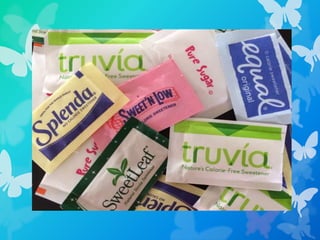
 A sugar substitute is a food additive that
provides a sweet taste like that of sugar while
containing significantly less food energy.
 Some sugar substitutes are produced by
nature, and others produced synthetically.
Those that are not produced by nature are, in
general, called artificial sweeteners.
Artificial Sweeteners are used by
Those trying to cut out sugar.
Someone who can’t have sugar would be
a diabetic.
Who concerned with diabetes, weight
gain, obesity-related disorder and dental
caries.
Using artificial sweeteners is safe to
control blood sugar levels.
But consuming too much natural
sweeteners, can lead to health problems
such as:
 Tooth decay
 Weight gain
 Increased triglycerides.
 Also honey can contain small amounts of
bacterial spores that can produce botulism toxin.
For that, honey shouldn't be given to children less
than 1 year old.
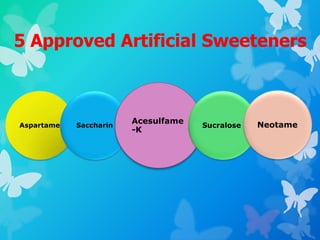
5 Approved Artificial Sweeteners
Aspartame Saccharin
Acesulfame
-K
Sucralose Neotame
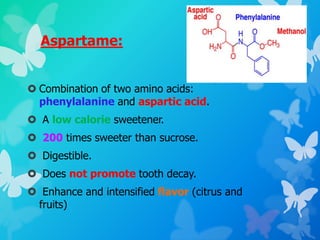
Aspartame:
 Combination of two amino acids:
phenylalanine and aspartic acid.
 A low calorie sweetener.
 200 times sweeter than sucrose.
 Digestible.
 Does not promote tooth decay.
 Enhance and intensified flavor (citrus and
fruits)
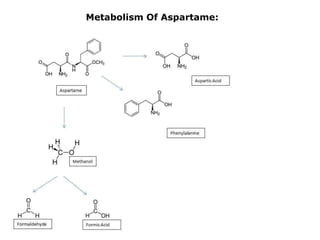
Metabolism of Aspartame:
Metabolism Of Aspartame:
Restrictions:
People with phenyl-ketonuria (PKU) disease.
PKU is a rare inherited disease that prevent the
metabolism of essential amino acids.
Accumulation of phenyl-alanine in the body
could cause health problems including mental
retardation.
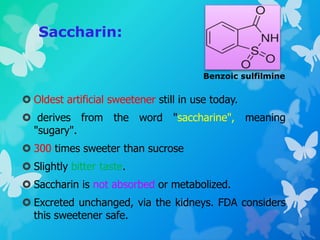
Saccharin:
 Oldest artificial sweetener still in use today.
 derives from the word "saccharine", meaning
"sugary".
 300 times sweeter than sucrose
 Slightly bitter taste.
 Saccharin is not absorbed or metabolized.
 Excreted unchanged, via the kidneys. FDA considers
this sweetener safe.
Benzoic sulfilmine
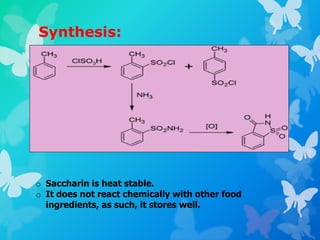
Synthesis:
o Saccharin is heat stable.
o It does not react chemically with other food
ingredients, as such, it stores well.
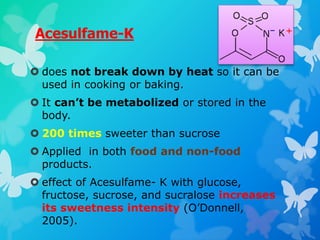
Acesulfame-K
 does not break down by heat so it can be
used in cooking or baking.
 It can’t be metabolized or stored in the
body.
 200 times sweeter than sucrose
 Applied in both food and non-food
products.
 effect of Acesulfame- K with glucose,
fructose, sucrose, and sucralose increases
its sweetness intensity (O’Donnell,
2005).
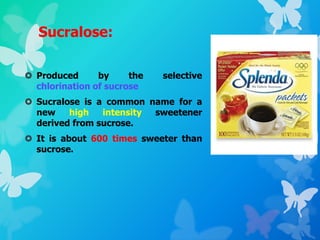
Sucralose:
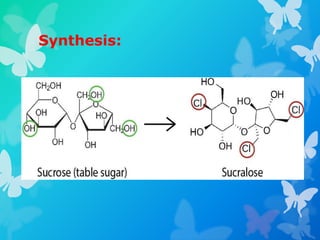
 Produced by the selective
chlorination of sucrose
 Sucralose is a common name for a
new high intensity sweetener
derived from sucrose.
 It is about 600 times sweeter than
sucrose.
Synthesis:
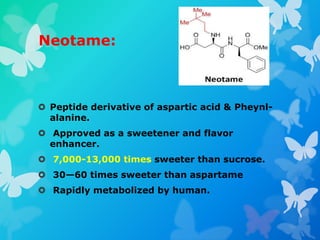
Neotame:
 Peptide derivative of aspartic acid & Pheynl-
alanine.
 Approved as a sweetener and flavor
enhancer.
 7,000-13,000 times sweeter than sucrose.
 30—60 times sweeter than aspartame
 Rapidly metabolized by human.
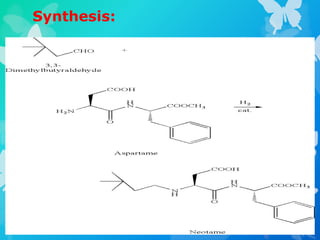
Synthesis:
Benefits and Conclusion:
 Non-cloric and does not breakdown in the body.
 Does not promote tooth decay.
 Soluble in water.
 Excellent stability in wide range of processed
foods and beverages.
 Heat stable.
 It should be used by recommended amount.
Artificial sweeteners

Artificial sweeteners

  • 2.
  • 4.
    Introduction:  A sugarsubstitute is a food additive that provides a sweet taste like that of sugar while containing significantly less food energy.  Some sugar substitutes are produced by nature, and others produced synthetically. Those that are not produced by nature are, in general, called artificial sweeteners.
  • 5.
    Artificial Sweeteners areused by Those trying to cut out sugar. Someone who can’t have sugar would be a diabetic. Who concerned with diabetes, weight gain, obesity-related disorder and dental caries. Using artificial sweeteners is safe to control blood sugar levels.
  • 6.
    But consuming toomuch natural sweeteners, can lead to health problems such as:  Tooth decay  Weight gain  Increased triglycerides.  Also honey can contain small amounts of bacterial spores that can produce botulism toxin. For that, honey shouldn't be given to children less than 1 year old.
  • 7.
    5 Approved ArtificialSweeteners Aspartame Saccharin Acesulfame -K Sucralose Neotame
  • 8.
    Aspartame:  Combination oftwo amino acids: phenylalanine and aspartic acid.  A low calorie sweetener.  200 times sweeter than sucrose.  Digestible.  Does not promote tooth decay.  Enhance and intensified flavor (citrus and fruits)
  • 9.
  • 10.
    Restrictions: People with phenyl-ketonuria(PKU) disease. PKU is a rare inherited disease that prevent the metabolism of essential amino acids. Accumulation of phenyl-alanine in the body could cause health problems including mental retardation.
  • 11.
    Saccharin:  Oldest artificialsweetener still in use today.  derives from the word "saccharine", meaning "sugary".  300 times sweeter than sucrose  Slightly bitter taste.  Saccharin is not absorbed or metabolized.  Excreted unchanged, via the kidneys. FDA considers this sweetener safe. Benzoic sulfilmine
  • 12.
    Synthesis: o Saccharin isheat stable. o It does not react chemically with other food ingredients, as such, it stores well.
  • 13.
    Acesulfame-K  does notbreak down by heat so it can be used in cooking or baking.  It can’t be metabolized or stored in the body.  200 times sweeter than sucrose  Applied in both food and non-food products.  effect of Acesulfame- K with glucose, fructose, sucrose, and sucralose increases its sweetness intensity (O’Donnell, 2005).
  • 14.
    Sucralose:  Produced bythe selective chlorination of sucrose  Sucralose is a common name for a new high intensity sweetener derived from sucrose.  It is about 600 times sweeter than sucrose.
  • 15.
  • 16.
    Neotame:  Peptide derivativeof aspartic acid & Pheynl- alanine.  Approved as a sweetener and flavor enhancer.  7,000-13,000 times sweeter than sucrose.  30—60 times sweeter than aspartame  Rapidly metabolized by human.
  • 17.
  • 18.
    Benefits and Conclusion: Non-cloric and does not breakdown in the body.  Does not promote tooth decay.  Soluble in water.  Excellent stability in wide range of processed foods and beverages.  Heat stable.  It should be used by recommended amount.