SUSPENDING AGENTS
AND THEIR CLASSIFICATIONS
SUSPENDING AGENTS
 Suspending agents also called
thickening agents are used to
stabilize suspensions are
hydrophilic colloid i.e.
substances that
spontaneously form colloidal
dispersions with water
because of an affinity between
the dispersed particles and
the dispersion medium.
 They help in lowering the
sedimentation rate of particles
in suspension.
 The sedimentation rate is slowed
down by increasing the viscosity of
liquid vehicle, and slowing down
settling in accordance to stokes law.
 They usually prevent caking at the
base of an suspension . It could be
resuspendend by agitation.
 It is majorly used as an excipients to
help active pharmaceutical ingredients
stay suspended in formulation.
 Examples : bentonite, carbomer,
tragacanth, kaolin, carboxymethyl
cellulose sodium etc.
Types of suspending agents:
A. POLYSACCHARIDES.
B. INORGANIC SALTS.
C. SYNTHETIC COMPOUNDS.
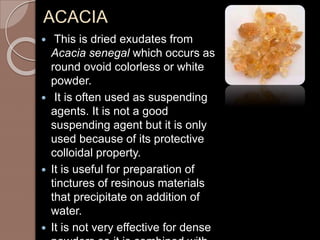
A. POLYSACCHARIDES.
 The official suspending agents were
natural polysaccharides but nowadays
semi synthetic compounds are
increasingly used.
Following are some examples of it:
o ACACIA.
o TRAGACANTH.
o STARCH .
o ALGINATES.
o XANTHAMN GUMS.
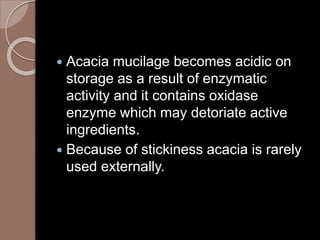
ACACIA
 This is dried exudates from
Acacia senegal which occurs as
round ovoid colorless or white
powder.
 It is often used as suspending
agents. It is not a good
suspending agent but it is only
used because of its protective
colloidal property.
 It is useful for preparation of
tinctures of resinous materials
that precipitate on addition of
water.
 It is not very effective for dense
 Acacia mucilage becomes acidic on
storage as a result of enzymatic
activity and it contains oxidase
enzyme which may detoriate active
ingredients.
 Because of stickiness acacia is rarely
used externally.
TRAGACANTH
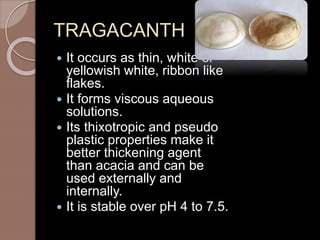
 It occurs as thin, white or
yellowish white, ribbon like
flakes.
 It forms viscous aqueous
solutions.
 Its thixotropic and pseudo
plastic properties make it
better thickening agent
than acacia and can be
used externally and
internally.
 It is stable over pH 4 to 7.5.
B . INORGANIC SALTS
The following are examples of inorganic
salts:
Clay
Bentonite
Aluminum magnesium silicate
Aluminum hydroxide
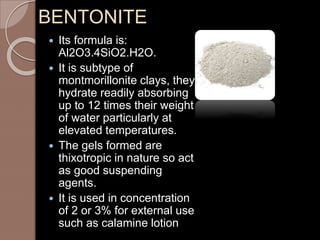
BENTONITE
 Its formula is:
Al2O3.4SiO2.H2O.
 It is subtype of
montmorillonite clays, they
hydrate readily absorbing
up to 12 times their weight
of water particularly at
elevated temperatures.
 The gels formed are
thixotropic in nature so act
as good suspending
agents.
 It is used in concentration
of 2 or 3% for external use
such as calamine lotion
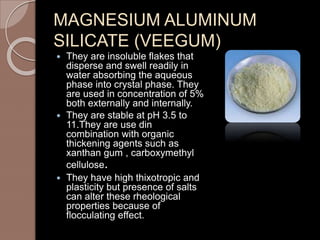
MAGNESIUM ALUMINUM
SILICATE (VEEGUM)
 They are insoluble flakes that
disperse and swell readily in
water absorbing the aqueous
phase into crystal phase. They
are used in concentration of 5%
both externally and internally.
 They are stable at pH 3.5 to
11.They are use din
combination with organic
thickening agents such as
xanthan gum , carboxymethyl
cellulose.
 They have high thixotropic and
plasticity but presence of salts
can alter these rheological
properties because of
flocculating effect.
C . SYNTHETICS
These were introduced to over come
various problems occurring from
natural products. Following are its
examples
Carbomers.
Colloidal silicon dioxide.
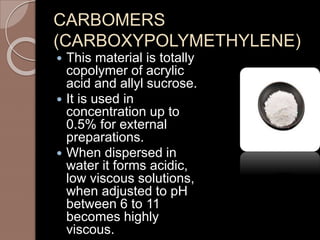
CARBOMERS
(CARBOXYPOLYMETHYLENE)
 This material is totally
copolymer of acrylic
acid and allyl sucrose.
 It is used in
concentration up to
0.5% for external
preparations.
 When dispersed in
water it forms acidic,
low viscous solutions,
when adjusted to pH
between 6 to 11
becomes highly
viscous.
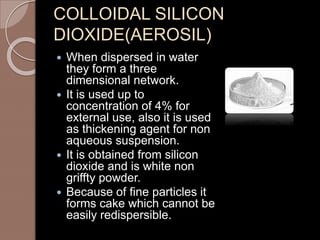
COLLOIDAL SILICON
DIOXIDE(AEROSIL)
 When dispersed in water
they form a three
dimensional network.
 It is used up to
concentration of 4% for
external use, also it is used
as thickening agent for non
aqueous suspension.
 It is obtained from silicon
dioxide and is white non
griffty powder.
 Because of fine particles it
forms cake which cannot be
easily redispersible.
Thank you!
From SILVI SINGH
Roll No.13BPH094
Semester 5 , B.PHARM

Suspending agents

  • 1.
  • 2.
    SUSPENDING AGENTS  Suspendingagents also called thickening agents are used to stabilize suspensions are hydrophilic colloid i.e. substances that spontaneously form colloidal dispersions with water because of an affinity between the dispersed particles and the dispersion medium.  They help in lowering the sedimentation rate of particles in suspension.
  • 3.
     The sedimentationrate is slowed down by increasing the viscosity of liquid vehicle, and slowing down settling in accordance to stokes law.  They usually prevent caking at the base of an suspension . It could be resuspendend by agitation.  It is majorly used as an excipients to help active pharmaceutical ingredients stay suspended in formulation.  Examples : bentonite, carbomer, tragacanth, kaolin, carboxymethyl cellulose sodium etc.
  • 4.
    Types of suspendingagents: A. POLYSACCHARIDES. B. INORGANIC SALTS. C. SYNTHETIC COMPOUNDS.
  • 5.
    A. POLYSACCHARIDES.  Theofficial suspending agents were natural polysaccharides but nowadays semi synthetic compounds are increasingly used. Following are some examples of it: o ACACIA. o TRAGACANTH. o STARCH . o ALGINATES. o XANTHAMN GUMS.
  • 6.
    ACACIA  This isdried exudates from Acacia senegal which occurs as round ovoid colorless or white powder.  It is often used as suspending agents. It is not a good suspending agent but it is only used because of its protective colloidal property.  It is useful for preparation of tinctures of resinous materials that precipitate on addition of water.  It is not very effective for dense
  • 7.
     Acacia mucilagebecomes acidic on storage as a result of enzymatic activity and it contains oxidase enzyme which may detoriate active ingredients.  Because of stickiness acacia is rarely used externally.
  • 8.
    TRAGACANTH  It occursas thin, white or yellowish white, ribbon like flakes.  It forms viscous aqueous solutions.  Its thixotropic and pseudo plastic properties make it better thickening agent than acacia and can be used externally and internally.  It is stable over pH 4 to 7.5.
  • 9.
    B . INORGANICSALTS The following are examples of inorganic salts: Clay Bentonite Aluminum magnesium silicate Aluminum hydroxide
  • 10.
    BENTONITE  Its formulais: Al2O3.4SiO2.H2O.  It is subtype of montmorillonite clays, they hydrate readily absorbing up to 12 times their weight of water particularly at elevated temperatures.  The gels formed are thixotropic in nature so act as good suspending agents.  It is used in concentration of 2 or 3% for external use such as calamine lotion
  • 11.
    MAGNESIUM ALUMINUM SILICATE (VEEGUM) They are insoluble flakes that disperse and swell readily in water absorbing the aqueous phase into crystal phase. They are used in concentration of 5% both externally and internally.  They are stable at pH 3.5 to 11.They are use din combination with organic thickening agents such as xanthan gum , carboxymethyl cellulose.  They have high thixotropic and plasticity but presence of salts can alter these rheological properties because of flocculating effect.
  • 12.
    C . SYNTHETICS Thesewere introduced to over come various problems occurring from natural products. Following are its examples Carbomers. Colloidal silicon dioxide.
  • 13.
    CARBOMERS (CARBOXYPOLYMETHYLENE)  This materialis totally copolymer of acrylic acid and allyl sucrose.  It is used in concentration up to 0.5% for external preparations.  When dispersed in water it forms acidic, low viscous solutions, when adjusted to pH between 6 to 11 becomes highly viscous.
  • 14.
    COLLOIDAL SILICON DIOXIDE(AEROSIL)  Whendispersed in water they form a three dimensional network.  It is used up to concentration of 4% for external use, also it is used as thickening agent for non aqueous suspension.  It is obtained from silicon dioxide and is white non griffty powder.  Because of fine particles it forms cake which cannot be easily redispersible.
  • 15.
    Thank you! From SILVISINGH Roll No.13BPH094 Semester 5 , B.PHARM