Pharmaceutical
Suspension
Made by:
Urooj Ilyas
Batch 16
Roll # 14
What is Suspension???
Definition:
"A Pharmaceutical suspension is
a coarse dispersion in which
internal phase ( therapeutically
active ingredient ) is dispersed
uniformily throughout the external
phase."
• Internal Phase:
This phase consisting of insoluble solid particles
having a range of size ( 0.5 to 5 microns) which is
maintained uniformily through out the suspending
vehicle with the aid of suspending agents.
• External Phase:
This phase is aqueous in some instances, may be an
organic or oily liquid.
Reasons for the formulation of a
suspension:
• when the drug is insoluble in the delivery
vehicle.
• To mask the bitter taste of the drug.
• To increase drug stability.
• To achieve sustained drug release.
Classification:
• On Basis of Route of Administration:
 Oral Suspensions
e.g: Parcetamol suspension
 Topical suspensions
e.g: Calamine Lotion
 Parentral suspensions
e.g: Insulin Zinc suspension
• On basis of size of solid particles:
 Colloidal suspension:
Suspensions having dispersed particle size less than 1
micron.It can be seen by electron microscope.
 Coarse suspension:
Suspension having particle size of greater than 1
micron,can be seen by microscope.
 Nano suspension:
Suspension having nanosized drug particles i.e less than
1mm.
Advantages & Disadvantages:
 Advantages:
• Can improve chemical stability of certain drugs.
• Higher rate of bioavailability, as order of bioavailabilty is:
Solution > Suspensions > Capsules > Compressed tablets
 Dias advantages:
• Physical stability, sedimentation and compaction.
• Bulky, handling reqire care.
• Uniform drug delivery can not be achieved sometimes.
Pharmaceutical Applications:
• For delivery of poor soluble drugs.
• To improve stability of drug.
• To mask the unpleasant taste.
• Can be formulated for topical use.
• Vaccines are often formulated.
• X-ray contrast agent are formulated as suspensions.
Desired Features :
• Should not settle rapidly,must be easily re-dispersed.
• No grittiness or too watery.
• Pleasant odour,taste and color.
• Good syringeability.
• Physically, chemically and microbiologically stable
Formulation Consideration of Suspensions:
• Wetting agents
• Particle Size
• Particle shape
• Particle- particle Interaction
• Suspending agent
• Wetting agent:
A substance is referred to as a wetting agent if it
lowers the surface tension of a liquid and thus allows
it to spread more easily.
It is the important factor to be considered for
formulation of suspension because the more the
wetable particle the more stable the
suspension.Wetting ability depends upon the angle of
contact between the particle and the solvent which
should be less than 900
C.
e.g: Polysorbate 80 etc.
• Particle size:
It is critical part to be considered and the particle size
must be reduced within the range.
Too large or too small particles should be avoided.
 Large particles settle down faster.
Smaller particles may form agglomerates.
Required particles size maintained to form stable
suspension.
• Particle shape:
Spherical shape particles form the more viscous with
low rate of sedimentation of suspension thats why it is
preferable over needle shaped particles.
• Particle- Particle Interaction:
Zeta potential:
The zeta potential is defined as
"the difference in potential between the surface of
tightly bound layer."
If the zeta potential is reduced, the attractive forces
exceed the repulsive forces and the particles come
together, this phenomena is known as flocculation.
Deflocculation and Flocculation:
• Flocculated Suspension:
In flocculated suspension, formed flocs i.e loose
aggregates will increase in sedimentation rate due to
increase in size of sedimenting particeles.It also
depends upon the porosity of flocs.
• Deflocculated Suspension:
In this, individual particles are settling,rate of
sedimentation is slow,which prevents entrapping of
liquid medium which makes it difficult to redisperse
by agitation.This phenomena known as caking.
The larger particles settle fast and smaller remain in
supernatant so supernatent appears cloudy.
• Suspending agent:
They form film around particle and decrease the
interparticle attraction.
They also imparts viscosity to the solution.
Examples: Sodium alignate, Methylcellulose,
CMC,silicon dioxide etc.
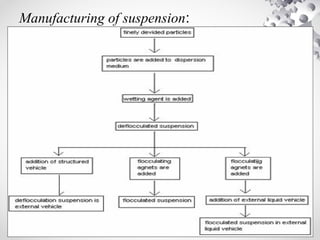
Manufacturing of suspension:
Features of Maunfacturing:
• Deionized water is used for preparation.
• Auxillary testing is done before, during and after
manufacturing.
• Piping from manufacturing to storage and packaging vessel
shoul be of SS304 and silicon piping.
• Air blow is used to dry and clean.
• Labelling and sealing properly.
Pharmaceutical suspension

Pharmaceutical suspension

  • 1.
  • 2.
    What is Suspension??? Definition: "APharmaceutical suspension is a coarse dispersion in which internal phase ( therapeutically active ingredient ) is dispersed uniformily throughout the external phase."
  • 3.
    • Internal Phase: Thisphase consisting of insoluble solid particles having a range of size ( 0.5 to 5 microns) which is maintained uniformily through out the suspending vehicle with the aid of suspending agents. • External Phase: This phase is aqueous in some instances, may be an organic or oily liquid.
  • 4.
    Reasons for theformulation of a suspension: • when the drug is insoluble in the delivery vehicle. • To mask the bitter taste of the drug. • To increase drug stability. • To achieve sustained drug release.
  • 5.
    Classification: • On Basisof Route of Administration:  Oral Suspensions e.g: Parcetamol suspension  Topical suspensions e.g: Calamine Lotion  Parentral suspensions e.g: Insulin Zinc suspension
  • 6.
    • On basisof size of solid particles:  Colloidal suspension: Suspensions having dispersed particle size less than 1 micron.It can be seen by electron microscope.  Coarse suspension: Suspension having particle size of greater than 1 micron,can be seen by microscope.  Nano suspension: Suspension having nanosized drug particles i.e less than 1mm.
  • 7.
    Advantages & Disadvantages: Advantages: • Can improve chemical stability of certain drugs. • Higher rate of bioavailability, as order of bioavailabilty is: Solution > Suspensions > Capsules > Compressed tablets  Dias advantages: • Physical stability, sedimentation and compaction. • Bulky, handling reqire care. • Uniform drug delivery can not be achieved sometimes.
  • 8.
    Pharmaceutical Applications: • Fordelivery of poor soluble drugs. • To improve stability of drug. • To mask the unpleasant taste. • Can be formulated for topical use. • Vaccines are often formulated. • X-ray contrast agent are formulated as suspensions.
  • 9.
    Desired Features : •Should not settle rapidly,must be easily re-dispersed. • No grittiness or too watery. • Pleasant odour,taste and color. • Good syringeability. • Physically, chemically and microbiologically stable
  • 10.
    Formulation Consideration ofSuspensions: • Wetting agents • Particle Size • Particle shape • Particle- particle Interaction • Suspending agent
  • 11.
    • Wetting agent: Asubstance is referred to as a wetting agent if it lowers the surface tension of a liquid and thus allows it to spread more easily. It is the important factor to be considered for formulation of suspension because the more the wetable particle the more stable the suspension.Wetting ability depends upon the angle of contact between the particle and the solvent which should be less than 900 C. e.g: Polysorbate 80 etc.
  • 12.
    • Particle size: Itis critical part to be considered and the particle size must be reduced within the range. Too large or too small particles should be avoided.  Large particles settle down faster. Smaller particles may form agglomerates. Required particles size maintained to form stable suspension.
  • 13.
    • Particle shape: Sphericalshape particles form the more viscous with low rate of sedimentation of suspension thats why it is preferable over needle shaped particles.
  • 14.
    • Particle- ParticleInteraction: Zeta potential: The zeta potential is defined as "the difference in potential between the surface of tightly bound layer." If the zeta potential is reduced, the attractive forces exceed the repulsive forces and the particles come together, this phenomena is known as flocculation.
  • 15.
    Deflocculation and Flocculation: •Flocculated Suspension: In flocculated suspension, formed flocs i.e loose aggregates will increase in sedimentation rate due to increase in size of sedimenting particeles.It also depends upon the porosity of flocs.
  • 16.
    • Deflocculated Suspension: Inthis, individual particles are settling,rate of sedimentation is slow,which prevents entrapping of liquid medium which makes it difficult to redisperse by agitation.This phenomena known as caking. The larger particles settle fast and smaller remain in supernatant so supernatent appears cloudy.
  • 17.
    • Suspending agent: Theyform film around particle and decrease the interparticle attraction. They also imparts viscosity to the solution. Examples: Sodium alignate, Methylcellulose, CMC,silicon dioxide etc.
  • 18.
  • 19.
    Features of Maunfacturing: •Deionized water is used for preparation. • Auxillary testing is done before, during and after manufacturing. • Piping from manufacturing to storage and packaging vessel shoul be of SS304 and silicon piping. • Air blow is used to dry and clean. • Labelling and sealing properly.