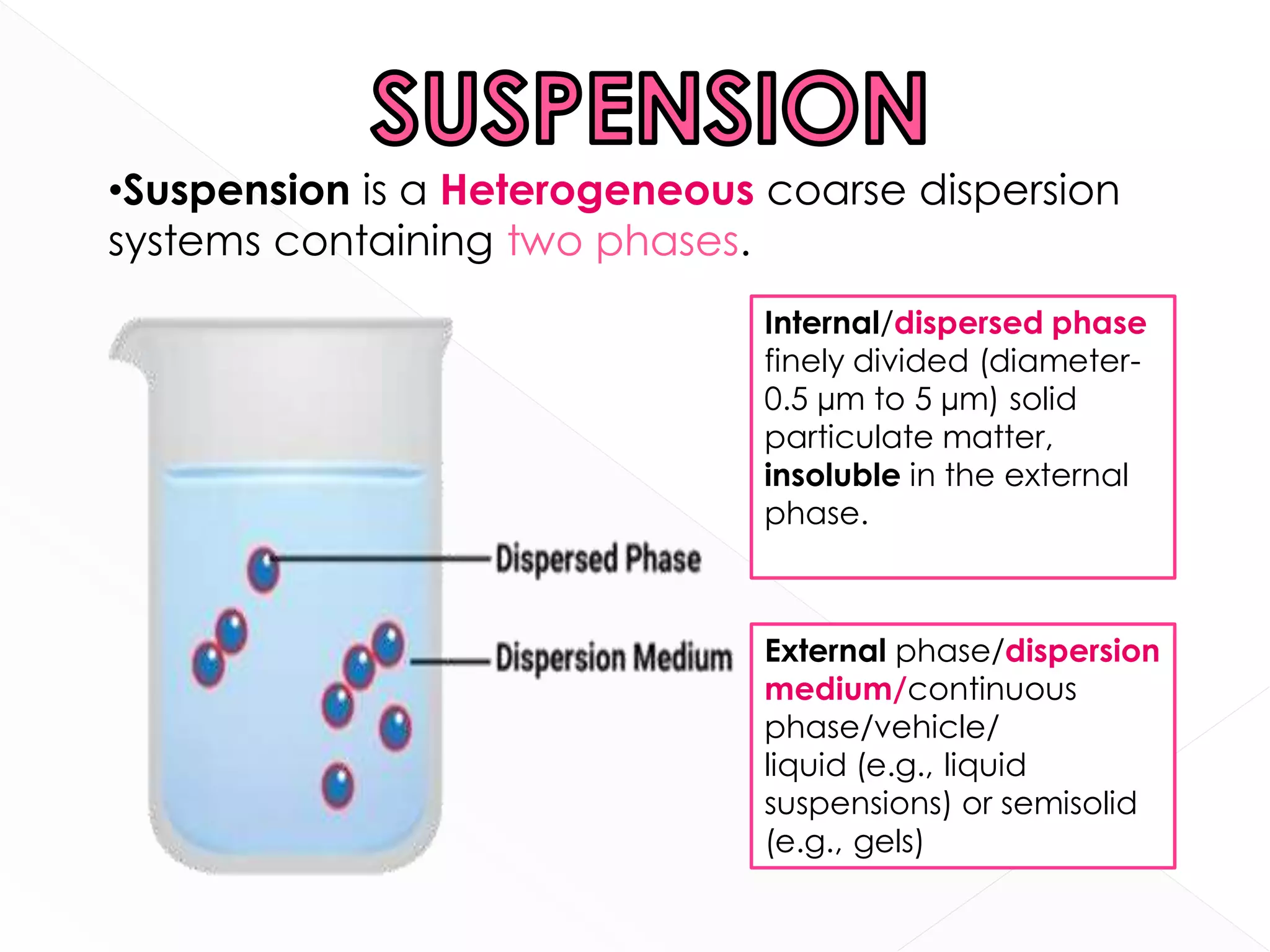
•Suspension is a Heterogeneous coarse dispersion
systems containing two phases.
External phase/dispersion
medium/continuous
phase/vehicle/
liquid (e.g., liquid
suspensions) or semisolid
(e.g., gels)
Internal/dispersed phase
finely divided (diameter-
0.5 µm to 5 µm) solid
particulate matter,
insoluble in the external
phase.
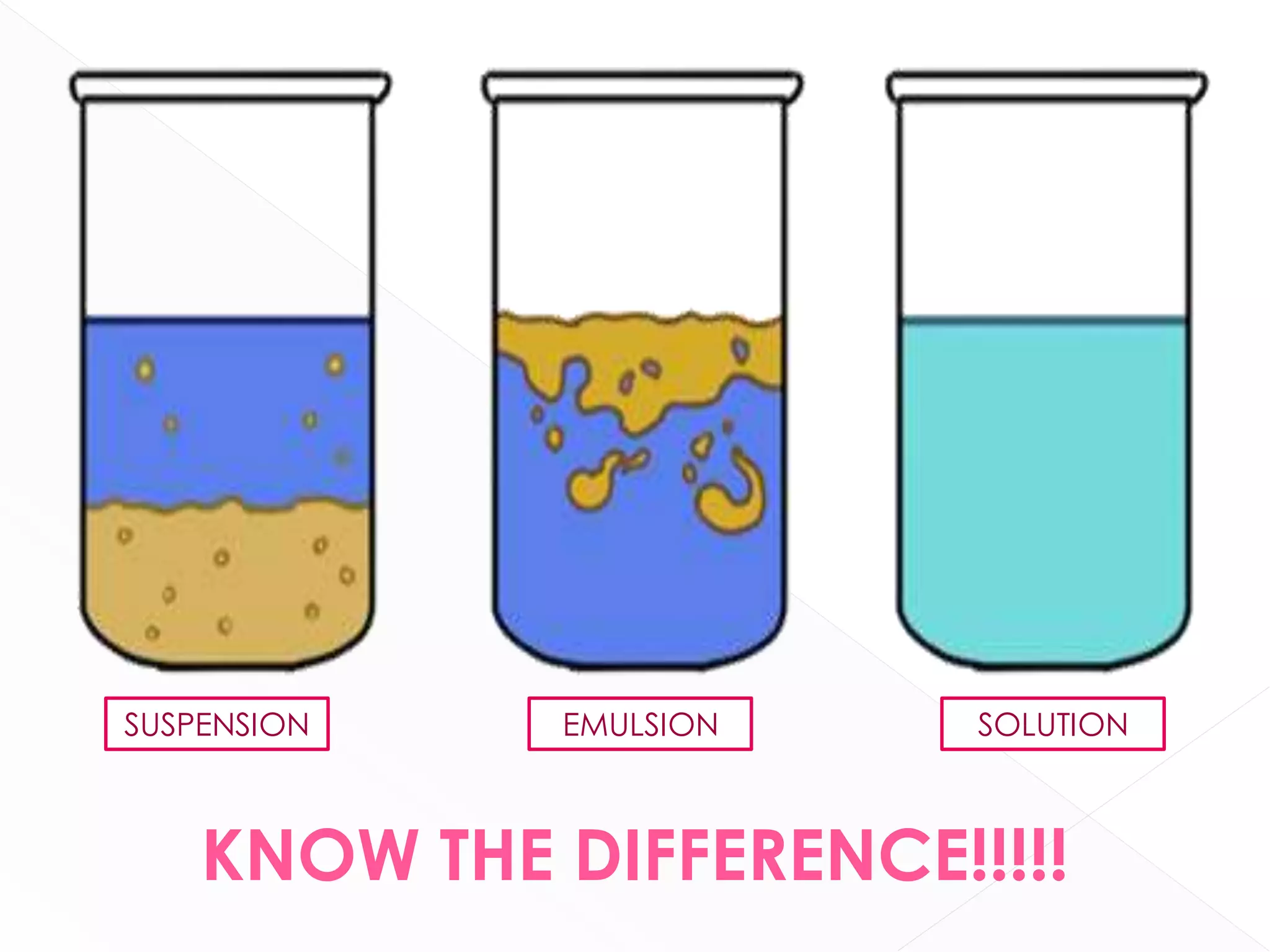
KNOW THE DIFFERENCE!!!!!
SUSPENSION SOLUTION
EMULSION
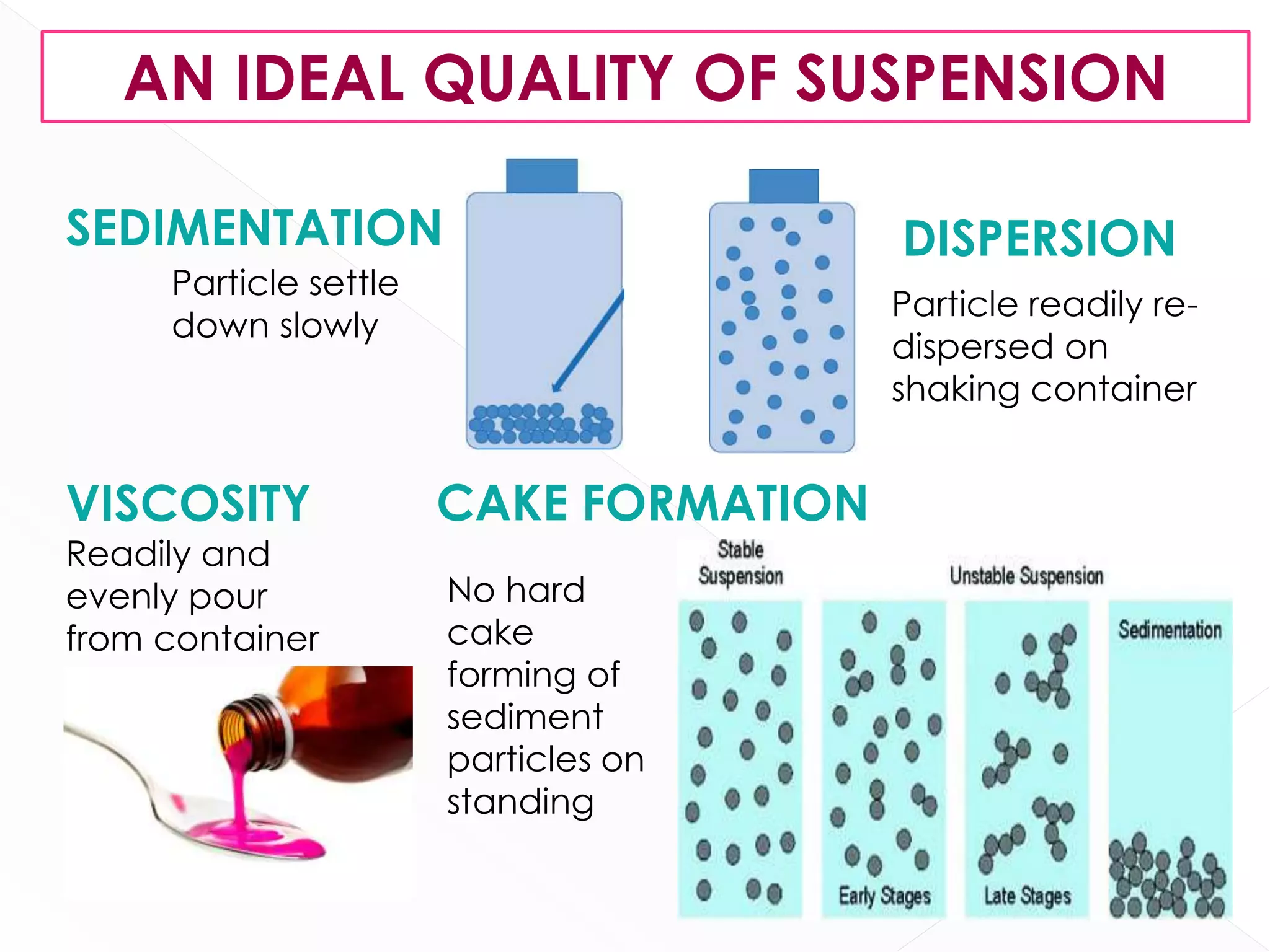
AN IDEAL QUALITY OF SUSPENSION
SEDIMENTATION DISPERSION
Particle settle
down slowly
Particle readily re-
dispersed on
shaking container
VISCOSITY
Readily and
evenly pour
from container
CAKE FORMATION
No hard
cake
forming of
sediment
particles on
standing
AN IDEAL QUALITY OF SUSPENSION
ELEGANCE PALATABILITY
Uniform size of
particles Oral: No
gritty
taste
NATURE
Physically,
chemically,
microbiologically
inert
THIXOTROPIC PROPERTY
Gel to sol upon shaking; Sol to gel upon storage
External:
No
irritability
Parenteral:
Good
syringeability
and
sterilizable
APPLICATIONS OF SUSPENSIONS
•Applicable for
insoluble or poorly
soluble drug
•Prevent
degradation of
drug
•Mask the bitter taste of drug
Oxytetracycline Chloramphenicol
palmitate
Prednisolone
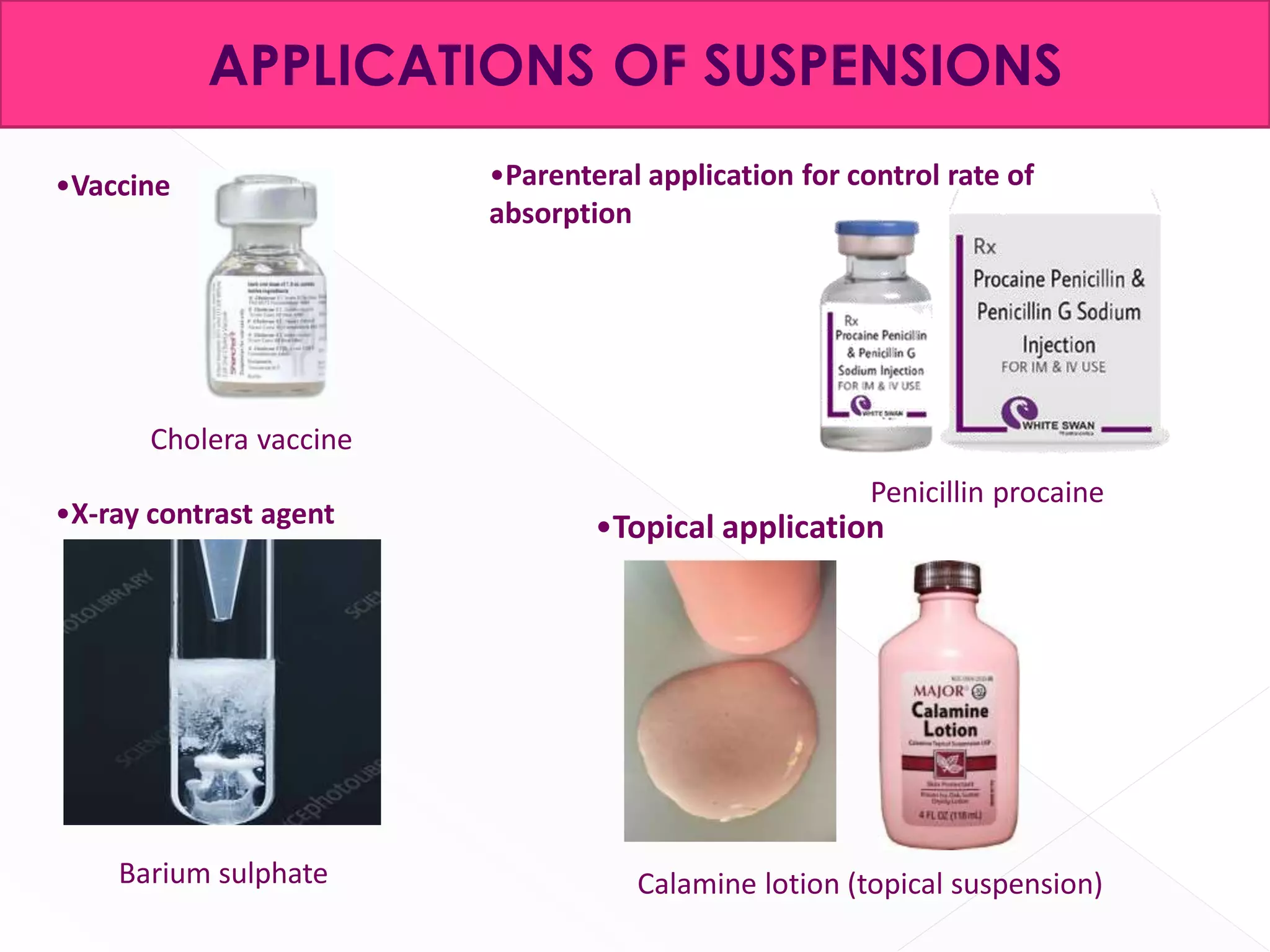
APPLICATIONS OF SUSPENSIONS
•Parenteral application for control rate of
absorption
•Vaccine
•X-ray contrast agent
Penicillin procaine
Cholera vaccine
Barium sulphate
•Topical application
Calamine lotion (topical suspension)
CLASSIFICATION OF SUSPENSIONS
Suspension of solid particle
Size
Colloidal
(< 1
micron)
Coarse
(>1 micron)
Nano
(10 ng)
Electrokinetic
Nature
Flocculated
Deflocculated
Proportion
Dilute
(2 to10%w/v
solid)
predinisolone
acetate
Concentrated
(50%w/v solid)
zinc oxide
Route Of Administration
Oral
Paracetamol
Parenteral
Procaine
penicillin G
Ophthalmic
Prednisolone
External
Calamine
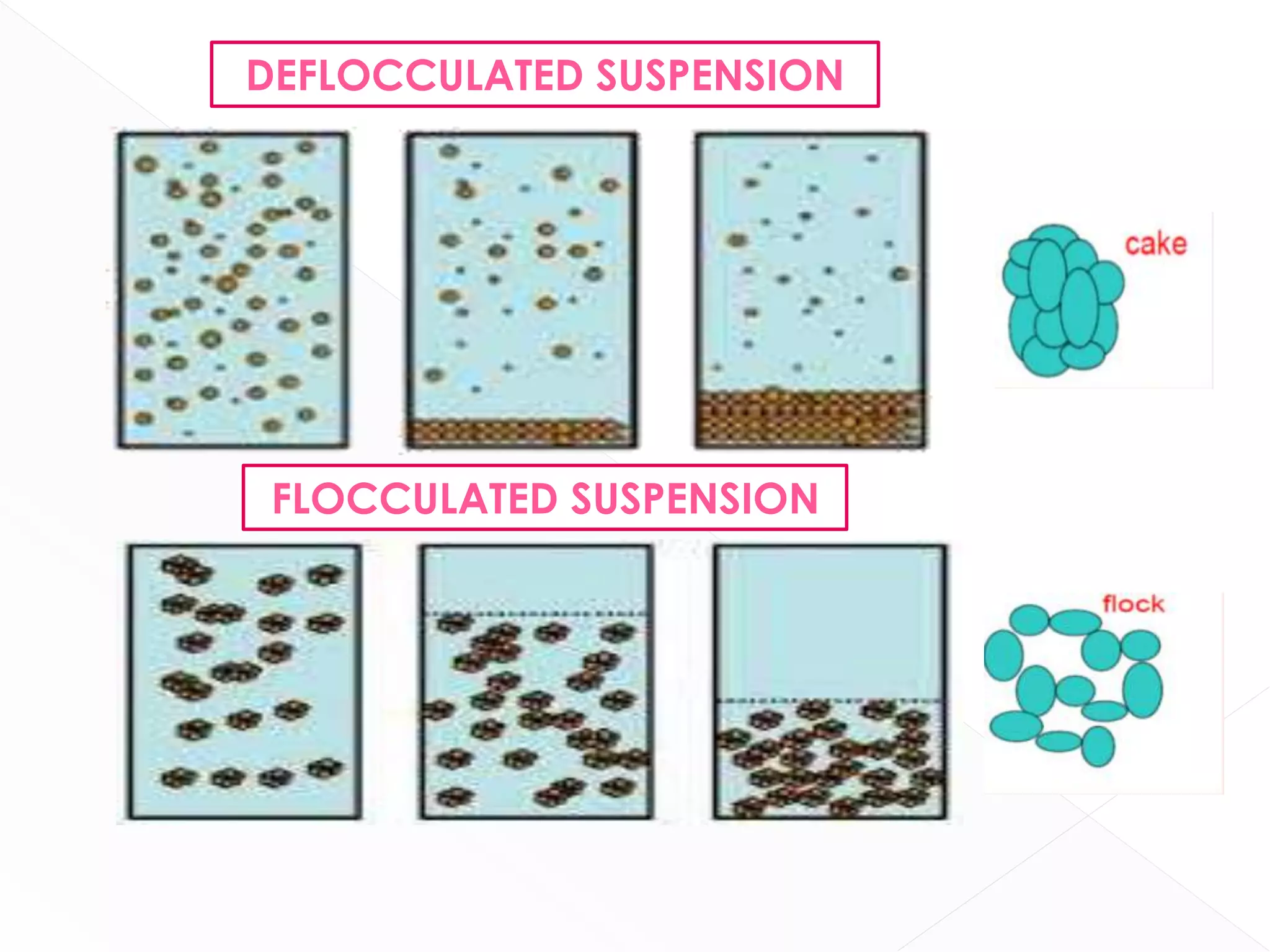
DEFLOCCULATED SUSPENSION
FLOCCULATED SUSPENSION
PROPERTIES DEFLOCCULATED FLOCCULATED
PARTICLES Exist in separate
entities
Form loose
aggregates (flocs)
SEDIMENTATION
RATE
Slow Fast
SEDIMENT
STRUCTURE
Compact Scaffold-like loose
RE-DISPERSION Difficult Easy
SUPERNATANT
LIQUID
Cloudy Clear
HARD CAKE Yes No
APPEARANCE Pleasing Un-pleasing
FLOCCULANT STICK
TO SIDES OF BOTTLE
No Yes
Flocculated Vs deflocculated suspension
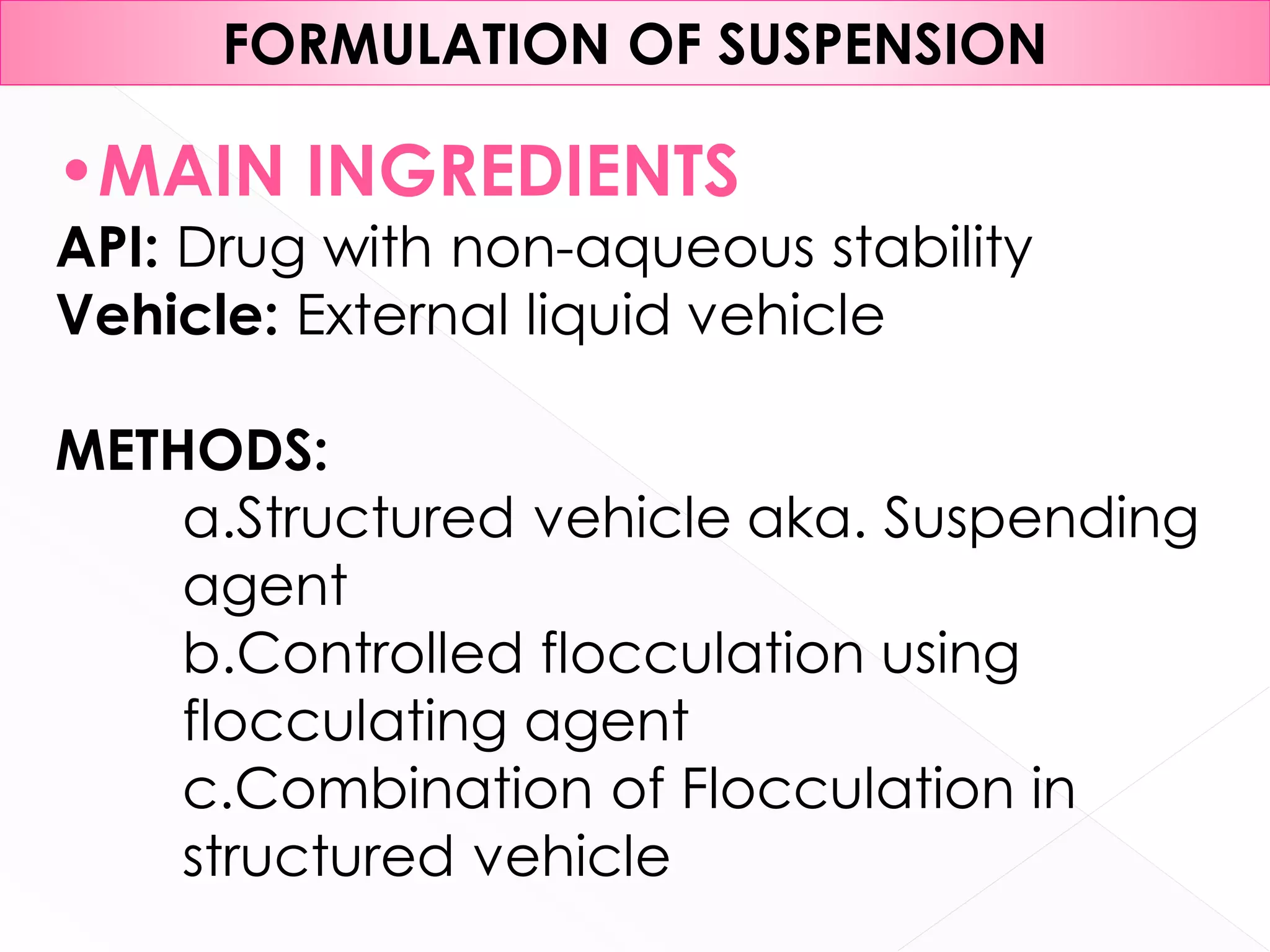
•MAIN INGREDIENTS
API: Drug with non-aqueous stability
Vehicle: External liquid vehicle
METHODS:
a.Structured vehicle aka. Suspending
agent
b.Controlled flocculation using
flocculating agent
c.Combination of Flocculation in
structured vehicle
FORMULATION OF SUSPENSION
Particle
Addition of dispersion medium and wetting agent
Uniform dispersion of deflocculated particles
DEFLOCCULATED
SUSPENSION IN
STRUCTURED VEHICLE
FLOCCULATED
SUSPENSION
FLOCCULATED
SUSPENSION
INCORPORATION OF
STRUCTURED VEHICLE
FLOCCULATED
SUSPENSION IN
STRUCTURED VEHICLE
FORMULATION OF SUSPENSION
•EXCIPIENTS USED
1. Suspending/Thickening Agent
2. Flocculating Agent
3. Deflocculating Agent
4. Wetting Agent
5. Organoleptic Agent
6. Stabilizing Agent
7. Solvent
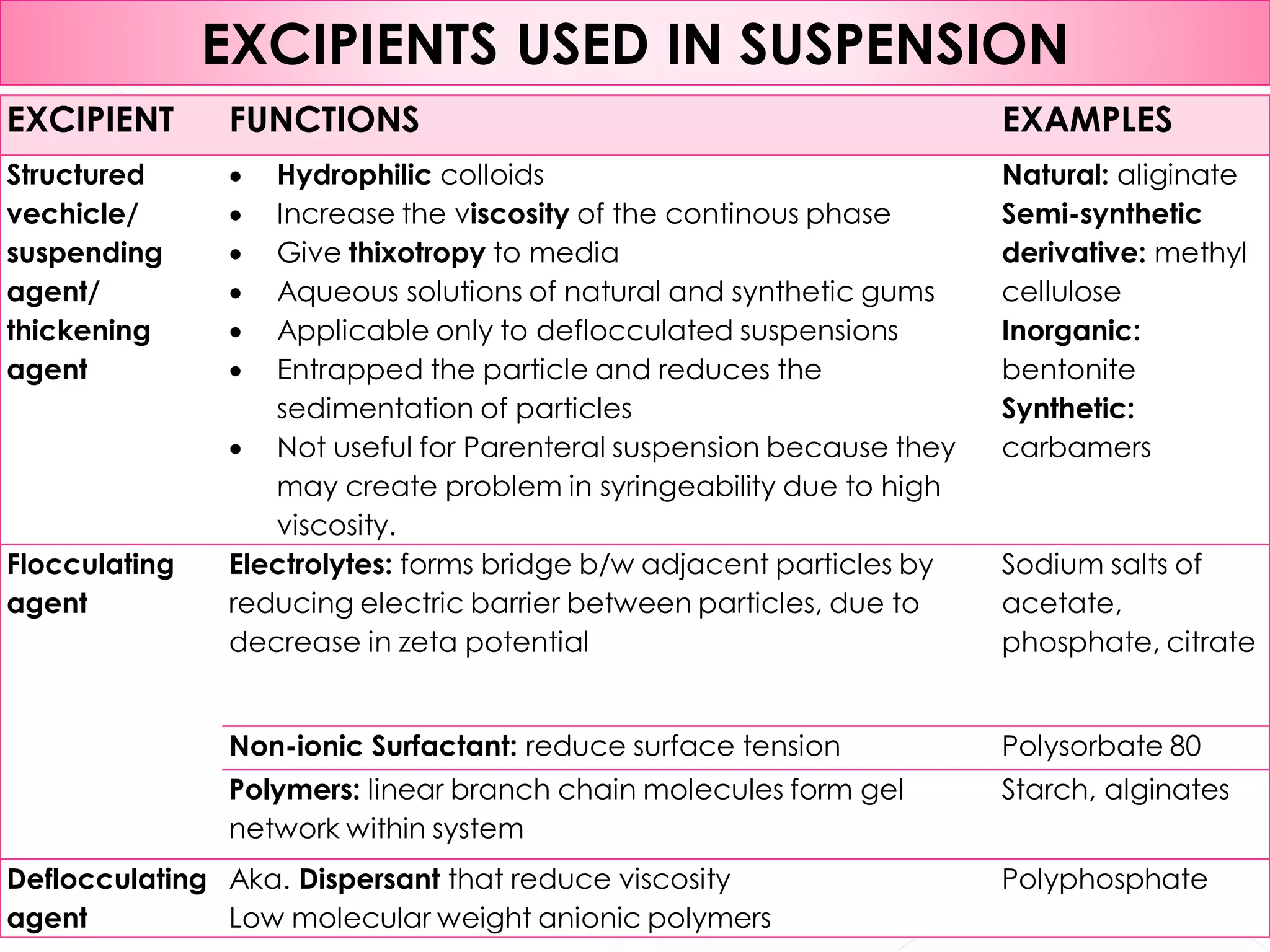
EXCIPIENT FUNCTIONS EXAMPLES
Structured
vechicle/
suspending
agent/
thickening
agent
 Hydrophilic colloids
 Increase the viscosity of the continous phase
 Give thixotropy to media
 Aqueous solutions of natural and synthetic gums
 Applicable only to deflocculated suspensions
 Entrapped the particle and reduces the
sedimentation of particles
 Not useful for Parenteral suspension because they
may create problem in syringeability due to high
viscosity.
Natural: aliginate
Semi-synthetic
derivative: methyl
cellulose
Inorganic:
bentonite
Synthetic:
carbamers
Flocculating
agent
Electrolytes: forms bridge b/w adjacent particles by
reducing electric barrier between particles, due to
decrease in zeta potential
Sodium salts of
acetate,
phosphate, citrate
Non-ionic Surfactant: reduce surface tension Polysorbate 80
Polymers: linear branch chain molecules form gel
network within system
Starch, alginates
Deflocculating
agent
Aka. Dispersant that reduce viscosity
Low molecular weight anionic polymers
Polyphosphate
EXCIPIENTS USED IN SUSPENSION
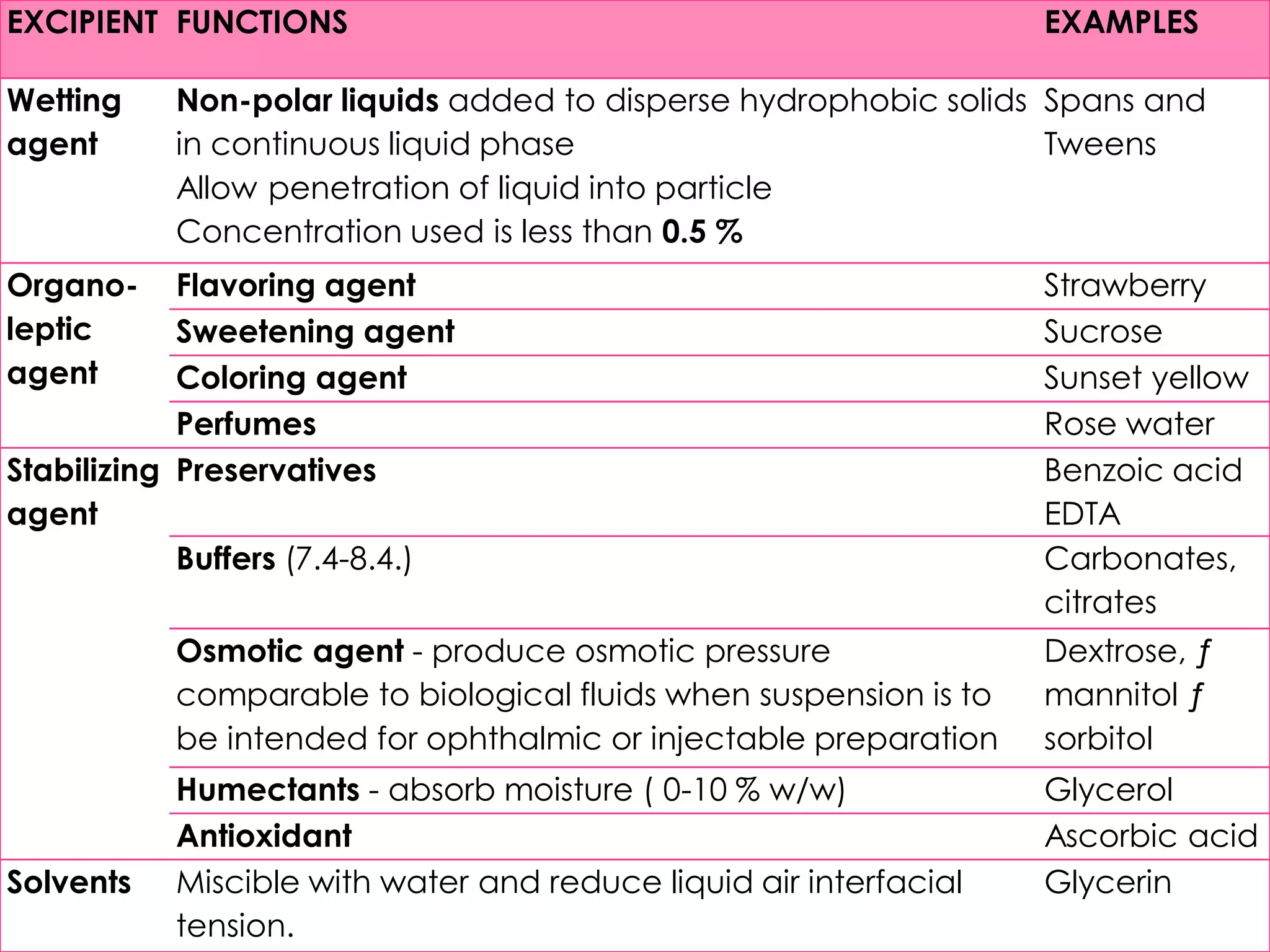
EXCIPIENT FUNCTIONS EXAMPLES
Wetting
agent
Non-polar liquids added to disperse hydrophobic solids
in continuous liquid phase
Allow penetration of liquid into particle
Concentration used is less than 0.5 %
Spans and
Tweens
Organo-
leptic
agent
Flavoring agent Strawberry
Sweetening agent Sucrose
Coloring agent Sunset yellow
Perfumes Rose water
Stabilizing
agent
Preservatives Benzoic acid
EDTA
Buffers (7.4-8.4.) Carbonates,
citrates
Osmotic agent - produce osmotic pressure
comparable to biological fluids when suspension is to
be intended for ophthalmic or injectable preparation
Dextrose, ƒ
mannitol ƒ
sorbitol
Humectants - absorb moisture ( 0-10 % w/w) Glycerol
Antioxidant Ascorbic acid
Solvents Miscible with water and reduce liquid air interfacial
tension.
Glycerin
Finely powdered drug+
ingredients
3/4th vehicle added to
make cream
Rest of the volume is
makeup
Labelled and corked (shake
well before use)
1. Suspension containing
diffusible solids
Eg. Light kaolin, light magnesium
carbonate
2. Suspension containing
indiffusible solids
Eg. Aspirin, zinc oxide
Finely powdered
drug+ ingredients+
suspending agent
3/4th vehicle added
Trituration with suspending agent
(tragacanth mucileage/
compound tragacanth powder)
Rest of the volume is
makeup
Labelled and corked
(shake well before use)
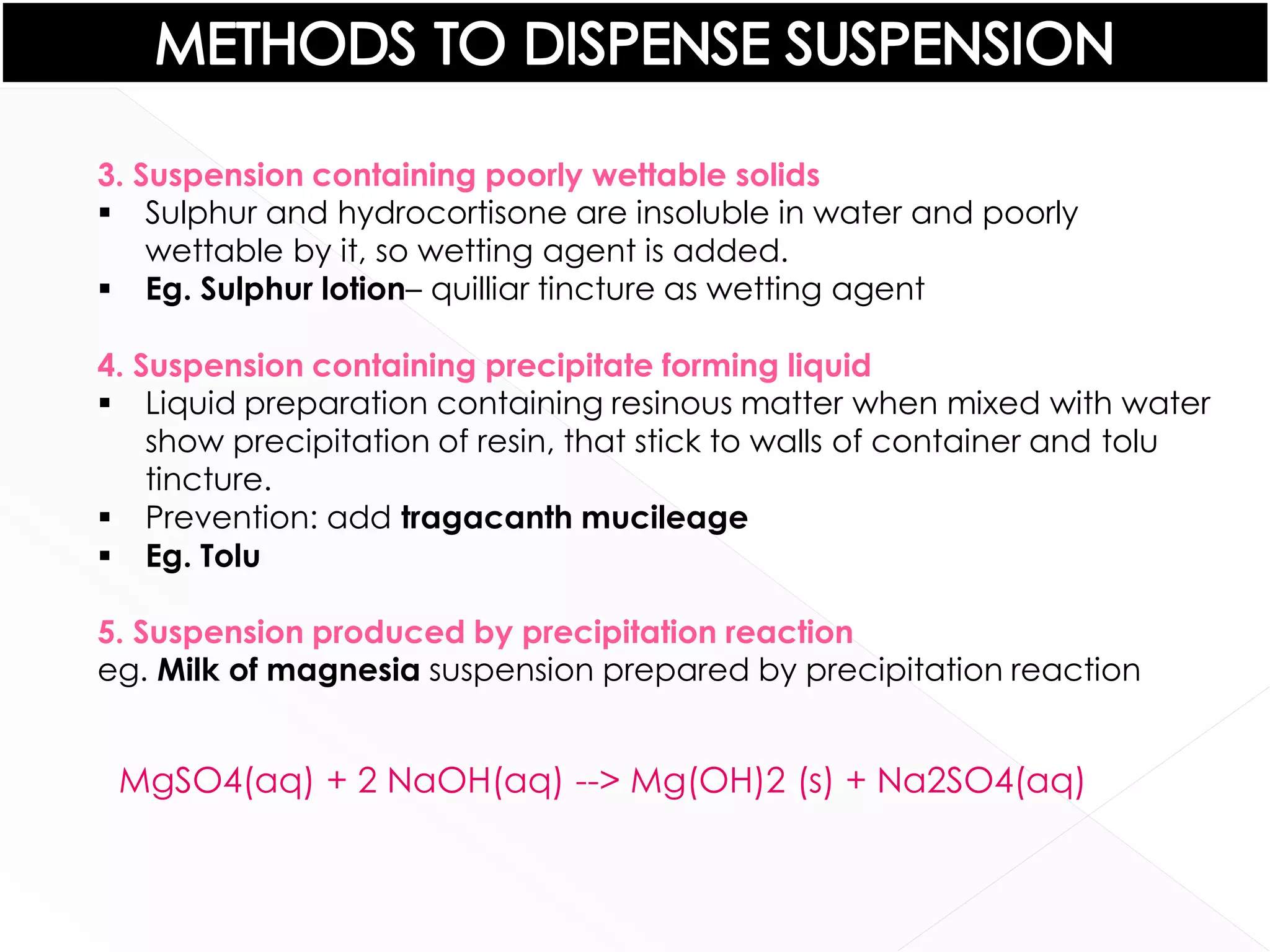
3. Suspension containing poorly wettable solids
 Sulphur and hydrocortisone are insoluble in water and poorly
wettable by it, so wetting agent is added.
 Eg. Sulphur lotion– quilliar tincture as wetting agent
4. Suspension containing precipitate forming liquid
 Liquid preparation containing resinous matter when mixed with water
show precipitation of resin, that stick to walls of container and tolu
tincture.
 Prevention: add tragacanth mucileage
 Eg. Tolu
5. Suspension produced by precipitation reaction
eg. Milk of magnesia suspension prepared by precipitation reaction
MgSO4(aq) + 2 NaOH(aq) --> Mg(OH)2 (s) + Na2SO4(aq)
PACKAGING
ORAL
Wide mouth bottles
PARENTERAL
Vials and glass ampoules
Materials used
1.Amber colored
glass bottles
2. Plastic bottles
(polyethylene,
polysterene)
Closures and Liners
With an exception of
ampoules all containers
required elastomeric
closure.
STORAGE &
LABELLING
•Shake well before use
•Do not freeze
•Protect from direct light
•In case of dry suspensions powder
the specified amount of vehicle to
be mixed
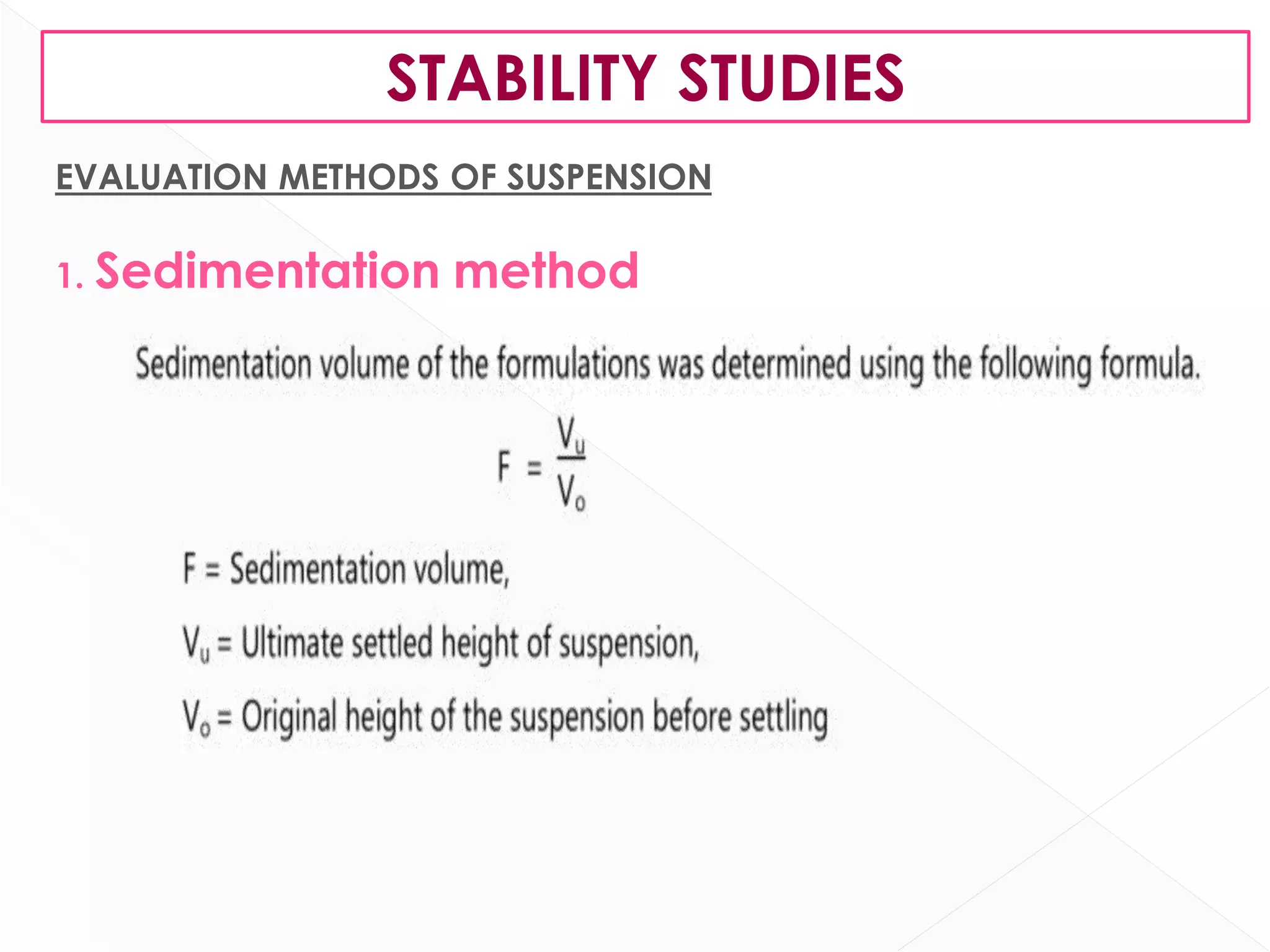
STABILITY STUDIES
EVALUATION METHODS OF SUSPENSION
1. Sedimentation method
STABILITY STUDIES
2. RHEOLOGICAL METHOD
STABILITY STUDIES
3. ELECTROKINETIC METHOD
STABILITY STUDIES
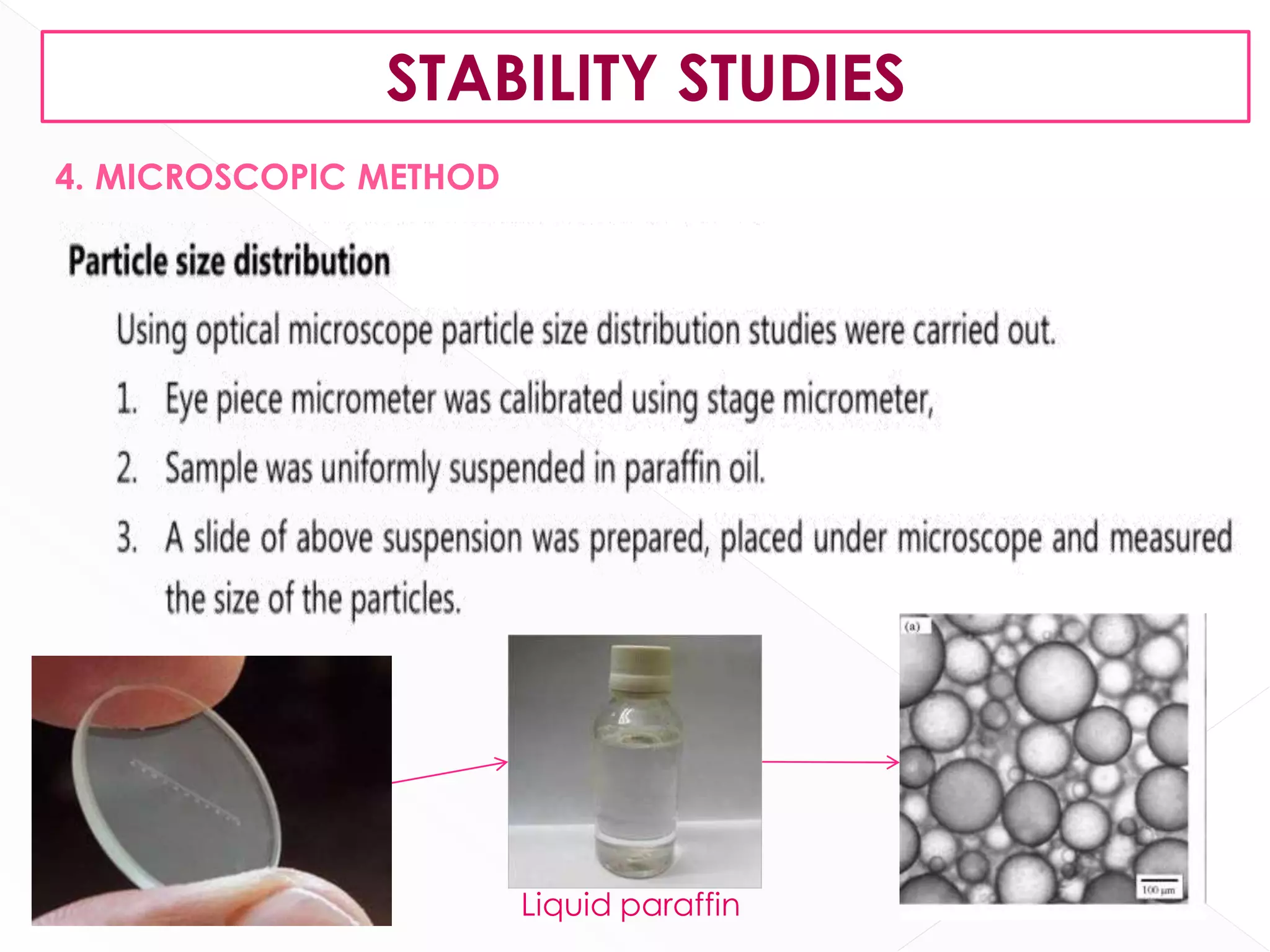
4. MICROSCOPIC METHOD
Liquid paraffin

SUSPENSION PHARMACEUTICS-1 BPHARM 1ST YEAR.pdf

  • 2.
    •Suspension is aHeterogeneous coarse dispersion systems containing two phases. External phase/dispersion medium/continuous phase/vehicle/ liquid (e.g., liquid suspensions) or semisolid (e.g., gels) Internal/dispersed phase finely divided (diameter- 0.5 µm to 5 µm) solid particulate matter, insoluble in the external phase.
  • 3.
  • 5.
    AN IDEAL QUALITYOF SUSPENSION SEDIMENTATION DISPERSION Particle settle down slowly Particle readily re- dispersed on shaking container VISCOSITY Readily and evenly pour from container CAKE FORMATION No hard cake forming of sediment particles on standing
  • 6.
    AN IDEAL QUALITYOF SUSPENSION ELEGANCE PALATABILITY Uniform size of particles Oral: No gritty taste NATURE Physically, chemically, microbiologically inert THIXOTROPIC PROPERTY Gel to sol upon shaking; Sol to gel upon storage External: No irritability Parenteral: Good syringeability and sterilizable
  • 8.
    APPLICATIONS OF SUSPENSIONS •Applicablefor insoluble or poorly soluble drug •Prevent degradation of drug •Mask the bitter taste of drug Oxytetracycline Chloramphenicol palmitate Prednisolone
  • 9.
    APPLICATIONS OF SUSPENSIONS •Parenteralapplication for control rate of absorption •Vaccine •X-ray contrast agent Penicillin procaine Cholera vaccine Barium sulphate •Topical application Calamine lotion (topical suspension)
  • 10.
    CLASSIFICATION OF SUSPENSIONS Suspensionof solid particle Size Colloidal (< 1 micron) Coarse (>1 micron) Nano (10 ng) Electrokinetic Nature Flocculated Deflocculated Proportion Dilute (2 to10%w/v solid) predinisolone acetate Concentrated (50%w/v solid) zinc oxide Route Of Administration Oral Paracetamol Parenteral Procaine penicillin G Ophthalmic Prednisolone External Calamine
  • 11.
  • 12.
    PROPERTIES DEFLOCCULATED FLOCCULATED PARTICLESExist in separate entities Form loose aggregates (flocs) SEDIMENTATION RATE Slow Fast SEDIMENT STRUCTURE Compact Scaffold-like loose RE-DISPERSION Difficult Easy SUPERNATANT LIQUID Cloudy Clear HARD CAKE Yes No APPEARANCE Pleasing Un-pleasing FLOCCULANT STICK TO SIDES OF BOTTLE No Yes Flocculated Vs deflocculated suspension
  • 13.
    •MAIN INGREDIENTS API: Drugwith non-aqueous stability Vehicle: External liquid vehicle METHODS: a.Structured vehicle aka. Suspending agent b.Controlled flocculation using flocculating agent c.Combination of Flocculation in structured vehicle FORMULATION OF SUSPENSION
  • 14.
    FORMULATION OF SUSPENSION Particle Additionof dispersion medium and wetting agent Uniform dispersion of deflocculated particles DEFLOCCULATED SUSPENSION IN STRUCTURED VEHICLE FLOCCULATED SUSPENSION FLOCCULATED SUSPENSION INCORPORATION OF STRUCTURED VEHICLE FLOCCULATED SUSPENSION IN STRUCTURED VEHICLE
  • 15.
    FORMULATION OF SUSPENSION •EXCIPIENTSUSED 1. Suspending/Thickening Agent 2. Flocculating Agent 3. Deflocculating Agent 4. Wetting Agent 5. Organoleptic Agent 6. Stabilizing Agent 7. Solvent
  • 16.
    EXCIPIENT FUNCTIONS EXAMPLES Structured vechicle/ suspending agent/ thickening agent Hydrophilic colloids  Increase the viscosity of the continous phase  Give thixotropy to media  Aqueous solutions of natural and synthetic gums  Applicable only to deflocculated suspensions  Entrapped the particle and reduces the sedimentation of particles  Not useful for Parenteral suspension because they may create problem in syringeability due to high viscosity. Natural: aliginate Semi-synthetic derivative: methyl cellulose Inorganic: bentonite Synthetic: carbamers Flocculating agent Electrolytes: forms bridge b/w adjacent particles by reducing electric barrier between particles, due to decrease in zeta potential Sodium salts of acetate, phosphate, citrate Non-ionic Surfactant: reduce surface tension Polysorbate 80 Polymers: linear branch chain molecules form gel network within system Starch, alginates Deflocculating agent Aka. Dispersant that reduce viscosity Low molecular weight anionic polymers Polyphosphate EXCIPIENTS USED IN SUSPENSION
  • 17.
    EXCIPIENT FUNCTIONS EXAMPLES Wetting agent Non-polarliquids added to disperse hydrophobic solids in continuous liquid phase Allow penetration of liquid into particle Concentration used is less than 0.5 % Spans and Tweens Organo- leptic agent Flavoring agent Strawberry Sweetening agent Sucrose Coloring agent Sunset yellow Perfumes Rose water Stabilizing agent Preservatives Benzoic acid EDTA Buffers (7.4-8.4.) Carbonates, citrates Osmotic agent - produce osmotic pressure comparable to biological fluids when suspension is to be intended for ophthalmic or injectable preparation Dextrose, ƒ mannitol ƒ sorbitol Humectants - absorb moisture ( 0-10 % w/w) Glycerol Antioxidant Ascorbic acid Solvents Miscible with water and reduce liquid air interfacial tension. Glycerin
  • 18.
    Finely powdered drug+ ingredients 3/4thvehicle added to make cream Rest of the volume is makeup Labelled and corked (shake well before use) 1. Suspension containing diffusible solids Eg. Light kaolin, light magnesium carbonate 2. Suspension containing indiffusible solids Eg. Aspirin, zinc oxide Finely powdered drug+ ingredients+ suspending agent 3/4th vehicle added Trituration with suspending agent (tragacanth mucileage/ compound tragacanth powder) Rest of the volume is makeup Labelled and corked (shake well before use)
  • 19.
    3. Suspension containingpoorly wettable solids  Sulphur and hydrocortisone are insoluble in water and poorly wettable by it, so wetting agent is added.  Eg. Sulphur lotion– quilliar tincture as wetting agent 4. Suspension containing precipitate forming liquid  Liquid preparation containing resinous matter when mixed with water show precipitation of resin, that stick to walls of container and tolu tincture.  Prevention: add tragacanth mucileage  Eg. Tolu 5. Suspension produced by precipitation reaction eg. Milk of magnesia suspension prepared by precipitation reaction MgSO4(aq) + 2 NaOH(aq) --> Mg(OH)2 (s) + Na2SO4(aq)
  • 20.
    PACKAGING ORAL Wide mouth bottles PARENTERAL Vialsand glass ampoules Materials used 1.Amber colored glass bottles 2. Plastic bottles (polyethylene, polysterene) Closures and Liners With an exception of ampoules all containers required elastomeric closure.
  • 21.
    STORAGE & LABELLING •Shake wellbefore use •Do not freeze •Protect from direct light •In case of dry suspensions powder the specified amount of vehicle to be mixed
  • 22.
    STABILITY STUDIES EVALUATION METHODSOF SUSPENSION 1. Sedimentation method
  • 23.
  • 24.
  • 26.
    STABILITY STUDIES 4. MICROSCOPICMETHOD Liquid paraffin