Creams and Gels
Md. Saiful Islam
BPharm, MPharm (PCP)
North South University
Fb Group: Pharmacy Universe
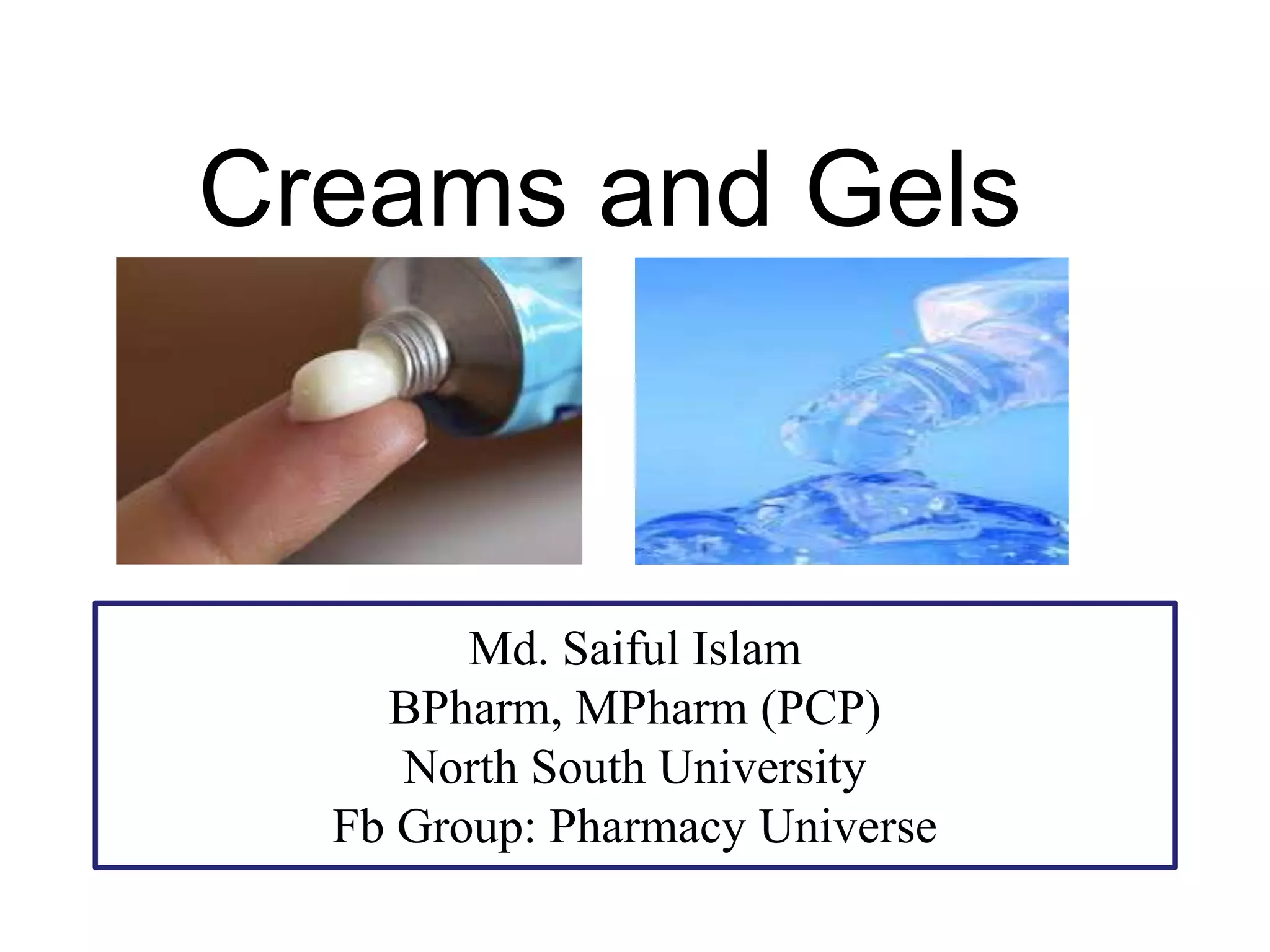
Creams
Definition:
Pharmaceutical creams are semisolid preparations containing one or
more medicinal agents dissolved or dispersed in either a water-in-oil
emulsion or an oil-in-water emulsion or in another type of water-
washable base
Properties of creams:
• The so-called vanishing creams are o/w type emulsions containing
large percentages of water, stearic acid or other oleaginous
components
• After application of the cream , the water evaporates, leaving behind
a thin residue film of the stearic acid or other oleaginous
components
Properties of creams:
• The primary application of creams is as topical skin
products
• Sometimes creams are preferable to ointments because
they are easier to spread and remove
• Pharmaceutical manufacturers frequently manufacture
topical preparations of a drug in both cream and
ointment bases to satisfy the preference of the patient
and physician
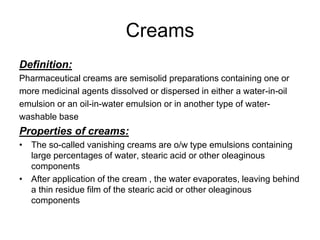
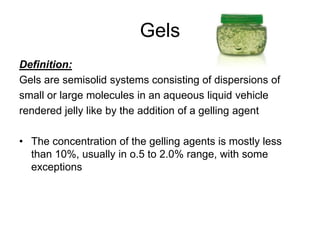
Gels
Definition:
Gels are semisolid systems consisting of dispersions of
small or large molecules in an aqueous liquid vehicle
rendered jelly like by the addition of a gelling agent
• The concentration of the gelling agents is mostly less
than 10%, usually in o.5 to 2.0% range, with some
exceptions
Terminology related to gel
A number of terms are commonly used in discussing some
of the characteristics of gels. These are:
1) Imbibition:
- Taking up of a certain amount of liquid without a
measurable increase in volume
2) Swelling:
- Taking up of a liquid by a gel with an increase in volume
- Only liquids that solvate a gel can cause swelling
Terminology…….
3) Syneresis:
- This occurs when the interaction between particles of the
dispersed phase becomes so great that on standing, the
dispersing medium is squeezed out in droplets and the
gel shrinks
- This is a form of instability in aqueous and non-aqueous
gels
- Separation of a solvent phase is thought to occur
because of the elastic contraction of the polymeric
molecules (in the swelling process during gel formation,
the macromolecules become stretched and the elastic
forces increase as swelling proceeds)
Terminology…..
4) Thixotropy:
- A reversible gel-sol formation with no change in volume
or temperature, a type of non-Newtonian flow
5) Xerogel:
- A xerogel is formed when the liquid is removed from a
gel and only the framework remains
Classification and types of gels
Depending on the appearance and number of phases, the
gels are primarily divided into two classes:
1) Single-phase gels:
- Gels in which the macromolecules are distributed so that
no apparent boundaries exist between them
- these gels look as clear as water
2) Two-phase system:
- Gels in which the mass consists of floccules of small,
distinct particles and may not be completely molecularly
dispersed
- these gels look turbid and frequently called magma or a
milk
Classification…….
Single-phase and two-phase gels are further classified into
two schemes. The first scheme divides gels into 2 types:
1) Inorganic hydrogels:
- These are two-phase systems
- Examples: Aluminum hydroxide gel, Bentonite magma
2) Organic gels:
- These are single-phase systems
- Examples: Carbopol, Tragacanth
Classification…….
The second scheme divides gels into 2 types:
1) Hydrogels:
- Include ingredients that are dispersible as colloids or
soluble in water
- They include organic hydrogels, natural and synthetic
gums and inorganic hydrogels
- Examples: Pectin paste, Tragacanth jelly, Methyl
cellulose, Sodium CMC, Bentonite gel, Veegum, Silica
Classification…….
2) Organogels:
- These include the hydrocarbons, animal and vegetable
fats, soap base greases, hydrophilic organogels
- Examples: Petrolatum, Lard, cocoa butter, Aluminum
stearate with heavy mineral oil gel, carbowax bases
Preparation of magmas and gels
Magmas and gels are prepared by one of the two ways:
1) By freshly precipitating the disperse phase:
- The disperse phase is precipitated to achieve a fine
degree of subdivision and a gelatinous character to
those particles
- When the solutions of inorganic agents react to form an
insoluble chemical, the desired gelatinous precipitates
results
- As the microcrystalline particles of the precipitate
develop, they strongly attract water to yield gelatinous
particles, which combine to form the desired gel
Preparation of……
2) By directly hydrating the inorganic chemical:
- The inorganic chemicals are hydrated directly which
produces the disperse phase of the dispersion
- In addition to the water vehicle, other agents as
propylene glycol, propyl gallate, and hydroxypropyl
cellulose may be used to enhance gel formation

(Creams and gels)

  • 1.
    Creams and Gels Md.Saiful Islam BPharm, MPharm (PCP) North South University Fb Group: Pharmacy Universe
  • 2.
    Creams Definition: Pharmaceutical creams aresemisolid preparations containing one or more medicinal agents dissolved or dispersed in either a water-in-oil emulsion or an oil-in-water emulsion or in another type of water- washable base Properties of creams: • The so-called vanishing creams are o/w type emulsions containing large percentages of water, stearic acid or other oleaginous components • After application of the cream , the water evaporates, leaving behind a thin residue film of the stearic acid or other oleaginous components
  • 3.
    Properties of creams: •The primary application of creams is as topical skin products • Sometimes creams are preferable to ointments because they are easier to spread and remove • Pharmaceutical manufacturers frequently manufacture topical preparations of a drug in both cream and ointment bases to satisfy the preference of the patient and physician
  • 4.
    Gels Definition: Gels are semisolidsystems consisting of dispersions of small or large molecules in an aqueous liquid vehicle rendered jelly like by the addition of a gelling agent • The concentration of the gelling agents is mostly less than 10%, usually in o.5 to 2.0% range, with some exceptions
  • 5.
    Terminology related togel A number of terms are commonly used in discussing some of the characteristics of gels. These are: 1) Imbibition: - Taking up of a certain amount of liquid without a measurable increase in volume 2) Swelling: - Taking up of a liquid by a gel with an increase in volume - Only liquids that solvate a gel can cause swelling
  • 6.
    Terminology……. 3) Syneresis: - Thisoccurs when the interaction between particles of the dispersed phase becomes so great that on standing, the dispersing medium is squeezed out in droplets and the gel shrinks - This is a form of instability in aqueous and non-aqueous gels - Separation of a solvent phase is thought to occur because of the elastic contraction of the polymeric molecules (in the swelling process during gel formation, the macromolecules become stretched and the elastic forces increase as swelling proceeds)
  • 7.
    Terminology….. 4) Thixotropy: - Areversible gel-sol formation with no change in volume or temperature, a type of non-Newtonian flow 5) Xerogel: - A xerogel is formed when the liquid is removed from a gel and only the framework remains
  • 8.
    Classification and typesof gels Depending on the appearance and number of phases, the gels are primarily divided into two classes: 1) Single-phase gels: - Gels in which the macromolecules are distributed so that no apparent boundaries exist between them - these gels look as clear as water 2) Two-phase system: - Gels in which the mass consists of floccules of small, distinct particles and may not be completely molecularly dispersed - these gels look turbid and frequently called magma or a milk
  • 9.
    Classification……. Single-phase and two-phasegels are further classified into two schemes. The first scheme divides gels into 2 types: 1) Inorganic hydrogels: - These are two-phase systems - Examples: Aluminum hydroxide gel, Bentonite magma 2) Organic gels: - These are single-phase systems - Examples: Carbopol, Tragacanth
  • 10.
    Classification……. The second schemedivides gels into 2 types: 1) Hydrogels: - Include ingredients that are dispersible as colloids or soluble in water - They include organic hydrogels, natural and synthetic gums and inorganic hydrogels - Examples: Pectin paste, Tragacanth jelly, Methyl cellulose, Sodium CMC, Bentonite gel, Veegum, Silica
  • 11.
    Classification……. 2) Organogels: - Theseinclude the hydrocarbons, animal and vegetable fats, soap base greases, hydrophilic organogels - Examples: Petrolatum, Lard, cocoa butter, Aluminum stearate with heavy mineral oil gel, carbowax bases
  • 12.
    Preparation of magmasand gels Magmas and gels are prepared by one of the two ways: 1) By freshly precipitating the disperse phase: - The disperse phase is precipitated to achieve a fine degree of subdivision and a gelatinous character to those particles - When the solutions of inorganic agents react to form an insoluble chemical, the desired gelatinous precipitates results - As the microcrystalline particles of the precipitate develop, they strongly attract water to yield gelatinous particles, which combine to form the desired gel
  • 13.
    Preparation of…… 2) Bydirectly hydrating the inorganic chemical: - The inorganic chemicals are hydrated directly which produces the disperse phase of the dispersion - In addition to the water vehicle, other agents as propylene glycol, propyl gallate, and hydroxypropyl cellulose may be used to enhance gel formation