PREPARED BY:  SUTHAR SHAKTI M.PHARM  PHARMACEUTICS
CONTENTS: RECENT ADVANCE IN EMULSION Multiple emulsion Microemulsion  Self emulsifying drug delivery system Nanoemulsion  09/26/11 Shakti Suthar
Multiple emulsion 09/26/11 Shakti Suthar
Contents: Introduction Method of preparation Characterization of Multiple emulsion  Application 09/26/11 Shakti Suthar
Introduction: Multiple emulsion systems are  novel developments in the field of emulsion technology and are more complex type of dispersed system. These are the emulsion systems in which the dispersed phase contain smaller droplets that have the same compositon as the external phase. These made possible by the double emulsification hence the systems are also called as “double emulsion”. Diameter of the droplets in a  Multiple  emulsion is in the range of o.5 to 3µm. 09/26/11 Shakti Suthar
Like simple emulsion multiple emulsion are classified into two type. 1)O/W/O type 2)W/O/W type The immiscible phase ,which separates  the two miscible phase is known as “liquid membrane” and act as a diffusion barrier and semipermeable membrane for drugs or moities entrapped in the internal aqueous phase. 09/26/11 Shakti Suthar
Methods of preparation Multiple emulsion systems can be formed by the reemulsification of a primary emulsion or they can be produced when an emulsion inverts from one type to another,eg.W/O to O/W. Three methods for preparation: 1)Two step emulsification(Double  emulsification) 2)Phase inversion technique(One step technique) 3)Membrane emulsification technique 09/26/11 Shakti Suthar
1)Two step emulsification : First prepare primary emulsion (W/O or O/W ) Then it  is reemulsified with an excess of aqueous or oil phase. 2)Phase inversion technique: A queous phase containing hydrophilic emulsifier is added into the oil phase containing the lipophilic surfactant  in a mixer at a rate of 5ml/min.  The mixer is rotate at 88rpm at room temperature. When volume fraction of a queous  solution  containing hydrophilic emulsifier exceeds 0.7, the continuous oil phase is converted into aqueous phase containing number of small oil droplets.  09/26/11 Shakti Suthar
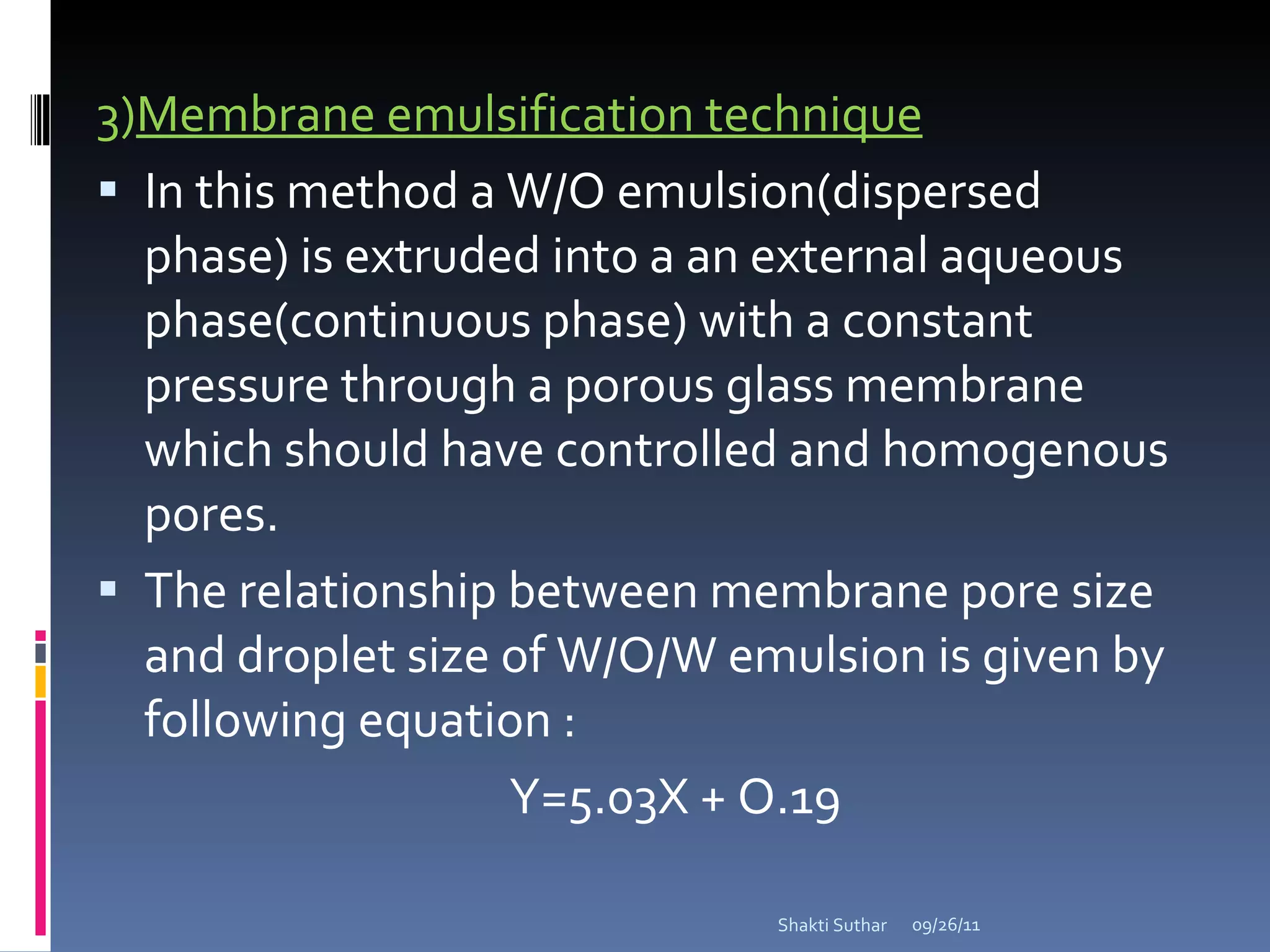
3) Membrane emulsification technique In this method a W/O emulsion(dispersed phase) is extruded into a an external aqueous phase(continuous phase) with a constant pressure through a porous glass membrane which should have controlled and homogenous pores. The relationship between membrane pore size and droplet size of W/O/W emulsion is given by following equation :  Y=5.03X + O.19 09/26/11 Shakti Suthar
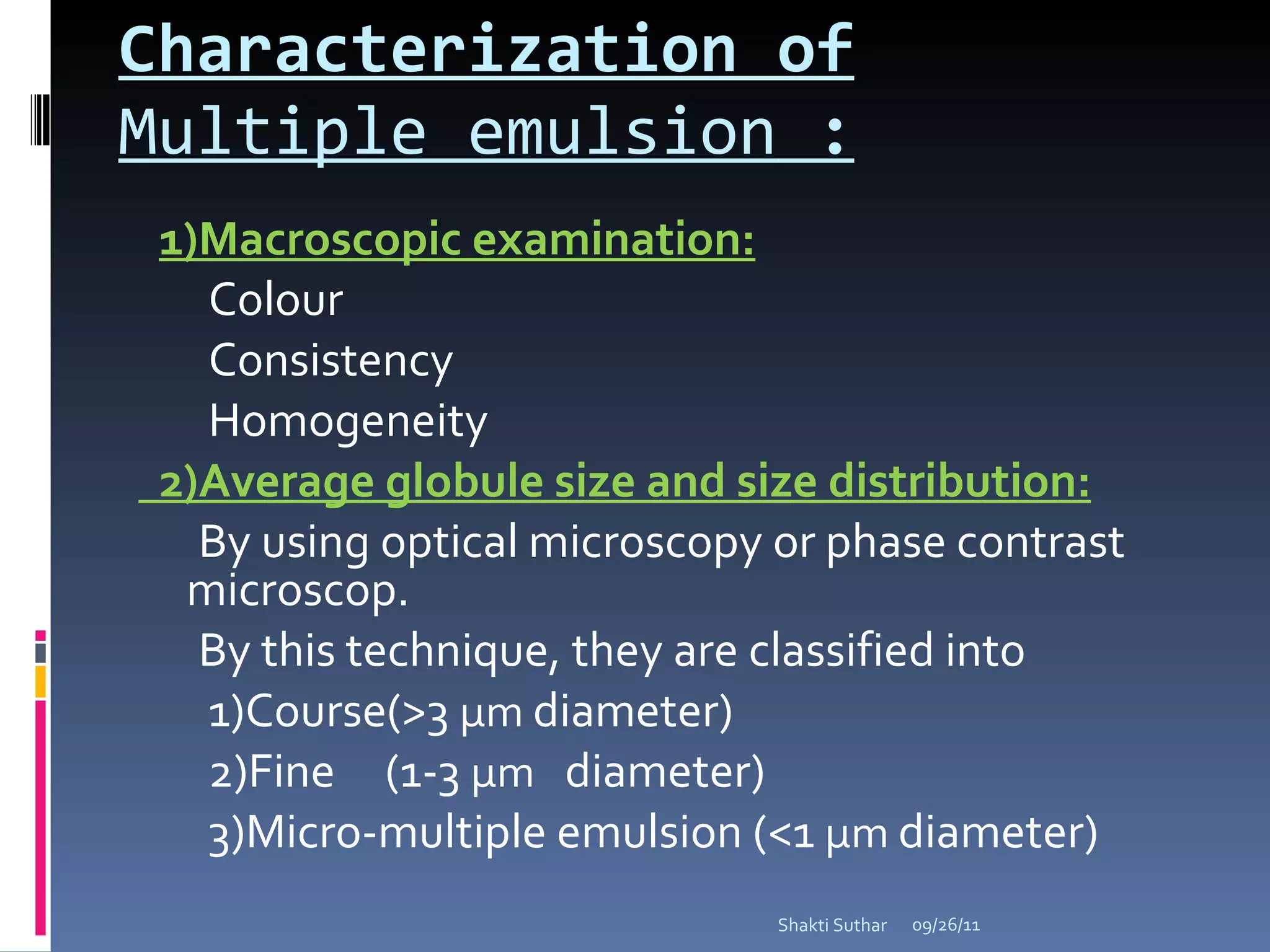
Characterization of  Multiple emulsion  : 1)Macroscopic examination: Colour Consistency Homogeneity 2)Average globule size and size distribution: By using optical microscopy or phase contrast microscop. By this technique, they are classified into  1)Course(>3  µm  diameter) 2)Fine  (1-3  µm   diameter) 3)Micro-multiple emulsion (<1  µm  diameter)  09/26/11 Shakti Suthar
3) Area of interfaces: The average globule diameter determine can be used in the calculation of the total area of interface using the formula: S= 6 / d 4) Rheological evaluation: It include 2 parameters: Viscosity (By brookfield viscometer ) Interfacial film strength (By Oscillatory surface rheometer) 09/26/11 Shakti Suthar
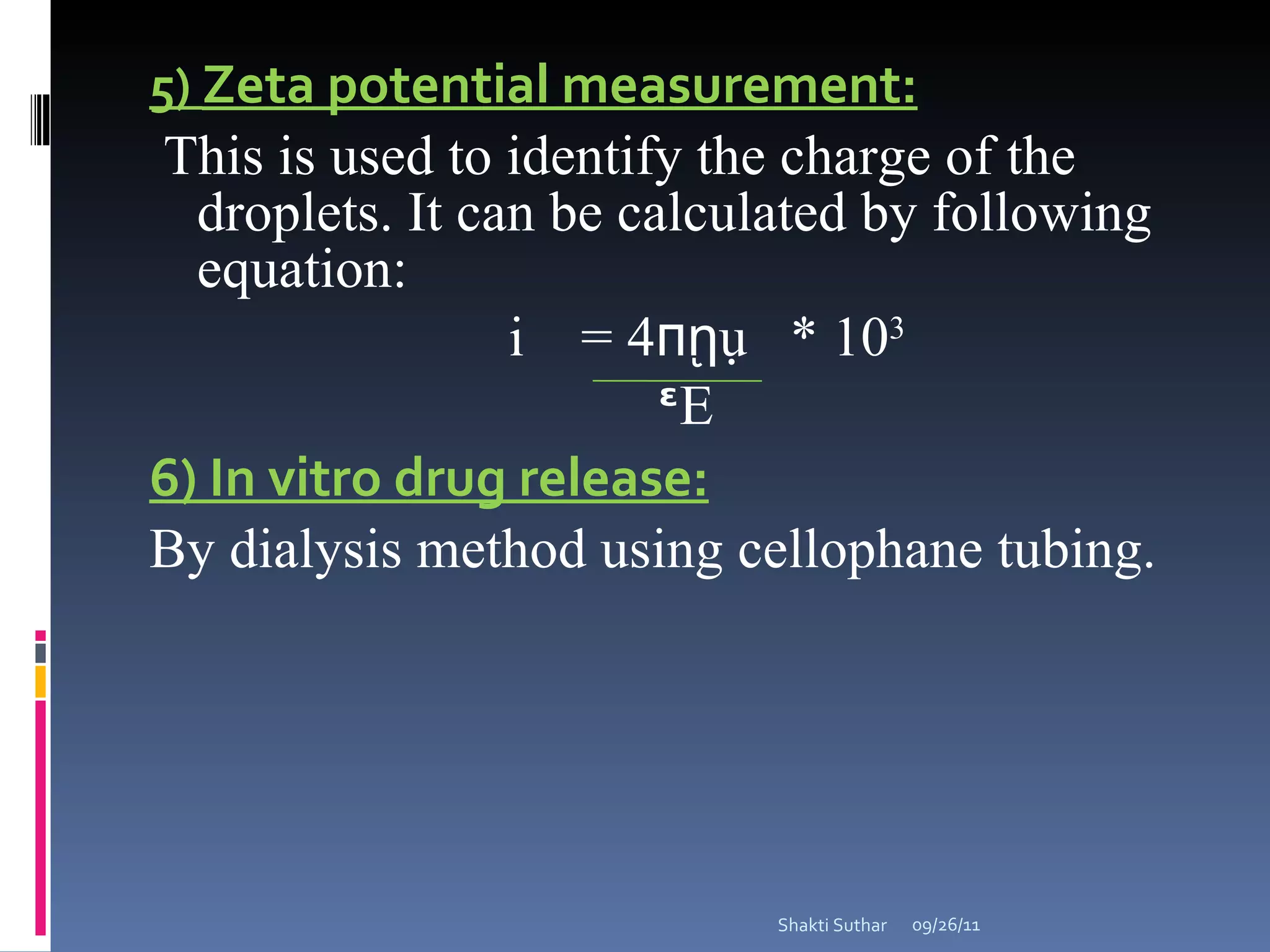
5)  Zeta potential measurement: This is used to identify the charge of the droplets. It can be calculated by following equation: ᶎ  = 4 ᴨῃ ụ  * 10 3 ᵋ E 6) In vitro drug release: By dialysis method using cellophane tubing. 09/26/11 Shakti Suthar
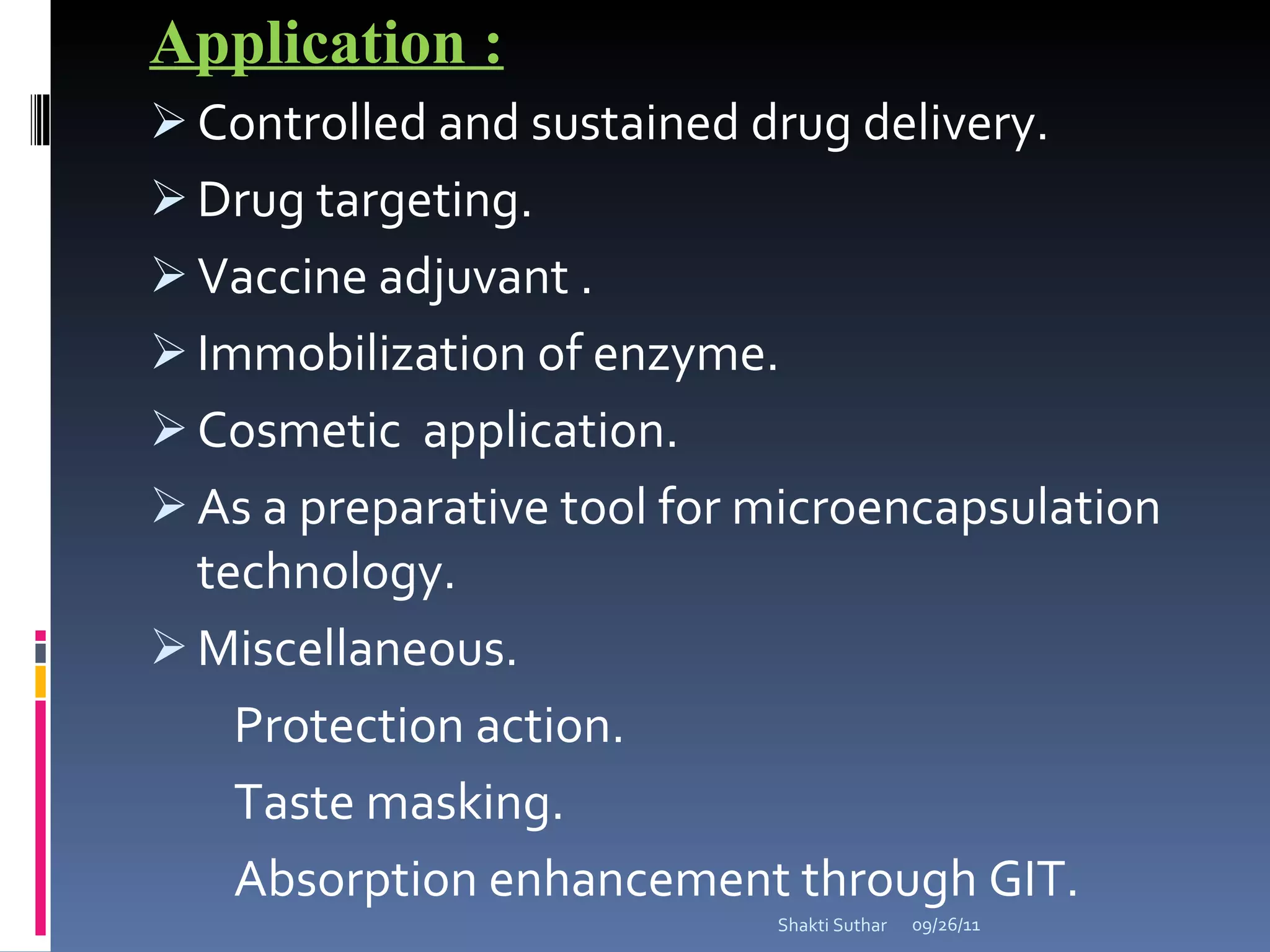
Application : Controlled and sustained drug delivery. Drug targeting. Vaccine adjuvant . Immobilization of enzyme. Cosmetic  application. As a preparative tool for microencapsulation technology. Miscellaneous. Protection action. Taste masking. Absorption enhancement through GIT. 09/26/11 Shakti Suthar
Microemulsion 09/26/11 Shakti Suthar
Contents: Introduction  Advantages  Disadvantages  Diffference  Preparation  Evaluation  Research work  09/26/11 Shakti Suthar
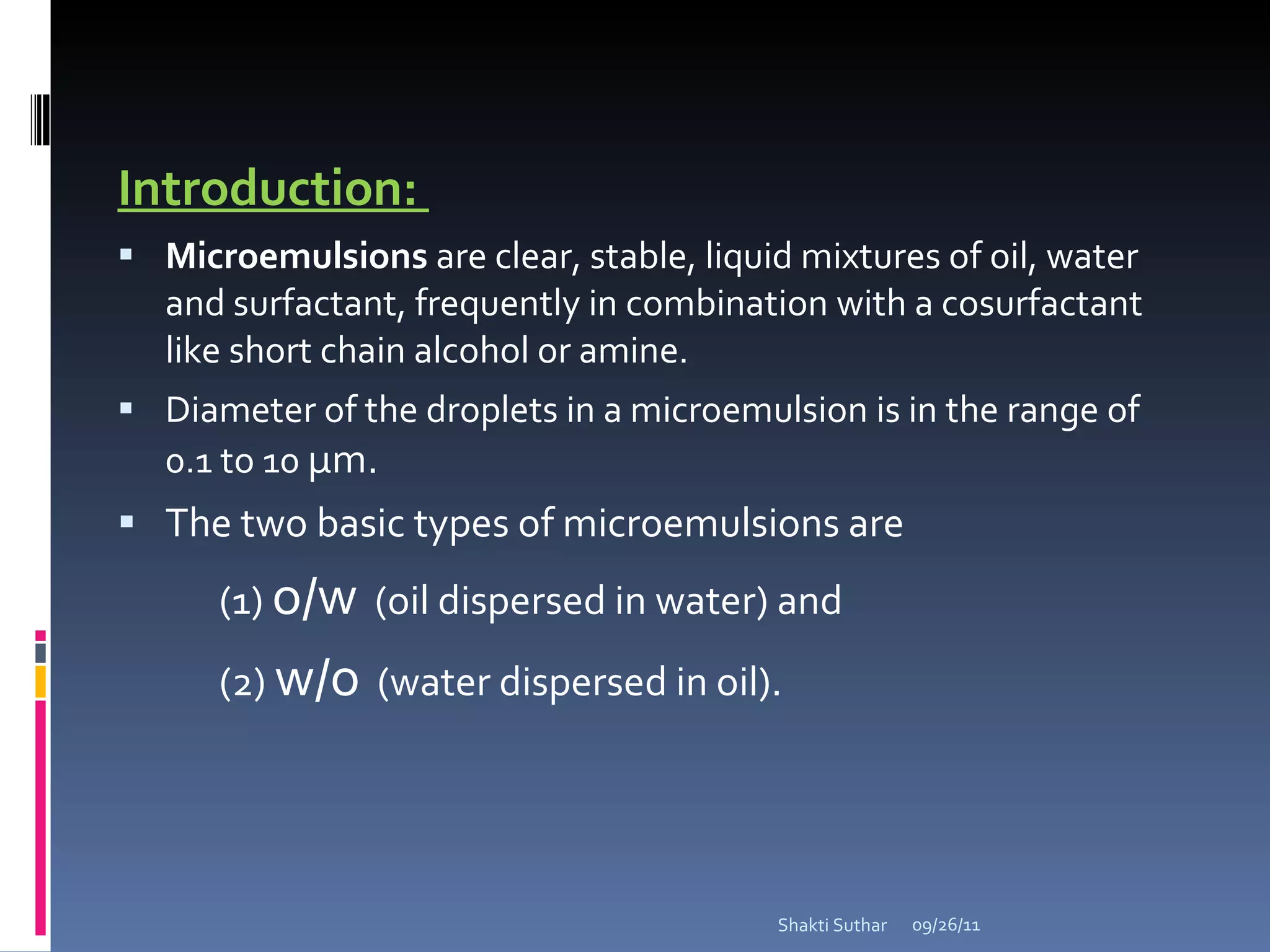
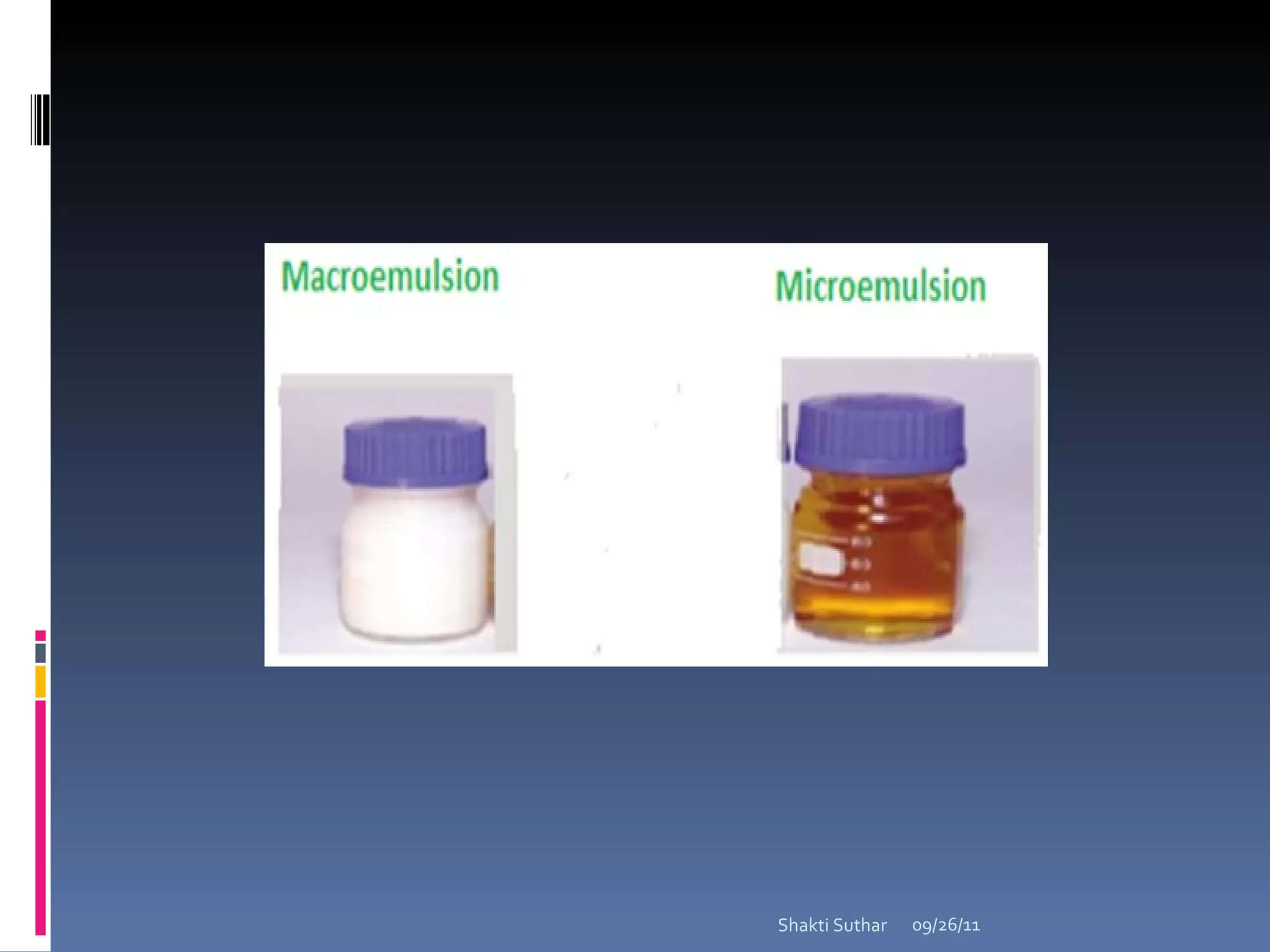
Introduction:  Microemulsions  are clear, stable, liquid mixtures of oil, water and surfactant, frequently in combination with a cosurfactant like short chain alcohol or amine. Diameter of the droplets in a microemulsion is in the range of 0.1 to 10  µm. The two basic types of microemulsions are (1)  o/w   (oil dispersed in water) and  (2)  w/o   (water dispersed in oil). 09/26/11 Shakti Suthar
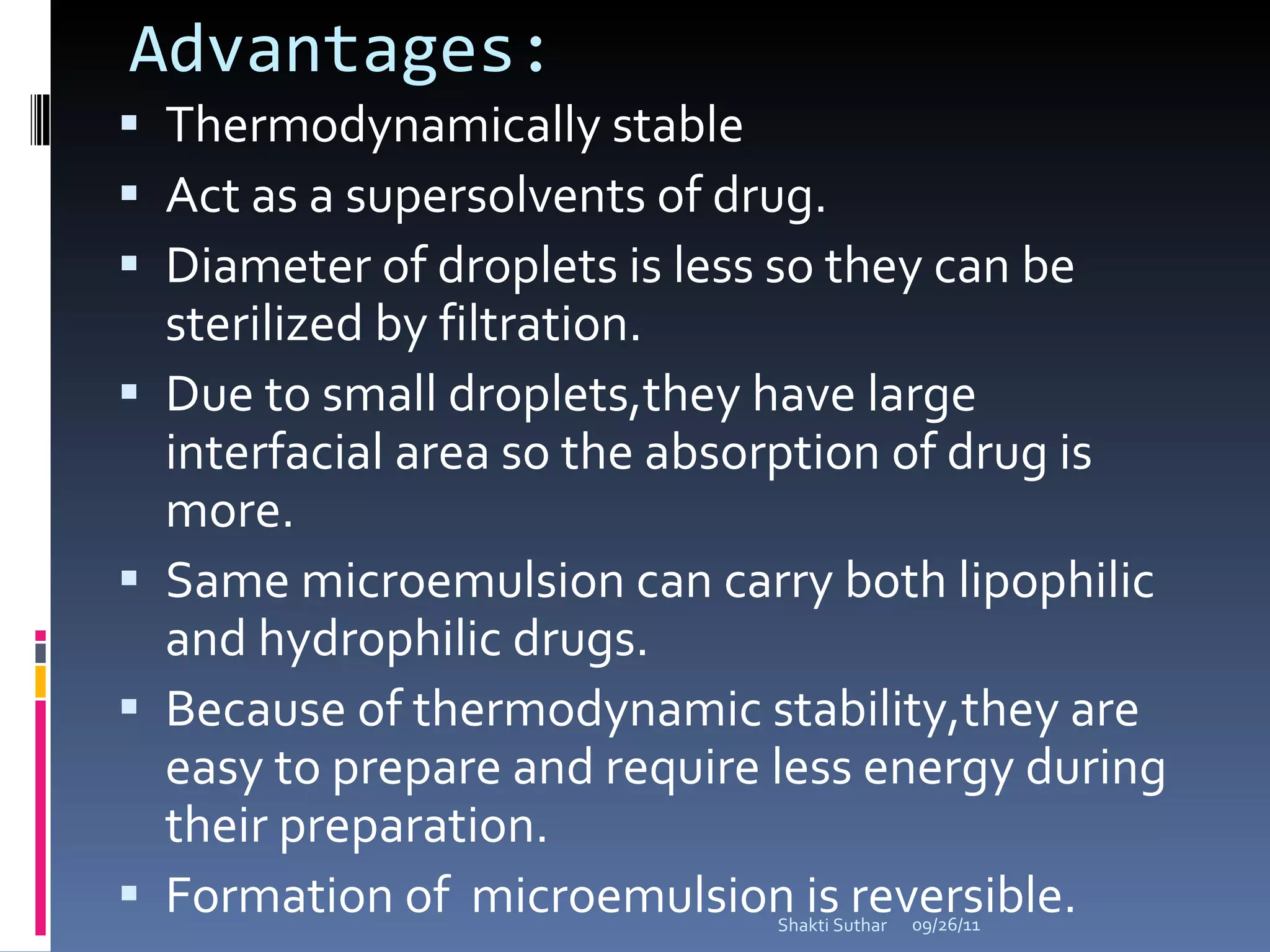
Advantages: Thermodynamically stable Act as a supersolvents of drug. Diameter of droplets is less so they can be sterilized by filtration. Due to small droplets,they have large interfacial area so the absorption of drug is more.  Same microemulsion can carry both lipophilic and hydrophilic drugs. Because of thermodynamic stability,they are easy to prepare and require less energy during their preparation.  Formation of  microemulsion is reversible. 09/26/11 Shakti Suthar
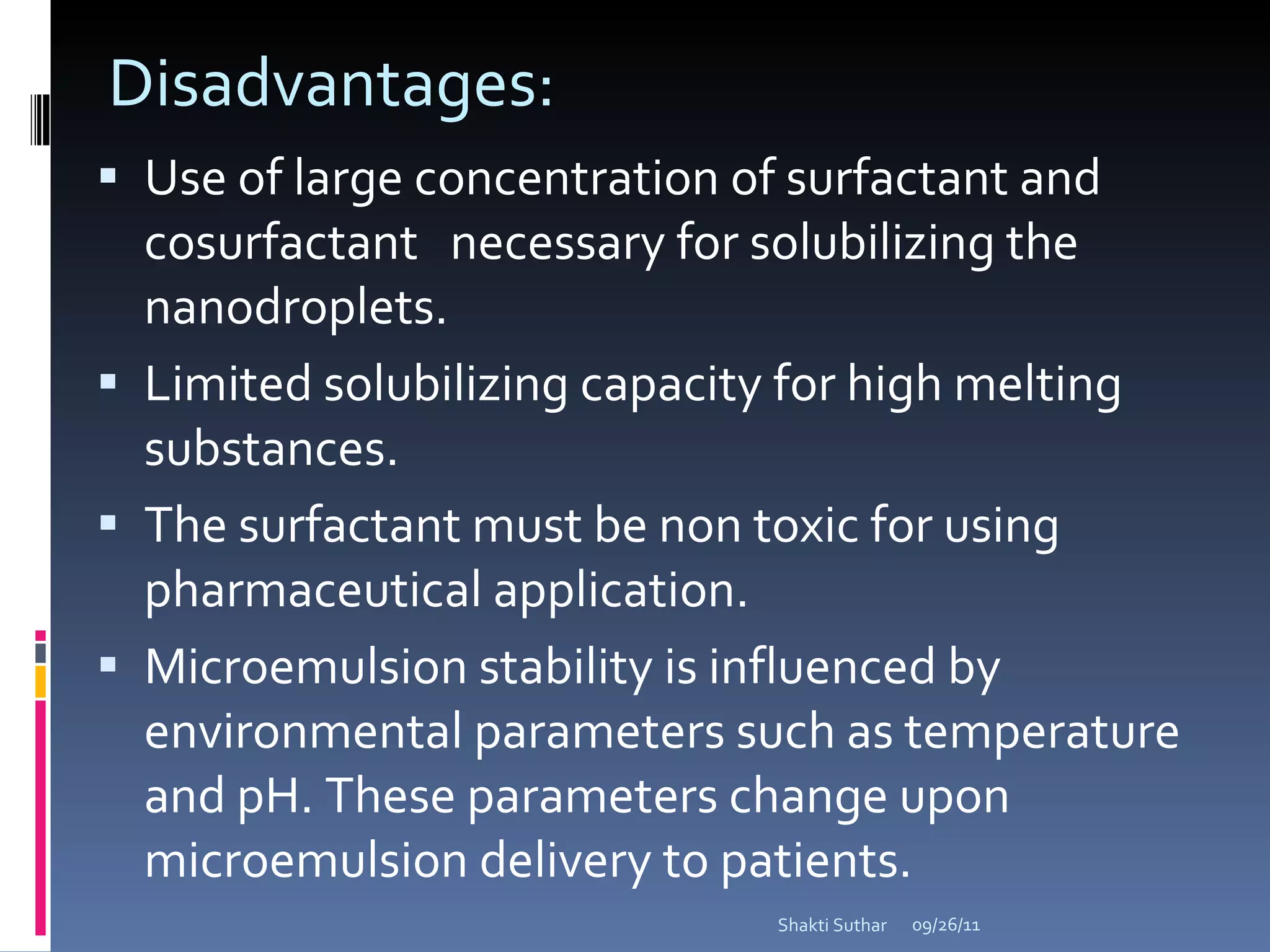
Disadvantages: Use of large concentration of surfactant and cosurfactant  necessary for solubilizing the nanodroplets. Limited solubilizing capacity for high melting substances. The surfactant must be non toxic for using pharmaceutical application. Microemulsion stability is influenced by environmental parameters such as temperature and pH. These parameters change upon microemulsion delivery to patients.  09/26/11 Shakti Suthar
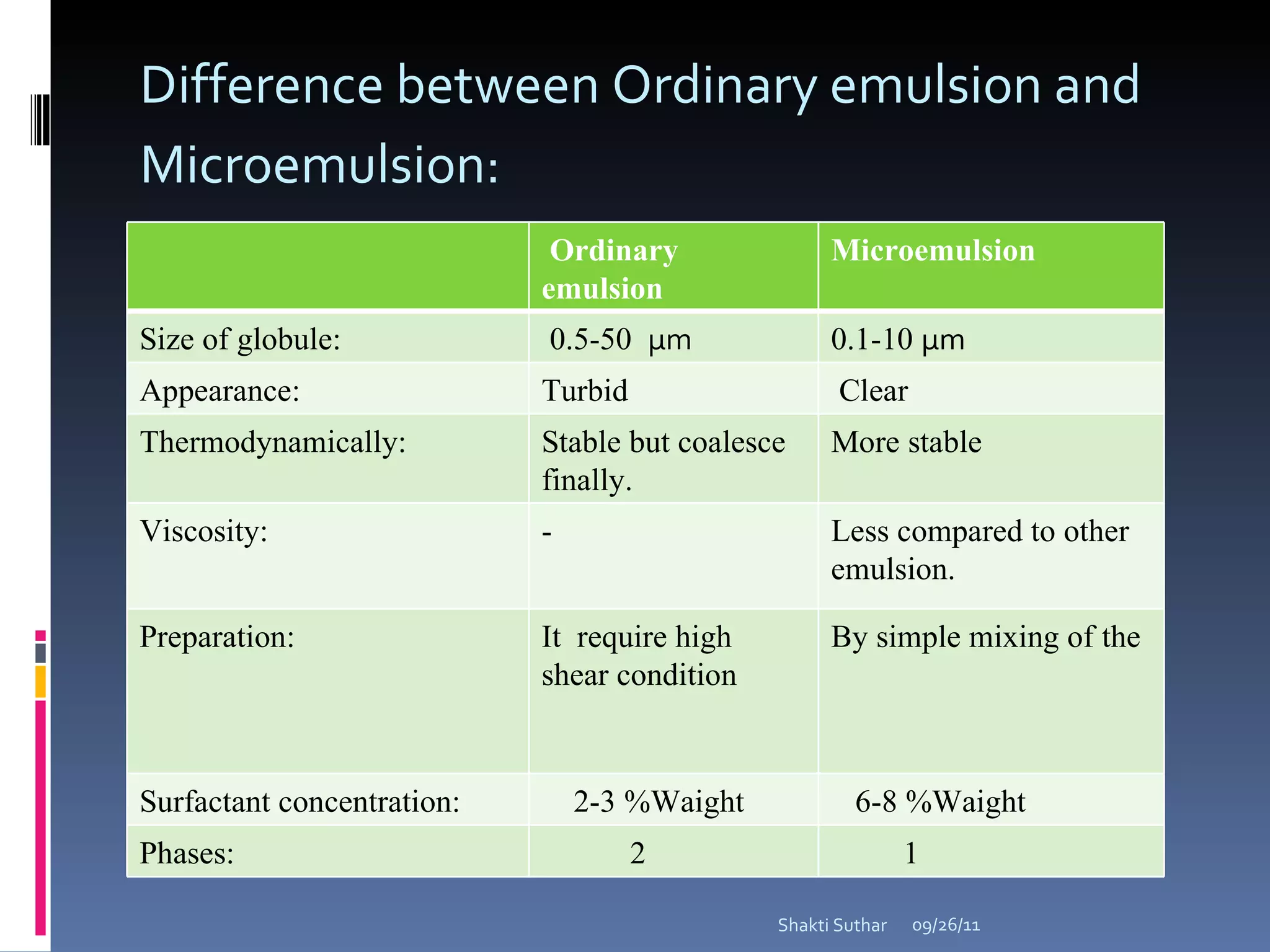
Difference between Ordinary emulsion and Microemulsion:   09/26/11 Shakti Suthar Ordinary emulsion  Microemulsion Size of globule: 0.5-50  µm 0.1-10  µm Appearance: Turbid  Clear Thermodynamically: Stable but coalesce finally. More stable Viscosity:  - Less compared to other emulsion. Preparation:  It  require high shear condition  By simple mixing of the  component and do not  require high shear  condition Surfactant concentration: 2-3 %Waight 6-8 %Waight Phases: 2 1
09/26/11 Shakti Suthar
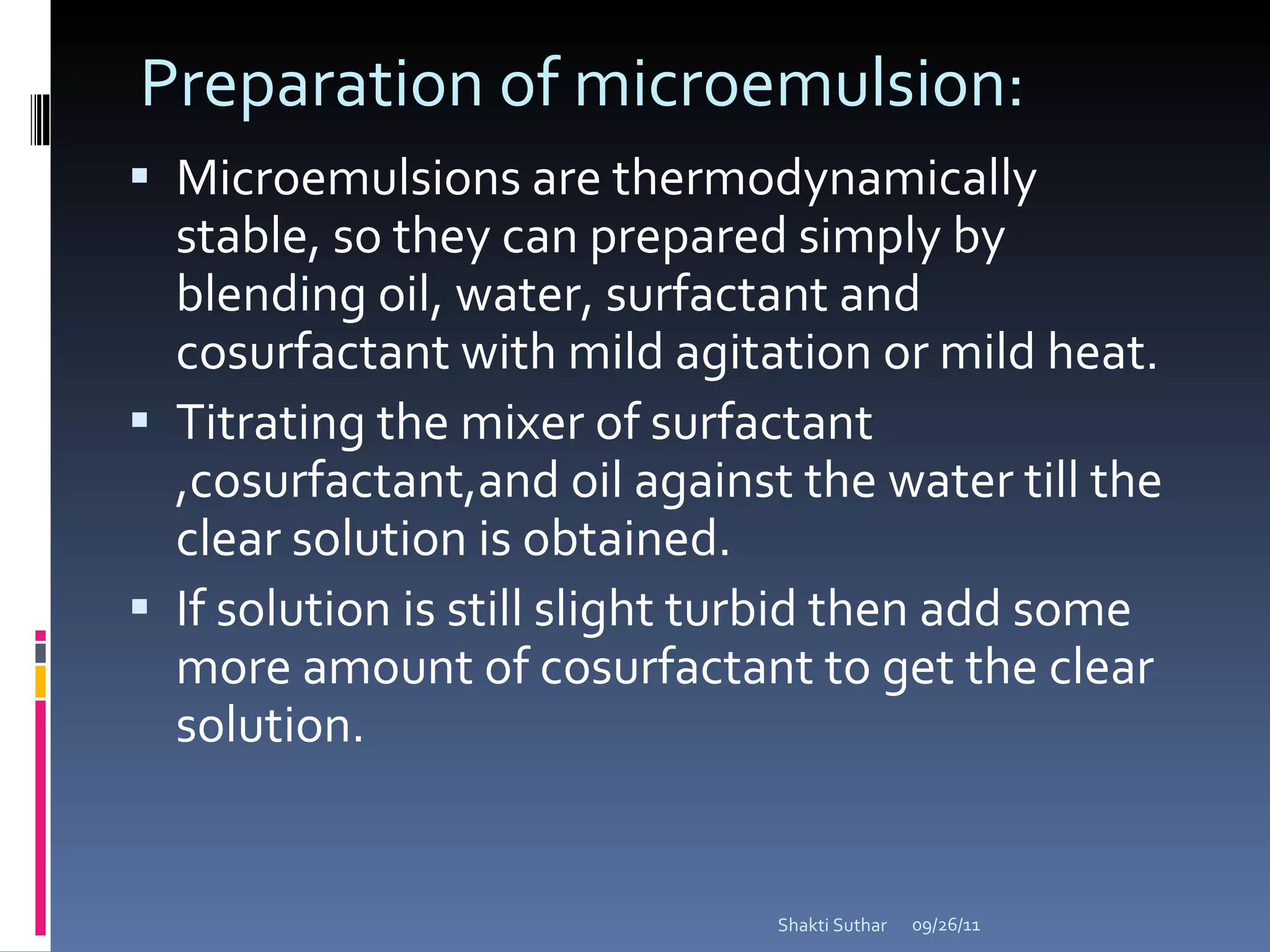
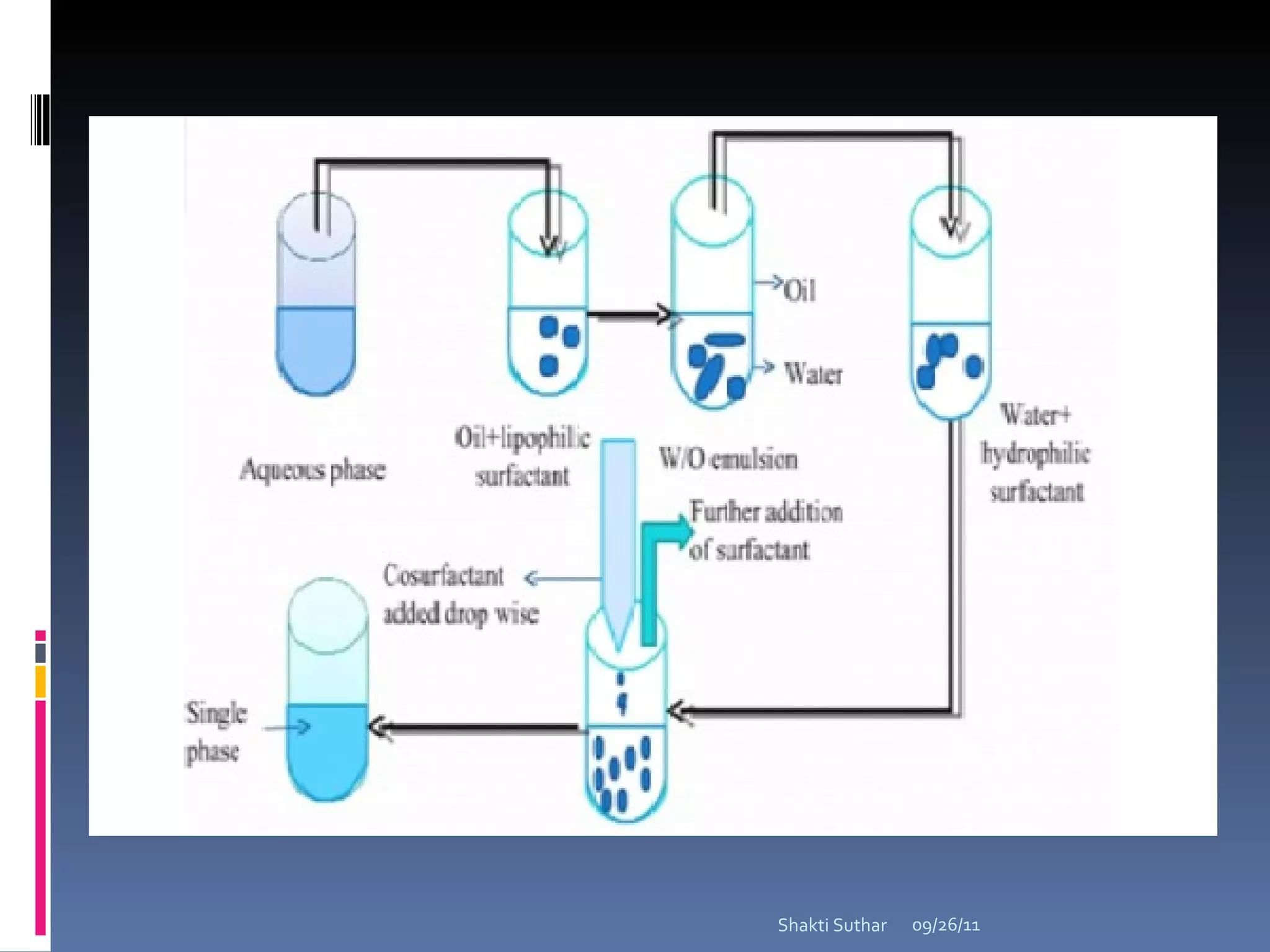
Preparation of microemulsion: Microemulsions are thermodynamically stable, so they can prepared simply by blending oil, water, surfactant and cosurfactant with mild agitation or mild heat. Titrating the mixer of surfactant ,cosurfactant,and oil against the water till the clear solution is obtained. If solution is still slight turbid then add some more amount of cosurfactant to get the clear solution. 09/26/11 Shakti Suthar
09/26/11 Shakti Suthar
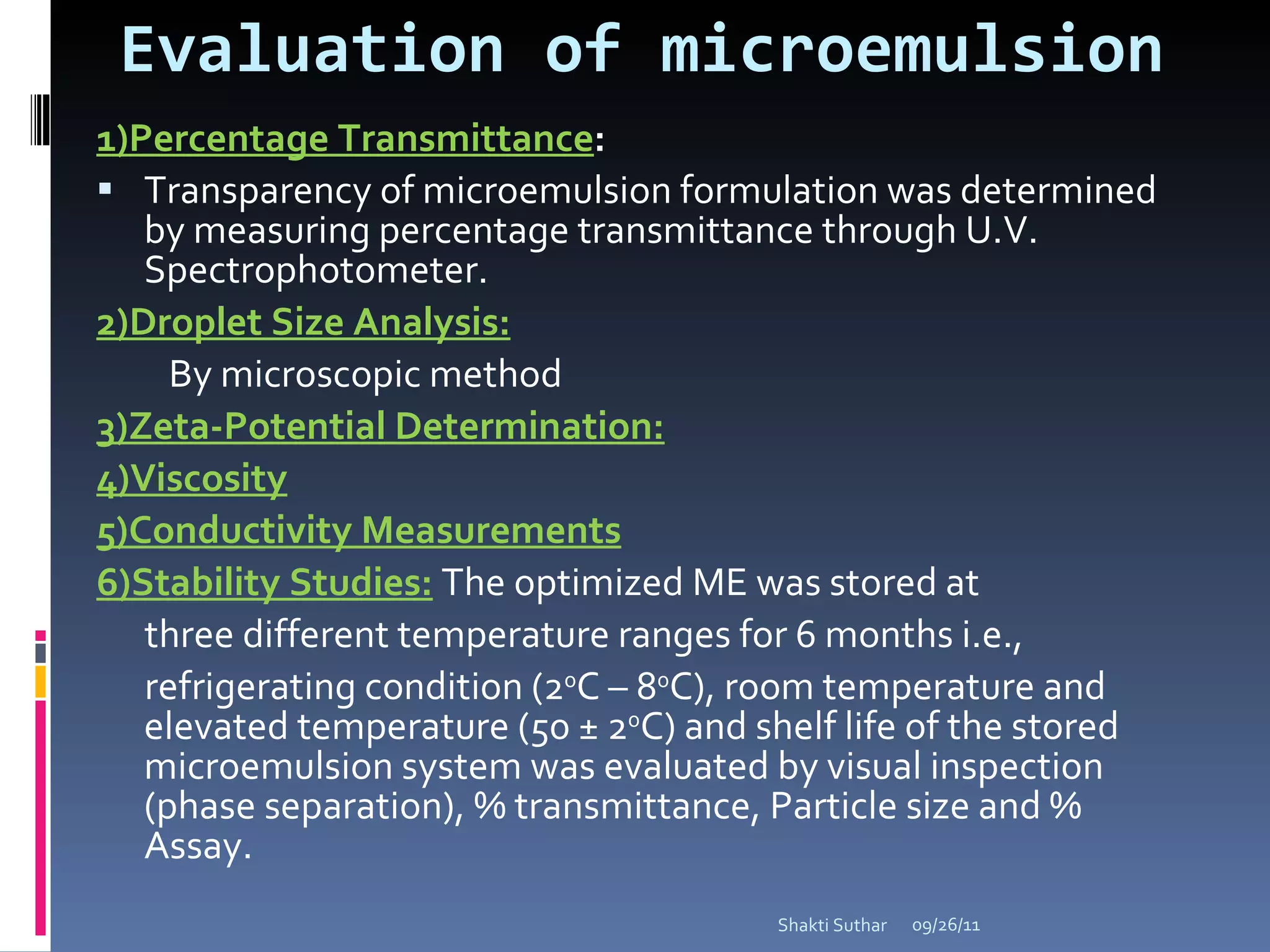
Evaluation of microemulsion 1)Percentage Transmittance :  Transparency of microemulsion formulation was determined by measuring percentage transmittance through U.V. Spectrophotometer. 2)Droplet Size Analysis: By microscopic method 3)Zeta-Potential Determination: 4)Viscosity 5)Conductivity Measurements 6)Stability Studies:   The optimized ME was stored at three different temperature ranges for 6 months i.e., refrigerating condition (2 0 C – 8 0 C), room temperature and elevated temperature (50 ± 2 0 C) and shelf life of the stored microemulsion system was evaluated by visual inspection (phase separation), % transmittance, Particle size and % Assay. 09/26/11 Shakti Suthar
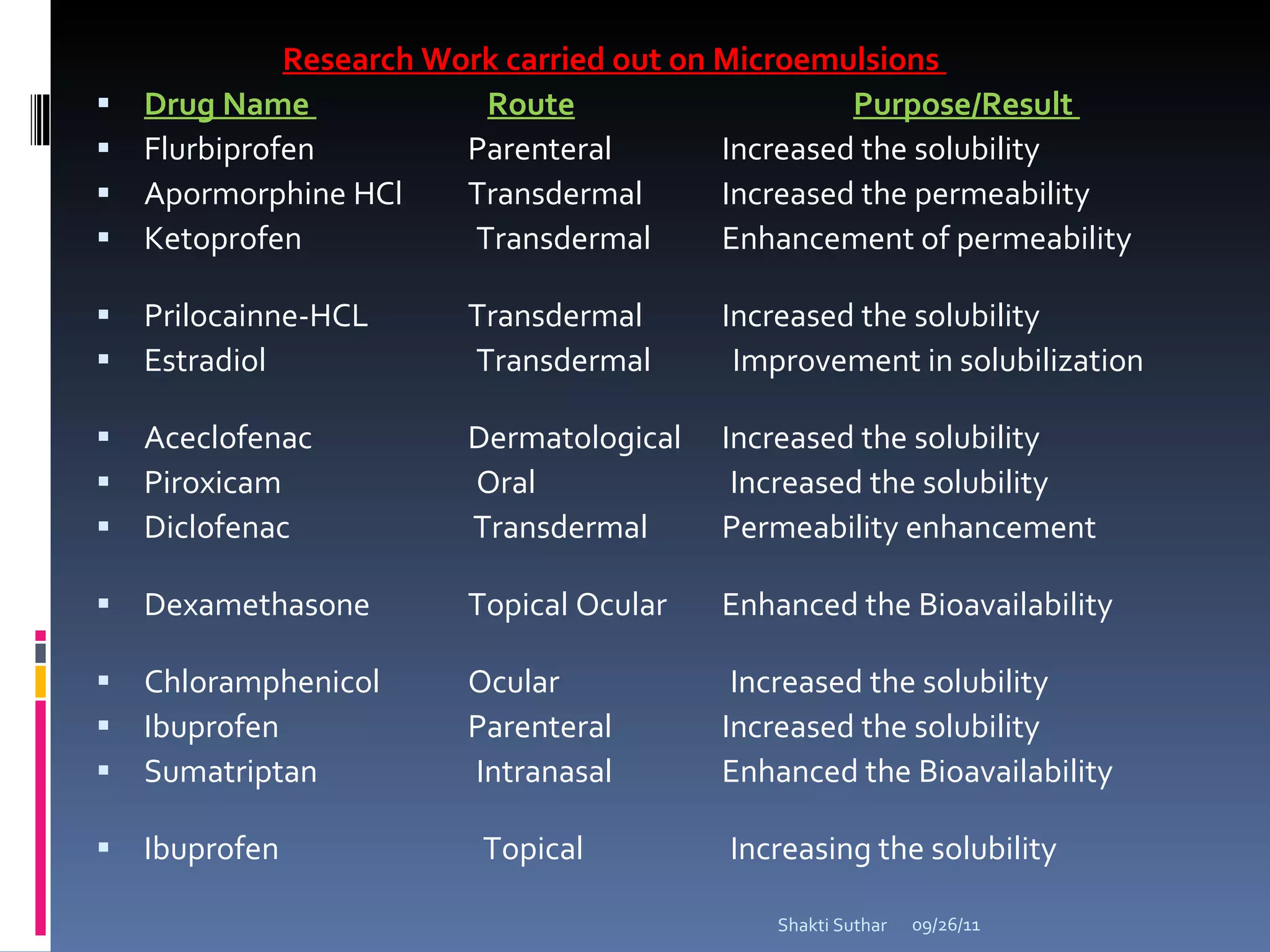
Research Work carried out on Microemulsions  Drug Name    Route     Purpose/Result  Flurbiprofen  Parenteral  Increased the solubility  Apormorphine HCl  Transdermal  Increased the permeability  Ketoprofen    Transdermal  Enhancement of permeability  Prilocainne-HCL  Transdermal  Increased the solubility  Estradiol    Transdermal  Improvement in solubilization  Aceclofenac  Dermatological  Increased the solubility  Piroxicam   Oral    Increased the solubility  Diclofenac  Transdermal  Permeability enhancement  Dexamethasone  Topical Ocular  Enhanced the Bioavailability  Chloramphenicol  Ocular    Increased the solubility  Ibuprofen  Parenteral  Increased the solubility  Sumatriptan    Intranasal  Enhanced the Bioavailability  Ibuprofen    Topical    Increasing the solubility  09/26/11 Shakti Suthar
SELF EMULSIFYING DRUG DELIVERY SYSTEM 09/26/11 Shakti Suthar
Contents: Introduction Need of SEDDS Composition of SEDDS Formulation of SEDDS Characterization of SEDDS Application Drawback 09/26/11 Shakti Suthar
Introduction: Self-emulsifying drug delivery systems (SEDDS) are usually used to improve the bioavailability of  hydrophobic drugs. Approximately 40% of new chemical entities exhibit poor aqueous solubility and present a major challenge to modern drug delivery system, because of their low bioavailability. SEDDS is ideally an isotropic mixture of oils and surfactants and sometimes co solvents.  The multi-component delivery systems have optimized by evaluating their ability to self-emulsify when introduced to an aqueous medium under gentle agitation, and by determination of particle size of the resulting emulsion .  09/26/11 Shakti Suthar
Upon oral administration,these systems form fine (micro) emulsions in the gastrointestinal tract (GIT) with mild agitation provided by gastric mobility.  Fine oil droplets would pass rapidly from the stomach and promote wide distribution of the drug throughout the GI tract, thereby minimizing the irritation frequently encountered during extended contact between bulk drug substances and the gut wall.  When compared with emulsions, which are sensitive and metastable dispersed forms, SEDDS are physically stable formulations that are easy to manufacture.  09/26/11 Shakti Suthar
Need of SEDDS : Oral delivery of poorly water-soluble compounds is to pre-dissolve the compound in a suitable solvent and fill the formulation into capsules. The main benefit of this approach is that pre-dissolving the compound overcomes the initial rate limiting step of particulate dissolution in the aqueous environment within the GI tract. 09/26/11 Shakti Suthar
Composition of SEDDS: 1)Oils.   2)Surfactant 3)Cosolvents 4)Medicament 09/26/11 Shakti Suthar
1)Oils: Oils can solubilize the lipophilic drug in a specific amount.  It is the most important excipient because it can facilitate self-emulsification and increase the fraction of lipophilic drug transported via the intestinal lymphatic system, thereby increasing absorption from the GI tract. Mainly triglycerides are use.  2)Surfactant: Nonionic surfactants with high hydrophilic–lipophilic balance (HLB) values are used in formulation of SEDDSs. 09/26/11 Shakti Suthar
The usual surfactant strength ranges between 30–60% w/w of the formulation in order to form a stable SEDDS e.g., Tween, Labrasol, Labrafac CM 10, Cremophore, etc.). 3)Cosolvents: It may help to dissolve large amounts of hydrophilic surfactants or the hydrophobic drug in the lipid base. These solvents sometimes play the role of the cosurfactant in the microemulsion systems. Eg.diehylene glycol monoethyl ether (transcutol), propylene glycol, polyethylene glycol, polyoxyethylene, propylene carbonate, tetrahydrofurfuryl alcohol,polyethylene glycol ether (Glycofurol), etc . 09/26/11 Shakti Suthar
Formulation of SEDDSs :   The following should be considered in the formulation of a SEDDS:   The solubility of the drug in different oil, surfactants and cosolvents.  The selection of oil, surfactant and cosolvent based on the solubility of the drug and the preparation of the phase diagram. For preparation following steps are involve  1) Preparation of phase diagram 2) Solubilizing a poorly water-soluble drug and/or pharmaceutical ingredient, in a mixture  of  surfactant ,  cosurfactant and solvent.  09/26/11 Shakti Suthar
Now mix the oil phase suitably prepared, if necessary,by heating or other preparatory means, to the solubilized drug formulation and thoroughly mixed. 3) The emulsion can then be added to a suitable dosage form such as soft or hard-filled gelatin capsules and allowed to cool .  09/26/11 Shakti Suthar
Characterization of SEDDSs: Visual assessment .  This may provide important information about the self-emulsifying and microemulsifying property of the mixture and about the resulting dispersion. Turbidity Measurement . This is to identify efficient self-emulsification by establishing whether the dispersion reaches equilibrium rapidly and in a reproducible time.   Droplet Size .  This is a crucial factor in self-emulsification performance because it determines the rate and extent of drug release as well as the stability of the emulsion. Photon correlation spectroscopy, microscopic techniques or a Coulter Nanosizer are mainly used for the determination of the emulsion droplet size. The reduction of the droplet size to values below 50 μm leads to the formation of SMEDDSs, which are stable and clear o/w dispersions.  09/26/11 Shakti Suthar
Zeta potential measurement . This is used to identify the charge of the droplets. In conventional SEDDSs, the charge on an oil droplet is negative due to presence of free fatty acids.  Determination of emulsification time .  Self-emulsification time, dispersibility, appearance and flowability was observed. 09/26/11 Shakti Suthar
Applications Improvement in Solubility and bioavailability. Eg.  Ketoprofen Protection against Biodegradation Eg .Aspirin  Drawbacks of SEDDS Chemical instabilities of drugs and high surfactant concentrations. The large quantity of surfactant in self-emulsifying formulations (30-60%) irritates GIT. Consequently, the safety aspect of the surfactant vehicle had to be considered. Volatile cosolvents in the conventional self-emulsifying formulations are known to migrate into the shells of soft or hard gelatin capsules, resulting in the precipitation of the lipophilic drugs. 09/26/11 Shakti Suthar
NANOEMULSION 09/26/11 Shakti Suthar
Contents: Introduction  Advantages  Method of preparation Characterization  Marketed products Patented NE  Application  09/26/11 Shakti Suthar
Introduction: Nanoemulsion are thermodynamically stable system in which the two immisible liquid (water  and oil)are mix to form a single phase by means of appropriate surfactant . Diameter of the droplets in a nanoemulsion is in the range of 20 to 200 nm. 09/26/11 Shakti Suthar
Advantages: High surface area and free energy then macroemulsion that make them effective transport system. NEs do not show the problem of creaming, flocculation, coalescence and sedimentation which are associated with macroemulsion. It can be formulated in variety of formulation such as foam,spray,cream,liquid etc. NEs are non toxic and non irritant so they can be easily applied to skin and mucous membrane. NEs are formulated by the surfactant which are approved by the GRAAS,so they can be given by the enteric route. NEs do not damage the animal and human cells hence are suitable for human and veterinary purpose 09/26/11 Shakti Suthar
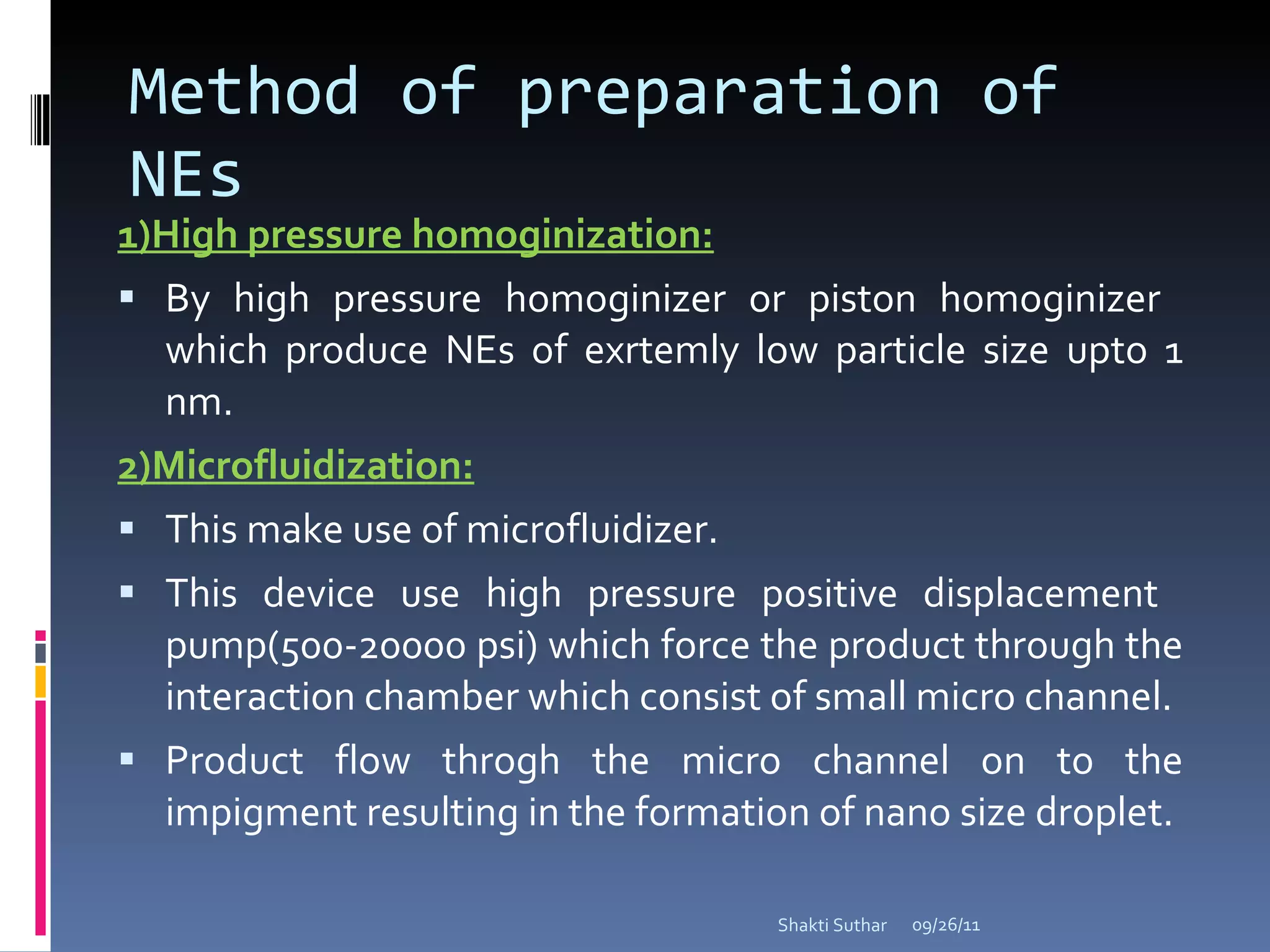
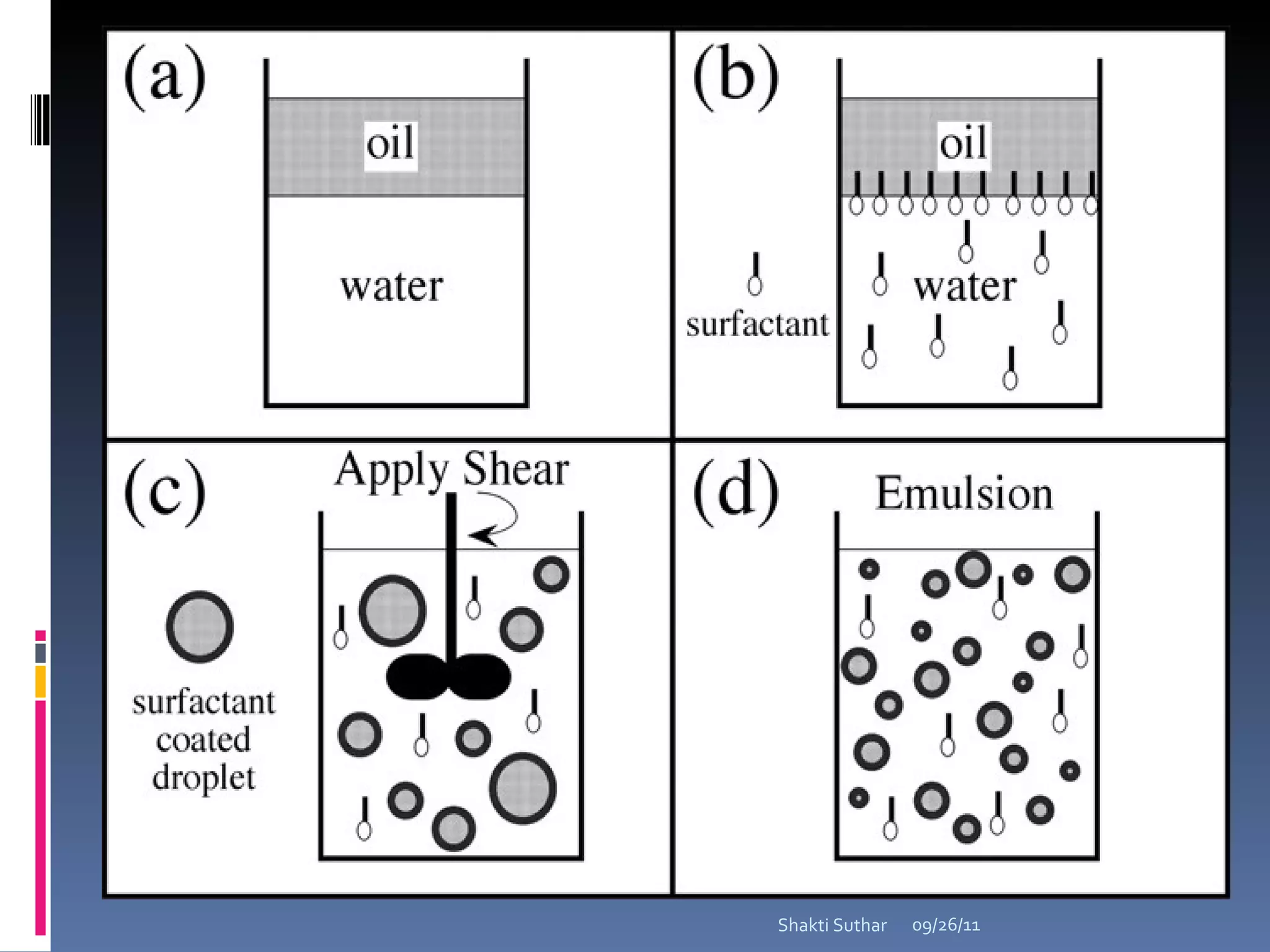
Method of preparation of NEs 1)High pressure homoginization: By high pressure homoginizer or piston homoginizer  which produce NEs of exrtemly low particle size upto 1 nm. 2)Microfluidization: This make use of microfluidizer. This device use high pressure positive displacement  pump(500-20000 psi) which force the product through the interaction chamber which consist of small micro channel. Product flow throgh the micro channel on to the impigment resulting in the formation of nano size droplet. 09/26/11 Shakti Suthar
09/26/11 Shakti Suthar
Characterization of NEs: Transmission eletron microscopy Drolet size analysis Viscosity Refractive index Skin irritation test Thermodynamic stability study Surface characteristics 09/26/11 Shakti Suthar
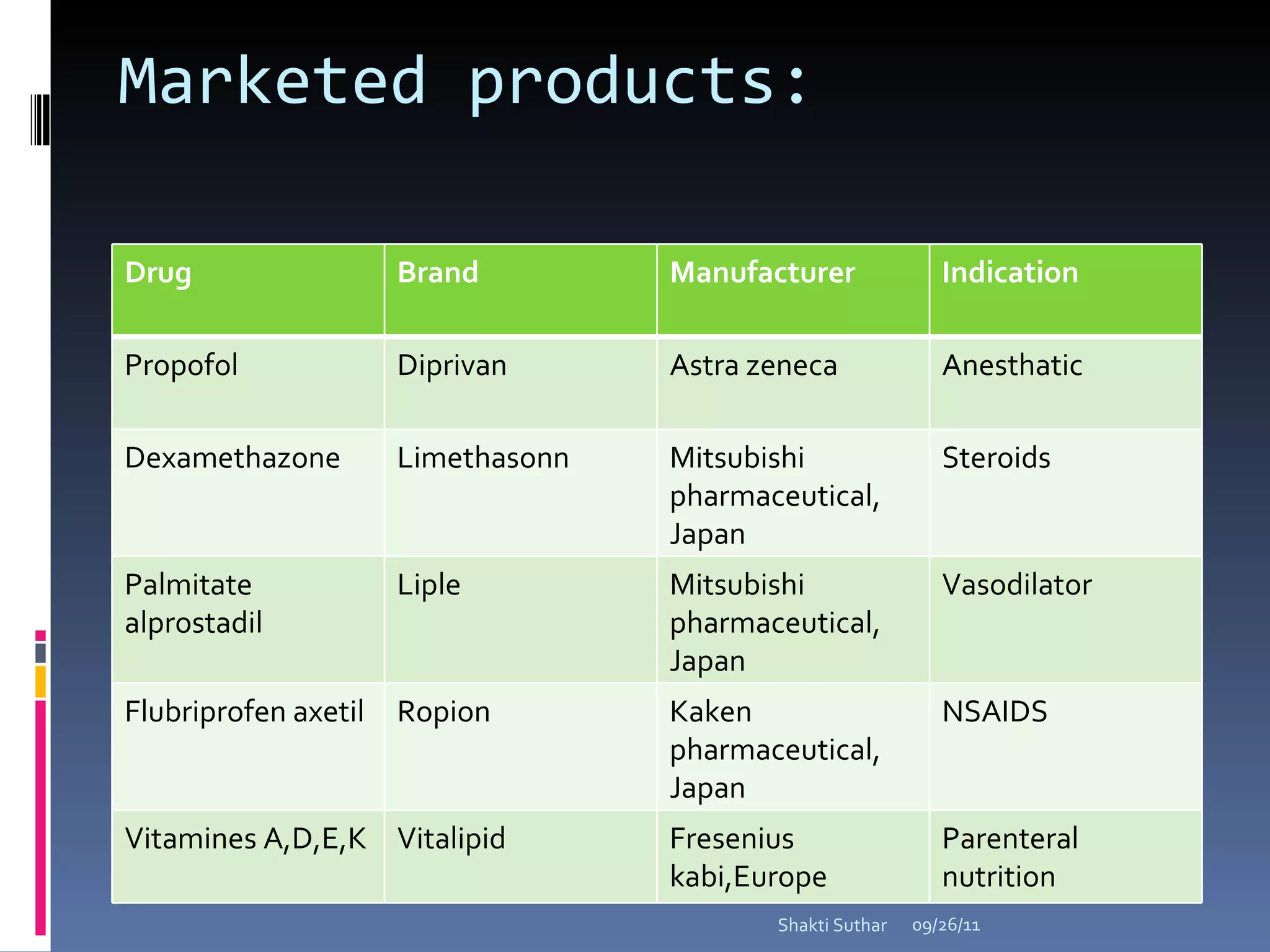
Marketed products: 09/26/11 Shakti Suthar Drug  Brand  Manufacturer  Indication  Propofol  Diprivan  Astra zeneca  Anesthatic  Dexamethazone  Limethasonn  Mitsubishi pharmaceutical, Japan Steroids  Palmitate alprostadil Liple  Mitsubishi pharmaceutical, Japan Vasodilator  Flubriprofen axetil Ropion  Kaken pharmaceutical, Japan NSAIDS Vitamines A,D,E,K Vitalipid Fresenius kabi,Europe Parenteral nutrition
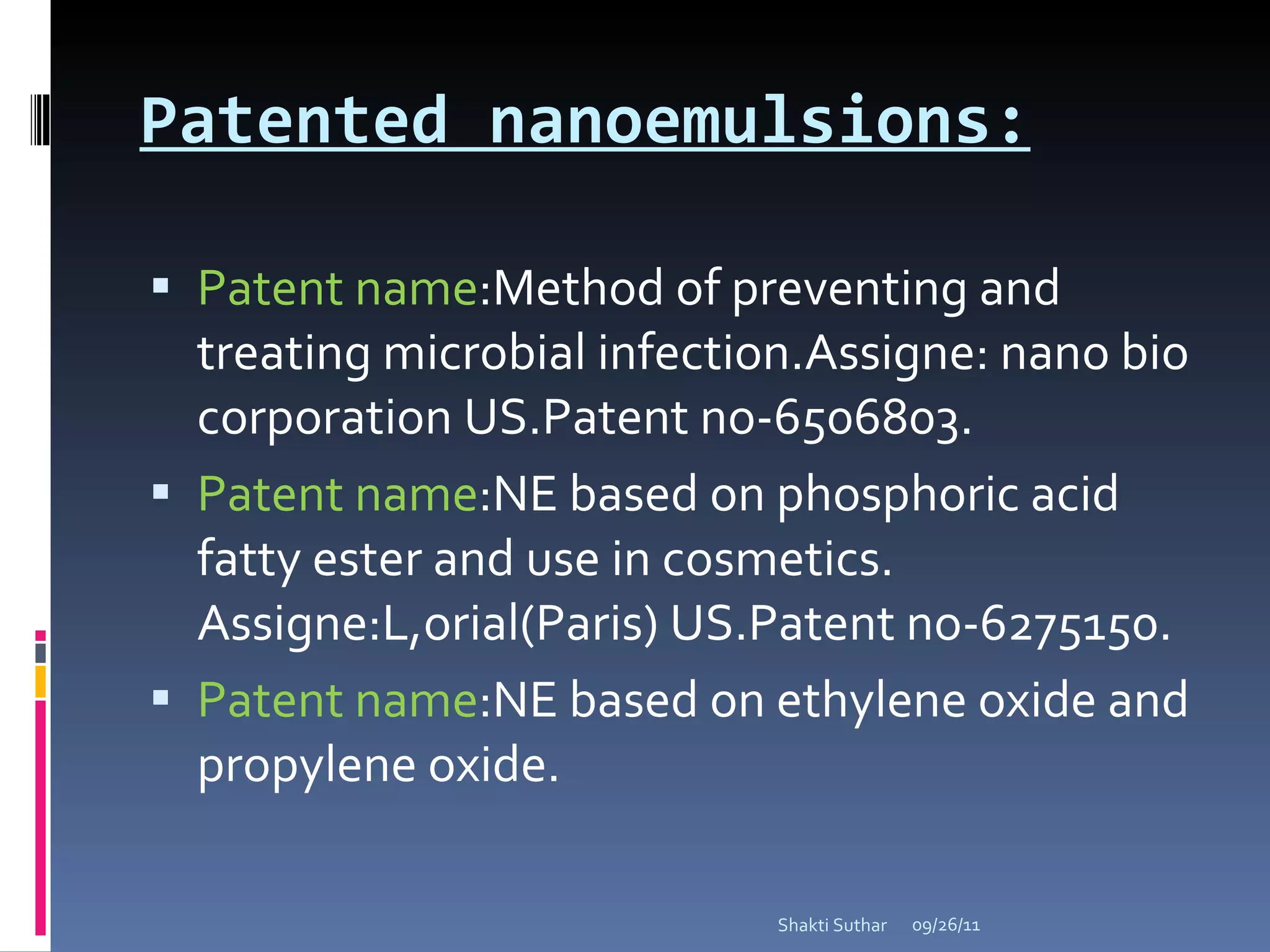
Patented nanoemulsions: Patent name :Method of preventing and treating microbial infection.Assigne: nano bio corporation US.Patent no-6506803. Patent name :NE based on phosphoric acid fatty ester and use in cosmetics. Assigne:L,orial(Paris) US.Patent no-6275150. Patent name :NE based on ethylene oxide and propylene oxide. 09/26/11 Shakti Suthar
Application: Use in cosmetics As a antimicrobial nanoemulsion Use in cell culture technology As a non toxic disinfectant cleaner Use in cancer therapy For improved oral delivery of poorly soluble drugs. As a vehicle for transdermal delivery 09/26/11 Shakti Suthar
References:  1) Advances in controlled and novel drug delivery. By N.K.Jain 2) Targeted and controlled drug delivery  By S.P.Vyas and R.K.Khar 3) Nano emulsion: A pharmaceuticle review. http:/www.sysrevpharm.org 4)  Review Article :Microemulsions: a novel drug carrier system.International Journal of Drug Delivery Technology 2009; 1(2): 39-41  www.ijddt.com 09/26/11 Shakti Suthar
5)  Self emulsifying drug delivery system: an approach to enhance bioavailability International Journal of Pharma Research and Development – Online  www.ijprd.com 6)   TOPICAL REVIEW: nanoemulsions: Formation, structure, and physical properties. Journal of physics: condensed matter 18 (2006) r635–r666 Stacks.Iop.Org/jphyscm/18/R633 09/26/11 Shakti Suthar
Study question:  Write a note on  Self-emulsifying drug delivery systems.   (GTU-remidial  December 2010) 09/26/11 Shakti Suthar
09/26/11 Shakti Suthar

Shakti Emulsion

  • 1.
    PREPARED BY: SUTHAR SHAKTI M.PHARM PHARMACEUTICS
  • 2.
    CONTENTS: RECENT ADVANCEIN EMULSION Multiple emulsion Microemulsion Self emulsifying drug delivery system Nanoemulsion 09/26/11 Shakti Suthar
  • 3.
  • 4.
    Contents: Introduction Methodof preparation Characterization of Multiple emulsion Application 09/26/11 Shakti Suthar
  • 5.
    Introduction: Multiple emulsionsystems are novel developments in the field of emulsion technology and are more complex type of dispersed system. These are the emulsion systems in which the dispersed phase contain smaller droplets that have the same compositon as the external phase. These made possible by the double emulsification hence the systems are also called as “double emulsion”. Diameter of the droplets in a Multiple emulsion is in the range of o.5 to 3µm. 09/26/11 Shakti Suthar
  • 6.
    Like simple emulsionmultiple emulsion are classified into two type. 1)O/W/O type 2)W/O/W type The immiscible phase ,which separates the two miscible phase is known as “liquid membrane” and act as a diffusion barrier and semipermeable membrane for drugs or moities entrapped in the internal aqueous phase. 09/26/11 Shakti Suthar
  • 7.
    Methods of preparationMultiple emulsion systems can be formed by the reemulsification of a primary emulsion or they can be produced when an emulsion inverts from one type to another,eg.W/O to O/W. Three methods for preparation: 1)Two step emulsification(Double emulsification) 2)Phase inversion technique(One step technique) 3)Membrane emulsification technique 09/26/11 Shakti Suthar
  • 8.
    1)Two step emulsification: First prepare primary emulsion (W/O or O/W ) Then it is reemulsified with an excess of aqueous or oil phase. 2)Phase inversion technique: A queous phase containing hydrophilic emulsifier is added into the oil phase containing the lipophilic surfactant in a mixer at a rate of 5ml/min. The mixer is rotate at 88rpm at room temperature. When volume fraction of a queous solution containing hydrophilic emulsifier exceeds 0.7, the continuous oil phase is converted into aqueous phase containing number of small oil droplets. 09/26/11 Shakti Suthar
  • 9.
    3) Membrane emulsificationtechnique In this method a W/O emulsion(dispersed phase) is extruded into a an external aqueous phase(continuous phase) with a constant pressure through a porous glass membrane which should have controlled and homogenous pores. The relationship between membrane pore size and droplet size of W/O/W emulsion is given by following equation : Y=5.03X + O.19 09/26/11 Shakti Suthar
  • 10.
    Characterization of Multiple emulsion : 1)Macroscopic examination: Colour Consistency Homogeneity 2)Average globule size and size distribution: By using optical microscopy or phase contrast microscop. By this technique, they are classified into 1)Course(>3 µm diameter) 2)Fine (1-3 µm diameter) 3)Micro-multiple emulsion (<1 µm diameter) 09/26/11 Shakti Suthar
  • 11.
    3) Area ofinterfaces: The average globule diameter determine can be used in the calculation of the total area of interface using the formula: S= 6 / d 4) Rheological evaluation: It include 2 parameters: Viscosity (By brookfield viscometer ) Interfacial film strength (By Oscillatory surface rheometer) 09/26/11 Shakti Suthar
  • 12.
    5) Zetapotential measurement: This is used to identify the charge of the droplets. It can be calculated by following equation: ᶎ = 4 ᴨῃ ụ * 10 3 ᵋ E 6) In vitro drug release: By dialysis method using cellophane tubing. 09/26/11 Shakti Suthar
  • 13.
    Application : Controlledand sustained drug delivery. Drug targeting. Vaccine adjuvant . Immobilization of enzyme. Cosmetic application. As a preparative tool for microencapsulation technology. Miscellaneous. Protection action. Taste masking. Absorption enhancement through GIT. 09/26/11 Shakti Suthar
  • 14.
  • 15.
    Contents: Introduction Advantages Disadvantages Diffference Preparation Evaluation Research work 09/26/11 Shakti Suthar
  • 16.
    Introduction: Microemulsions are clear, stable, liquid mixtures of oil, water and surfactant, frequently in combination with a cosurfactant like short chain alcohol or amine. Diameter of the droplets in a microemulsion is in the range of 0.1 to 10 µm. The two basic types of microemulsions are (1) o/w (oil dispersed in water) and (2) w/o (water dispersed in oil). 09/26/11 Shakti Suthar
  • 17.
    Advantages: Thermodynamically stableAct as a supersolvents of drug. Diameter of droplets is less so they can be sterilized by filtration. Due to small droplets,they have large interfacial area so the absorption of drug is more. Same microemulsion can carry both lipophilic and hydrophilic drugs. Because of thermodynamic stability,they are easy to prepare and require less energy during their preparation. Formation of microemulsion is reversible. 09/26/11 Shakti Suthar
  • 18.
    Disadvantages: Use oflarge concentration of surfactant and cosurfactant necessary for solubilizing the nanodroplets. Limited solubilizing capacity for high melting substances. The surfactant must be non toxic for using pharmaceutical application. Microemulsion stability is influenced by environmental parameters such as temperature and pH. These parameters change upon microemulsion delivery to patients. 09/26/11 Shakti Suthar
  • 19.
    Difference between Ordinaryemulsion and Microemulsion: 09/26/11 Shakti Suthar Ordinary emulsion Microemulsion Size of globule: 0.5-50 µm 0.1-10 µm Appearance: Turbid Clear Thermodynamically: Stable but coalesce finally. More stable Viscosity: - Less compared to other emulsion. Preparation: It require high shear condition By simple mixing of the component and do not require high shear condition Surfactant concentration: 2-3 %Waight 6-8 %Waight Phases: 2 1
  • 20.
  • 21.
    Preparation of microemulsion:Microemulsions are thermodynamically stable, so they can prepared simply by blending oil, water, surfactant and cosurfactant with mild agitation or mild heat. Titrating the mixer of surfactant ,cosurfactant,and oil against the water till the clear solution is obtained. If solution is still slight turbid then add some more amount of cosurfactant to get the clear solution. 09/26/11 Shakti Suthar
  • 22.
  • 23.
    Evaluation of microemulsion1)Percentage Transmittance : Transparency of microemulsion formulation was determined by measuring percentage transmittance through U.V. Spectrophotometer. 2)Droplet Size Analysis: By microscopic method 3)Zeta-Potential Determination: 4)Viscosity 5)Conductivity Measurements 6)Stability Studies: The optimized ME was stored at three different temperature ranges for 6 months i.e., refrigerating condition (2 0 C – 8 0 C), room temperature and elevated temperature (50 ± 2 0 C) and shelf life of the stored microemulsion system was evaluated by visual inspection (phase separation), % transmittance, Particle size and % Assay. 09/26/11 Shakti Suthar
  • 24.
    Research Work carriedout on Microemulsions Drug Name Route Purpose/Result Flurbiprofen Parenteral Increased the solubility Apormorphine HCl Transdermal Increased the permeability Ketoprofen Transdermal Enhancement of permeability Prilocainne-HCL Transdermal Increased the solubility Estradiol Transdermal Improvement in solubilization Aceclofenac Dermatological Increased the solubility Piroxicam Oral Increased the solubility Diclofenac Transdermal Permeability enhancement Dexamethasone Topical Ocular Enhanced the Bioavailability Chloramphenicol Ocular Increased the solubility Ibuprofen Parenteral Increased the solubility Sumatriptan Intranasal Enhanced the Bioavailability Ibuprofen Topical Increasing the solubility 09/26/11 Shakti Suthar
  • 25.
    SELF EMULSIFYING DRUGDELIVERY SYSTEM 09/26/11 Shakti Suthar
  • 26.
    Contents: Introduction Needof SEDDS Composition of SEDDS Formulation of SEDDS Characterization of SEDDS Application Drawback 09/26/11 Shakti Suthar
  • 27.
    Introduction: Self-emulsifying drugdelivery systems (SEDDS) are usually used to improve the bioavailability of hydrophobic drugs. Approximately 40% of new chemical entities exhibit poor aqueous solubility and present a major challenge to modern drug delivery system, because of their low bioavailability. SEDDS is ideally an isotropic mixture of oils and surfactants and sometimes co solvents. The multi-component delivery systems have optimized by evaluating their ability to self-emulsify when introduced to an aqueous medium under gentle agitation, and by determination of particle size of the resulting emulsion . 09/26/11 Shakti Suthar
  • 28.
    Upon oral administration,thesesystems form fine (micro) emulsions in the gastrointestinal tract (GIT) with mild agitation provided by gastric mobility. Fine oil droplets would pass rapidly from the stomach and promote wide distribution of the drug throughout the GI tract, thereby minimizing the irritation frequently encountered during extended contact between bulk drug substances and the gut wall. When compared with emulsions, which are sensitive and metastable dispersed forms, SEDDS are physically stable formulations that are easy to manufacture. 09/26/11 Shakti Suthar
  • 29.
    Need of SEDDS: Oral delivery of poorly water-soluble compounds is to pre-dissolve the compound in a suitable solvent and fill the formulation into capsules. The main benefit of this approach is that pre-dissolving the compound overcomes the initial rate limiting step of particulate dissolution in the aqueous environment within the GI tract. 09/26/11 Shakti Suthar
  • 30.
    Composition of SEDDS:1)Oils. 2)Surfactant 3)Cosolvents 4)Medicament 09/26/11 Shakti Suthar
  • 31.
    1)Oils: Oils cansolubilize the lipophilic drug in a specific amount. It is the most important excipient because it can facilitate self-emulsification and increase the fraction of lipophilic drug transported via the intestinal lymphatic system, thereby increasing absorption from the GI tract. Mainly triglycerides are use. 2)Surfactant: Nonionic surfactants with high hydrophilic–lipophilic balance (HLB) values are used in formulation of SEDDSs. 09/26/11 Shakti Suthar
  • 32.
    The usual surfactantstrength ranges between 30–60% w/w of the formulation in order to form a stable SEDDS e.g., Tween, Labrasol, Labrafac CM 10, Cremophore, etc.). 3)Cosolvents: It may help to dissolve large amounts of hydrophilic surfactants or the hydrophobic drug in the lipid base. These solvents sometimes play the role of the cosurfactant in the microemulsion systems. Eg.diehylene glycol monoethyl ether (transcutol), propylene glycol, polyethylene glycol, polyoxyethylene, propylene carbonate, tetrahydrofurfuryl alcohol,polyethylene glycol ether (Glycofurol), etc . 09/26/11 Shakti Suthar
  • 33.
    Formulation of SEDDSs:   The following should be considered in the formulation of a SEDDS:   The solubility of the drug in different oil, surfactants and cosolvents. The selection of oil, surfactant and cosolvent based on the solubility of the drug and the preparation of the phase diagram. For preparation following steps are involve 1) Preparation of phase diagram 2) Solubilizing a poorly water-soluble drug and/or pharmaceutical ingredient, in a mixture of surfactant , cosurfactant and solvent. 09/26/11 Shakti Suthar
  • 34.
    Now mix theoil phase suitably prepared, if necessary,by heating or other preparatory means, to the solubilized drug formulation and thoroughly mixed. 3) The emulsion can then be added to a suitable dosage form such as soft or hard-filled gelatin capsules and allowed to cool . 09/26/11 Shakti Suthar
  • 35.
    Characterization of SEDDSs:Visual assessment . This may provide important information about the self-emulsifying and microemulsifying property of the mixture and about the resulting dispersion. Turbidity Measurement . This is to identify efficient self-emulsification by establishing whether the dispersion reaches equilibrium rapidly and in a reproducible time.   Droplet Size . This is a crucial factor in self-emulsification performance because it determines the rate and extent of drug release as well as the stability of the emulsion. Photon correlation spectroscopy, microscopic techniques or a Coulter Nanosizer are mainly used for the determination of the emulsion droplet size. The reduction of the droplet size to values below 50 μm leads to the formation of SMEDDSs, which are stable and clear o/w dispersions. 09/26/11 Shakti Suthar
  • 36.
    Zeta potential measurement. This is used to identify the charge of the droplets. In conventional SEDDSs, the charge on an oil droplet is negative due to presence of free fatty acids. Determination of emulsification time . Self-emulsification time, dispersibility, appearance and flowability was observed. 09/26/11 Shakti Suthar
  • 37.
    Applications Improvement inSolubility and bioavailability. Eg. Ketoprofen Protection against Biodegradation Eg .Aspirin Drawbacks of SEDDS Chemical instabilities of drugs and high surfactant concentrations. The large quantity of surfactant in self-emulsifying formulations (30-60%) irritates GIT. Consequently, the safety aspect of the surfactant vehicle had to be considered. Volatile cosolvents in the conventional self-emulsifying formulations are known to migrate into the shells of soft or hard gelatin capsules, resulting in the precipitation of the lipophilic drugs. 09/26/11 Shakti Suthar
  • 38.
  • 39.
    Contents: Introduction Advantages Method of preparation Characterization Marketed products Patented NE Application 09/26/11 Shakti Suthar
  • 40.
    Introduction: Nanoemulsion arethermodynamically stable system in which the two immisible liquid (water and oil)are mix to form a single phase by means of appropriate surfactant . Diameter of the droplets in a nanoemulsion is in the range of 20 to 200 nm. 09/26/11 Shakti Suthar
  • 41.
    Advantages: High surfacearea and free energy then macroemulsion that make them effective transport system. NEs do not show the problem of creaming, flocculation, coalescence and sedimentation which are associated with macroemulsion. It can be formulated in variety of formulation such as foam,spray,cream,liquid etc. NEs are non toxic and non irritant so they can be easily applied to skin and mucous membrane. NEs are formulated by the surfactant which are approved by the GRAAS,so they can be given by the enteric route. NEs do not damage the animal and human cells hence are suitable for human and veterinary purpose 09/26/11 Shakti Suthar
  • 42.
    Method of preparationof NEs 1)High pressure homoginization: By high pressure homoginizer or piston homoginizer which produce NEs of exrtemly low particle size upto 1 nm. 2)Microfluidization: This make use of microfluidizer. This device use high pressure positive displacement pump(500-20000 psi) which force the product through the interaction chamber which consist of small micro channel. Product flow throgh the micro channel on to the impigment resulting in the formation of nano size droplet. 09/26/11 Shakti Suthar
  • 43.
  • 44.
    Characterization of NEs:Transmission eletron microscopy Drolet size analysis Viscosity Refractive index Skin irritation test Thermodynamic stability study Surface characteristics 09/26/11 Shakti Suthar
  • 45.
    Marketed products: 09/26/11Shakti Suthar Drug Brand Manufacturer Indication Propofol Diprivan Astra zeneca Anesthatic Dexamethazone Limethasonn Mitsubishi pharmaceutical, Japan Steroids Palmitate alprostadil Liple Mitsubishi pharmaceutical, Japan Vasodilator Flubriprofen axetil Ropion Kaken pharmaceutical, Japan NSAIDS Vitamines A,D,E,K Vitalipid Fresenius kabi,Europe Parenteral nutrition
  • 46.
    Patented nanoemulsions: Patentname :Method of preventing and treating microbial infection.Assigne: nano bio corporation US.Patent no-6506803. Patent name :NE based on phosphoric acid fatty ester and use in cosmetics. Assigne:L,orial(Paris) US.Patent no-6275150. Patent name :NE based on ethylene oxide and propylene oxide. 09/26/11 Shakti Suthar
  • 47.
    Application: Use incosmetics As a antimicrobial nanoemulsion Use in cell culture technology As a non toxic disinfectant cleaner Use in cancer therapy For improved oral delivery of poorly soluble drugs. As a vehicle for transdermal delivery 09/26/11 Shakti Suthar
  • 48.
    References: 1)Advances in controlled and novel drug delivery. By N.K.Jain 2) Targeted and controlled drug delivery By S.P.Vyas and R.K.Khar 3) Nano emulsion: A pharmaceuticle review. http:/www.sysrevpharm.org 4) Review Article :Microemulsions: a novel drug carrier system.International Journal of Drug Delivery Technology 2009; 1(2): 39-41 www.ijddt.com 09/26/11 Shakti Suthar
  • 49.
    5) Selfemulsifying drug delivery system: an approach to enhance bioavailability International Journal of Pharma Research and Development – Online www.ijprd.com 6) TOPICAL REVIEW: nanoemulsions: Formation, structure, and physical properties. Journal of physics: condensed matter 18 (2006) r635–r666 Stacks.Iop.Org/jphyscm/18/R633 09/26/11 Shakti Suthar
  • 50.
    Study question: Write a note on Self-emulsifying drug delivery systems. (GTU-remidial December 2010) 09/26/11 Shakti Suthar
  • 51.