OINTMENT
PRESENTATION BY:
Ms. Krutika H. Pardeshi
WHAT ARE SEMISOLID DOSAGE
FORMS?
• External application.
Example- Ointment, Pastes and Jellies.
• Semi solid dosage forms are the topical
dosage form used for the therapeutic,
protective or cosmetic function.
OINTMENTS
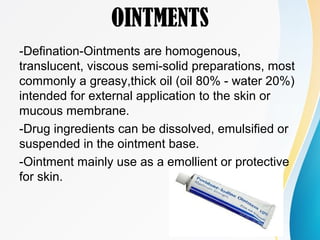
-Defination-Ointments are homogenous,
translucent, viscous semi-solid preparations, most
commonly a greasy,thick oil (oil 80% - water 20%)
intended for external application to the skin or
mucous membrane.
-Drug ingredients can be dissolved, emulsified or
suspended in the ointment base.
-Ointment mainly use as a emollient or protective
for skin.
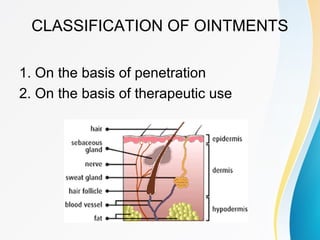
CLASSIFICATION OF OINTMENTS
1. On the basis of penetration
2. On the basis of therapeutic use
1. ON THE BASIS OF PENITRATION
1. Epidermic ointments- These ointments are intended to produce
their action on the surface of the skin and produce local effect, they
are not absorbed. They acts as protectives, antiseptics and
parasiticides.
2.Endodermic ointments-These ointments are intended to release
the medicaments that penetrate into the skin. They are partially
absorbed and acts as emollients, stimulants and local irritants.
3. Diadermic ointments-These ointments are intended to release the
medicaments that pass through the skin and produce systemic
effects.
2. ON THE BASIS OF THERAPEUTIC USE
1. Antibiotic Ointments- e.g Bacitracin
2. Antifungal Ointments- e.g Benzoic acid
3. Anti-inflammatory Ointments- e.g Fluocinolone
acetonide
4. Antipruritic Ointments- e.g Benzocaine
5. Astringent ointments- e.g Zinc oxide and calamine
6. Antieczematous ointments- e.g Hydricortisone or
salicylic acid
7. Keratolytic ointmemts- e.g Resorcinol,salicylic acid,
sulphur.
8. Counter-irritant Ointments- e.g Methyl salicylate
9. Antidandruff Ointments- e.g. Salicylic acid
10.Ointment used for psoriasis- e.g. Salicylic acid, coal tar
11.Parasiticide ointments- e.g. Benzyl benzoate, Sulphur.
12.Protective ointments- e.g. Calamine Zinc oxide.
OINTMENT BASES
• Serve as carrier or vehicle.
• Factors to be consider while selecting ointment
bases are-
- Desired action
- Nature of medicament to be incorporated
- Stability of ointment
•Properties of ideal ointment bases-
1. Inert, odourless,non-irritating and non-sensitizing.
2. Compatible with skin pH and with the incorporated drug.
3. Good solvent and/or emulsifying agent.
4. Emollient, protective, non-greasy and easily removable.
5. Release medicament readily at the site of application.
6. Pharmaceutically elegant and possess good stability.
7. It should not retard healing of wound.
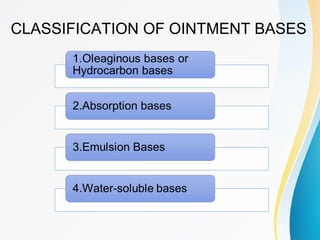
CLASSIFICATION OF OINTMENT BASES
1.OleaginOus bases (HydrOcarbOn
bases)
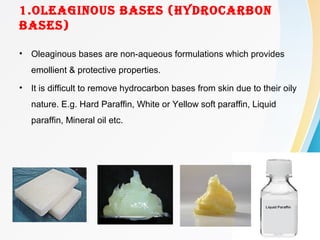
• Oleaginous bases are non-aqueous formulations which provides
emollient & protective properties.
• It is difficult to remove hydrocarbon bases from skin due to their oily
nature. E.g. Hard Paraffin, White or Yellow soft paraffin, Liquid
paraffin, Mineral oil etc.
I. Petrolatum (Soft Paraffin):
• It is purified mixture of semi-solid hydrocarbons obtained from
petroleum.
• There are two types of soft paraffin one is yellow & other is white
soft paraffin.
• White soft paraffin prepared by bleaching the yellow soft paraffin.
• The melting point of soft paraffin is 38 to 56 C.⁰
• White soft paraffin not be used in ophthalmic ointment preparations
because small amt of bleaching agents involved in that & they
causes irritation in the eye.
II. Hard Paraffin
• It is purified mixture of solid hydrocarbons & obtained
from petrolatum.
• It is colourless or white translucent, odorless, tasteless
wax like substance.
• It is used to harden or soften the ointment base.
III. Liquid Paraffin
• It consist of mixture of liquid hydrocarbons & obtained from
petroleum by distillation.
• It is also called white mineral oil or liquid petroleum.
• It is colourless, odourless, tasteless it is soluble in ether &
chloroform but its insoluble in water & alcohol.
• Now a days oleaginous bases are not used commonly because
They are greasy, so its difficult to remove from skin & clothing.
• They retain body heat which may produce an uncomfortable feeling
of warmth.
• They do not help in the absorption of medicaments.
2.ABSORPTION BASES
• In the absorption bases contains small amount of water
& they provide relatively less emollient properties than
hydrocarbon bases.
• These bases are generally anhydrous substances which
have the property of absorbing considerable quantity of
water but still retaining their ointment like consistency.
• They have 2 types :
1. Non-emulsified bases
2. Water in oil emulsion bases
1. NON-EmulSIfIEd BASES
Those bases absorb water & aqueous solution producing
W/O emulsion. e.g. Wool fat, Wool alcohol, Beeswax
etc..
2. WATER IN OIl EmulSION BASES:
Those bases have the capability of absorbing more
water & have the properties of non- emulsified bases.
e.g. Hydrous wool fat (Lanolin)
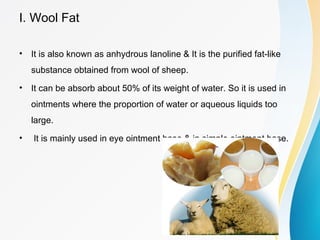
I. Wool Fat
• It is also known as anhydrous lanoline & It is the purified fat-like
substance obtained from wool of sheep.
• It can be absorb about 50% of its weight of water. So it is used in
ointments where the proportion of water or aqueous liquids too
large.
• It is mainly used in eye ointment base & in simple ointment base.
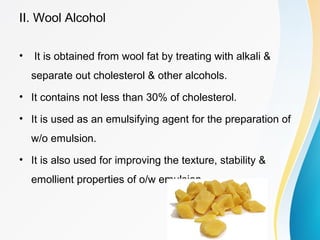
II. Wool Alcohol
• It is obtained from wool fat by treating with alkali &
separate out cholesterol & other alcohols.
• It contains not less than 30% of cholesterol.
• It is used as an emulsifying agent for the preparation of
w/o emulsion.
• It is also used for improving the texture, stability &
emollient properties of o/w emulsion.
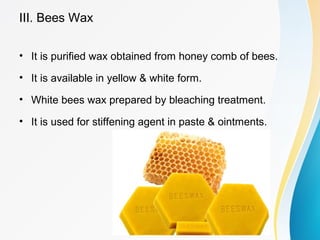
III. Bees Wax
• It is purified wax obtained from honey comb of bees.
• It is available in yellow & white form.
• White bees wax prepared by bleaching treatment.
• It is used for stiffening agent in paste & ointments.
ADVANTAGES OF ABSORPTION BASES
• Compatible with large no of medicament
• Absorbs large quantity of water or aqueous substances.
• Relatively heat stable
• Emulsified as well as unhydrous form can be used.
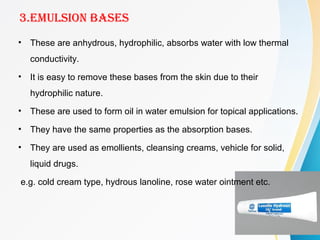
3.EMULSION BASES
• These are anhydrous, hydrophilic, absorbs water with low thermal
conductivity.
• It is easy to remove these bases from the skin due to their
hydrophilic nature.
• These are used to form oil in water emulsion for topical applications.
• They have the same properties as the absorption bases.
• They are used as emollients, cleansing creams, vehicle for solid,
liquid drugs.
e.g. cold cream type, hydrous lanoline, rose water ointment etc.
4.WATER SOLUBLE BASES
• In that bases does not contain oily substances & are called
greaseless bases & completely soluble in water.
• Those are prepared using mixtures of different molecular weights of
polyethylene glycol (Macrogols).
• PEG are mixture of polycondensation product of ethylene oxide &
water.
• Lower M.W of this polymers (200,400 & 600g/mol) are liquids & the
average M.W increases of this polymers changes from liq. To a
waxy solid but not greater than 1000g/mol.
• Tragacanth, gelatin, pectin, cellulose derivatives, bentonite , sodium
alginate are also used as water soluble bases.

Semisolid dosage forms (Ointments)

  • 1.
  • 2.
    WHAT ARE SEMISOLIDDOSAGE FORMS? • External application. Example- Ointment, Pastes and Jellies. • Semi solid dosage forms are the topical dosage form used for the therapeutic, protective or cosmetic function.
  • 3.
    OINTMENTS -Defination-Ointments are homogenous, translucent,viscous semi-solid preparations, most commonly a greasy,thick oil (oil 80% - water 20%) intended for external application to the skin or mucous membrane. -Drug ingredients can be dissolved, emulsified or suspended in the ointment base. -Ointment mainly use as a emollient or protective for skin.
  • 4.
    CLASSIFICATION OF OINTMENTS 1.On the basis of penetration 2. On the basis of therapeutic use
  • 5.
    1. ON THEBASIS OF PENITRATION 1. Epidermic ointments- These ointments are intended to produce their action on the surface of the skin and produce local effect, they are not absorbed. They acts as protectives, antiseptics and parasiticides. 2.Endodermic ointments-These ointments are intended to release the medicaments that penetrate into the skin. They are partially absorbed and acts as emollients, stimulants and local irritants. 3. Diadermic ointments-These ointments are intended to release the medicaments that pass through the skin and produce systemic effects.
  • 6.
    2. ON THEBASIS OF THERAPEUTIC USE 1. Antibiotic Ointments- e.g Bacitracin 2. Antifungal Ointments- e.g Benzoic acid 3. Anti-inflammatory Ointments- e.g Fluocinolone acetonide 4. Antipruritic Ointments- e.g Benzocaine 5. Astringent ointments- e.g Zinc oxide and calamine 6. Antieczematous ointments- e.g Hydricortisone or salicylic acid
  • 7.
    7. Keratolytic ointmemts-e.g Resorcinol,salicylic acid, sulphur. 8. Counter-irritant Ointments- e.g Methyl salicylate 9. Antidandruff Ointments- e.g. Salicylic acid 10.Ointment used for psoriasis- e.g. Salicylic acid, coal tar 11.Parasiticide ointments- e.g. Benzyl benzoate, Sulphur. 12.Protective ointments- e.g. Calamine Zinc oxide.
  • 9.
    OINTMENT BASES • Serveas carrier or vehicle. • Factors to be consider while selecting ointment bases are- - Desired action - Nature of medicament to be incorporated - Stability of ointment
  • 10.
    •Properties of idealointment bases- 1. Inert, odourless,non-irritating and non-sensitizing. 2. Compatible with skin pH and with the incorporated drug. 3. Good solvent and/or emulsifying agent. 4. Emollient, protective, non-greasy and easily removable. 5. Release medicament readily at the site of application. 6. Pharmaceutically elegant and possess good stability. 7. It should not retard healing of wound.
  • 11.
  • 12.
    1.OleaginOus bases (HydrOcarbOn bases) •Oleaginous bases are non-aqueous formulations which provides emollient & protective properties. • It is difficult to remove hydrocarbon bases from skin due to their oily nature. E.g. Hard Paraffin, White or Yellow soft paraffin, Liquid paraffin, Mineral oil etc.
  • 13.
    I. Petrolatum (SoftParaffin): • It is purified mixture of semi-solid hydrocarbons obtained from petroleum. • There are two types of soft paraffin one is yellow & other is white soft paraffin. • White soft paraffin prepared by bleaching the yellow soft paraffin. • The melting point of soft paraffin is 38 to 56 C.⁰ • White soft paraffin not be used in ophthalmic ointment preparations because small amt of bleaching agents involved in that & they causes irritation in the eye.
  • 14.
    II. Hard Paraffin •It is purified mixture of solid hydrocarbons & obtained from petrolatum. • It is colourless or white translucent, odorless, tasteless wax like substance. • It is used to harden or soften the ointment base.
  • 15.
    III. Liquid Paraffin •It consist of mixture of liquid hydrocarbons & obtained from petroleum by distillation. • It is also called white mineral oil or liquid petroleum. • It is colourless, odourless, tasteless it is soluble in ether & chloroform but its insoluble in water & alcohol. • Now a days oleaginous bases are not used commonly because They are greasy, so its difficult to remove from skin & clothing. • They retain body heat which may produce an uncomfortable feeling of warmth. • They do not help in the absorption of medicaments.
  • 16.
    2.ABSORPTION BASES • Inthe absorption bases contains small amount of water & they provide relatively less emollient properties than hydrocarbon bases. • These bases are generally anhydrous substances which have the property of absorbing considerable quantity of water but still retaining their ointment like consistency. • They have 2 types : 1. Non-emulsified bases 2. Water in oil emulsion bases
  • 17.
    1. NON-EmulSIfIEd BASES Thosebases absorb water & aqueous solution producing W/O emulsion. e.g. Wool fat, Wool alcohol, Beeswax etc.. 2. WATER IN OIl EmulSION BASES: Those bases have the capability of absorbing more water & have the properties of non- emulsified bases. e.g. Hydrous wool fat (Lanolin)
  • 18.
    I. Wool Fat •It is also known as anhydrous lanoline & It is the purified fat-like substance obtained from wool of sheep. • It can be absorb about 50% of its weight of water. So it is used in ointments where the proportion of water or aqueous liquids too large. • It is mainly used in eye ointment base & in simple ointment base.
  • 19.
    II. Wool Alcohol •It is obtained from wool fat by treating with alkali & separate out cholesterol & other alcohols. • It contains not less than 30% of cholesterol. • It is used as an emulsifying agent for the preparation of w/o emulsion. • It is also used for improving the texture, stability & emollient properties of o/w emulsion.
  • 20.
    III. Bees Wax •It is purified wax obtained from honey comb of bees. • It is available in yellow & white form. • White bees wax prepared by bleaching treatment. • It is used for stiffening agent in paste & ointments.
  • 21.
    ADVANTAGES OF ABSORPTIONBASES • Compatible with large no of medicament • Absorbs large quantity of water or aqueous substances. • Relatively heat stable • Emulsified as well as unhydrous form can be used.
  • 22.
    3.EMULSION BASES • Theseare anhydrous, hydrophilic, absorbs water with low thermal conductivity. • It is easy to remove these bases from the skin due to their hydrophilic nature. • These are used to form oil in water emulsion for topical applications. • They have the same properties as the absorption bases. • They are used as emollients, cleansing creams, vehicle for solid, liquid drugs. e.g. cold cream type, hydrous lanoline, rose water ointment etc.
  • 23.
    4.WATER SOLUBLE BASES •In that bases does not contain oily substances & are called greaseless bases & completely soluble in water. • Those are prepared using mixtures of different molecular weights of polyethylene glycol (Macrogols). • PEG are mixture of polycondensation product of ethylene oxide & water. • Lower M.W of this polymers (200,400 & 600g/mol) are liquids & the average M.W increases of this polymers changes from liq. To a waxy solid but not greater than 1000g/mol. • Tragacanth, gelatin, pectin, cellulose derivatives, bentonite , sodium alginate are also used as water soluble bases.