MADE BY: KOMAL DEVI
ROLL.NO: 35
Viscosity : Flow property of a liquid is Expressesd in terms of viscosity. And the agents which
are used to build or promote the viscosity are known as viscosity Builders.viscosity builders
are of various types such as given in classification:
1) Natural Gums: Acacia, Tragacanth, Alginic acid, Guar Gum.
2)Cellulose derivatives: carboxy methyl cellulose, methyl cellulose, ethyl cellulose.
3) synthetic polymers:cabomer, polyvinyl alcohol.
4) Microcrystalline cellulose
5) Chitosan
6) clays: magnessium aluminium silicate, bentonite.
>Natural Gums: They are polysaccharides of natural origin. They are capable of causing a
large viscosity increase in solution ,even at small concentrations
They may be non- ionic or anionic.
Natural gums can be classified according to their origin:
1) Natural gums obtained from seaweeds: agar, carrageenan,sodium alginate.
2) 2)Natural gums obtained from non-marine botanical sources: gum
arabica,gum tragacantha,locust bean gum.
3)Natural gums produced by bacterial fermentation:gellan gum, xanthan gum.
>Cellulose derivatives: cellulose is one of the most widely used starting material
for manufacturing of modified natural polymers. Cellulose ethers with methyl
subsitution generally form a gel at a elevated temperature. Gel formation is
reversed when temperature is reduced.
>4 Microcrystalline cellulose(MCC): Dispersions of MCC do not have viscosities
that are significantly greater than that of water. However, combinations of CMC,
MC, OF HPMC are used to thicken aqueous solutions.
> Chitosan: it is a natural biopolymer derived from the outer shell of
crustaceans.it is a weak cationic polysaccharide, biocompatible,
biodegredable, non-toxic. It carries a positive charge (at Ph below
6.5)and thus attracted to a variety of biologiocal tissues and surfaces
that are negatively charged.
>synthetic polymers: solutions of carbomers are very pseudoplastic and
lotions.carbomer 934P is the official name given to one member of
acrylic polymers. Manufactured under the trade carbopol 934P , It is
used as a thickening agent in a variety of pharmaceutical and cotsmetic
products .
>Clays: the gels are formed at about 5% conc. They exhibit plastic flow. It
functions well as a suspending agent.it is superior suspending agent
because it prevents caking without affecting pourability or spreadability
of suspension.
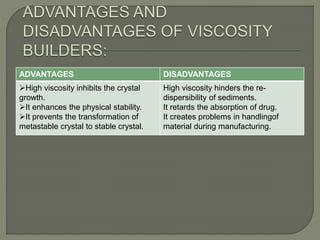
ADVANTAGES DISADVANTAGES
High viscosity inhibits the crystal
growth.
It enhances the physical stability.
It prevents the transformation of
metastable crystal to stable crystal.
High viscosity hinders the re-
dispersibility of sediments.
It retards the absorption of drug.
It creates problems in handlingof
material during manufacturing.
Should produce a structured vehicle.
Should exhibit yield stress.
Should be compatible with other
excepients.
Should be non-toxic.
Viscosity should not be altered by
temperature or on aging.
Should have high viscosity at negligible
shear during storage and low viscosity at
high shearing rates during pouring.
YOU.....

Herbal drug technology

  • 1.
    MADE BY: KOMALDEVI ROLL.NO: 35
  • 2.
    Viscosity : Flowproperty of a liquid is Expressesd in terms of viscosity. And the agents which are used to build or promote the viscosity are known as viscosity Builders.viscosity builders are of various types such as given in classification: 1) Natural Gums: Acacia, Tragacanth, Alginic acid, Guar Gum. 2)Cellulose derivatives: carboxy methyl cellulose, methyl cellulose, ethyl cellulose. 3) synthetic polymers:cabomer, polyvinyl alcohol. 4) Microcrystalline cellulose 5) Chitosan 6) clays: magnessium aluminium silicate, bentonite. >Natural Gums: They are polysaccharides of natural origin. They are capable of causing a large viscosity increase in solution ,even at small concentrations They may be non- ionic or anionic. Natural gums can be classified according to their origin: 1) Natural gums obtained from seaweeds: agar, carrageenan,sodium alginate. 2) 2)Natural gums obtained from non-marine botanical sources: gum arabica,gum tragacantha,locust bean gum. 3)Natural gums produced by bacterial fermentation:gellan gum, xanthan gum. >Cellulose derivatives: cellulose is one of the most widely used starting material for manufacturing of modified natural polymers. Cellulose ethers with methyl subsitution generally form a gel at a elevated temperature. Gel formation is reversed when temperature is reduced. >4 Microcrystalline cellulose(MCC): Dispersions of MCC do not have viscosities that are significantly greater than that of water. However, combinations of CMC, MC, OF HPMC are used to thicken aqueous solutions.
  • 3.
    > Chitosan: itis a natural biopolymer derived from the outer shell of crustaceans.it is a weak cationic polysaccharide, biocompatible, biodegredable, non-toxic. It carries a positive charge (at Ph below 6.5)and thus attracted to a variety of biologiocal tissues and surfaces that are negatively charged. >synthetic polymers: solutions of carbomers are very pseudoplastic and lotions.carbomer 934P is the official name given to one member of acrylic polymers. Manufactured under the trade carbopol 934P , It is used as a thickening agent in a variety of pharmaceutical and cotsmetic products . >Clays: the gels are formed at about 5% conc. They exhibit plastic flow. It functions well as a suspending agent.it is superior suspending agent because it prevents caking without affecting pourability or spreadability of suspension.
  • 4.
    ADVANTAGES DISADVANTAGES High viscosityinhibits the crystal growth. It enhances the physical stability. It prevents the transformation of metastable crystal to stable crystal. High viscosity hinders the re- dispersibility of sediments. It retards the absorption of drug. It creates problems in handlingof material during manufacturing.
  • 5.
    Should produce astructured vehicle. Should exhibit yield stress. Should be compatible with other excepients. Should be non-toxic. Viscosity should not be altered by temperature or on aging. Should have high viscosity at negligible shear during storage and low viscosity at high shearing rates during pouring.
  • 6.