Download as PDF, PPTX




![31
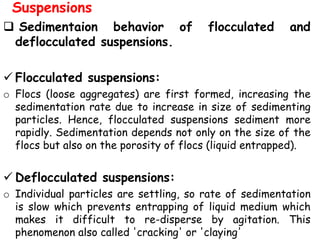
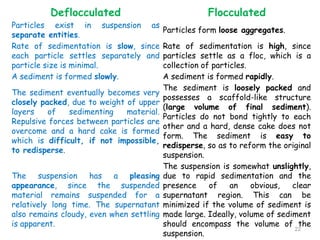
flocculation versus caking (claying)
They are determined by forces of
attraction (van der Waals) versus forces
of electrostatic repulsion.
Deflocculated:
– repulsion > attraction
– affected by [electrolytes]
Flocculated:
– attraction > repulsion](https://image.slidesharecdn.com/pharmaceutics-suspension-151213073408/85/Pharmaceutics-suspension-31-320.jpg)


![• WettingAgents
II. Hydrocolloids
• Hydrophilic colloids coat hydrophobic drug particles
in one or more than one layer. This will provide
hydrophillicity to drug particles and facilitate
wetting.
• They cause deflocculation of suspension because
force of attraction is declined.
• Examples:
- Polymers: [gums likes acacia (arabic gum), tragacanth, xanthan
gum, guar gum, polysaccharides like pectin, alginates , Cellulose
derivatives]
- Proteins: egg yolk, gelatin
- Inorganic hyrocolloids: betonite, hectorite, Veegum, attapulgite,
colloidal silicon dioxide.](https://image.slidesharecdn.com/pharmaceutics-suspension-151213073408/85/Pharmaceutics-suspension-43-320.jpg)


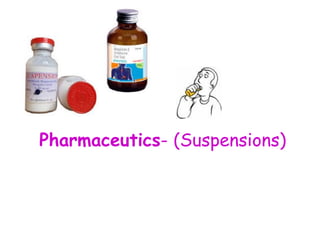
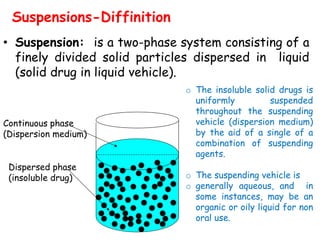
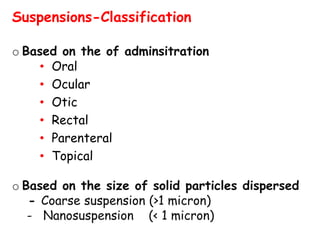
This document discusses suspensions, which are two-phase systems consisting of finely divided solid particles dispersed in a liquid vehicle. Suspensions can be classified based on administration route or particle size. They are useful for drugs with low solubility and can improve stability, release properties, and bioavailability compared to other dosage forms. However, suspensions are also prone to physical instability issues like sedimentation. The document outlines factors that affect sedimentation and strategies to improve suspension stability such as controlling particle size, viscosity, surface charge, and use of surfactants or flocculating agents. Wetting agents are also discussed which help disperse solid particles in the liquid vehicle by reducing surface tension.


