Dr. Sonia Alqadi
BZU, 2015-2016.
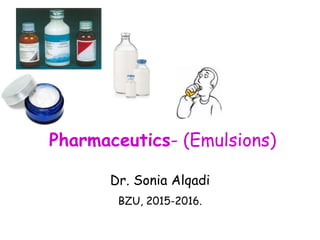
Pharmaceutics- (Emulsions)
Emulsion
A: Two immisicble liquids, not emulsified; B: An emulsion of Phase
B dispersed in Phase A; C: The unstable emulsion progressively
separates; D: The (purple) surfactant positions itself on the
interfaces between Phase A and Phase B, stabilizing the emulsion
An emulsion is a thermodynamically unstable system consisting of
at least two immiscible liquid phases, one of which is dispersed as
globules in the other liquid phase, stabilized by the presence of
an emulsifying agent.
Emulsion types
 Types
• Oil-in-water (o/w)
• Water-in-oil (w/o)
• Oil-in-water-in-oil (o/w/o)
• Water-in-oil-in-water (w/o/w)
 Pharmaceutical emulsions an be divided according to
droplet size:
Microemulsions Nanoemulsions
 Determination of o/w or w/o
• Dye solubility test (e.g., methylene blue)
• Dilution of emulsions
• Conductivity measurement
Emulsion: Composition
Interfacial layer (emulsifying
agent) . Essential to stabilizing
the emulsion
Oil Phase (dispersed medium).
Limited effects on the
properties of the emulsion
Aqueous Phase (contineous
medium). Aqueous chemical
reactions affect the interface
and hence emulsion stability
Example: o/w emulsion
Pharmaceutical emulsions.
 Applications of emulsions:
- Oral emulsions: o/w (liquid)
- External emulsions: liniments, lotions (liquid)
Creams (semi-solid)
- Parenteral emulsions: o/w (parenteral nutrition)
o/w or w/o intramuscular.
Emulsions
The characteristics of an acceptable pharmceutical
emulsion include:.
Physical stability (no phase separation).
The flow properties of the emulsion should enable the
formulation to be easily removed from the container.
Furthermore, if the formulation is designed for external
application to the skin, for example, the formulation must be
easily spread over the affected area.
The formulation must be aesthetically and texturally
pleasing. If the emulsion is designed for oral administration,
a suitable flavourant must be included, whereas if emulsions
are to be externally applied, they must have the correct
"feel˝ (termed texture).
Emulsions-Advantages
 Pharmaceutical emulsions may be used to deliver drugs
with low aqueous solubility. For instance, in o/w emulsions,
the therapeutic agent is dissolved in the internal oil phase.
Following oral administration, the oil droplet containing the
drug may be then absorbed using the normal absorption
mechanisms of oils.
Emulsions may be used to mask the unpleasant taste of a
therapeutic agent, by dissolving it in the internal phase of an
o/w emulsion. The external phase (water) may be then
formulated to contain the appropriate sweetening and
flavoring agents.
Emulsions are employed for total parenteral nutrition.
Emulsions-Advantages
Pharmaceutical emulsions may be used to administer oils
having a therapeutic effect. For example, the cathartic
effect of oils (e.g., liquid paraffin) is enhanced following
administration to the patient as droplets within an o/w
emulsion. The taste of the oil may be masked using a
sweetening and flavouring agent.
If the therapeutic agent is irritant when applied topically,
irritancy may be reduced by formulating it within the
internal phase of an o/w emulsion.
Pharmaceutical emulsions may be employed to deliver drugs
to patients who have difficulty to swallow solid dosage
forms.
Emulsions-Disadvantages
Pharmaceutical emulsions are thermodynamically unstable
and, therefore must be correctly formulated to avoid the
separation of the two phases (emulsion stabilization) .
Pharmaceutical emulsions are sometimes difficult to
manufacture.
Emulsifier versus Emulsion
• An emulsion is a mixture of oil and water
• An emulsifier is a specific molecule able to bind the two ends
so they ‘stick together’ (i.e. the oil and water bind) and,
consequently stabilizes the emulsion.
• E.g. Lecithin is an emulsifier which binds the emulsion of water
and oil
Pharmaceutically acceptable emulsifiers must also :
 be stable .
 be compatible with other ingredients .
 be non – toxic .
 possess little odor , taste , or color.
 not interfere with the stability of
efficacy of the active agent .
Theory of emulsification
Change from A to B will significantly increase of the
surface area of phase.
e.g., if 1 cm3 of mineral oil is dispersed into globules
having diameter of 0.01 mm in 1 cm3 of water, how much
will be the surface area increased.
The surface area will become 600 m2 (greater than a
basketball court); the surface free energy will increase by
8 calories. Therefore, emulsions are thermodynamically
unstable, and the droplets have the tendency to coalesce.
Emulsifying agents are needed to decrease the surface
tension and to stabilize the droplets.
Classification of emulsifying agents
I. Surface-active agents
(monomolecular film)
II. Hydrophilic colloids
(multimolecular film)
III. Finely divided solid
particles (Particulate film)
I. Surface-active agents: Monomolecular
adsorption
Interfacial film formation: The subdivision of the one of the phases (either the
oil or water phase) into small droplets (globules) results in a large increase in the
surface area and, hence interfacial free energy of the system. The system is
thus thermodynamically unstable which means that the resulting spherical
globules tend to coalesce, causing phase separation which represents the state
of minimum surface free energy.
The adsorption of surface-active agents (surfactants) at the globule interface
will lower the interfacial tension (air displacement). Ionic surfactants with
charged heads (anionic or cationic) will create and an electrostatic barrier
around globules (electrostatic repulsion that resist coalescence of globules),
whilst non-ionic surfactants stabilize emulsions against globules coagulation by
steric stabilization.
Surface-active agents (Surfactants)
• Surfactants are molecules that have two )different
ends:
– A hydrophilic end (water-loving) that forms chemical
bonds with water but not with oils
– A hydrophobic end (water-hating) that forms
chemical bonds with oils but not with water.
• The hydrophilic 'head' dissolves in the water and the
hydrophobic 'tail' dissolves in the oil
• In this way, the water and oil droplets become unable to
separate out – the mixture formed is called an emulsion
glyceryl laurate
Types of
surfactants
Sodium lauryl sulphate
Surfactants
Anionic
surfactants
cationic
surfactants
Amphoteric
surfactants
Polymeric
surfactants
Non-ionic
surfactants
They also have antimicrobial
properties & are the most toxic and
irritant, as compard with other
surfactants e.g., cetrimide
(cetyltrimethyl ammonium bromide)
Ionic
surfactants
are rritant
& toxic to
the mucous
membranes
Least toxic
surfactants
Based on:
• A hydrophobic moiety with 12-18
carbon atoms. The starting aterial
may be a fatty acid or sorbitan.
• A hydrophilic moiety composed of
an alcohol (-OH) and/or ethylene
oxide groups linked together to
form long polyoxyethylene chains.
E.g., Glyceryl
monostearate
& glyceryl
monooleate
They are polyxamers (also known as
pluronics®) which are a series of
neutral synthetic polyoxyethylene-
polyoxypropylene block co-polymers.
E.g., poloxamer 188 (Pluronic ® F68).
Non-ionic surfactants
• Polyoxyethylene glycol ethers (macrogols): used as both o/w and
w/o emulsifiers. Their water or oil solubility can be controlled by
alterin both the length of the hydrocarbon chain and the length of
the polyoxyethylene (POE) chain.
• Sorbitan esters (commerially known as Spans®): produced by
esterifiation of one or more of the hydroxyl groups of sorbitan
with a fatty acid. E.g., sorbitan monolaurate (Span 20), sorbitan
monopalmitate (Span 40), sorbitan monostearate (Span 60),
sorbitan monooleate (Span 80).
• Polyoxyethylene sorbitan ester (polysorbates; also known as
Tweens®): They are more hydrophilic polyoxyethylene derivatives
of sorbitan esters. E.g., polyethylene 20 sorbitan monolaurate
(polysorbate 20, Tween 20), polyethylene 20 sorbitan
monopalmitate (polysorbate 40, tween 40), polyethylene 20 sorbitan
monostearate (polysorbate 60, Tween 60), polyethylene 20 sorbitan
monooleate (polysorbate 80, Tween 80).
Non-ionic surfactants
II. Hydrocolloids: Multi-molecular adsorption
and film formation
• Generally, they exhibit little surface activity.
• They adsorb at the oil/water interface, providing a
protective sheath in the form of multilayers around
the droplets. These multilayers are viscoelastic (gel-
like) that resist rupture and, hence form mechanical
barriers to coalescence.
• They also swell to increase the viscosity of the
system (so that droplets are less likely to merge).
• Some of them (e.g., acacia, protein emulsifiers) have
ionizable groups (e.g., amino & carboxylic acid groups)
that impart a charge to the dispersed droplets, thus
providing electrostatic repulsion as an additional
barrier to coalescence.
II. Multi-molecular adsorption and film formation
1. Polysaccharides
Gums: acacia,
tragacanth
Alginate & cellulose
derivatives
• They are susceptible to degradation e.g., depolymerization.
• Provide a good growth medium for microorganisms Preservatives
must be used.
• They do not lower interfacial tension but stablize emulsions by the
formation of thick multi-layered films.
• They also act as viscosity modifiers, increasing the consistency of
the external phase Inhibit creaming & coalescence
 Classification of hydrocolloids
2. Phospholipids (lecithins)
Animal: egg yolk Plant: soya bean oil.
• They are extensively used as o/w emulsifiers in parenteral an oral
liquid emulsions.
• They are complex mixtures of neutral (e.g., phosphatidylcholine,
phosphatidylethanolamine) and negatively charged phospholipids
(e.g., phosphatidylserine, phosphatidylglycerol & phosphatidic acid).
• They stabilize emulsions by increasing the surface charge of
droplets and formation of interfacial liquid crystalline phases.
 Classification of hydrocolloids
II. Multi-molecular adsorption and film formation
3. Steroidal emulsifiers
Animal: wool fat
(lanolin), beewax
& cholesterol.
 Classification of hydrocolloids
• They are used as complex mixtures in dermatological emulsions (w/o)
and for their emollient effect.
• They are prone to oxidation and hydrolysis Anti-oxidants are
needed in the emulsion.
• Some times they are modified to produce o/w emulsions e.g., a water
soluble lanolin derivative (a product of lanolin reaction with ethylene
oxide).
II. Multi-molecular adsorption and film formation
4. Others
Proteins: gelatin, casein Synthetic agents, e.g.,
carbomers (PEG
and acrylic acid)
 Classification of hydrocolloids
II. Multi-molecular adsorption and film formation
III. Solid particle adsorption
• Description: Finely divided solid particles that are
wetted to some degree by both oil and water can act
as emulsifying agents. This results from their being
concentrated at the interface, where they produce a
particulate film around the dispersed droplets to
prevent coalescence.
• Example of agents:
• Bentonite (Al2O3.4SiO2.H2O), veegum (Magnesium
Aluminum Silicate), hectorite, magnesium hydroxide,
aluminum hydroxide and magnesium trisilicate: They
are preferentially wetted by water and hence
stabilize o/w emulsions.
• Carbon black and talc are preferentially wetted by oil
and thus stabilize w/o emulsions.
Emulsifier selection: Hydrophile-lipophile balance
(HLB)
 The solubility characteristics of the emulsifier define the
type of emulsion formed. Therefore, polymers and
surfactants that are predominantly hydrophilic will form
o/w emulsions, whereas predominantly hydrophobic
surfactants will form w/o emulsions.
 Surfactants contain both hydrophilic and lipophilic groups
and, therefore it is the relative contribution of such
groups that determine wheather the surfactant is
predominantly hydrophilic or lipophilic (hydrophobic).
 The contribution of these groups to the overall solubility
is commonly referred to as the HLB.
 HLB: a ratio scale that assigns a number to a surfactant,
based on the contribution of the individual groups of the
surfactant molecule. This number can be then used when
selecting surfactants for the formulation of o/w or w/o
emulsions.
Emulsifier selection: Hydrophile-lipophile balance
(HLB)
 So, HLB expresses the strength of the polar portion
relative to the non-polar portion of the molecule.
Accordingly, the higher the higher the HLB number, the
more hydrophilic or water soluble the surfactant, and the
lower number the more lipophilic (oil soluble) the
surfactant.
 HLB value of a surfactant can be estimated by Griffin's
method for as follows:
Where Mh is the molecular mass of the hydrophilic portion of the
molecule, and M is the molecular mass of the whole molecule,
giving a result on a scale of 0 to 50.
The HLB value can be used to predict
the surfactant properties of a
molecule:
 Surfactants exhibiting HLB values
from 3-6 are used to produce w/o
emulsions and are therefore termed
w/o emulsifiers e.g., Span 80 (HLB
4.3).
 Surfactants exhibiting HLB from 8-
16 are used to produce o/w emulsions
and, thus termed o/w emulsifiers e.g.,
Tween 65 (HLB 10.5).
 HLB values of ionic surfactants are
greater than 16 (up to 50).
Emulsifier selection: Hydrophile-lipophile balance
(HLB)
 A mixture of surfactants give more stable emulsions
than when singly used.
 The HLB value of the emulsifier blend giving a more
stable emulsion is known as “the required HLB value” for
that oil phase.
 The HLB of a mixture of surfactants, consisting of
fraction x of emulsifier A and (1-x) of emulsifier B, can
be calculated as follows:
HLBmix = xHLBA + (1-x)HLBB
Emulsifier selection: Hydrophile-lipophile
balance (HLB)
Emulsifier selection: Hydrophile-lipophile
balance (HLB)
 Stability of emulsions:
A stable emulsion may be defined as a system in which
globues retain their initial character (retain their diameter)
and remain uniformly distributed throughout the contineous
phase.
1.1. Flocculation: On standing, neighbouring globules of the
dispersed phase come closer to each other and form colonies
in the contineous phase (due to the interaction of attracrive
and repulsive forces). However, the droplets may be
redispersed by shaking and may lead to coalescence.
 The extent of flocculation depends on:
- Globules size distribution
- Charge on globules surface
- Viscosity of external medium (contineous phase)
Flocculation and Coalescence
FLOCCULATION
COALESCENCE
 Stability of emulsions:
1.2. Creaming:
o On standing, creaming is the concentration of globules at the
top or bottom of emulsion (due to density differencs between
the two phases).
o Globules move either upwards (o/w emulsion) or sink
downwards (w/o emulsion) leading to creaming.
o It can be observed by a differnce in color shade of both
layers, and in both cases, emulsion can be easily redispersed by
shaking.
o As in flocculation, droplets do not coalesce and can be
redispersed by gentle shaking.
o Creaming is however undesirable pharmaceutically
beacuse:
1. Increased possibility of coalescence of droplets
2. Creamed emulsion is inelegant
3. Risk of incorrect dose if not skaken enough.
 Stability of emulsions:
1.2. Creaming:
 Factors affecting creaming are best described by Stoke’s
law.
 Creaming can be reduced by:
1. Reducing globule size by homogenization
2. Increasing viscosity of dispersion medium
3. Reducing the difference in density.
 Stability of emulsions:
1.3. Coalescence:
o Is followed by the creaming stage wherein droplets merge
froming larger droplets (irreversible process). This
process continues until the emulsion breaks (cracks).
o In this process, the emulsifier film around globules is
destroyed to a certain extent.
o This step is recongized by increased size but reduced
number of globules.
o Coalescence is observed due to:
- Insufficient amount of the emulsifying agent.
- Altered partitioning of the emulsifier.
- Incompatibilities between emulsifiers.
The major fact preventing
coalescence is the mechanical
strength of the interfacial film.
 Stability of emulsions:
1.4. Cracking (breaking):
o It is indicated by complete separation of oil and
the aqueous phase.
o It is an irreversible process that simple mixing
fails to resuspend globules into a uniform
emulsion.
o In breaking, the protective sheath around
globules is completely destroyed.
 Stability of emulsions:
1.4. Cracking (breaking)
Factors that cause emulsion cracking:
o The addition of a chemical that is incompatible with the
emulsifier e.g., addition of a cationic surfactant to an
emulsion stabilized with an anionic surfactant; addition of
electrolytes to emulsion stabilized with opposite ionic
surfactants.
o Bacterial growth: Protein and polysaccharide emulsifiers
are excellent media for bacterial growth.
o Temperature fluctuations: Protein emulsfifiers may be
denatured and the solubility of non-ionic surfactants
change with a rise in temperature (heating above 70C
destroys most emulsifiers). Freezing will also crack
emulsion because the ice crystals formd distrup the
interfacial film around droplets.
 Stability of emulsions:
1.5. Phase inversion:
o This involves the change of emulsion type from
o/w to w/o and viceversa.
o When we intend to prepare an o/w emulsion and
if the final emulsion turns out to be w/o, it can
be termed as a sign of instability.
 Stability of emulsions:
1.5. Phase inversion
Reasons of phase inversion:
• Increasing the dispersed phase concentration above the
accepted value: the most suitable range of dispersed phase
concentration is 30-60% (o/w 74%, w/o 40%).
• Adding substances that alter the solubility of the emulsifier
(e.g., precipitation of hydrophilic colloids in the presence of
alcohol).
• Suppression of ionization for ionic surfactants by adding
subbstances with opposite charges (e.g., addition of CaCl2 into
o/w emulsion formed by sodium stearate can be inverted to
w/o).
• Phase volume ratio.
• Temperature of the system: Temperature of o/w makes the
emulsifier more hydrophobic and the emulsion may invert to
w/o (e.g., temperature-induced breakage of H-bonds of polysorbates, which
are responsible for hydrophilicity, will lower HLB value).
 Physical instability of emulsions:
Rate of coalescence, which is a measure of emulsion
stability, depends on:
(a) Physical nature of the interfacial surfactant
film
(b) Electrical or steric barrier
(c) Viscosity of the continuous phase
Viscosity may be increased by adding natural or synthetic
thickening agents
(d) Phase volume ratio
As volume of dispersed phase , stability of emulsion 
(eventually phase inversion can occur)
 Physical instability of emulsions:
(e) Size distribution of droplets
Emulsion with a fairly uniform size distribution is
more stable. On the other hand, controlling droplet
size of emulsions is very important especially when
emulsions are intended for parenteral
administration so that the formation of emboli can
be avoided.
(f) Temperature
 Temperature , usually emulsion stability 
 Temperature affects interfacial tension,
solubility of surfactant and viscosity of liquid.
Formulation of emulsions
 When formulating a pharmaceutical emulsion, the choice of
oil, emulsifier, and emulsion type (w/o, o/w, or multiple
emulsions) will depend on the route of administration and
ultimate therapeutic use.
Emulsion components
Oil
phase
Aqueous
phase
Emulsifier
Additives/excipients:
preservatives, anti-oxidants,
humectants (in creams), falvorants
& sweteners (in oral emulsions).
Vehicle
Aqueous and oil phases are formulated separately
Formulation of emulsions
Oil phase
External emulsions
e.g., liquid paraffin,
soft or hard
paraffin, turpentine
oil, silicone oils.
Internal emulsions
e.g., liquid
paraffin, castor
oil, fis liver oil,
arachis oil.
Parenteral
emulsions e.g.,
purified mineral
oil (for IM),
purified vegetable
oil (for IV) like
soya bean &
safflower,
coconut oils.
 Selection of the oil phase depends on:
- The desired physical properties
of the emulsion
- The miscibility of the oil and aqueous phase.
- The solubility of drug (if present in the oil
phase)
- The desired consistency of the final emulsion.
Formulation of emulsions
 Prolems with oils used in emulsions:
- Some of them, particularly unsaturated oils of vegetable
origin, are liable to auto-oxidation and become rancid.
Additives/excipients
Preservatives e.g.,
phenoxyethanol, benzoic
acid, parabenzoates.
• Preservatives should be in
aqueous
phase.
•They must not bind to other
components of the emulsion.
Anti-oxidants: added to
prevent oxidation of oil,
emulsifier and probably the drug
during storage e.g., Butylated
hydroxyanisole, butylated
hydroxytoluene (up to 0.2%),
alkyl gallates (0.001-0.1%), alpha
tocopherol.
Humectants: often added to
dermatological emulsions e.g.,
glycerol, propylene glycol,
sorbitol (up to 5%).
Important message:
The type of emulsifiers used dictate the
stability and type of emulsion produced.

Pharmaceutics - emulsions

  • 1.
    Dr. Sonia Alqadi BZU,2015-2016. Pharmaceutics- (Emulsions)
  • 2.
    Emulsion A: Two immisicbleliquids, not emulsified; B: An emulsion of Phase B dispersed in Phase A; C: The unstable emulsion progressively separates; D: The (purple) surfactant positions itself on the interfaces between Phase A and Phase B, stabilizing the emulsion An emulsion is a thermodynamically unstable system consisting of at least two immiscible liquid phases, one of which is dispersed as globules in the other liquid phase, stabilized by the presence of an emulsifying agent.
  • 3.
    Emulsion types  Types •Oil-in-water (o/w) • Water-in-oil (w/o) • Oil-in-water-in-oil (o/w/o) • Water-in-oil-in-water (w/o/w)  Pharmaceutical emulsions an be divided according to droplet size: Microemulsions Nanoemulsions  Determination of o/w or w/o • Dye solubility test (e.g., methylene blue) • Dilution of emulsions • Conductivity measurement
  • 4.
    Emulsion: Composition Interfacial layer(emulsifying agent) . Essential to stabilizing the emulsion Oil Phase (dispersed medium). Limited effects on the properties of the emulsion Aqueous Phase (contineous medium). Aqueous chemical reactions affect the interface and hence emulsion stability Example: o/w emulsion
  • 5.
    Pharmaceutical emulsions.  Applicationsof emulsions: - Oral emulsions: o/w (liquid) - External emulsions: liniments, lotions (liquid) Creams (semi-solid) - Parenteral emulsions: o/w (parenteral nutrition) o/w or w/o intramuscular.
  • 6.
    Emulsions The characteristics ofan acceptable pharmceutical emulsion include:. Physical stability (no phase separation). The flow properties of the emulsion should enable the formulation to be easily removed from the container. Furthermore, if the formulation is designed for external application to the skin, for example, the formulation must be easily spread over the affected area. The formulation must be aesthetically and texturally pleasing. If the emulsion is designed for oral administration, a suitable flavourant must be included, whereas if emulsions are to be externally applied, they must have the correct "feel˝ (termed texture).
  • 7.
    Emulsions-Advantages  Pharmaceutical emulsionsmay be used to deliver drugs with low aqueous solubility. For instance, in o/w emulsions, the therapeutic agent is dissolved in the internal oil phase. Following oral administration, the oil droplet containing the drug may be then absorbed using the normal absorption mechanisms of oils. Emulsions may be used to mask the unpleasant taste of a therapeutic agent, by dissolving it in the internal phase of an o/w emulsion. The external phase (water) may be then formulated to contain the appropriate sweetening and flavoring agents. Emulsions are employed for total parenteral nutrition.
  • 8.
    Emulsions-Advantages Pharmaceutical emulsions maybe used to administer oils having a therapeutic effect. For example, the cathartic effect of oils (e.g., liquid paraffin) is enhanced following administration to the patient as droplets within an o/w emulsion. The taste of the oil may be masked using a sweetening and flavouring agent. If the therapeutic agent is irritant when applied topically, irritancy may be reduced by formulating it within the internal phase of an o/w emulsion. Pharmaceutical emulsions may be employed to deliver drugs to patients who have difficulty to swallow solid dosage forms.
  • 9.
    Emulsions-Disadvantages Pharmaceutical emulsions arethermodynamically unstable and, therefore must be correctly formulated to avoid the separation of the two phases (emulsion stabilization) . Pharmaceutical emulsions are sometimes difficult to manufacture.
  • 10.
    Emulsifier versus Emulsion •An emulsion is a mixture of oil and water • An emulsifier is a specific molecule able to bind the two ends so they ‘stick together’ (i.e. the oil and water bind) and, consequently stabilizes the emulsion. • E.g. Lecithin is an emulsifier which binds the emulsion of water and oil Pharmaceutically acceptable emulsifiers must also :  be stable .  be compatible with other ingredients .  be non – toxic .  possess little odor , taste , or color.  not interfere with the stability of efficacy of the active agent .
  • 11.
    Theory of emulsification Changefrom A to B will significantly increase of the surface area of phase. e.g., if 1 cm3 of mineral oil is dispersed into globules having diameter of 0.01 mm in 1 cm3 of water, how much will be the surface area increased. The surface area will become 600 m2 (greater than a basketball court); the surface free energy will increase by 8 calories. Therefore, emulsions are thermodynamically unstable, and the droplets have the tendency to coalesce. Emulsifying agents are needed to decrease the surface tension and to stabilize the droplets.
  • 12.
    Classification of emulsifyingagents I. Surface-active agents (monomolecular film) II. Hydrophilic colloids (multimolecular film) III. Finely divided solid particles (Particulate film)
  • 13.
    I. Surface-active agents:Monomolecular adsorption Interfacial film formation: The subdivision of the one of the phases (either the oil or water phase) into small droplets (globules) results in a large increase in the surface area and, hence interfacial free energy of the system. The system is thus thermodynamically unstable which means that the resulting spherical globules tend to coalesce, causing phase separation which represents the state of minimum surface free energy. The adsorption of surface-active agents (surfactants) at the globule interface will lower the interfacial tension (air displacement). Ionic surfactants with charged heads (anionic or cationic) will create and an electrostatic barrier around globules (electrostatic repulsion that resist coalescence of globules), whilst non-ionic surfactants stabilize emulsions against globules coagulation by steric stabilization.
  • 14.
    Surface-active agents (Surfactants) •Surfactants are molecules that have two )different ends: – A hydrophilic end (water-loving) that forms chemical bonds with water but not with oils – A hydrophobic end (water-hating) that forms chemical bonds with oils but not with water. • The hydrophilic 'head' dissolves in the water and the hydrophobic 'tail' dissolves in the oil • In this way, the water and oil droplets become unable to separate out – the mixture formed is called an emulsion
  • 18.
  • 19.
    Surfactants Anionic surfactants cationic surfactants Amphoteric surfactants Polymeric surfactants Non-ionic surfactants They also haveantimicrobial properties & are the most toxic and irritant, as compard with other surfactants e.g., cetrimide (cetyltrimethyl ammonium bromide) Ionic surfactants are rritant & toxic to the mucous membranes Least toxic surfactants Based on: • A hydrophobic moiety with 12-18 carbon atoms. The starting aterial may be a fatty acid or sorbitan. • A hydrophilic moiety composed of an alcohol (-OH) and/or ethylene oxide groups linked together to form long polyoxyethylene chains. E.g., Glyceryl monostearate & glyceryl monooleate They are polyxamers (also known as pluronics®) which are a series of neutral synthetic polyoxyethylene- polyoxypropylene block co-polymers. E.g., poloxamer 188 (Pluronic ® F68).
  • 20.
    Non-ionic surfactants • Polyoxyethyleneglycol ethers (macrogols): used as both o/w and w/o emulsifiers. Their water or oil solubility can be controlled by alterin both the length of the hydrocarbon chain and the length of the polyoxyethylene (POE) chain. • Sorbitan esters (commerially known as Spans®): produced by esterifiation of one or more of the hydroxyl groups of sorbitan with a fatty acid. E.g., sorbitan monolaurate (Span 20), sorbitan monopalmitate (Span 40), sorbitan monostearate (Span 60), sorbitan monooleate (Span 80). • Polyoxyethylene sorbitan ester (polysorbates; also known as Tweens®): They are more hydrophilic polyoxyethylene derivatives of sorbitan esters. E.g., polyethylene 20 sorbitan monolaurate (polysorbate 20, Tween 20), polyethylene 20 sorbitan monopalmitate (polysorbate 40, tween 40), polyethylene 20 sorbitan monostearate (polysorbate 60, Tween 60), polyethylene 20 sorbitan monooleate (polysorbate 80, Tween 80).
  • 21.
  • 23.
    II. Hydrocolloids: Multi-molecularadsorption and film formation • Generally, they exhibit little surface activity. • They adsorb at the oil/water interface, providing a protective sheath in the form of multilayers around the droplets. These multilayers are viscoelastic (gel- like) that resist rupture and, hence form mechanical barriers to coalescence. • They also swell to increase the viscosity of the system (so that droplets are less likely to merge). • Some of them (e.g., acacia, protein emulsifiers) have ionizable groups (e.g., amino & carboxylic acid groups) that impart a charge to the dispersed droplets, thus providing electrostatic repulsion as an additional barrier to coalescence.
  • 24.
    II. Multi-molecular adsorptionand film formation 1. Polysaccharides Gums: acacia, tragacanth Alginate & cellulose derivatives • They are susceptible to degradation e.g., depolymerization. • Provide a good growth medium for microorganisms Preservatives must be used. • They do not lower interfacial tension but stablize emulsions by the formation of thick multi-layered films. • They also act as viscosity modifiers, increasing the consistency of the external phase Inhibit creaming & coalescence  Classification of hydrocolloids
  • 25.
    2. Phospholipids (lecithins) Animal:egg yolk Plant: soya bean oil. • They are extensively used as o/w emulsifiers in parenteral an oral liquid emulsions. • They are complex mixtures of neutral (e.g., phosphatidylcholine, phosphatidylethanolamine) and negatively charged phospholipids (e.g., phosphatidylserine, phosphatidylglycerol & phosphatidic acid). • They stabilize emulsions by increasing the surface charge of droplets and formation of interfacial liquid crystalline phases.  Classification of hydrocolloids II. Multi-molecular adsorption and film formation
  • 26.
    3. Steroidal emulsifiers Animal:wool fat (lanolin), beewax & cholesterol.  Classification of hydrocolloids • They are used as complex mixtures in dermatological emulsions (w/o) and for their emollient effect. • They are prone to oxidation and hydrolysis Anti-oxidants are needed in the emulsion. • Some times they are modified to produce o/w emulsions e.g., a water soluble lanolin derivative (a product of lanolin reaction with ethylene oxide). II. Multi-molecular adsorption and film formation
  • 27.
    4. Others Proteins: gelatin,casein Synthetic agents, e.g., carbomers (PEG and acrylic acid)  Classification of hydrocolloids II. Multi-molecular adsorption and film formation
  • 28.
    III. Solid particleadsorption • Description: Finely divided solid particles that are wetted to some degree by both oil and water can act as emulsifying agents. This results from their being concentrated at the interface, where they produce a particulate film around the dispersed droplets to prevent coalescence. • Example of agents: • Bentonite (Al2O3.4SiO2.H2O), veegum (Magnesium Aluminum Silicate), hectorite, magnesium hydroxide, aluminum hydroxide and magnesium trisilicate: They are preferentially wetted by water and hence stabilize o/w emulsions. • Carbon black and talc are preferentially wetted by oil and thus stabilize w/o emulsions.
  • 30.
    Emulsifier selection: Hydrophile-lipophilebalance (HLB)  The solubility characteristics of the emulsifier define the type of emulsion formed. Therefore, polymers and surfactants that are predominantly hydrophilic will form o/w emulsions, whereas predominantly hydrophobic surfactants will form w/o emulsions.  Surfactants contain both hydrophilic and lipophilic groups and, therefore it is the relative contribution of such groups that determine wheather the surfactant is predominantly hydrophilic or lipophilic (hydrophobic).  The contribution of these groups to the overall solubility is commonly referred to as the HLB.  HLB: a ratio scale that assigns a number to a surfactant, based on the contribution of the individual groups of the surfactant molecule. This number can be then used when selecting surfactants for the formulation of o/w or w/o emulsions.
  • 31.
    Emulsifier selection: Hydrophile-lipophilebalance (HLB)  So, HLB expresses the strength of the polar portion relative to the non-polar portion of the molecule. Accordingly, the higher the higher the HLB number, the more hydrophilic or water soluble the surfactant, and the lower number the more lipophilic (oil soluble) the surfactant.  HLB value of a surfactant can be estimated by Griffin's method for as follows: Where Mh is the molecular mass of the hydrophilic portion of the molecule, and M is the molecular mass of the whole molecule, giving a result on a scale of 0 to 50.
  • 32.
    The HLB valuecan be used to predict the surfactant properties of a molecule:  Surfactants exhibiting HLB values from 3-6 are used to produce w/o emulsions and are therefore termed w/o emulsifiers e.g., Span 80 (HLB 4.3).  Surfactants exhibiting HLB from 8- 16 are used to produce o/w emulsions and, thus termed o/w emulsifiers e.g., Tween 65 (HLB 10.5).  HLB values of ionic surfactants are greater than 16 (up to 50). Emulsifier selection: Hydrophile-lipophile balance (HLB)
  • 33.
     A mixtureof surfactants give more stable emulsions than when singly used.  The HLB value of the emulsifier blend giving a more stable emulsion is known as “the required HLB value” for that oil phase.  The HLB of a mixture of surfactants, consisting of fraction x of emulsifier A and (1-x) of emulsifier B, can be calculated as follows: HLBmix = xHLBA + (1-x)HLBB Emulsifier selection: Hydrophile-lipophile balance (HLB)
  • 34.
  • 35.
     Stability ofemulsions: A stable emulsion may be defined as a system in which globues retain their initial character (retain their diameter) and remain uniformly distributed throughout the contineous phase. 1.1. Flocculation: On standing, neighbouring globules of the dispersed phase come closer to each other and form colonies in the contineous phase (due to the interaction of attracrive and repulsive forces). However, the droplets may be redispersed by shaking and may lead to coalescence.  The extent of flocculation depends on: - Globules size distribution - Charge on globules surface - Viscosity of external medium (contineous phase)
  • 36.
  • 37.
     Stability ofemulsions: 1.2. Creaming: o On standing, creaming is the concentration of globules at the top or bottom of emulsion (due to density differencs between the two phases). o Globules move either upwards (o/w emulsion) or sink downwards (w/o emulsion) leading to creaming. o It can be observed by a differnce in color shade of both layers, and in both cases, emulsion can be easily redispersed by shaking. o As in flocculation, droplets do not coalesce and can be redispersed by gentle shaking. o Creaming is however undesirable pharmaceutically beacuse: 1. Increased possibility of coalescence of droplets 2. Creamed emulsion is inelegant 3. Risk of incorrect dose if not skaken enough.
  • 38.
     Stability ofemulsions: 1.2. Creaming:  Factors affecting creaming are best described by Stoke’s law.  Creaming can be reduced by: 1. Reducing globule size by homogenization 2. Increasing viscosity of dispersion medium 3. Reducing the difference in density.
  • 39.
     Stability ofemulsions: 1.3. Coalescence: o Is followed by the creaming stage wherein droplets merge froming larger droplets (irreversible process). This process continues until the emulsion breaks (cracks). o In this process, the emulsifier film around globules is destroyed to a certain extent. o This step is recongized by increased size but reduced number of globules. o Coalescence is observed due to: - Insufficient amount of the emulsifying agent. - Altered partitioning of the emulsifier. - Incompatibilities between emulsifiers. The major fact preventing coalescence is the mechanical strength of the interfacial film.
  • 40.
     Stability ofemulsions: 1.4. Cracking (breaking): o It is indicated by complete separation of oil and the aqueous phase. o It is an irreversible process that simple mixing fails to resuspend globules into a uniform emulsion. o In breaking, the protective sheath around globules is completely destroyed.
  • 41.
     Stability ofemulsions: 1.4. Cracking (breaking) Factors that cause emulsion cracking: o The addition of a chemical that is incompatible with the emulsifier e.g., addition of a cationic surfactant to an emulsion stabilized with an anionic surfactant; addition of electrolytes to emulsion stabilized with opposite ionic surfactants. o Bacterial growth: Protein and polysaccharide emulsifiers are excellent media for bacterial growth. o Temperature fluctuations: Protein emulsfifiers may be denatured and the solubility of non-ionic surfactants change with a rise in temperature (heating above 70C destroys most emulsifiers). Freezing will also crack emulsion because the ice crystals formd distrup the interfacial film around droplets.
  • 42.
     Stability ofemulsions: 1.5. Phase inversion: o This involves the change of emulsion type from o/w to w/o and viceversa. o When we intend to prepare an o/w emulsion and if the final emulsion turns out to be w/o, it can be termed as a sign of instability.
  • 43.
     Stability ofemulsions: 1.5. Phase inversion Reasons of phase inversion: • Increasing the dispersed phase concentration above the accepted value: the most suitable range of dispersed phase concentration is 30-60% (o/w 74%, w/o 40%). • Adding substances that alter the solubility of the emulsifier (e.g., precipitation of hydrophilic colloids in the presence of alcohol). • Suppression of ionization for ionic surfactants by adding subbstances with opposite charges (e.g., addition of CaCl2 into o/w emulsion formed by sodium stearate can be inverted to w/o). • Phase volume ratio. • Temperature of the system: Temperature of o/w makes the emulsifier more hydrophobic and the emulsion may invert to w/o (e.g., temperature-induced breakage of H-bonds of polysorbates, which are responsible for hydrophilicity, will lower HLB value).
  • 44.
  • 45.
    Rate of coalescence,which is a measure of emulsion stability, depends on: (a) Physical nature of the interfacial surfactant film (b) Electrical or steric barrier (c) Viscosity of the continuous phase Viscosity may be increased by adding natural or synthetic thickening agents (d) Phase volume ratio As volume of dispersed phase , stability of emulsion  (eventually phase inversion can occur)  Physical instability of emulsions:
  • 46.
    (e) Size distributionof droplets Emulsion with a fairly uniform size distribution is more stable. On the other hand, controlling droplet size of emulsions is very important especially when emulsions are intended for parenteral administration so that the formation of emboli can be avoided. (f) Temperature  Temperature , usually emulsion stability   Temperature affects interfacial tension, solubility of surfactant and viscosity of liquid.
  • 47.
    Formulation of emulsions When formulating a pharmaceutical emulsion, the choice of oil, emulsifier, and emulsion type (w/o, o/w, or multiple emulsions) will depend on the route of administration and ultimate therapeutic use. Emulsion components Oil phase Aqueous phase Emulsifier Additives/excipients: preservatives, anti-oxidants, humectants (in creams), falvorants & sweteners (in oral emulsions). Vehicle Aqueous and oil phases are formulated separately
  • 48.
    Formulation of emulsions Oilphase External emulsions e.g., liquid paraffin, soft or hard paraffin, turpentine oil, silicone oils. Internal emulsions e.g., liquid paraffin, castor oil, fis liver oil, arachis oil. Parenteral emulsions e.g., purified mineral oil (for IM), purified vegetable oil (for IV) like soya bean & safflower, coconut oils.  Selection of the oil phase depends on: - The desired physical properties of the emulsion - The miscibility of the oil and aqueous phase. - The solubility of drug (if present in the oil phase) - The desired consistency of the final emulsion.
  • 49.
    Formulation of emulsions Prolems with oils used in emulsions: - Some of them, particularly unsaturated oils of vegetable origin, are liable to auto-oxidation and become rancid. Additives/excipients Preservatives e.g., phenoxyethanol, benzoic acid, parabenzoates. • Preservatives should be in aqueous phase. •They must not bind to other components of the emulsion. Anti-oxidants: added to prevent oxidation of oil, emulsifier and probably the drug during storage e.g., Butylated hydroxyanisole, butylated hydroxytoluene (up to 0.2%), alkyl gallates (0.001-0.1%), alpha tocopherol. Humectants: often added to dermatological emulsions e.g., glycerol, propylene glycol, sorbitol (up to 5%).
  • 50.
    Important message: The typeof emulsifiers used dictate the stability and type of emulsion produced.