Mr.Ravikumar R Patil
Dr.Shivajirao Kadam College of Pharmacy
Kasabe digraj, Sangli
INTRODUCTION
GELS
 Gels are semisolid dosage form.
 In that dispersion of small or large molecules in an aqueous liquid
vehicle.
 They produce jelly like consistency by the addition of a gelling agent.
 Gels are formed by using synthetic polymers such as carbomer 934 &
cellulose such as hydroxypropylcellulose &
hdroxypropylmethylcellulose.
 Tragacnth, pectin, agar natural gums are used in the formulation of gels.
 As per NF, six polymers are used for gel formulation.
Those are followings,
 Carbomers 910
 Carbomer 934
 Carbomer 934P
 Carbomer 940
 Carbomer 941
And
 Carbomer 1342
 Carbomer 940 produce highest viscosity betw.
40,000 & 60,000 centipoises in 0.5% aq. Solution.
 Gels may thicken on standing, forming a thixotrope and
must be shaken before use to liquefy the gel.
 In the gel contains drug substance with water.
 Also contain solvents such as, alcohol or propylene glycol.
 Antimicrobial preservatives used in gel formulation such
as, methylparaben, propylparaben etc.
 It also contains stabilizers e.g. edetate disodium (EDTA).
 Medicated gels prepared for administration by various
routes for eye, nose, vaginal & rectum.
CLASSIFICATION OF GELS
 Single- phase gel
 Two- phase gel
 In single phase gel contains macromolecules are uniformly
distribute throughout the liquid with no apparent
boundaries betw. macromolecules & the liquid.
 In two phase gel contains small separate particles also
called as magma.
 E.g. Milk of magnesia (Magnesia magma) in that
gelatinous precipitate of magnesium hydroxide.
TYPES OF GELS
HYDROGELS
XEROGELS
ORGANOGELS
HYDROGELS
 A hydrogel is a network of polymer chains that are
hydrophilic, sometimes found as a colloidal gel in which
water is the dispersion medium.
 Hydrogels are highly absorbent(they can contain over
90% water) natural or synthetic polymeric networks.
 Hydrogels also possess a degree of flexibility very similar
to natural tissue, due to their significant water content.
 Common ingredients include polyvinyl alcohol, sodium
polyacrylate, acrylate polymers and copolymers with an
abundance of hydrophilic groups.
Uses:
 As scaffolds in tissue engineering.
As environment sensitivity detector.
Sustained release DDS.
Contact lenses.
ECG medical electrode.
Glue
XEROGELS
 Open network formed by the removal of all swelling
agents from a gel.
 Xerogels usually retain high porosity (15–50%) and
enormous surface area (150–900 m2/g), along with very
small pore size (1–10 nm).
 When solvent removal occurs under supercritical
conditions, the network does not shrink and a highly
porous, low-density material known as an aerogel is
produced.
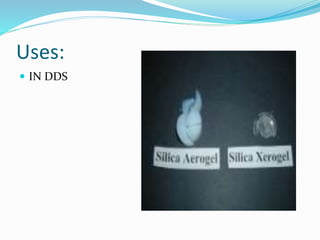
Uses:
 IN DDS
ORGANOGELS
 An organogel is a non-crystalline, non-glassy thermo
reversible (thermoplastic) solid material composed of a
liquid organic phase entrapped in a three-dimensionally
cross-linked network.
 The liquid can be, for example, an organic solvent, mineral
oil, or vegetable oil.
 These systems are based on self-assembly of the structuring
molecules.
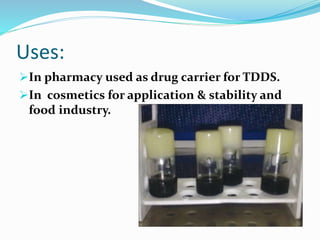
Uses:
In pharmacy used as drug carrier for TDDS.
In cosmetics for application & stability and
food industry.
Commonly Used Gelling Agents
 Acacia
 Pectin
 Starch
 Tragacanth
 Xanthan gum
 Alginic acid (seaweed)
 Animal/vegatable fats: cocoa butter
 Gelatin
 Bentonite, veegum (magnesium aluminum silicate)
 Carboxymethylcellulose (CMC) and other cellulose
derivatives
 Carbomer resins (Carbopols)
 Colloidal silicon dioxide
 Polyvinyl alcohol (PVA)
 Petrolatum, mineral oil/polyethylene gel.
Method of Formulation
There are 3 methods:
Fusion Method
Cold Method
Dispersion Method
Fusion Method
 In this method various waxy materials employed
as gellant in non polar media.
 Drug was added when waxy materials melted by
fusion.
 stirred slowly until uniform gel formed.
Cold Method
 Water was cooled to 4-100c and placed it in
mixing container.
 Gelling agent was slowly added and agitating
until solution is complete.
 Maintained temperature below 100c .
 Drug was added in solution form slowly with
gentle mixing.
 Immediately transfer to container & allow to
warm to R.T where upon liquid becomes clear
gel.
Dispersion Method
 Gelling agent was dispersed in water with stirring
at 1200 rpm for 30 min .
 Drug was dissolved in non-aqueous solvent with
preservative.
 This solution was added in above gel with
continuous stirring.
JELLIES
INTRODUCTION
 Jellies are transparent or translucent non-greasy
semisolid dosage form.
 They are less greasy compare gel.
 They are mainly used for mucous membrane for
lubricating, antiseptic purpose.
 Jellies are also used for lubricating surgical gloves,
catheters & rectal thermometers.
 Vaginal jellies & contraceptive jellies are also commonly
used.
 Medicated jellies contains a considerable amount of water
therefore those are suitable for water soluble medicaments.
 Such as, anaesthetics, antiseptics and spermicides.
 They are unsuitable for insoluble medicaments.
 They are easy to apply.
 After evaporation of water they produce cooling sensation to the
skin.
 When treatment is over, they can be easily removed by washing
with water.
Preparation of Jellies
 Pharmaceutical jellies are usually prepared by adding a
thickening agents.
 Such as tragacanth or carboxymethyl cellulose.
 Thickening agents is transferred into aqueous solution in
which drug has been dissolved.
 The mass is triturated in mortar until a uniform product
is obtained.
Following jelling agents are used…
 Tragacanth
 Sodium alginate
 Pectin
 Starch
 Gelatin
 Cellulose derivatives
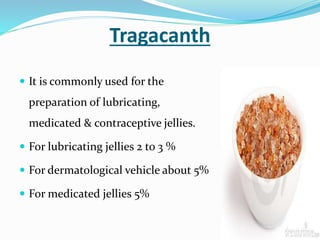
Tragacanth
 It is commonly used for the
preparation of lubricating,
medicated & contraceptive jellies.
 For lubricating jellies 2 to 3 %
 For dermatological vehicle about 5%
 For medicated jellies 5%
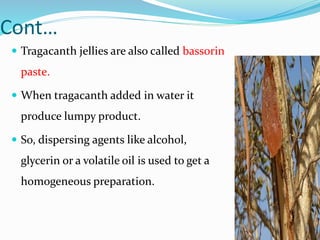
Cont…
 Tragacanth jellies are also called bassorin
paste.
 When tragacanth added in water it
produce lumpy product.
 So, dispersing agents like alcohol,
glycerin or a volatile oil is used to get a
homogeneous preparation.
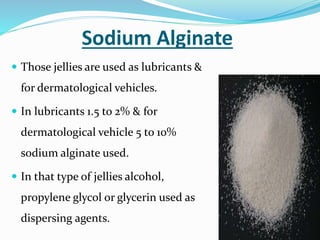
Sodium Alginate
 Those jellies are used as lubricants &
for dermatological vehicles.
 In lubricants 1.5 to 2% & for
dermatological vehicle 5 to 10%
sodium alginate used.
 In that type of jellies alcohol,
propylene glycol or glycerin used as
dispersing agents.
Pectin
 Pectin is a very good gelling agent.
 Pectin used in various preparation of jellies including
edible jellies.
 It is mainly used in dermatological jellies.
 Glycerin is used as humectant & dispersing agent.
 Pectin jellies prepared with suitable preservatives.
Starch
 Starch jellies prepared with combination of gelatin &
glycerin.
 Starch glycerin jellies prepared by heating method or
fusion method.
 Glycerin in large amounts i.e 50% may be act as
preservative & humectant.
Gelatin
 Gelatin soluble in hot water.
 2% gelatin produce jelly in a hot solution.
 Very stiff medicated jellies can be prepared by
incorporating with 15% gelatin.
 Such jellies melted before use & after cooling to desired
temperature it can be applied with brush on affected area.
 Those applied areas are cover with bandage.
 The dressing may be left in place after several weeks.
 Zinc gelatin jellies is also known as Unna’s paste.
Cellulose derivatives
 Methyl cellulose & sodium carboxy methyl cellulose
are widely used for preparation of jellies.
 Those substances produce natural & stable jellies.
 Those afford good resistance against bacterial growth.
 Those produce strong film on the skin after drying on
skin.
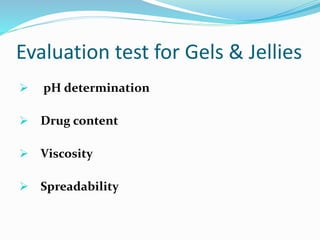
Evaluation test for Gels & Jellies
 pH determination
 Drug content
 Viscosity
 Spreadability
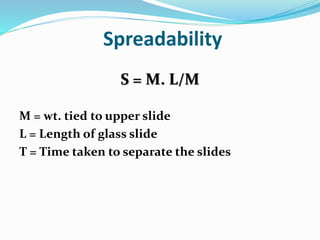
Spreadability
S = M. L/M
M = wt. tied to upper slide
L = Length of glass slide
T = Time taken to separate the slides
Gels & jellies

Gels & jellies

  • 1.
    Mr.Ravikumar R Patil Dr.ShivajiraoKadam College of Pharmacy Kasabe digraj, Sangli
  • 2.
    INTRODUCTION GELS  Gels aresemisolid dosage form.  In that dispersion of small or large molecules in an aqueous liquid vehicle.  They produce jelly like consistency by the addition of a gelling agent.  Gels are formed by using synthetic polymers such as carbomer 934 & cellulose such as hydroxypropylcellulose & hdroxypropylmethylcellulose.  Tragacnth, pectin, agar natural gums are used in the formulation of gels.
  • 3.
     As perNF, six polymers are used for gel formulation. Those are followings,  Carbomers 910  Carbomer 934  Carbomer 934P  Carbomer 940  Carbomer 941 And  Carbomer 1342  Carbomer 940 produce highest viscosity betw. 40,000 & 60,000 centipoises in 0.5% aq. Solution.
  • 4.
     Gels maythicken on standing, forming a thixotrope and must be shaken before use to liquefy the gel.  In the gel contains drug substance with water.  Also contain solvents such as, alcohol or propylene glycol.  Antimicrobial preservatives used in gel formulation such as, methylparaben, propylparaben etc.  It also contains stabilizers e.g. edetate disodium (EDTA).  Medicated gels prepared for administration by various routes for eye, nose, vaginal & rectum.
  • 5.
    CLASSIFICATION OF GELS Single- phase gel  Two- phase gel  In single phase gel contains macromolecules are uniformly distribute throughout the liquid with no apparent boundaries betw. macromolecules & the liquid.  In two phase gel contains small separate particles also called as magma.  E.g. Milk of magnesia (Magnesia magma) in that gelatinous precipitate of magnesium hydroxide.
  • 6.
  • 7.
    HYDROGELS  A hydrogelis a network of polymer chains that are hydrophilic, sometimes found as a colloidal gel in which water is the dispersion medium.  Hydrogels are highly absorbent(they can contain over 90% water) natural or synthetic polymeric networks.  Hydrogels also possess a degree of flexibility very similar to natural tissue, due to their significant water content.  Common ingredients include polyvinyl alcohol, sodium polyacrylate, acrylate polymers and copolymers with an abundance of hydrophilic groups.
  • 8.
    Uses:  As scaffoldsin tissue engineering. As environment sensitivity detector. Sustained release DDS. Contact lenses. ECG medical electrode. Glue
  • 9.
    XEROGELS  Open networkformed by the removal of all swelling agents from a gel.  Xerogels usually retain high porosity (15–50%) and enormous surface area (150–900 m2/g), along with very small pore size (1–10 nm).  When solvent removal occurs under supercritical conditions, the network does not shrink and a highly porous, low-density material known as an aerogel is produced.
  • 10.
  • 11.
    ORGANOGELS  An organogelis a non-crystalline, non-glassy thermo reversible (thermoplastic) solid material composed of a liquid organic phase entrapped in a three-dimensionally cross-linked network.  The liquid can be, for example, an organic solvent, mineral oil, or vegetable oil.  These systems are based on self-assembly of the structuring molecules.
  • 12.
    Uses: In pharmacy usedas drug carrier for TDDS. In cosmetics for application & stability and food industry.
  • 13.
    Commonly Used GellingAgents  Acacia  Pectin  Starch  Tragacanth  Xanthan gum  Alginic acid (seaweed)  Animal/vegatable fats: cocoa butter  Gelatin  Bentonite, veegum (magnesium aluminum silicate)  Carboxymethylcellulose (CMC) and other cellulose derivatives  Carbomer resins (Carbopols)  Colloidal silicon dioxide  Polyvinyl alcohol (PVA)  Petrolatum, mineral oil/polyethylene gel.
  • 14.
    Method of Formulation Thereare 3 methods: Fusion Method Cold Method Dispersion Method
  • 15.
    Fusion Method  Inthis method various waxy materials employed as gellant in non polar media.  Drug was added when waxy materials melted by fusion.  stirred slowly until uniform gel formed.
  • 16.
    Cold Method  Waterwas cooled to 4-100c and placed it in mixing container.  Gelling agent was slowly added and agitating until solution is complete.  Maintained temperature below 100c .  Drug was added in solution form slowly with gentle mixing.  Immediately transfer to container & allow to warm to R.T where upon liquid becomes clear gel.
  • 17.
    Dispersion Method  Gellingagent was dispersed in water with stirring at 1200 rpm for 30 min .  Drug was dissolved in non-aqueous solvent with preservative.  This solution was added in above gel with continuous stirring.
  • 18.
    JELLIES INTRODUCTION  Jellies aretransparent or translucent non-greasy semisolid dosage form.  They are less greasy compare gel.  They are mainly used for mucous membrane for lubricating, antiseptic purpose.  Jellies are also used for lubricating surgical gloves, catheters & rectal thermometers.  Vaginal jellies & contraceptive jellies are also commonly used.
  • 19.
     Medicated jelliescontains a considerable amount of water therefore those are suitable for water soluble medicaments.  Such as, anaesthetics, antiseptics and spermicides.  They are unsuitable for insoluble medicaments.  They are easy to apply.  After evaporation of water they produce cooling sensation to the skin.  When treatment is over, they can be easily removed by washing with water.
  • 20.
    Preparation of Jellies Pharmaceutical jellies are usually prepared by adding a thickening agents.  Such as tragacanth or carboxymethyl cellulose.  Thickening agents is transferred into aqueous solution in which drug has been dissolved.  The mass is triturated in mortar until a uniform product is obtained.
  • 21.
    Following jelling agentsare used…  Tragacanth  Sodium alginate  Pectin  Starch  Gelatin  Cellulose derivatives
  • 22.
    Tragacanth  It iscommonly used for the preparation of lubricating, medicated & contraceptive jellies.  For lubricating jellies 2 to 3 %  For dermatological vehicle about 5%  For medicated jellies 5%
  • 23.
    Cont…  Tragacanth jelliesare also called bassorin paste.  When tragacanth added in water it produce lumpy product.  So, dispersing agents like alcohol, glycerin or a volatile oil is used to get a homogeneous preparation.
  • 24.
    Sodium Alginate  Thosejellies are used as lubricants & for dermatological vehicles.  In lubricants 1.5 to 2% & for dermatological vehicle 5 to 10% sodium alginate used.  In that type of jellies alcohol, propylene glycol or glycerin used as dispersing agents.
  • 25.
    Pectin  Pectin isa very good gelling agent.  Pectin used in various preparation of jellies including edible jellies.  It is mainly used in dermatological jellies.  Glycerin is used as humectant & dispersing agent.  Pectin jellies prepared with suitable preservatives.
  • 26.
    Starch  Starch jelliesprepared with combination of gelatin & glycerin.  Starch glycerin jellies prepared by heating method or fusion method.  Glycerin in large amounts i.e 50% may be act as preservative & humectant.
  • 27.
    Gelatin  Gelatin solublein hot water.  2% gelatin produce jelly in a hot solution.  Very stiff medicated jellies can be prepared by incorporating with 15% gelatin.  Such jellies melted before use & after cooling to desired temperature it can be applied with brush on affected area.  Those applied areas are cover with bandage.  The dressing may be left in place after several weeks.  Zinc gelatin jellies is also known as Unna’s paste.
  • 28.
    Cellulose derivatives  Methylcellulose & sodium carboxy methyl cellulose are widely used for preparation of jellies.  Those substances produce natural & stable jellies.  Those afford good resistance against bacterial growth.  Those produce strong film on the skin after drying on skin.
  • 29.
    Evaluation test forGels & Jellies  pH determination  Drug content  Viscosity  Spreadability
  • 30.
    Spreadability S = M.L/M M = wt. tied to upper slide L = Length of glass slide T = Time taken to separate the slides