POWDERS
Phr.Nirmal Raj Marasine
Introduction
Pharmaceutical powders are solid dosage forms of
medicament in which one or more drugs are
dispensed in finely divided state with or without
excipients.
They are available in crystalline or amorphous
form.
ADVANTAGES
It is used both internally and externally .
 It is more stable than liquid dosage form.
 It is convenient for the physician to prescribe a
specific amount of powder
 On set of action is faster as compared to tablet,
capsules .because it is easily in dissolved in body
fluids
Easy to carry
 Easy to administration to the patient orally by
dissolving in suitable liquids.
DISADVANTAGE
Drugs have bitter taste , nausea and unpleasant taste
cannot be administered in powder form .
Deliquescent and hygroscopic drugs cannot be
dispensed in powder form they are packed in double
wrapping .
 Drugs which get affected by atmospheric condition
are not suitable for dispense .
 Quantity less than 100 mg cannot be weighed
conveniently
CLASSIFICATION OF POWDERS
1. Bulk powders for internal use
2. Bulk powders for external use
3. Simple and compound powder for internal use
4. Powders enclosed in cachets and capsules
5. Compressed powders(tablets).
1.BULK POWDERS FOR INTERNAL
USE
i. Powders are dispensed in bulk when accuracy of
dosage is not important .
ii. They are supplied in wide mouthed container
with spoon
Compound Rhubarb powders (Gregory'spowder)
•Rhubarb powder 250 g
•Light magnesium carbonate 325 g
• Heavy magnesium carbonate 325 g
•Ginger in powder 100g
• Direction : 0.5 g to 5 gm to be taken twice a day
2.BULK POWDERS FOR EXTERNAL
USE
Dusting powders
 Insufflations
Snuffs
Dentifrices
The label must indicate powders for external use
A.DUSTING POWDERS
These are meant for external application to the skin.
 It is fine state to avoid local irritation .
These powders passed through sieve no 85( 180µm)
to get a fine powder.
They are two types
 Medical dusting powder
 Surgical dusting powder
Medical dusting powder are mainly used for
superficial skin condition .
Surgical dusting powders are used in body cavities
or wound or umbilical cords of infants . It must be
sterilized before used .( Hot air oven-160 o C)
Dusting powders are generally prepared by mixing
two or more ingredients (Talc/ Kaolin).
DUSTING POWDERS contains antiseptic ,
astringent , antiperspirant ,anti pruritic. These may
also applied with powder puff or sterilized gauze
pad.
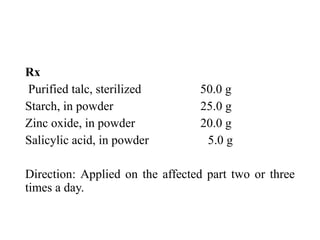
Rx
Purified talc, sterilized 50.0 g
Starch, in powder 25.0 g
Zinc oxide, in powder 20.0 g
Salicylic acid, in powder 5.0 g
Direction: Applied on the affected part two or three
times a day.
B.INSUFFLATION
These are medicated dusting powder meant for
application into body cavities like nose, throat , ear
infection with the help of insufflators .
It sprays the powder into a stream of finely powder
It is available in pressurized aerosol container
C.SNUFFS
•These are finely divided solid dosage forms of
medicament which are inhaled into nostrils .
•It contains antiseptics,bronchodilators ,decongestant
D.DENTIFRICES :( TOOTH POWDER )
Dental powders are applied with the help of a tooth
brush for cleaning the surface of the teeth.
Dental powders contain detergents, abrasives,
antiseptics and colouring and flavouring agents
incorporated in a suitable base.
Base is calcium carbonate. The detergent is in the
form of soap and the abrasive action is provided by
finely powdered pumice stone
Essential oils are added to provide flavour and
freshness to the mouth as well as antiseptic action.
Rx
Hard soap, in fine powder 50.0 g
Precipitated calcium carbonate 935.0 g
Saccharin sodium 2.0 g
Peppermint oil 4.0 ml
Cinnamon oil 2.0 ml
Methyl salicylate 8.0 ml
Direction: To be applied on the surface of the teeth
with the help of tooth brush.
3.SIMPLE AND COMPOUND POWDERS FOR
INTERNAL USE
In this form of powder each individual dose is
enclosed in paper .
 The number of ingredients may be one ( simple )
or more than one ( compound ) The minimum
quantity of each powder shouldn’t less than 100 mg.
Simple powders contains only one ingredients
either in crystalline or amorphous form.
When the powder is in crystal form it is reduced
into fine powder . Weigh the powder and divided
into number of doses and wrapped as individual
doses .
Compound powders
These powders contain two or more than two
substance which are mixed together and then
divided into desired number of individual dosed and
dispensed into each powder paper.
 E.g.. Powders of A.P.C
Aspirin 300 mg
Paracetamol 150 mg
Caffeine 50 mg
4.POWDERS ENCLOSED IN CACHETS :
(WAFER CAPSULE )
Cachets are the solid unit dosage form of drugs . These
are molded from rice paper .
 which is made by pouring a mixture of rice flour and
water between two hot polished cylinders .
 The water evaporates and a sheet of wafer is formed.
Cachets are used to enclose nauseous or disagreeable
powders are available from 0.2 to 1.5 g of powder .
They are quite hard to swallow as such but they are
softened by dipping in water for few seconds and then
place on the tongue and swallowed with a water
DISADVANTAGE
It must be softened before swallowing .
They cannot protect the drug against light moisture
The shell of cachets are fragile
TYPES OF CACHETS
Wet seal cachets
 Dry seal cachets
Wet seal cachets
A wet seal cachets is made up of two similar
convex halves having flat edges .
The weighed quantity of powdered drug is placed in
one half , the edges of the other half moistened with
water and place exactly over the first half containing
drug .
The flat edges of both the halves are pressed
together to seal it
DIRECTION : IMMERSE IN WATER FOR
FEW SECONDS AND THEN SWALLOW
WITH DRAUGHT OF WATER
DRY SEAL CACHETS
It consists of two halves , the upper half and the
Lower half .
The diameter of the upper half is slightly larger
than the lower half .
The powdered drug is filled in lower half and upper
half is fitted over it .
The filled cachets are then sealed in machine by
pressing the two halves.
Eg. Sodium aminosalicylate
6.TABLET TRITURATE
These are powdered molded into tablets .
Molded tablets are flat circular disc are usually
contains potent drugs which is mixed with lactose ,
dextrose ( diluents ).
Preparation of powders
1. Reduction of particle size of all ingredients
2. Sieving.
3. Weighing of each ingredient.
4. Mixing.
5. Packaging.
MIXING OF POWDERS
• The aim of mixing is to obtain a homogeneous
association of several solid products.
•Factors influencing the mixing of powders- nature of
surface, density, particle size, particle shape, particle
charge and proportion of materials.
•If these factors are not under control, segregation
(demixing) can occur.
•Types of segregation include percolation, trajectory
and densification.
Methods of Powder Mixing
1) Mechanical Mixing
2) Hand Mixing:
a. Spatulation (spatula + tile)
b. Trituration (mortar + pestle)
c. Tumbling (wide mouth closed container)
3) Geometric dilution:
Entire quantity of potent drug (x volume) + (x volume) of the
diluents + (2x volume) of the diluents + (4x volume) of the
diluents………repeated until all the diluents are used.
Powder packaging
PAPER WRAPPING
Divided powders are supplied or dispensed by wrapping
in suitable paper(glazed).
The paper used for packing of powder should have
following properties:
It should fold easily.
It should protect the powders without cracking at the
fold.
 It should impermeable to atmospheric condition.
 It should be water repellant.
 It should be light weight and elegant.
•Powder papers (glazed) of special grades are
available readily in different in size otherwise
pharmacist may cut the sheets in suitable size .
•The shape of the paper should be rectangular. The
wrapping of powders may be single or double
wrapping.
•Packed in sifter top containers, pressurized
containers, flat metalboxes.

Powders

  • 1.
  • 2.
    Introduction Pharmaceutical powders aresolid dosage forms of medicament in which one or more drugs are dispensed in finely divided state with or without excipients. They are available in crystalline or amorphous form.
  • 3.
    ADVANTAGES It is usedboth internally and externally .  It is more stable than liquid dosage form.  It is convenient for the physician to prescribe a specific amount of powder  On set of action is faster as compared to tablet, capsules .because it is easily in dissolved in body fluids Easy to carry  Easy to administration to the patient orally by dissolving in suitable liquids.
  • 4.
    DISADVANTAGE Drugs have bittertaste , nausea and unpleasant taste cannot be administered in powder form . Deliquescent and hygroscopic drugs cannot be dispensed in powder form they are packed in double wrapping .  Drugs which get affected by atmospheric condition are not suitable for dispense .  Quantity less than 100 mg cannot be weighed conveniently
  • 5.
    CLASSIFICATION OF POWDERS 1.Bulk powders for internal use 2. Bulk powders for external use 3. Simple and compound powder for internal use 4. Powders enclosed in cachets and capsules 5. Compressed powders(tablets).
  • 6.
    1.BULK POWDERS FORINTERNAL USE i. Powders are dispensed in bulk when accuracy of dosage is not important . ii. They are supplied in wide mouthed container with spoon
  • 7.
    Compound Rhubarb powders(Gregory'spowder) •Rhubarb powder 250 g •Light magnesium carbonate 325 g • Heavy magnesium carbonate 325 g •Ginger in powder 100g • Direction : 0.5 g to 5 gm to be taken twice a day
  • 8.
    2.BULK POWDERS FOREXTERNAL USE Dusting powders  Insufflations Snuffs Dentifrices The label must indicate powders for external use
  • 9.
    A.DUSTING POWDERS These aremeant for external application to the skin.  It is fine state to avoid local irritation . These powders passed through sieve no 85( 180µm) to get a fine powder. They are two types  Medical dusting powder  Surgical dusting powder
  • 10.
    Medical dusting powderare mainly used for superficial skin condition . Surgical dusting powders are used in body cavities or wound or umbilical cords of infants . It must be sterilized before used .( Hot air oven-160 o C) Dusting powders are generally prepared by mixing two or more ingredients (Talc/ Kaolin). DUSTING POWDERS contains antiseptic , astringent , antiperspirant ,anti pruritic. These may also applied with powder puff or sterilized gauze pad.
  • 11.
    Rx Purified talc, sterilized50.0 g Starch, in powder 25.0 g Zinc oxide, in powder 20.0 g Salicylic acid, in powder 5.0 g Direction: Applied on the affected part two or three times a day.
  • 12.
    B.INSUFFLATION These are medicateddusting powder meant for application into body cavities like nose, throat , ear infection with the help of insufflators . It sprays the powder into a stream of finely powder It is available in pressurized aerosol container C.SNUFFS •These are finely divided solid dosage forms of medicament which are inhaled into nostrils . •It contains antiseptics,bronchodilators ,decongestant
  • 13.
    D.DENTIFRICES :( TOOTHPOWDER ) Dental powders are applied with the help of a tooth brush for cleaning the surface of the teeth. Dental powders contain detergents, abrasives, antiseptics and colouring and flavouring agents incorporated in a suitable base. Base is calcium carbonate. The detergent is in the form of soap and the abrasive action is provided by finely powdered pumice stone Essential oils are added to provide flavour and freshness to the mouth as well as antiseptic action.
  • 14.
    Rx Hard soap, infine powder 50.0 g Precipitated calcium carbonate 935.0 g Saccharin sodium 2.0 g Peppermint oil 4.0 ml Cinnamon oil 2.0 ml Methyl salicylate 8.0 ml Direction: To be applied on the surface of the teeth with the help of tooth brush.
  • 15.
    3.SIMPLE AND COMPOUNDPOWDERS FOR INTERNAL USE In this form of powder each individual dose is enclosed in paper .  The number of ingredients may be one ( simple ) or more than one ( compound ) The minimum quantity of each powder shouldn’t less than 100 mg. Simple powders contains only one ingredients either in crystalline or amorphous form. When the powder is in crystal form it is reduced into fine powder . Weigh the powder and divided into number of doses and wrapped as individual doses .
  • 16.
    Compound powders These powderscontain two or more than two substance which are mixed together and then divided into desired number of individual dosed and dispensed into each powder paper.  E.g.. Powders of A.P.C Aspirin 300 mg Paracetamol 150 mg Caffeine 50 mg
  • 17.
    4.POWDERS ENCLOSED INCACHETS : (WAFER CAPSULE ) Cachets are the solid unit dosage form of drugs . These are molded from rice paper .  which is made by pouring a mixture of rice flour and water between two hot polished cylinders .  The water evaporates and a sheet of wafer is formed. Cachets are used to enclose nauseous or disagreeable powders are available from 0.2 to 1.5 g of powder . They are quite hard to swallow as such but they are softened by dipping in water for few seconds and then place on the tongue and swallowed with a water
  • 18.
    DISADVANTAGE It must besoftened before swallowing . They cannot protect the drug against light moisture The shell of cachets are fragile TYPES OF CACHETS Wet seal cachets  Dry seal cachets
  • 19.
    Wet seal cachets Awet seal cachets is made up of two similar convex halves having flat edges . The weighed quantity of powdered drug is placed in one half , the edges of the other half moistened with water and place exactly over the first half containing drug . The flat edges of both the halves are pressed together to seal it DIRECTION : IMMERSE IN WATER FOR FEW SECONDS AND THEN SWALLOW WITH DRAUGHT OF WATER
  • 20.
    DRY SEAL CACHETS Itconsists of two halves , the upper half and the Lower half . The diameter of the upper half is slightly larger than the lower half . The powdered drug is filled in lower half and upper half is fitted over it . The filled cachets are then sealed in machine by pressing the two halves. Eg. Sodium aminosalicylate
  • 21.
    6.TABLET TRITURATE These arepowdered molded into tablets . Molded tablets are flat circular disc are usually contains potent drugs which is mixed with lactose , dextrose ( diluents ).
  • 22.
    Preparation of powders 1.Reduction of particle size of all ingredients 2. Sieving. 3. Weighing of each ingredient. 4. Mixing. 5. Packaging.
  • 23.
    MIXING OF POWDERS •The aim of mixing is to obtain a homogeneous association of several solid products. •Factors influencing the mixing of powders- nature of surface, density, particle size, particle shape, particle charge and proportion of materials. •If these factors are not under control, segregation (demixing) can occur. •Types of segregation include percolation, trajectory and densification.
  • 24.
    Methods of PowderMixing 1) Mechanical Mixing 2) Hand Mixing: a. Spatulation (spatula + tile) b. Trituration (mortar + pestle) c. Tumbling (wide mouth closed container) 3) Geometric dilution: Entire quantity of potent drug (x volume) + (x volume) of the diluents + (2x volume) of the diluents + (4x volume) of the diluents………repeated until all the diluents are used.
  • 25.
    Powder packaging PAPER WRAPPING Dividedpowders are supplied or dispensed by wrapping in suitable paper(glazed). The paper used for packing of powder should have following properties: It should fold easily. It should protect the powders without cracking at the fold.  It should impermeable to atmospheric condition.  It should be water repellant.  It should be light weight and elegant.
  • 26.
    •Powder papers (glazed)of special grades are available readily in different in size otherwise pharmacist may cut the sheets in suitable size . •The shape of the paper should be rectangular. The wrapping of powders may be single or double wrapping. •Packed in sifter top containers, pressurized containers, flat metalboxes.