SURGERY FOR PULMONARY 
TUBERCULOSIS 
PROFESSOR 
ABDULSALAM Y TAHA 
School of Medicine/ University of Sulaimani/ Iraq 
https://sulaimaniu.academia.edu/AbdulsalamTaha 
1
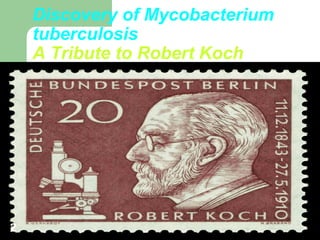
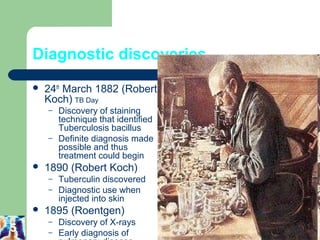
Discovery of Mycobacterium 
tuberculosis 
A Tribute to Robert Koch 
2
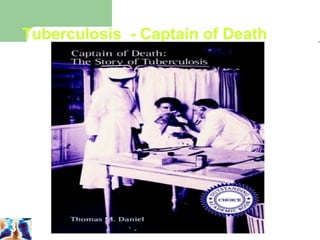
Tuberculosis - Captain of Death 
3
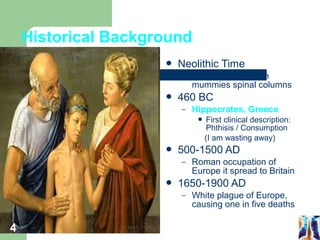
Historical Background 
 Neolithic Time 
– 2400 BC - Egyptian 
mummies spinal columns 
 460 BC 
– Hippocrates, Greece 
 First clinical description: 
Phthisis / Consumption 
(I am wasting away) 
 500-1500 AD 
– Roman occupation of 
Europe it spread to Britain 
 1650-1900 AD 
– White plague of Europe, 
causing one in five deaths 
4
Diagnostic discoveries 
 24th March 1882 (Robert 
Koch) TB Day 
– Discovery of staining 
technique that identified 
Tuberculosis bacillus 
– Definite diagnosis made 
possible and thus 
treatment could begin 
 1890 (Robert Koch) 
– Tuberculin discovered 
– Diagnostic use when 
injected into skin 
 1895 (Roentgen) 
– Discovery of X-rays 
– Early diagnosis of 
pulmonary disease 
5
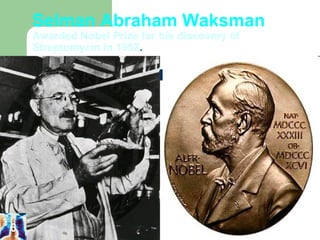
Selman Abraham Waksman 
Awarded Nobel Prize for his discovery of 
Streptomycin in 1952. 
6
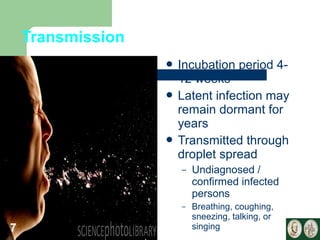
Transmission 
 Incubation period 4- 
12 weeks 
 Latent infection may 
remain dormant for 
years 
 Transmitted through 
droplet spread 
– Undiagnosed / 
confirmed infected 
persons 
– Breathing, coughing, 
sneezing, talking, or 
7 singing
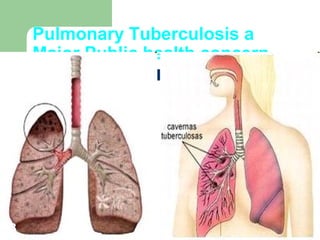
Pulmonary Tuberculosis a 
Major Public health concern 
8
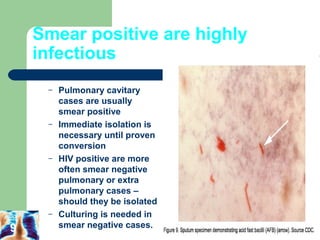
Smear positive are highly 
infectious 
– Pulmonary cavitary 
cases are usually 
smear positive 
– Immediate isolation is 
necessary until proven 
conversion 
– HIV positive are more 
often smear negative 
pulmonary or extra 
pulmonary cases – 
should they be isolated 
– Culturing is needed in 
9 smear negative cases.
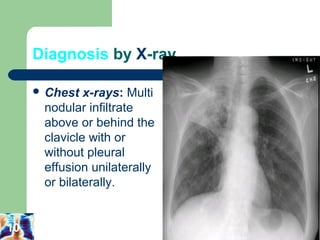
Diagnosis by X-ray 
 Chest x-rays: Multi 
nodular infiltrate 
above or behind the 
clavicle with or 
without pleural 
effusion unilaterally 
or bilaterally. 
10
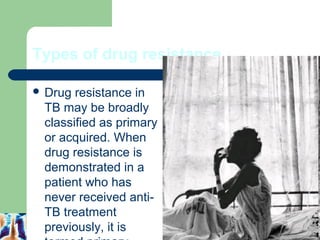
Types of drug resistance 
 Drug resistance in 
TB may be broadly 
classified as primary 
or acquired. When 
drug resistance is 
demonstrated in a 
patient who has 
never received anti- 
TB treatment 
previously, it is 
termed primary 
11
Surgery for PTB 
 Despite modern anti-tuberculous 
chemotherapy, approximately 2% of all cases 
of pulmonary mycobacterial infection require 
surgical treatment. 
 Therefore, surgical treatment of pulmonary 
mycobacterial disease is rarely necessary. 
 Prof Y D Al-Naman: 
65% of patients can be cured medically. 
25% need surgical treatment. 
12 10% fail to respond to therapy.
TYPES OF SURGICAL TREATMENT 
 Collapse therapy. 
 Pulmonary resection. 
 Lung decortication. 
 Drainage procedures: 
Closed tube thoracostomy. 
Rib resection. 
Open window thoracotomy. 
•Pulmonary resection+ collapse therapy 
13 (thoracoplasty).
COLLAPSE THERAPY 
It is based on the concept that 
collapsing the affected portion of the 
lung allows the diseased area to rest 
and recover. 
The efficacy of collapse therapy 
probably is derived from the lowering of 
O2 tensions in the collapsed portion of 
the lung thereby inhibiting growth of M 
14 tuberculosis, a strict aerobe.
COLLAPSE THERAPY 
Artificial pneumothorax. 
Unilateral phrenic nerve division. 
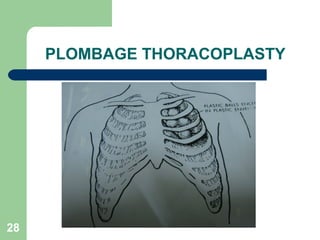
Extraperiosteal thoracoplasty with 
plombage. 
Standard paravertebral 
thoracoplasty. 
15
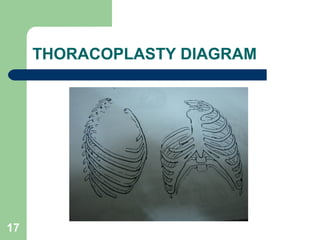
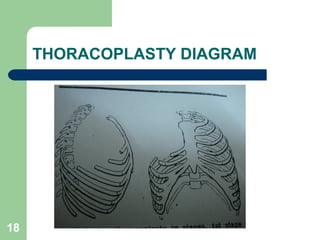
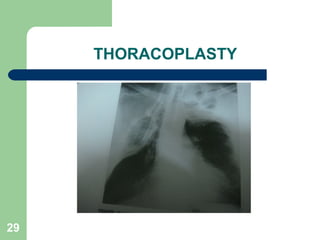
THORACOPLASTY 
It is the decostalization of chest wall. 
Tailoring thoracoplasty is done in 
stages: 
First stage: removing ribs 1, 2 and 3. 
Second stage: after two weeks; 
removing rib 4 and 5. 
Third stage: removing rib 6 and 7 in a 
tailoring fashion, leaving more rib 
16 anteriorly each time after the third.
THORACOPLASTY DIAGRAM 
17
THORACOPLASTY DIAGRAM 
18
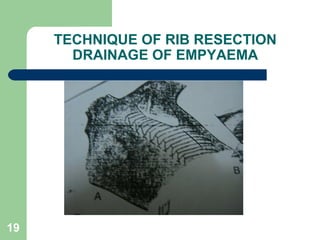
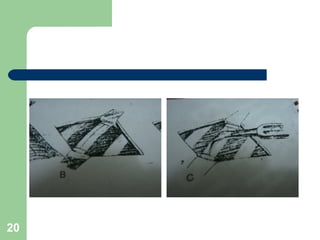
TECHNIQUE OF RIB RESECTION 
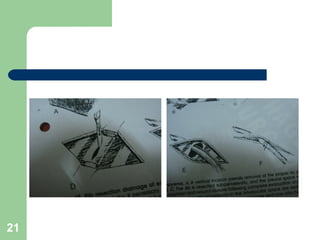
DRAINAGE OF EMPYAEMA 
19
20
21
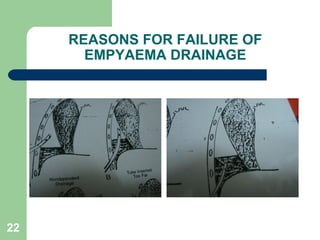
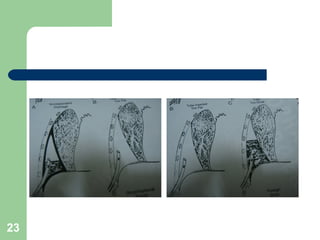
REASONS FOR FAILURE OF 
EMPYAEMA DRAINAGE 
22
23
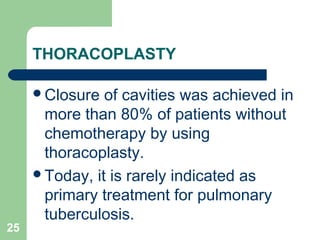
THORACOPLASTY 
Extrapleural paravertebral 
thoracoplasty was the most 
frequently employed surgical 
procedure for the treatment of 
pulmonary tuberculosis before the 
discovery of effective 
chemotherapy for tuberculosis. 
24
THORACOPLASTY 
Closure of cavities was achieved in 
more than 80% of patients without 
chemotherapy by using 
thoracoplasty. 
Today, it is rarely indicated as 
primary treatment for pulmonary 
tuberculosis. 
25
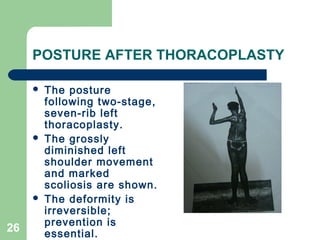
POSTURE AFTER THORACOPLASTY 
 The posture 
following two-stage, 
seven-rib left 
thoracoplasty. 
 The grossly 
diminished left 
shoulder movement 
and marked 
scoliosis are shown. 
 The deformity is 
irreversible; 
prevention is 
26 essential.
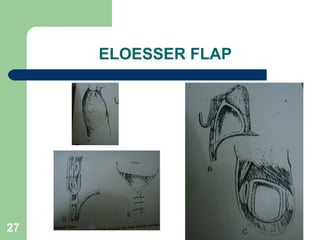
ELOESSER FLAP 
27
PLOMBAGE THORACOPLASTY 
28
THORACOPLASTY 
29
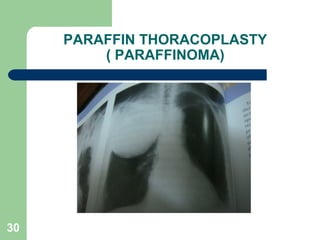
PARAFFIN THORACOPLASTY 
( PARAFFINOMA) 
30
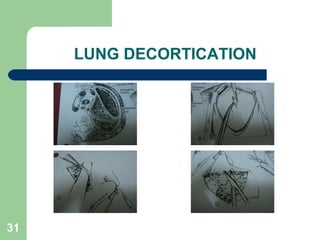
LUNG DECORTICATION 
31
32
PULMONARY RESECTION 
 Resection of the diseased portion of the lung. 
 Types: 
Wedge resection, Segmentectomy. 
Lobectomy, Bilobectomy, Pneumonectomy. 
Pleuropneumonectomy. 
• The extent of resection depends on the 
extent of the mycobacterial disease. All gross 
33 evidence of disease should be resected.
ACCEPTED INDICATIONS FOR 
PULMONARY RESECTION 
 Persistent positive sputum cultures with 
cavitation. 
 Localized pulmonary disease due to atypical 
mycobacterium ( M avium intracellulare) or 
drug resistent M tuberculosis. 
 A mass lesion of the lung in an area of 
tuberculous involvement. 
 Massive life-threatening haemoptysis or 
34 recurrent severe haemoptysis.
INDICATIONS FOR RESECTION.. 
In stabilized patients with a localized 
site of bleeding, lobectomy is the most 
definitive form of therapy for massive or 
recurrent haemoptysis. 
A bronchopleural fistula secondary to 
mycobacterial infection that does not 
respond to tube thoracostomy. 
35
OTHER INDICATIONS 
 Patients severely symptomatic from a 
destroyed lobe or bronchiectatic area of the 
lung may benefit from resection. 
 Patients with thick-walled cavities who have 
reactivated mycobacterial disease or who 
can not comply with prolonged chemotherapy 
may benefit from resection of the diseased 
area. 
 A patient with trapped lung: decortication. 
 Secondary fungal infection of tuberculous 
36 cavity ( Aspergillosis).
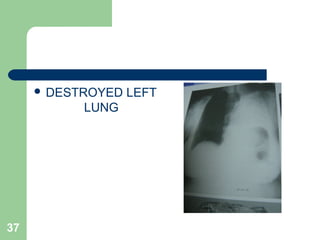
 DESTROYED LEFT 
LUNG 
37
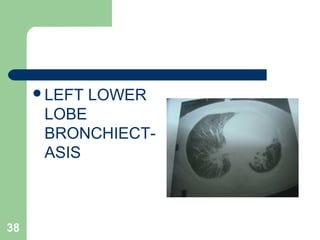
LEFT LOWER 
LOBE 
BRONCHIECT-ASIS 
38
ADVANTAGES OF LUNG RESECTION 
Prompt conversion into sputum-negative 
status in a single session. 
No chest wall deformity is 
produced. 
No limitation of ventilatory capacity. 
39
CONTRAINDICATIONS 
Widespread pulmonary or 
endobronchial disease. 
Children with mycobacterial 
disease rarely require lung 
resection. 
40
PREOPERATIVE MEASURES 
Adequate cardiopulmonary reserve. 
Conversion of the patient into sputum-negative 
status. 
Adequate physical and pulmonary 
toilet. 
Adequate nutritional support. 
Preoperative bronchoscopy. 
41
INTRAOPERATIVE MEASURES 
The use of a double-lumen 
endotracheal tube can make 
operation for PTB technically 
easier and safer. 
Bronchoscopy may be required at 
the conclusion of the operation to 
clear infected secretions or blood 
42 from the airway.
COMPLICATIONS OF RESECTION 
Empyaema with or without 
BPF. 
Bronchogenic spread of 
mycobacterial disease. 
43
COMPLICATIONS 
Both complications are more frequent 
when the patient is sputum positive at 
the time of operation. 
Judicious use of thoracoplasty or liberal 
use of muscle flaps in such patients at 
the time of operation can minimize the 
incidence of BPF and apical space 
problems. 
44
RESULTS OF RESECTION 
 The decreasing morbidity and mortality of 
pulmonary resection for PTB is due to: 
1. Careful patient selection ( failure of 
chemotherapy, massive haemoptysis, BPF). 
2. Improved anaesthetic techniques. 
3. Stapling devices. 
4. Better chemotherapy. 
•The prognosis after successful resection is 
excellent ( 90% survive and remain disease 
45 free).
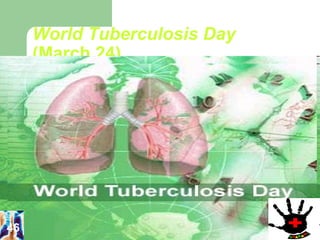
World Tuberculosis Day 
(March 24) 
46
47

Surgery for pulmonary tuberculosis

  • 1.
    SURGERY FOR PULMONARY TUBERCULOSIS PROFESSOR ABDULSALAM Y TAHA School of Medicine/ University of Sulaimani/ Iraq https://sulaimaniu.academia.edu/AbdulsalamTaha 1
  • 2.
    Discovery of Mycobacterium tuberculosis A Tribute to Robert Koch 2
  • 3.
  • 4.
    Historical Background Neolithic Time – 2400 BC - Egyptian mummies spinal columns  460 BC – Hippocrates, Greece  First clinical description: Phthisis / Consumption (I am wasting away)  500-1500 AD – Roman occupation of Europe it spread to Britain  1650-1900 AD – White plague of Europe, causing one in five deaths 4
  • 5.
    Diagnostic discoveries 24th March 1882 (Robert Koch) TB Day – Discovery of staining technique that identified Tuberculosis bacillus – Definite diagnosis made possible and thus treatment could begin  1890 (Robert Koch) – Tuberculin discovered – Diagnostic use when injected into skin  1895 (Roentgen) – Discovery of X-rays – Early diagnosis of pulmonary disease 5
  • 6.
    Selman Abraham Waksman Awarded Nobel Prize for his discovery of Streptomycin in 1952. 6
  • 7.
    Transmission  Incubationperiod 4- 12 weeks  Latent infection may remain dormant for years  Transmitted through droplet spread – Undiagnosed / confirmed infected persons – Breathing, coughing, sneezing, talking, or 7 singing
  • 8.
    Pulmonary Tuberculosis a Major Public health concern 8
  • 9.
    Smear positive arehighly infectious – Pulmonary cavitary cases are usually smear positive – Immediate isolation is necessary until proven conversion – HIV positive are more often smear negative pulmonary or extra pulmonary cases – should they be isolated – Culturing is needed in 9 smear negative cases.
  • 10.
    Diagnosis by X-ray  Chest x-rays: Multi nodular infiltrate above or behind the clavicle with or without pleural effusion unilaterally or bilaterally. 10
  • 11.
    Types of drugresistance  Drug resistance in TB may be broadly classified as primary or acquired. When drug resistance is demonstrated in a patient who has never received anti- TB treatment previously, it is termed primary 11
  • 12.
    Surgery for PTB  Despite modern anti-tuberculous chemotherapy, approximately 2% of all cases of pulmonary mycobacterial infection require surgical treatment.  Therefore, surgical treatment of pulmonary mycobacterial disease is rarely necessary.  Prof Y D Al-Naman: 65% of patients can be cured medically. 25% need surgical treatment. 12 10% fail to respond to therapy.
  • 13.
    TYPES OF SURGICALTREATMENT  Collapse therapy.  Pulmonary resection.  Lung decortication.  Drainage procedures: Closed tube thoracostomy. Rib resection. Open window thoracotomy. •Pulmonary resection+ collapse therapy 13 (thoracoplasty).
  • 14.
    COLLAPSE THERAPY Itis based on the concept that collapsing the affected portion of the lung allows the diseased area to rest and recover. The efficacy of collapse therapy probably is derived from the lowering of O2 tensions in the collapsed portion of the lung thereby inhibiting growth of M 14 tuberculosis, a strict aerobe.
  • 15.
    COLLAPSE THERAPY Artificialpneumothorax. Unilateral phrenic nerve division. Extraperiosteal thoracoplasty with plombage. Standard paravertebral thoracoplasty. 15
  • 16.
    THORACOPLASTY It isthe decostalization of chest wall. Tailoring thoracoplasty is done in stages: First stage: removing ribs 1, 2 and 3. Second stage: after two weeks; removing rib 4 and 5. Third stage: removing rib 6 and 7 in a tailoring fashion, leaving more rib 16 anteriorly each time after the third.
  • 17.
  • 18.
  • 19.
    TECHNIQUE OF RIBRESECTION DRAINAGE OF EMPYAEMA 19
  • 20.
  • 21.
  • 22.
    REASONS FOR FAILUREOF EMPYAEMA DRAINAGE 22
  • 23.
  • 24.
    THORACOPLASTY Extrapleural paravertebral thoracoplasty was the most frequently employed surgical procedure for the treatment of pulmonary tuberculosis before the discovery of effective chemotherapy for tuberculosis. 24
  • 25.
    THORACOPLASTY Closure ofcavities was achieved in more than 80% of patients without chemotherapy by using thoracoplasty. Today, it is rarely indicated as primary treatment for pulmonary tuberculosis. 25
  • 26.
    POSTURE AFTER THORACOPLASTY  The posture following two-stage, seven-rib left thoracoplasty.  The grossly diminished left shoulder movement and marked scoliosis are shown.  The deformity is irreversible; prevention is 26 essential.
  • 27.
  • 28.
  • 29.
  • 30.
    PARAFFIN THORACOPLASTY (PARAFFINOMA) 30
  • 31.
  • 32.
  • 33.
    PULMONARY RESECTION Resection of the diseased portion of the lung.  Types: Wedge resection, Segmentectomy. Lobectomy, Bilobectomy, Pneumonectomy. Pleuropneumonectomy. • The extent of resection depends on the extent of the mycobacterial disease. All gross 33 evidence of disease should be resected.
  • 34.
    ACCEPTED INDICATIONS FOR PULMONARY RESECTION  Persistent positive sputum cultures with cavitation.  Localized pulmonary disease due to atypical mycobacterium ( M avium intracellulare) or drug resistent M tuberculosis.  A mass lesion of the lung in an area of tuberculous involvement.  Massive life-threatening haemoptysis or 34 recurrent severe haemoptysis.
  • 35.
    INDICATIONS FOR RESECTION.. In stabilized patients with a localized site of bleeding, lobectomy is the most definitive form of therapy for massive or recurrent haemoptysis. A bronchopleural fistula secondary to mycobacterial infection that does not respond to tube thoracostomy. 35
  • 36.
    OTHER INDICATIONS Patients severely symptomatic from a destroyed lobe or bronchiectatic area of the lung may benefit from resection.  Patients with thick-walled cavities who have reactivated mycobacterial disease or who can not comply with prolonged chemotherapy may benefit from resection of the diseased area.  A patient with trapped lung: decortication.  Secondary fungal infection of tuberculous 36 cavity ( Aspergillosis).
  • 37.
  • 38.
    LEFT LOWER LOBE BRONCHIECT-ASIS 38
  • 39.
    ADVANTAGES OF LUNGRESECTION Prompt conversion into sputum-negative status in a single session. No chest wall deformity is produced. No limitation of ventilatory capacity. 39
  • 40.
    CONTRAINDICATIONS Widespread pulmonaryor endobronchial disease. Children with mycobacterial disease rarely require lung resection. 40
  • 41.
    PREOPERATIVE MEASURES Adequatecardiopulmonary reserve. Conversion of the patient into sputum-negative status. Adequate physical and pulmonary toilet. Adequate nutritional support. Preoperative bronchoscopy. 41
  • 42.
    INTRAOPERATIVE MEASURES Theuse of a double-lumen endotracheal tube can make operation for PTB technically easier and safer. Bronchoscopy may be required at the conclusion of the operation to clear infected secretions or blood 42 from the airway.
  • 43.
    COMPLICATIONS OF RESECTION Empyaema with or without BPF. Bronchogenic spread of mycobacterial disease. 43
  • 44.
    COMPLICATIONS Both complicationsare more frequent when the patient is sputum positive at the time of operation. Judicious use of thoracoplasty or liberal use of muscle flaps in such patients at the time of operation can minimize the incidence of BPF and apical space problems. 44
  • 45.
    RESULTS OF RESECTION  The decreasing morbidity and mortality of pulmonary resection for PTB is due to: 1. Careful patient selection ( failure of chemotherapy, massive haemoptysis, BPF). 2. Improved anaesthetic techniques. 3. Stapling devices. 4. Better chemotherapy. •The prognosis after successful resection is excellent ( 90% survive and remain disease 45 free).
  • 46.
    World Tuberculosis Day (March 24) 46
  • 47.