TUBERCULOSIS
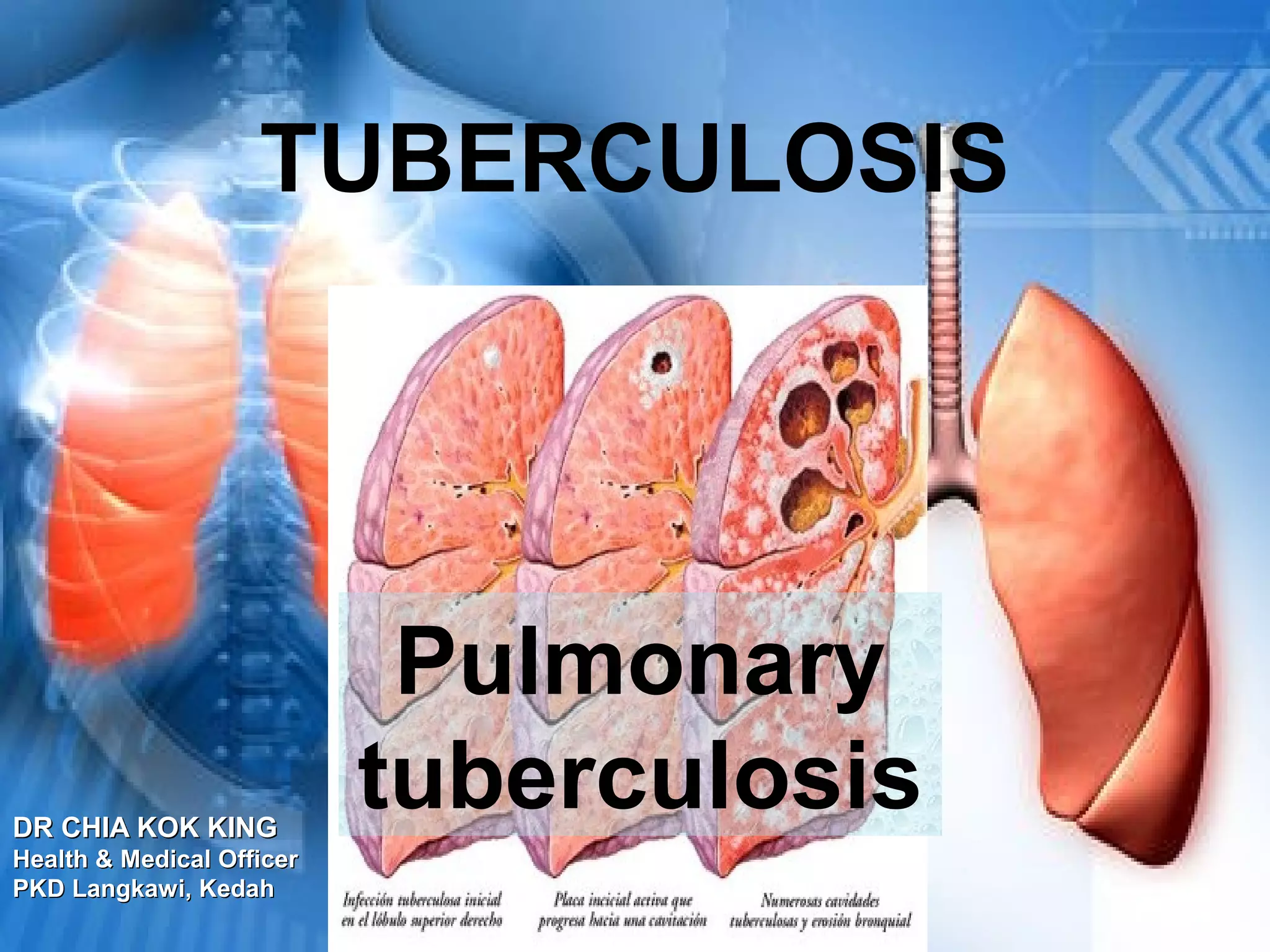
Pulmonary
tuberculosisDR CHIA KOK KINGDR CHIA KOK KING
Health & Medical OfficerHealth & Medical Officer
PKD Langkawi, KedahPKD Langkawi, Kedah
What is tuberculosis?
• Airborne infection caused by Mycobacterium
tuberculosis (MTB) or tubercle bacillus
(TB)
• Highly contagious
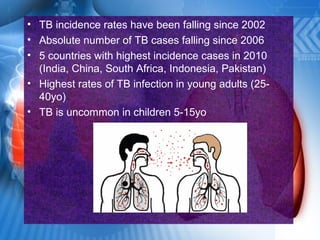
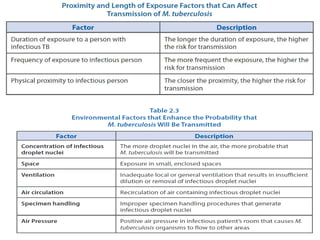
• Spreads by contact with infected person via
air droplets who is actively
coughing/talking/sneezing/shouting/singing
• >1 in 3 individuals is infected with TB.
• 8.8 million incident cases of TB worldwide in
2010, with 1.1 million deaths among HIV
negative persons, 0.35 million deaths from
HIV-associated TB.
• TB incidence rates have been falling since 2002
• Absolute number of TB cases falling since 2006
• 5 countries with highest incidence cases in 2010
(India, China, South Africa, Indonesia, Pakistan)
• Highest rates of TB infection in young adults (25-
40yo)
• TB is uncommon in children 5-15yo
Pulmonary tuberculosis
• Lungs are the most common site of development
• PTB is the commonest form as post-primary TB
• 85% of TB patients presented with pulmonary
complaints
• Classical clinical features :
Cough (>2 weeks in gen. pop / 7-10days in high risk)
Night sweats
LOA
Hemoptysis
LOW
Lethargy
Fever
Hoarseness of voice
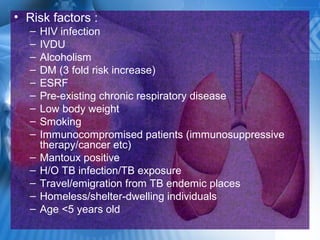
• Risk factors :
– HIV infection
– IVDU
– Alcoholism
– DM (3 fold risk increase)
– ESRF
– Pre-existing chronic respiratory disease
– Low body weight
– Smoking
– Immunocompromised patients (immunosuppressive
therapy/cancer etc)
– Mantoux positive
– H/O TB infection/TB exposure
– Travel/emigration from TB endemic places
– Homeless/shelter-dwelling individuals
– Age <5 years old
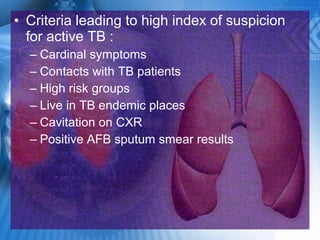
• Criteria leading to high index of suspicion
for active TB :
– Cardinal symptoms
– Contacts with TB patients
– High risk groups
– Live in TB endemic places
– Cavitation on CXR
– Positive AFB sputum smear results
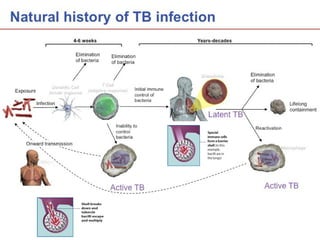
PathophysiologyPathophysiology
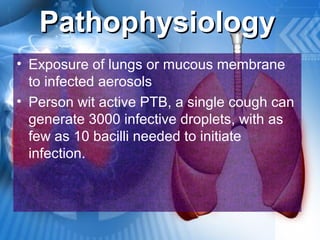
• Exposure of lungs or mucous membrane
to infected aerosols
• Person wit active PTB, a single cough can
generate 3000 infective droplets, with as
few as 10 bacilli needed to initiate
infection.
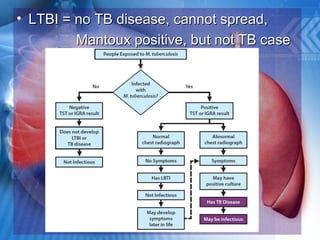
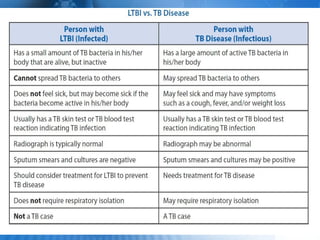
• LTBI = no TB disease, cannot spread,LTBI = no TB disease, cannot spread,
Mantoux positive, but not TB caseMantoux positive, but not TB case
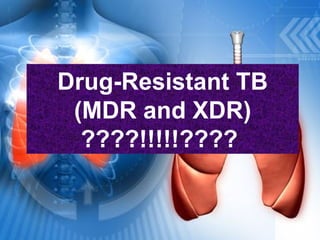
Drug-Resistant TB
(MDR and XDR)
????!!!!!????
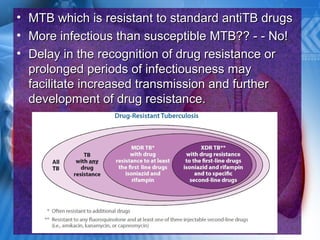
• MTB which is resistant to standard antiTB drugsMTB which is resistant to standard antiTB drugs
• More infectious than susceptible MTB?? - - No!More infectious than susceptible MTB?? - - No!
• Delay in the recognition of drug resistance orDelay in the recognition of drug resistance or
prolonged periods of infectiousness mayprolonged periods of infectiousness may
facilitate increased transmission and furtherfacilitate increased transmission and further
development of drug resistance.development of drug resistance.
• Multidrug-resistant TB (MDR TB) is caused by
organisms resistant to the most effective anti-TB
drugs : isoniazid and rifampin.
• Extensively drug-resistant TB (XDR TB) is a
rare type of drug-resistant TB to isoniazid and
rifampin, plus any fluoroquinolone and at least
one of three injectable second-line drugs (i.e.,
amikacin, kanamycin, or capreomycin). Patients
are left with treatment options that are more
toxic, more expensive, and much less effective.
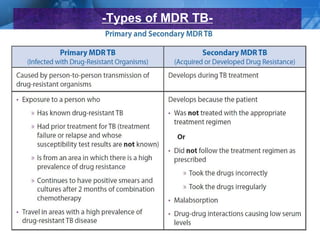
-Types of MDR TB-
Method of diagnosis for PTBMethod of diagnosis for PTB
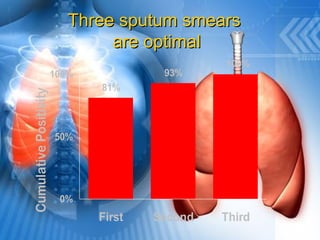
• Sputum AFB
– 3 specimens, preferably with one early morning sample
– Usually positive in cavitary disease
– 3 smears = sensitivity of 1 culture
− Advantages
- Rapid, high specificity
- Accurate diagnoses
- By paramedical personnel
- Using simple and available equipment
− Disadvantage
− Low sensitivity
81%
93%
100%
0%
50%
100%
First Second Third
CumulativePositivity
Three sputum smearsThree sputum smears
are optimalare optimal
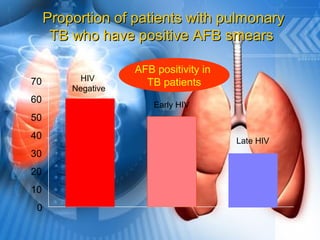
Proportion of patients with pulmonaryProportion of patients with pulmonary
TB who have positive AFB smearsTB who have positive AFB smears
0
10
20
30
40
50
60
70 HIV
Negative
Early HIV
Late HIV
AFB positivity in
TB patients
• Sputum MTB culture
– Egg-based media : DELAYS (8 weeks)
– BACTEC : for early diagnosis or smear negative (2
weeks)
– For identification and sensitivity of microorganism
– Indications :
– Sputum positive PTB
– Suspected TB with sputum AFB –ve
– Treatment failure
– TAI
– Sputum positive despite treatment
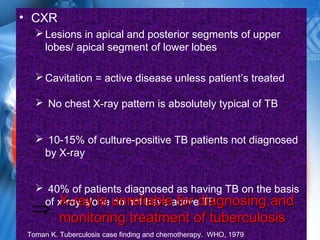
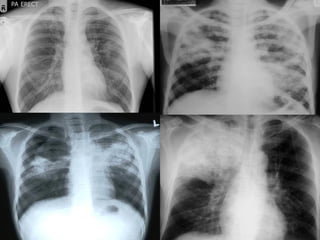
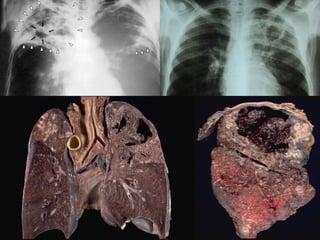
• CXR
Lesions in apical and posterior segments of upper
lobes/ apical segment of lower lobes
Cavitation = active disease unless patient’s treated
 No chest X-ray pattern is absolutely typical of TB
 10-15% of culture-positive TB patients not diagnosed
by X-ray
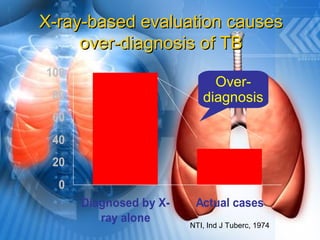
 40% of patients diagnosed as having TB on the basis
of x-ray alone do not have active TBX-ray is unreliable for diagnosing andX-ray is unreliable for diagnosing and
monitoring treatment of tuberculosismonitoring treatment of tuberculosis
⇒
Toman K. Tuberculosis case finding and chemotherapy. WHO, 1979
0
20
40
60
80
100
Diagnosed by X-
ray alone
Actual cases
X-ray-based evaluation causesX-ray-based evaluation causes
over-diagnosis of TBover-diagnosis of TB
NTI, Ind J Tuberc, 1974
Over-
diagnosis
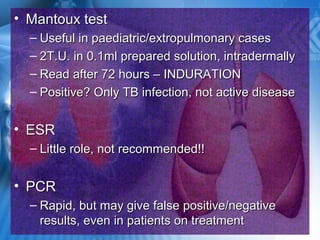
• Mantoux testMantoux test
– Useful in paediatric/extropulmonary casesUseful in paediatric/extropulmonary cases
– 2T.U. in 0.1ml prepared solution, intradermally2T.U. in 0.1ml prepared solution, intradermally
– Read after 72 hours – INDURATIONRead after 72 hours – INDURATION
– Positive? Only TB infection, not active diseasePositive? Only TB infection, not active disease
• ESRESR
– Little role, not recommended!!Little role, not recommended!!
• PCRPCR
– Rapid, but may give false positive/negativeRapid, but may give false positive/negative
results, even in patients on treatmentresults, even in patients on treatment
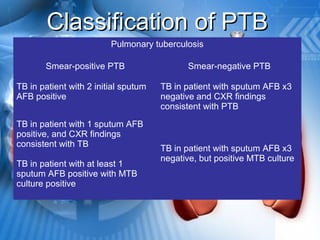
Classification of PTBClassification of PTB
Pulmonary tuberculosis
Smear-positive PTB Smear-negative PTB
TB in patient with 2 initial sputum
AFB positive
TB in patient with sputum AFB x3
negative and CXR findings
consistent with PTB
TB in patient with 1 sputum AFB
positive, and CXR findings
consistent with TB
TB in patient with sputum AFB x3
negative, but positive MTB culture
TB in patient with at least 1
sputum AFB positive with MTB
culture positive
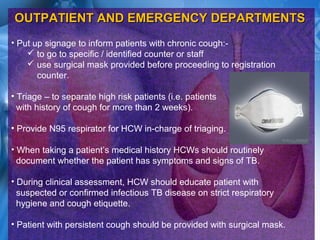
OUTPATIENT AND EMERGENCY DEPARTMENTSOUTPATIENT AND EMERGENCY DEPARTMENTS
• Put up signage to inform patients with chronic cough:-
 to go to specific / identified counter or staff
 use surgical mask provided before proceeding to registration
counter.
• Triage – to separate high risk patients (i.e. patients
with history of cough for more than 2 weeks).
• Provide N95 respirator for HCW in-charge of triaging.
• When taking a patient’s medical history HCWs should routinely
document whether the patient has symptoms and signs of TB.
• During clinical assessment, HCW should educate patient with
suspected or confirmed infectious TB disease on strict respiratory
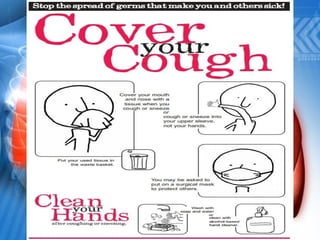
hygiene and cough etiquette.
• Patient with persistent cough should be provided with surgical mask.
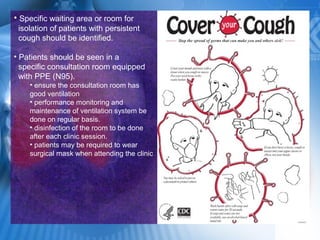
• Specific waiting area or room for
isolation of patients with persistent
cough should be identified.
• Patients should be seen in a
specific consultation room equipped
with PPE (N95).
• ensure the consultation room has
good ventilation
• performance monitoring and
maintenance of ventilation system be
done on regular basis.
• disinfection of the room to be done
after each clinic session.
• patients may be required to wear
surgical mask when attending the clinic
ReferencesReferences
• CDC : Transmission and Pathogenesis of TuberculosisCDC : Transmission and Pathogenesis of Tuberculosis
• CPG for the control and management of Tuberculosis, 2CPG for the control and management of Tuberculosis, 2ndnd
edition, 2002 (MOH)edition, 2002 (MOH)
• Guidelines On Prevention And Management ofGuidelines On Prevention And Management of
Tuberculosis For HCWs In MOHTuberculosis For HCWs In MOH

Basic pulmonary tuberculosis intro

  • 1.
    TUBERCULOSIS Pulmonary tuberculosisDR CHIA KOKKINGDR CHIA KOK KING Health & Medical OfficerHealth & Medical Officer PKD Langkawi, KedahPKD Langkawi, Kedah
  • 2.
    What is tuberculosis? •Airborne infection caused by Mycobacterium tuberculosis (MTB) or tubercle bacillus (TB) • Highly contagious • Spreads by contact with infected person via air droplets who is actively coughing/talking/sneezing/shouting/singing • >1 in 3 individuals is infected with TB. • 8.8 million incident cases of TB worldwide in 2010, with 1.1 million deaths among HIV negative persons, 0.35 million deaths from HIV-associated TB.
  • 3.
    • TB incidencerates have been falling since 2002 • Absolute number of TB cases falling since 2006 • 5 countries with highest incidence cases in 2010 (India, China, South Africa, Indonesia, Pakistan) • Highest rates of TB infection in young adults (25- 40yo) • TB is uncommon in children 5-15yo
  • 4.
    Pulmonary tuberculosis • Lungsare the most common site of development • PTB is the commonest form as post-primary TB • 85% of TB patients presented with pulmonary complaints • Classical clinical features : Cough (>2 weeks in gen. pop / 7-10days in high risk) Night sweats LOA Hemoptysis LOW Lethargy Fever Hoarseness of voice
  • 5.
    • Risk factors: – HIV infection – IVDU – Alcoholism – DM (3 fold risk increase) – ESRF – Pre-existing chronic respiratory disease – Low body weight – Smoking – Immunocompromised patients (immunosuppressive therapy/cancer etc) – Mantoux positive – H/O TB infection/TB exposure – Travel/emigration from TB endemic places – Homeless/shelter-dwelling individuals – Age <5 years old
  • 7.
    • Criteria leadingto high index of suspicion for active TB : – Cardinal symptoms – Contacts with TB patients – High risk groups – Live in TB endemic places – Cavitation on CXR – Positive AFB sputum smear results
  • 8.
    PathophysiologyPathophysiology • Exposure oflungs or mucous membrane to infected aerosols • Person wit active PTB, a single cough can generate 3000 infective droplets, with as few as 10 bacilli needed to initiate infection.
  • 10.
    • LTBI =no TB disease, cannot spread,LTBI = no TB disease, cannot spread, Mantoux positive, but not TB caseMantoux positive, but not TB case
  • 12.
    Drug-Resistant TB (MDR andXDR) ????!!!!!????
  • 13.
    • MTB whichis resistant to standard antiTB drugsMTB which is resistant to standard antiTB drugs • More infectious than susceptible MTB?? - - No!More infectious than susceptible MTB?? - - No! • Delay in the recognition of drug resistance orDelay in the recognition of drug resistance or prolonged periods of infectiousness mayprolonged periods of infectiousness may facilitate increased transmission and furtherfacilitate increased transmission and further development of drug resistance.development of drug resistance.
  • 14.
    • Multidrug-resistant TB(MDR TB) is caused by organisms resistant to the most effective anti-TB drugs : isoniazid and rifampin. • Extensively drug-resistant TB (XDR TB) is a rare type of drug-resistant TB to isoniazid and rifampin, plus any fluoroquinolone and at least one of three injectable second-line drugs (i.e., amikacin, kanamycin, or capreomycin). Patients are left with treatment options that are more toxic, more expensive, and much less effective.
  • 15.
  • 16.
    Method of diagnosisfor PTBMethod of diagnosis for PTB • Sputum AFB – 3 specimens, preferably with one early morning sample – Usually positive in cavitary disease – 3 smears = sensitivity of 1 culture − Advantages - Rapid, high specificity - Accurate diagnoses - By paramedical personnel - Using simple and available equipment − Disadvantage − Low sensitivity
  • 17.
    81% 93% 100% 0% 50% 100% First Second Third CumulativePositivity Threesputum smearsThree sputum smears are optimalare optimal
  • 18.
    Proportion of patientswith pulmonaryProportion of patients with pulmonary TB who have positive AFB smearsTB who have positive AFB smears 0 10 20 30 40 50 60 70 HIV Negative Early HIV Late HIV AFB positivity in TB patients
  • 19.
    • Sputum MTBculture – Egg-based media : DELAYS (8 weeks) – BACTEC : for early diagnosis or smear negative (2 weeks) – For identification and sensitivity of microorganism – Indications : – Sputum positive PTB – Suspected TB with sputum AFB –ve – Treatment failure – TAI – Sputum positive despite treatment
  • 20.
    • CXR Lesions inapical and posterior segments of upper lobes/ apical segment of lower lobes Cavitation = active disease unless patient’s treated  No chest X-ray pattern is absolutely typical of TB  10-15% of culture-positive TB patients not diagnosed by X-ray  40% of patients diagnosed as having TB on the basis of x-ray alone do not have active TBX-ray is unreliable for diagnosing andX-ray is unreliable for diagnosing and monitoring treatment of tuberculosismonitoring treatment of tuberculosis ⇒ Toman K. Tuberculosis case finding and chemotherapy. WHO, 1979
  • 23.
    0 20 40 60 80 100 Diagnosed by X- rayalone Actual cases X-ray-based evaluation causesX-ray-based evaluation causes over-diagnosis of TBover-diagnosis of TB NTI, Ind J Tuberc, 1974 Over- diagnosis
  • 24.
    • Mantoux testMantouxtest – Useful in paediatric/extropulmonary casesUseful in paediatric/extropulmonary cases – 2T.U. in 0.1ml prepared solution, intradermally2T.U. in 0.1ml prepared solution, intradermally – Read after 72 hours – INDURATIONRead after 72 hours – INDURATION – Positive? Only TB infection, not active diseasePositive? Only TB infection, not active disease • ESRESR – Little role, not recommended!!Little role, not recommended!! • PCRPCR – Rapid, but may give false positive/negativeRapid, but may give false positive/negative results, even in patients on treatmentresults, even in patients on treatment
  • 25.
    Classification of PTBClassificationof PTB Pulmonary tuberculosis Smear-positive PTB Smear-negative PTB TB in patient with 2 initial sputum AFB positive TB in patient with sputum AFB x3 negative and CXR findings consistent with PTB TB in patient with 1 sputum AFB positive, and CXR findings consistent with TB TB in patient with sputum AFB x3 negative, but positive MTB culture TB in patient with at least 1 sputum AFB positive with MTB culture positive
  • 26.
    OUTPATIENT AND EMERGENCYDEPARTMENTSOUTPATIENT AND EMERGENCY DEPARTMENTS • Put up signage to inform patients with chronic cough:-  to go to specific / identified counter or staff  use surgical mask provided before proceeding to registration counter. • Triage – to separate high risk patients (i.e. patients with history of cough for more than 2 weeks). • Provide N95 respirator for HCW in-charge of triaging. • When taking a patient’s medical history HCWs should routinely document whether the patient has symptoms and signs of TB. • During clinical assessment, HCW should educate patient with suspected or confirmed infectious TB disease on strict respiratory hygiene and cough etiquette. • Patient with persistent cough should be provided with surgical mask.
  • 27.
    • Specific waitingarea or room for isolation of patients with persistent cough should be identified. • Patients should be seen in a specific consultation room equipped with PPE (N95). • ensure the consultation room has good ventilation • performance monitoring and maintenance of ventilation system be done on regular basis. • disinfection of the room to be done after each clinic session. • patients may be required to wear surgical mask when attending the clinic
  • 29.
    ReferencesReferences • CDC :Transmission and Pathogenesis of TuberculosisCDC : Transmission and Pathogenesis of Tuberculosis • CPG for the control and management of Tuberculosis, 2CPG for the control and management of Tuberculosis, 2ndnd edition, 2002 (MOH)edition, 2002 (MOH) • Guidelines On Prevention And Management ofGuidelines On Prevention And Management of Tuberculosis For HCWs In MOHTuberculosis For HCWs In MOH