TUBERCLOSIS
Madeeha Farooq
MID 4th
year
University of Lahore
Case
A 40-year-women was admitted to the hospital from
home after 3 week of cough, profuse nocturnal,fever, a
30-poundweight loss, chills, loss of appetiteand night
sweats. He was seen by an emergency room physician
who noted signs of depression. The patient has a history
of HIV.
Patienthistory
Patient name xxx
Age 40years
Sex female
30-poundweight loss
Suffering from cough since 3 weeks
Night sweats
Human immune deficiency viruse (HIV)
Physical examination
Physical examination findings associated with TB depend
on the organs involved. Patients with pulmonary TB have
abnormal breath sounds.
Appearanceof the Patient
 Cachexia
 Pallor
Vitals
 Tachypnea
 Tachycardia
 Fever
Lungs
 Decreased breath sounds
 Rales
 Rhonchi
 Bronchial
breath sounds
Differential
Diagnosis
lung cancer
pleural indentation
pulmonarytuberculosis
pneumonia
investigations
chest x ray
Dense homogenous opacity in right, middle and lower
lobe of primary pulmonaryTB.
Microbiologicalexamination
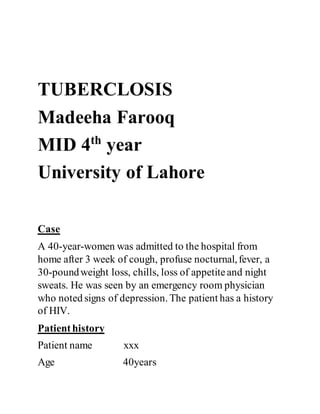
The polymerasechain reaction (PCR)
The TB-PCR test is ordered to diagnose and detects
M. Tuberculosis from other mycobacteria. It also helps
monitor treatment for TB.
Serologictests
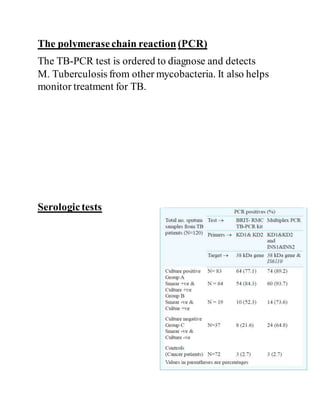
Tuberculosis skin test
The tuberculinskin test
---M. tuberculosis
 Purified protein derivative (PPD)
0.1 mL (5 TU) of standard PPD is injected on the
volar surface of the forearm
recorded after 48 to 72 hours
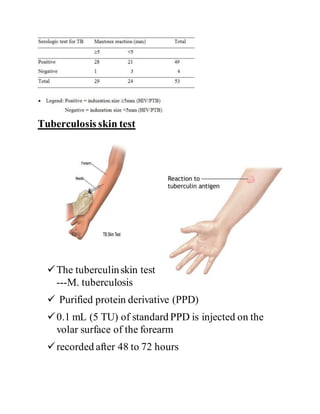
BRONCHOSCOPY
Bronchoscopyis commonly used for investigating
patients with possible pulmonarytuberculosis (TB) when
spontaneoussputumis smear negative.
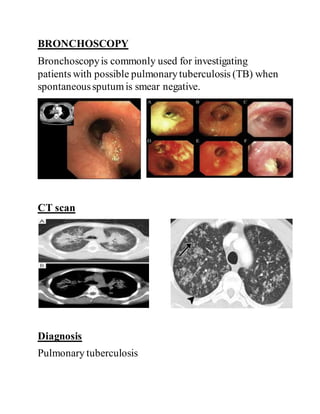
CT scan
Diagnosis
Pulmonary tuberculosis
Tuberculosis
Tuberculosis(TB) is a disease
caused by bacteria called
Mycobacterium tuberculosis.
The bacteria usually attack the
lungs, but they can also
damage otherparts of the
body. TB spreads through the
air when a person with TB of the lungs or throat coughs,
sneezes, or talks.
PulmonaryTB
PulmonaryTB is a bacterial
infection of the lungs that
can cause a range of
symptoms, includingchest
pain, breathlessness, and
severe coughing.
systemic tuberculosis
systemic tuberculosis is a potentiallylife-threateningtype
of tuberculosisthat occurs when a large number of the
bacteria travel through the bloodstreamand spread
throughoutthe body.
sign and symptoms of tuberculosis
 Coughing for three or more weeks.
 Coughing up blood or mucus.
 Chest pain, or pain with breathing or coughing.
 Unintentional weight loss.
 Fatigue.
 Fever.
 Night sweats.
 Chills.
Etiology
Tuberculosis(TB) is caused by a type of bacteriumcalled
Mycobacterium tuberculosis.
Pathophysiology
Complications
 Spinal pain. Back pain and stiffness are
common complicationsof tuberculosis.
 Joint damage. ...
 Swelling of the membranes that cover your brain
(meningitis). ...
 Liver or kidney problems. ...
 Heart disorders.
Treatment
If you have an active TB disease you will probablybe
treated with a combination of
antibacterial medications for a period of six to 12 months.
The most common treatment for active TB
is isoniazid INH in combination with three other drugs
rifampin, pyrazinamide and ethambutol.
Antituberculosisdrugs
 Isoniazid (INH)
 peripheral neuritis
 Rifampin (RFP)
 Pyrazinamide (PZA)
 Ethambutol(EMB)
 Streptomycin (SM)
Initial chemotherapy
both adults and children consist of a 6-month regimen that
is based on an initial 2-month bactericidal phase of INH
and RFP and PZA and either EMB or SM.
• Patients with cavitary pulmonarytuberculosis and
delayed sputum-culture conversion should have their
treatment extended by 3 months for a total course of
9 months.
• For patients with sputumculture-negative pulmonary
tuberculosis, the durationof treatment may be
reduced to 4 months
Recurrent chemotherapy
• Recurrencerefers to the circumstance in which a
patient becomes and remains culture-negative while
receiving antituberculosis drugs
• at some point after completion of therapy either
becomes culturepositive again or experiences
clinical or radiographic deteriorationconsistent with
active tuberculosis
• Recurrenceof pulmonarytuberculosis, due to
inadequateinitial chemotherapy, brings about
secondary drug-resistance, persistent positive sputum
smear, and delay recurrence
• Usual agents would includeEMB, a fluoroquinolone,
and an injectableagent such as SM, alizarin,
kanamycin or capreoraycin,
• at least two to three susceptibleor never used drugs
added to the regimens.
• A five-drug combination in intensive phase and three
in consolidationphase are suitable.
• Continuousadministration of 18 to 24 months after
conversion of sputumis necessary.
Surgery
• Indications of surgery
noneffective and multidrug-resistant cavities
large caseous lesions
tuberculousempyema
bronchial fistula
and uncontrolledmassive hemoptysis.
The recommendation was for the use of partial lung
resection (lobectomy or wedge resection) alongside
the provision of medication. A lobectomy is a type
of surgery, mostly used for lung cancer, in which one
lobe of a lung is removed. A lobe may be removed to
prevent the spread of TB to anotherlobe.

Tuberclosis

  • 1.
    TUBERCLOSIS Madeeha Farooq MID 4th year Universityof Lahore Case A 40-year-women was admitted to the hospital from home after 3 week of cough, profuse nocturnal,fever, a 30-poundweight loss, chills, loss of appetiteand night sweats. He was seen by an emergency room physician who noted signs of depression. The patient has a history of HIV. Patienthistory Patient name xxx Age 40years
  • 2.
    Sex female 30-poundweight loss Sufferingfrom cough since 3 weeks Night sweats Human immune deficiency viruse (HIV) Physical examination Physical examination findings associated with TB depend on the organs involved. Patients with pulmonary TB have abnormal breath sounds. Appearanceof the Patient  Cachexia  Pallor Vitals  Tachypnea  Tachycardia  Fever Lungs  Decreased breath sounds  Rales  Rhonchi
  • 3.
     Bronchial breath sounds Differential Diagnosis lungcancer pleural indentation pulmonarytuberculosis pneumonia investigations chest x ray Dense homogenous opacity in right, middle and lower lobe of primary pulmonaryTB. Microbiologicalexamination
  • 4.
    The polymerasechain reaction(PCR) The TB-PCR test is ordered to diagnose and detects M. Tuberculosis from other mycobacteria. It also helps monitor treatment for TB. Serologictests
  • 5.
    Tuberculosis skin test Thetuberculinskin test ---M. tuberculosis  Purified protein derivative (PPD) 0.1 mL (5 TU) of standard PPD is injected on the volar surface of the forearm recorded after 48 to 72 hours
  • 6.
    BRONCHOSCOPY Bronchoscopyis commonly usedfor investigating patients with possible pulmonarytuberculosis (TB) when spontaneoussputumis smear negative. CT scan Diagnosis Pulmonary tuberculosis
  • 7.
    Tuberculosis Tuberculosis(TB) is adisease caused by bacteria called Mycobacterium tuberculosis. The bacteria usually attack the lungs, but they can also damage otherparts of the body. TB spreads through the air when a person with TB of the lungs or throat coughs, sneezes, or talks. PulmonaryTB PulmonaryTB is a bacterial infection of the lungs that can cause a range of symptoms, includingchest pain, breathlessness, and severe coughing. systemic tuberculosis systemic tuberculosis is a potentiallylife-threateningtype of tuberculosisthat occurs when a large number of the bacteria travel through the bloodstreamand spread throughoutthe body.
  • 8.
    sign and symptomsof tuberculosis  Coughing for three or more weeks.  Coughing up blood or mucus.  Chest pain, or pain with breathing or coughing.  Unintentional weight loss.  Fatigue.
  • 9.
     Fever.  Nightsweats.  Chills. Etiology Tuberculosis(TB) is caused by a type of bacteriumcalled Mycobacterium tuberculosis.
  • 10.
    Pathophysiology Complications  Spinal pain.Back pain and stiffness are common complicationsof tuberculosis.  Joint damage. ...  Swelling of the membranes that cover your brain (meningitis). ...
  • 11.
     Liver orkidney problems. ...  Heart disorders. Treatment If you have an active TB disease you will probablybe treated with a combination of antibacterial medications for a period of six to 12 months. The most common treatment for active TB is isoniazid INH in combination with three other drugs rifampin, pyrazinamide and ethambutol.
  • 12.
    Antituberculosisdrugs  Isoniazid (INH) peripheral neuritis  Rifampin (RFP)  Pyrazinamide (PZA)  Ethambutol(EMB)  Streptomycin (SM) Initial chemotherapy both adults and children consist of a 6-month regimen that is based on an initial 2-month bactericidal phase of INH and RFP and PZA and either EMB or SM. • Patients with cavitary pulmonarytuberculosis and delayed sputum-culture conversion should have their treatment extended by 3 months for a total course of 9 months. • For patients with sputumculture-negative pulmonary tuberculosis, the durationof treatment may be reduced to 4 months Recurrent chemotherapy • Recurrencerefers to the circumstance in which a patient becomes and remains culture-negative while receiving antituberculosis drugs
  • 13.
    • at somepoint after completion of therapy either becomes culturepositive again or experiences clinical or radiographic deteriorationconsistent with active tuberculosis • Recurrenceof pulmonarytuberculosis, due to inadequateinitial chemotherapy, brings about secondary drug-resistance, persistent positive sputum smear, and delay recurrence • Usual agents would includeEMB, a fluoroquinolone, and an injectableagent such as SM, alizarin, kanamycin or capreoraycin, • at least two to three susceptibleor never used drugs added to the regimens. • A five-drug combination in intensive phase and three in consolidationphase are suitable. • Continuousadministration of 18 to 24 months after conversion of sputumis necessary.
  • 14.
    Surgery • Indications ofsurgery noneffective and multidrug-resistant cavities large caseous lesions tuberculousempyema bronchial fistula and uncontrolledmassive hemoptysis. The recommendation was for the use of partial lung resection (lobectomy or wedge resection) alongside the provision of medication. A lobectomy is a type of surgery, mostly used for lung cancer, in which one
  • 15.
    lobe of alung is removed. A lobe may be removed to prevent the spread of TB to anotherlobe.