By: M. Suleiman Aljajeh
1
2014-2015
1. Definition
2. Types
3. Clinical features
4. Risk factors
5. Diagnosis
6. Treatment
7. Complications
2
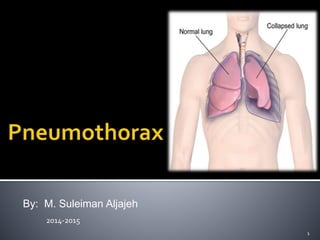
 “Pneumothorax : is an abnormal
collection of air or gas in the pleural
space separating the lung from
the chest wall which may interfere with
normal breathing, causing the lungs to
collapse.”
3
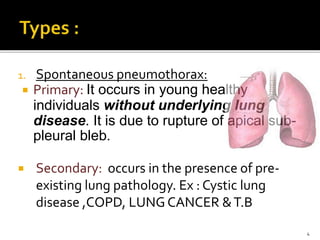
1. Spontaneous pneumothorax:
 Primary: It occurs in young healthy
individuals without underlying lung
disease. It is due to rupture of apical sub-
pleural bleb.
 Secondary: occurs in the presence of pre-
existing lung pathology. Ex : Cystic lung
disease ,COPD, LUNG CANCER &T.B
4
2. Traumatic pneumothorax:
 Open: Chest wall is damaged by any wound -
-outside air enters pleural space and causes
lungs to collapse.
 Closed: here chest wall is punctured or air
leaks from a ruptured bronchus
 Iatrogenic : Ex. Postoperative Mechanical
ventilation ,Thoracocentesis & Central
venous cannulation .
5
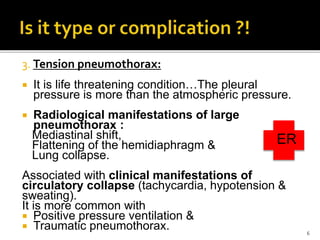
3. Tension pneumothorax:
 It is life threatening condition…The pleural
pressure is more than the atmospheric pressure.
 Radiological manifestations of large
pneumothorax :
Mediastinal shift,
Flattening of the hemidiaphragm &
Lung collapse.
Associated with clinical manifestations of
circulatory collapse (tachycardia, hypotension &
sweating).
It is more common with
 Positive pressure ventilation &
 Traumatic pneumothorax. 6
ER
7
The pleural cavity
pressure is < the
atmospheric
pressure
The pleural cavity
pressure is = the
atmospheric
pressure
The pleural cavity
pressure is > the
atmospheric pressure
8
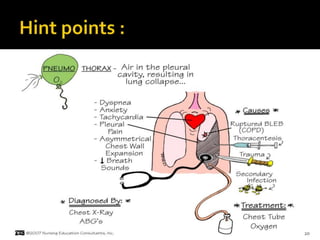
 Predominant symptom is acute pleuritic chest pain
 Dyspnoea results form pulmonary compression
 On physical examination:
 Breath sounds may be diminished on the affected side
 Percussion of the chest may be perceived as hyperresonant.
 Physical signs include
 Tachypnoea
 Increased resonance
 Absent breath sounds
 Hypoxemia
 Cyanosis
 Hypercapnia 9
10
11
 Sex : men are far more likely to have a pneumothorax than
are women.
 Smoking.
 Age.The type of pneumothorax caused by ruptured air
blisters is most likely to occur in people between 20 and 40
years old, especially if the person is a very tall and
underweight man.
 Genetics.
 Lung disease. Having an underlying lung disease —
especially chronic obstructive pulmonary disease (COPD) —
makes a collapsed lung more likely.
 Mechanical ventilation.
 A history of pneumothorax.
12
 The characteristics of
pneumothorax
 Pleural line
 No lung markings in
pneumothorax
13
 A further use of CT is in the identification of
underlying lung lesions
14
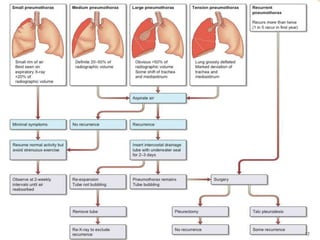
Goals :
To promote lung expansion.
To eliminate the pathogenesis.
To decrease pneumothorax
recurrence.
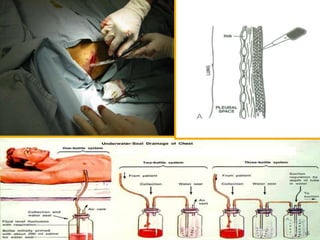
 Treatment options :
 Simple aspiration
 Intercostal tube drainage
 Guidewire tube thoracostomy
 Surgical treatment
15
16
17
18
Complications of pneumothorax
Recurrence of spontaneous pneumothorax
Tension pneumothorax
Hydropneumothorax
Encysted pneumothorax
Failure of expansion of the collapsed lung
Re-expansion pulmonary edema
Broncho-pleural fistula
Pneumomediastinum 19
20
21
1. Kumar and Clark Clinical Medicine
2. USMLE Step 2 CK
3. Harrison's Principles of Internal Medicine
22
23

Pneumothorax

  • 1.
    By: M. SuleimanAljajeh 1 2014-2015
  • 2.
    1. Definition 2. Types 3.Clinical features 4. Risk factors 5. Diagnosis 6. Treatment 7. Complications 2
  • 3.
     “Pneumothorax :is an abnormal collection of air or gas in the pleural space separating the lung from the chest wall which may interfere with normal breathing, causing the lungs to collapse.” 3
  • 4.
    1. Spontaneous pneumothorax: Primary: It occurs in young healthy individuals without underlying lung disease. It is due to rupture of apical sub- pleural bleb.  Secondary: occurs in the presence of pre- existing lung pathology. Ex : Cystic lung disease ,COPD, LUNG CANCER &T.B 4
  • 5.
    2. Traumatic pneumothorax: Open: Chest wall is damaged by any wound - -outside air enters pleural space and causes lungs to collapse.  Closed: here chest wall is punctured or air leaks from a ruptured bronchus  Iatrogenic : Ex. Postoperative Mechanical ventilation ,Thoracocentesis & Central venous cannulation . 5
  • 6.
    3. Tension pneumothorax: It is life threatening condition…The pleural pressure is more than the atmospheric pressure.  Radiological manifestations of large pneumothorax : Mediastinal shift, Flattening of the hemidiaphragm & Lung collapse. Associated with clinical manifestations of circulatory collapse (tachycardia, hypotension & sweating). It is more common with  Positive pressure ventilation &  Traumatic pneumothorax. 6 ER
  • 7.
  • 8.
    The pleural cavity pressureis < the atmospheric pressure The pleural cavity pressure is = the atmospheric pressure The pleural cavity pressure is > the atmospheric pressure 8
  • 9.
     Predominant symptomis acute pleuritic chest pain  Dyspnoea results form pulmonary compression  On physical examination:  Breath sounds may be diminished on the affected side  Percussion of the chest may be perceived as hyperresonant.  Physical signs include  Tachypnoea  Increased resonance  Absent breath sounds  Hypoxemia  Cyanosis  Hypercapnia 9
  • 10.
  • 11.
  • 12.
     Sex :men are far more likely to have a pneumothorax than are women.  Smoking.  Age.The type of pneumothorax caused by ruptured air blisters is most likely to occur in people between 20 and 40 years old, especially if the person is a very tall and underweight man.  Genetics.  Lung disease. Having an underlying lung disease — especially chronic obstructive pulmonary disease (COPD) — makes a collapsed lung more likely.  Mechanical ventilation.  A history of pneumothorax. 12
  • 13.
     The characteristicsof pneumothorax  Pleural line  No lung markings in pneumothorax 13
  • 14.
     A furtheruse of CT is in the identification of underlying lung lesions 14
  • 15.
    Goals : To promotelung expansion. To eliminate the pathogenesis. To decrease pneumothorax recurrence.  Treatment options :  Simple aspiration  Intercostal tube drainage  Guidewire tube thoracostomy  Surgical treatment 15
  • 16.
  • 17.
  • 18.
  • 19.
    Complications of pneumothorax Recurrenceof spontaneous pneumothorax Tension pneumothorax Hydropneumothorax Encysted pneumothorax Failure of expansion of the collapsed lung Re-expansion pulmonary edema Broncho-pleural fistula Pneumomediastinum 19
  • 20.
  • 21.
    21 1. Kumar andClark Clinical Medicine 2. USMLE Step 2 CK 3. Harrison's Principles of Internal Medicine
  • 22.
  • 23.