        
Hamza J. AlGhamdi
   
IHD                     IHD
                      Surgical management of
                           complications
Surgical Management
                         Mitral valve reflux

                            Post-MI VSD
  Acute Coronary
    Syndrome
                      Left ventricular aneurysm
   
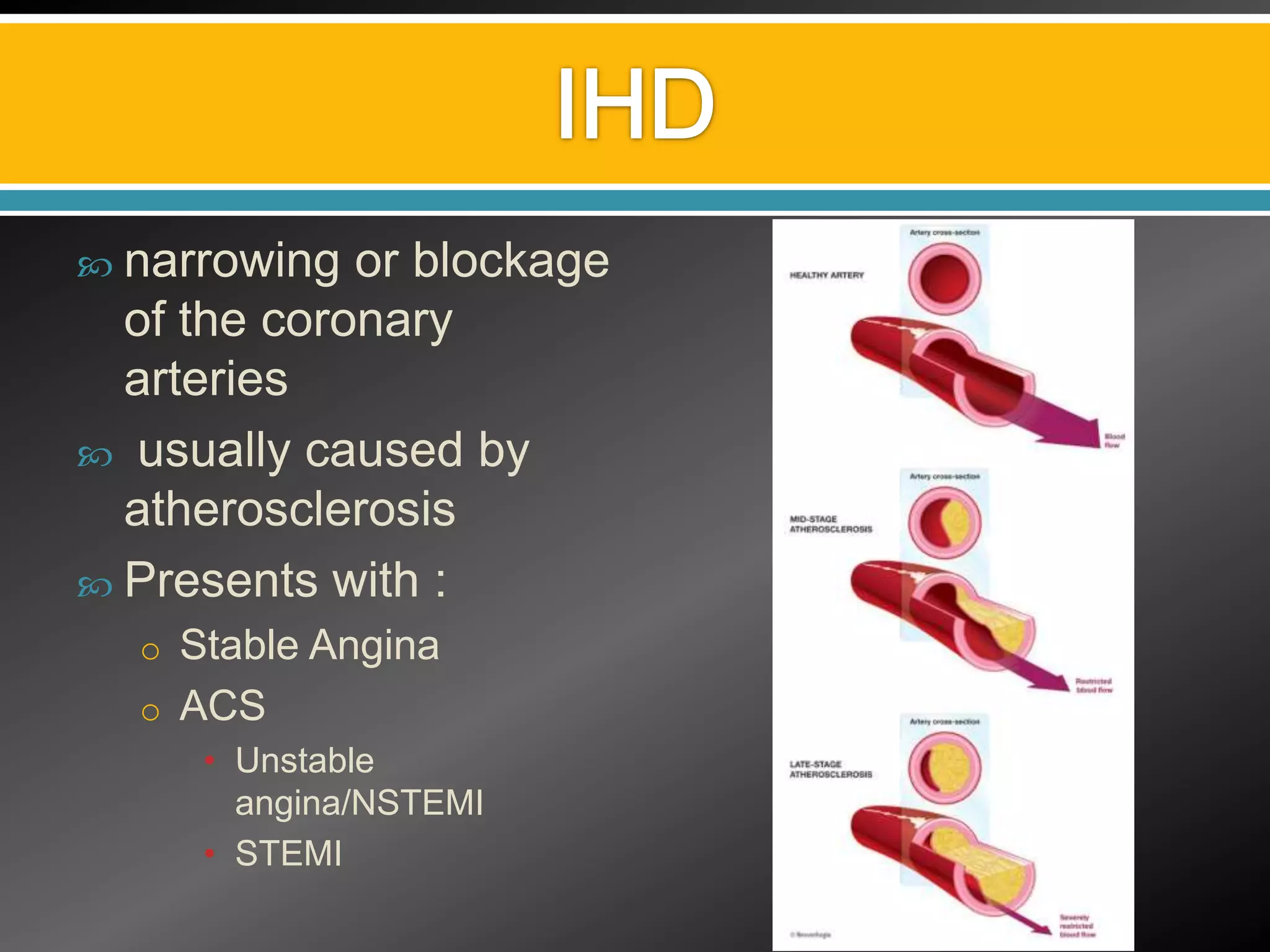
 narrowing  or blockage
  of the coronary
  arteries
 usually caused by
  atherosclerosis
 Presents with :
  o Stable Angina
  o ACS
     • Unstable
       angina/NSTEMI
     • STEMI
History
•   Symptoms
•   Risk factors
•   Family Hx
•   Medical Hx
•   Surgical Hx
•   Drug Hx
Examination

Investigation
TEE


Angiography                  Echocardiography


              Exercise ECG


   ECG
   
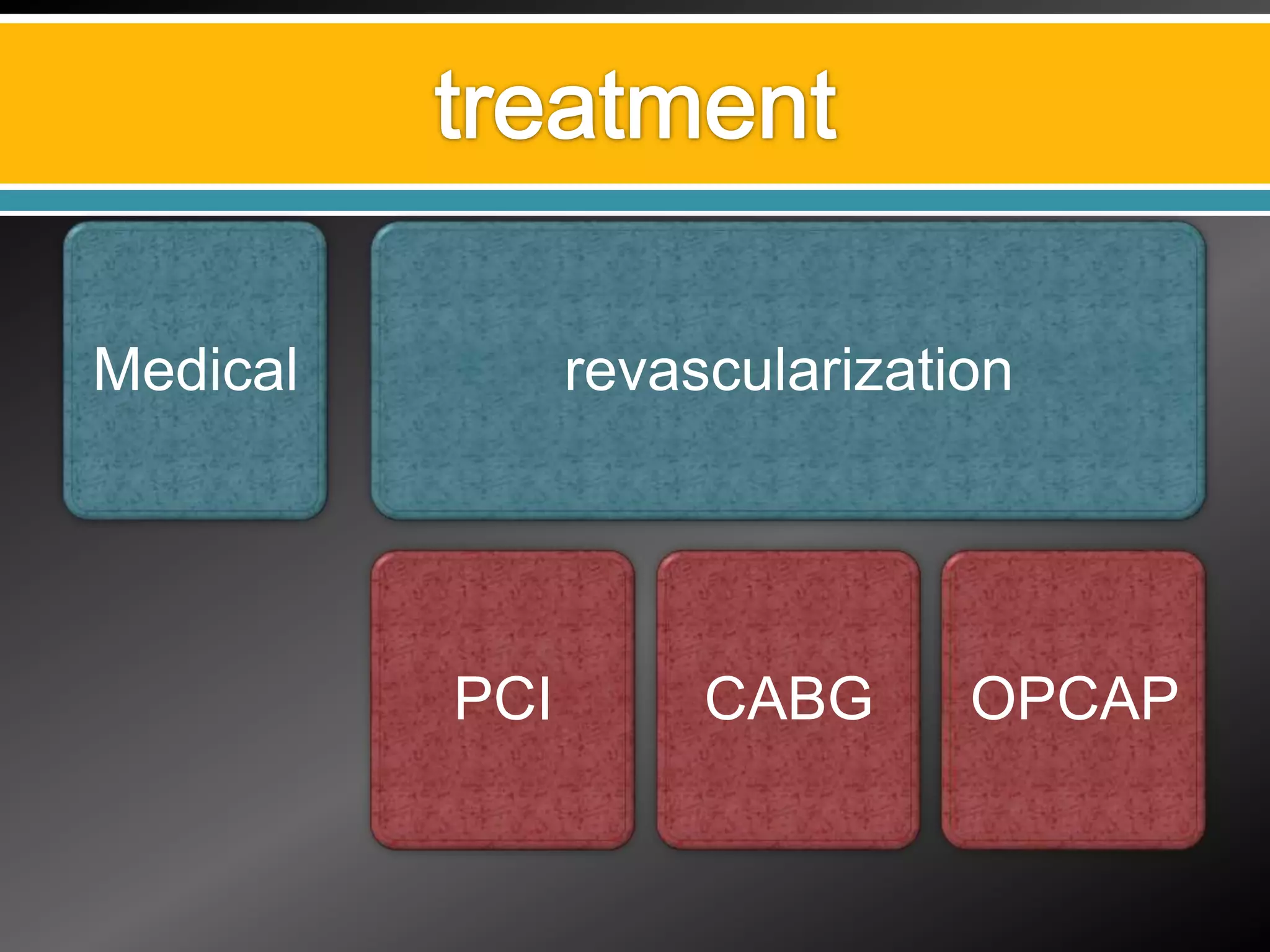
Medical         revascularization


          PCI        CABG      OPCAP
Medical

As an initial management strategy in patients with stable coronary artery
disease, PCI did not reduce the risk of death, myocardial infarction, or other
major cardiovascular events when added to optimal medical therapy.
                                                                                   COURAGE Trial
                                                     N Engl J Med 2007; 356:1503-1516April 12, 2007
   Interventional technique
   To relive the stenosis
   Balloon angioplasty , stenting
   Atherectomy
   Mortality <1%
   Significant left main artery disease
   Triple vessel disease
   Two vessel disease involving the proximal LAD
   Poor left ventricular function


CABG remains the standard of care for patients with three-vessel or left main
coronary artery disease, since the use of CABG, as compared with PCI,
resulted in lower rates of the combined end point of major adverse cardiac or
cerebrovascular events at 1 year.
     Percutaneous coronary intervention versus coronary-artery bypass grafting for severe coronary artery disease.-
                                                                                                      SYNTAX trial
                                                    N Engl J Med. 2009 Mar 5;360(10):961-72. Epub 2009 Feb 18
   Preoperative
    o MI from stress, anxiety or critical ischemia.
   Intraoperative
    o Myocardial failure and lack of adequate myocardial contraction at
      the end of bypass
    o Embolic infarction
   Postoperative
    o   Myocardial failure
    o   Infarction
    o   Inadequate myocardial protection or excess fluid load.
    o   Stroke
    o   Arrhythmias
    o   Wound
    o   And other complications of open heart surgery.
   
   stabilization devices hold
    heart in place allowing
    operation while
    positioning devices allow
    the surgeon to lift the
    beating heart to access
    the lateral and posterior
    vessels
   procedure is safe and
    well tolerated by most
    patients;
    however, OPCAB surgery
    remains technically more
    demanding
   OPCAB decreases in-hospital
    morbidity (decreased
    incidence of chest
    infection, inotropic
    requirement, supraventricular
    arrhythmia), blood product
    transfusion, ICU stay, length of
    hospitalization, and decreased
    CK-MB and troponin I level
   no significant difference in
    terms of survival at 2
    years, frequency of cardiac
    events
    (MI, PCI, CHF, recurrent
    angina, redo CABG) or
    medication usage compared to
    on-pump CABG
   
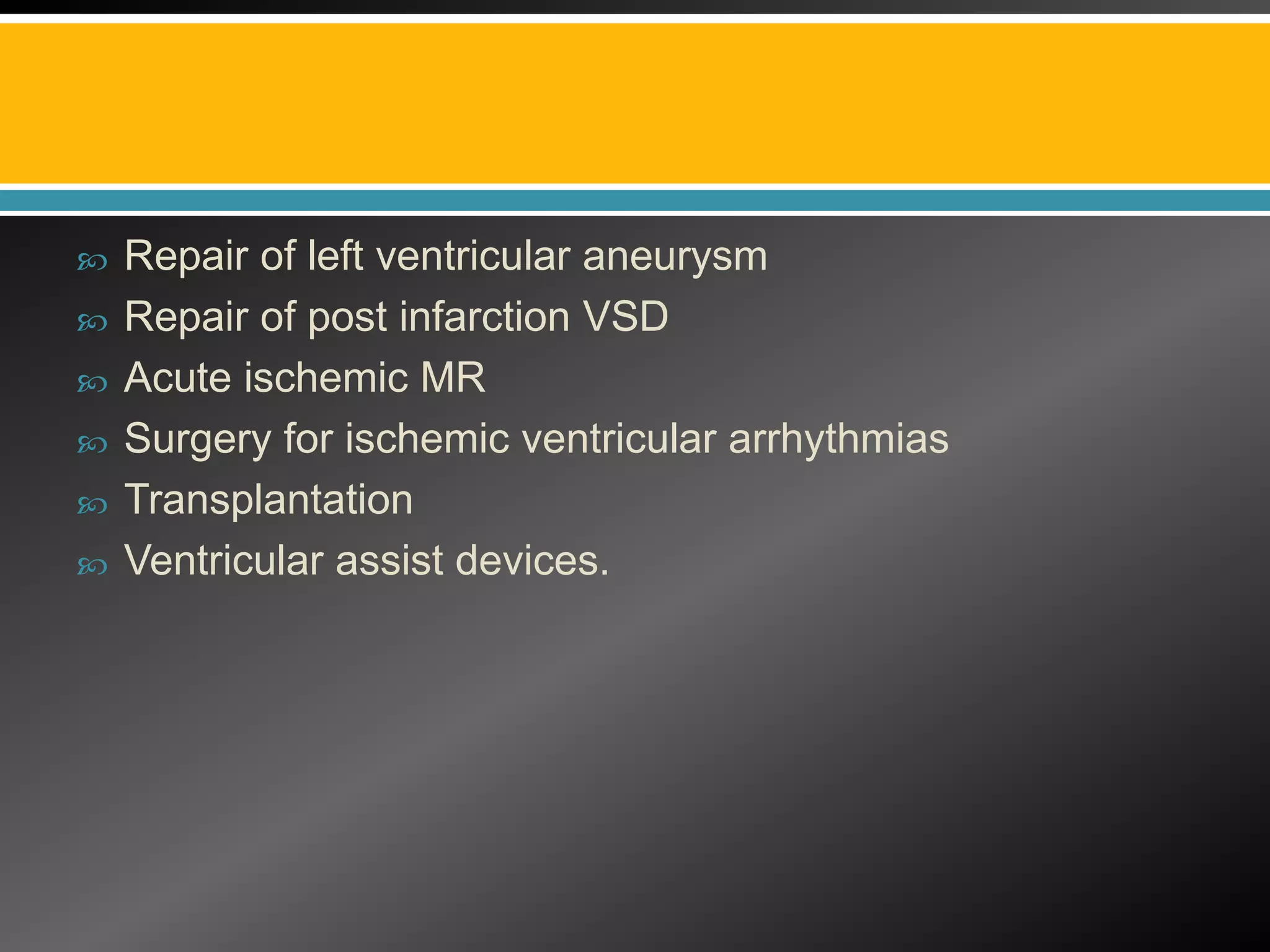
   Repair of left ventricular aneurysm
   Repair of post infarction VSD
   Acute ischemic MR
   Surgery for ischemic ventricular arrhythmias
   Transplantation
   Ventricular assist devices.
   

Ischemic Heart Disease Surgery

  • 1.
     Hamza J. AlGhamdi
  • 2.
  • 3.
    IHD IHD Surgical management of complications Surgical Management Mitral valve reflux Post-MI VSD Acute Coronary Syndrome Left ventricular aneurysm
  • 4.
  • 5.
     narrowing or blockage of the coronary arteries  usually caused by atherosclerosis  Presents with : o Stable Angina o ACS • Unstable angina/NSTEMI • STEMI
  • 6.
    History • Symptoms • Risk factors • Family Hx • Medical Hx • Surgical Hx • Drug Hx Examination Investigation
  • 7.
    TEE Angiography Echocardiography Exercise ECG ECG
  • 8.
  • 9.
    Medical revascularization PCI CABG OPCAP
  • 10.
    Medical As an initialmanagement strategy in patients with stable coronary artery disease, PCI did not reduce the risk of death, myocardial infarction, or other major cardiovascular events when added to optimal medical therapy. COURAGE Trial N Engl J Med 2007; 356:1503-1516April 12, 2007
  • 12.
    Interventional technique  To relive the stenosis  Balloon angioplasty , stenting  Atherectomy  Mortality <1%
  • 14.
    Significant left main artery disease  Triple vessel disease  Two vessel disease involving the proximal LAD  Poor left ventricular function CABG remains the standard of care for patients with three-vessel or left main coronary artery disease, since the use of CABG, as compared with PCI, resulted in lower rates of the combined end point of major adverse cardiac or cerebrovascular events at 1 year. Percutaneous coronary intervention versus coronary-artery bypass grafting for severe coronary artery disease.- SYNTAX trial N Engl J Med. 2009 Mar 5;360(10):961-72. Epub 2009 Feb 18
  • 18.
    Preoperative o MI from stress, anxiety or critical ischemia.  Intraoperative o Myocardial failure and lack of adequate myocardial contraction at the end of bypass o Embolic infarction  Postoperative o Myocardial failure o Infarction o Inadequate myocardial protection or excess fluid load. o Stroke o Arrhythmias o Wound o And other complications of open heart surgery.
  • 19.
  • 21.
    stabilization devices hold heart in place allowing operation while positioning devices allow the surgeon to lift the beating heart to access the lateral and posterior vessels  procedure is safe and well tolerated by most patients; however, OPCAB surgery remains technically more demanding
  • 22.
    OPCAB decreases in-hospital morbidity (decreased incidence of chest infection, inotropic requirement, supraventricular arrhythmia), blood product transfusion, ICU stay, length of hospitalization, and decreased CK-MB and troponin I level  no significant difference in terms of survival at 2 years, frequency of cardiac events (MI, PCI, CHF, recurrent angina, redo CABG) or medication usage compared to on-pump CABG
  • 23.
  • 24.
    Repair of left ventricular aneurysm  Repair of post infarction VSD  Acute ischemic MR  Surgery for ischemic ventricular arrhythmias  Transplantation  Ventricular assist devices.
  • 27.