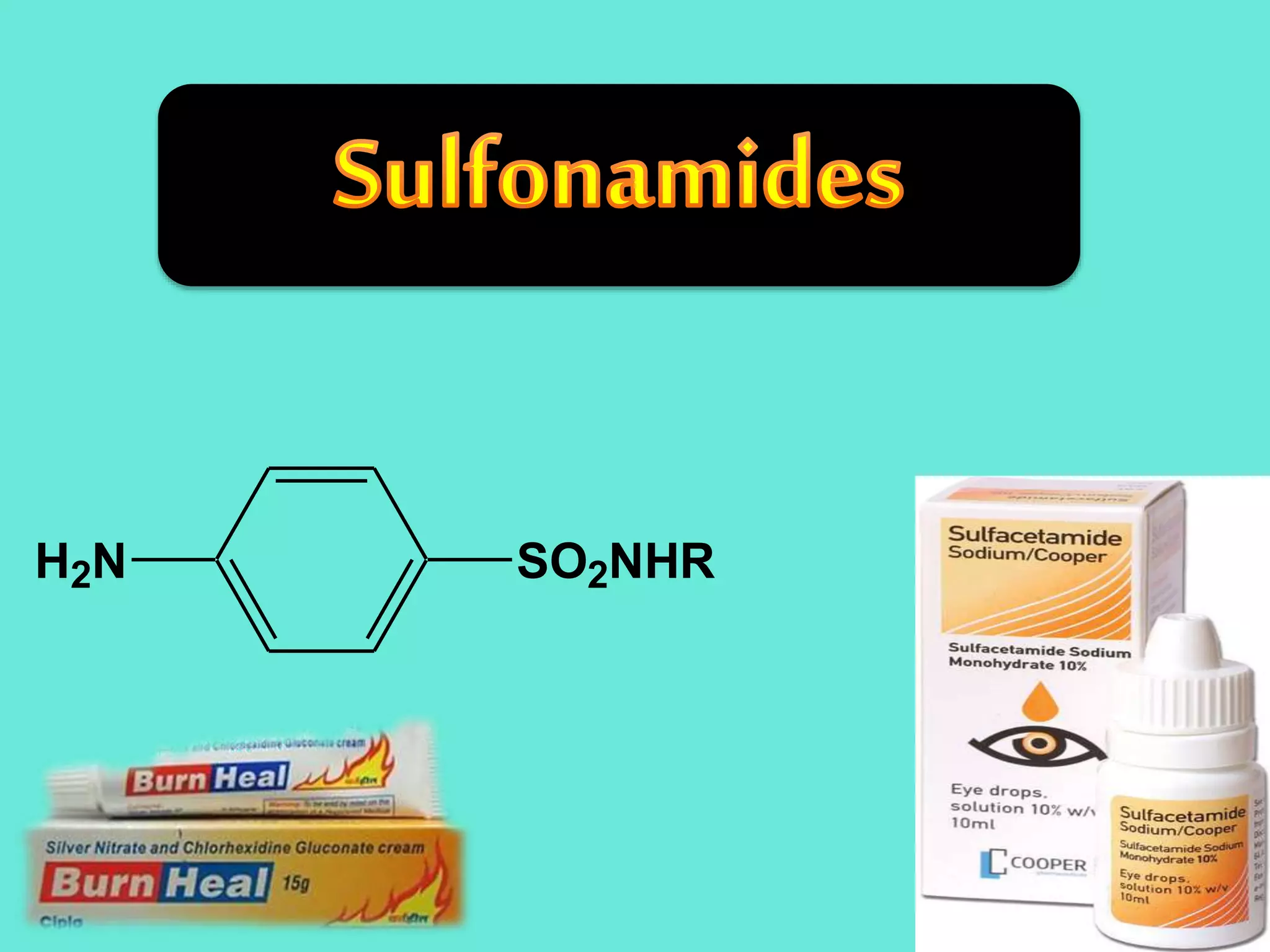
H2N SO2NHR
Anti-metabolites
• Drug interferes with endogenous metabolites
• Includes:-
• Sulfonamides
• Trimethoprim & iclaprim
• Pyrimethamine
• These are first synthetic antibacterial agents,
• Not Antibiotics (because antibiotics are obtained from some
fungi or bacteria)
• Used for coccal infection in 1935
• They are bacteriostatic because it inhibits bacterial synthesis
of folic acid
• They continue to occupy a small space in therapy
• Current utility- limited (Narrow spectrum)
Rapid emergence of bacterial resistance
superseded by more effective antibiotics
(Excpt-combination with trimethoprim & pyrimethamine)
 Physically – available as white powder, mildly acidic,
form water soluble salts with bases.
-:History:-
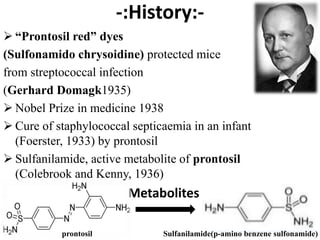
 “Prontosil red” dyes
(Sulfonamido chrysoidine) protected mice
from streptococcal infection
(Gerhard Domagk1935)
 Nobel Prize in medicine 1938
 Cure of staphylococcal septicaemia in an infant
(Foerster, 1933) by prontosil
 Sulfanilamide, active metabolite of prontosil
(Colebrook and Kenny, 1936)
 Metabolites
prontosil Sulfanilamide(p-amino benzene sulfonamide)
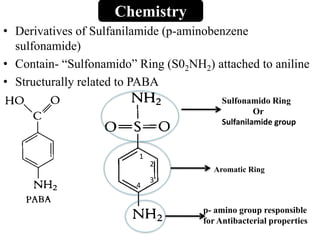
• Derivatives of Sulfanilamide (p-aminobenzene
sulfonamide)
• Contain- “Sulfonamido” Ring (S02NH2) attached to aniline
• Structurally related to PABA
Chemistry
Sulfonamido Ring
Or
Sulfanilamide group
Aromatic Ring
p- amino group responsible
for Antibacterial properties
1
2
3
4
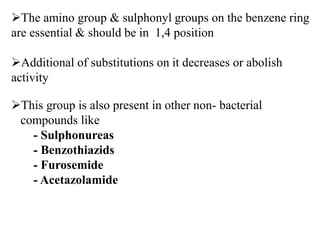
The amino group & sulphonyl groups on the benzene ring
are essential & should be in 1,4 position
Additional of substitutions on it decreases or abolish
activity
This group is also present in other non- bacterial
compounds like
- Sulphonureas
- Benzothiazids
- Furosemide
- Acetazolamide
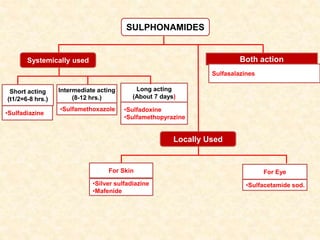
SULPHONAMIDES
Systemically used
Locally Used
Both action
Sulfasalazines
Short acting
(t1/2=6-8 hrs.)
•Sulfadiazine
Intermediate acting
(8-12 hrs.)
•Sulfamethoxazole
Long acting
(About 7 days)
•Sulfadoxine
•Sulfamethopyrazine
For Skin
•Silver sulfadiazine
•Mafenide
For Eye
•Sulfacetamide sod.
Mechanismof action
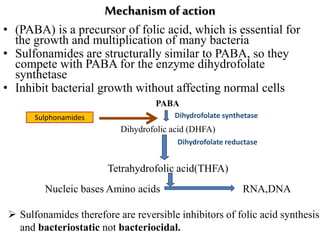
• (PABA) is a precursor of folic acid, which is essential for
the growth and multiplication of many bacteria
• Sulfonamides are structurally similar to PABA, so they
compete with PABA for the enzyme dihydrofolate
synthetase
• Inhibit bacterial growth without affecting normal cells
Tetrahydrofolic acid(THFA)
Nucleic bases Amino acids RNA,DNA
Dihydrofolate synthetase
Dihydrofolate reductase
Sulphonamides
 Sulfonamides therefore are reversible inhibitors of folic acid synthesis
and bacteriostatic not bacteriocidal.
Dihydrofolic acid (DHFA)
PABA
Antibacterial Spectrum
• Narrow spectrum Antibiotics-due to development
of resistance (Most Bacteria)
• Susceptible organisms include
– Strep. Pyogenes (septic infections)
– Strep. pneumoniae (pneumonia)
– Haemophilus influenzae (meningitis)
– H. ducreyi (chancroid)
– Toxoplasma
– Plasmodium sp.
Resistance to-staphylococci, Enterococci, Pseudomonas
• MIC-0.1 µg/ml for C. trachomatis
• 4 to 64 µg/ml for E. coli
Mainly given orally
Absorption-Rapidly absorbed from stomach and
small intestine.(70-100% absorption orally)
Distribution-Widely distributed to tissues and body
fluids ( including CNS, CSF ), placenta and fetus.
Absorbed sulfonamides bind to serum protein (
approx. 70% )
Displacement reaction- with bilirubin (↑conc.)
Metabolism →liver (acetylation).
Major metabolite –acetylated product (no
antibacterial action, but toxicity retained)
Excretion- in the urine
Pharmacokinetics
Therapeutic Uses
A.TOPICAL
1. Opthalmology:- ocular infections(conjunctivitis)
Sulfacetamide 10- 30% (eye drop or ointment)
2. Ulcerative colitis:- Sulfasalazine ( sulfapyridine+ 5-
amino salicylate )-( orally, not absorbed )
3. Infected burns:-
 Drugs-Mafenide acetate ( sulfamylon cream ),Silver
sulfadiazine
 Effective against p.aeruginosa
 Less effective against staphyllococci
B. ORAL
1. Pneumocystis carinii pneumonia **
2. Nocardiosis-sulfadiazine
(apart from amphicillin,Erythromycine,)
3. Toxoplasmosis-DOC
(Sulfadiazine+pyrimethamine)
4. RTIs ( H. influenza; S. pneumonia )
6. Acute otitis media in children
7. Prostatitis
8. Shigellosis
9. Falciparum malaria (chloroquine resistant)
Fansidar ( sulfadoxine+ pyrimethamine )
Adverse effects
• Urinary tract disturbances-acetylated product less soluble
in acidic urine leading to Crystalluria, haematuria, obstruction
Rx- 1.more water intake
2. Alkalizing urine
• Haemolytic anaemia- pt with G6PD deficiency -
Granulocytopenia etc
• Fever, skin rashes, dermatitis, photosensitivity, urticaria,
nausea, vomiting, diarrhoea
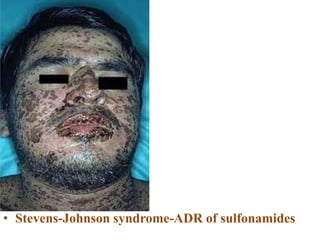
• Hypersensitivity (allergic) reactions like skin rashes,
Stevens-Johnson syndrome
• Cyanosis due to methaemoglobenemia
• Stevens-Johnson syndrome-ADR of sulfonamides
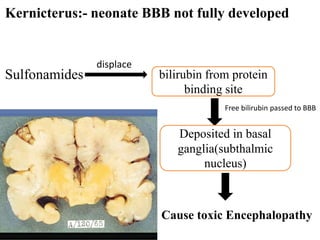
Kernicterus:- neonate BBB not fully developed
Sulfonamides
displace
bilirubin from protein
binding site
Deposited in basal
ganglia(subthalmic
nucleus)
Free bilirubin passed to BBB
Cause toxic Encephalopathy
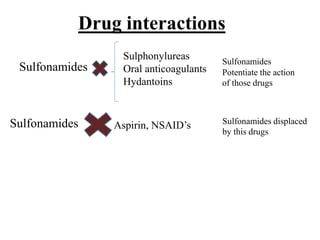
Drug interactions
Sulphonylureas
Oral anticoagulants
Hydantoins
Sulfonamides
Sulfonamides
Potentiate the action
of those drugs
Sulfonamides Aspirin, NSAID’s Sulfonamides displaced
by this drugs
Co-trimoxazole
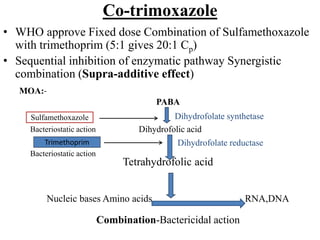
• WHO approve Fixed dose Combination of Sulfamethoxazole
with trimethoprim (5:1 gives 20:1 Cp)
• Sequential inhibition of enzymatic pathway Synergistic
combination (Supra-additive effect)
MOA:-
Tetrahydrofolic acid
Nucleic bases Amino acids RNA,DNA
Dihydrofolate synthetase
Dihydrofolate reductase
Sulfamethoxazole
Trimethoprim
Dihydrofolic acid
PABA
Bacteriostatic action
Combination-Bactericidal action
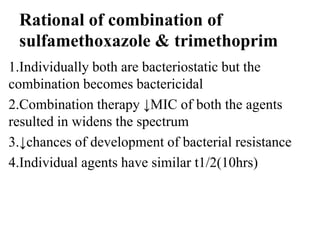
Rational of combination of
sulfamethoxazole & trimethoprim
1.Individually both are bacteriostatic but the
combination becomes bactericidal
2.Combination therapy ↓MIC of both the agents
resulted in widens the spectrum
3.↓chances of development of bacterial resistance
4.Individual agents have similar t1/2(10hrs)
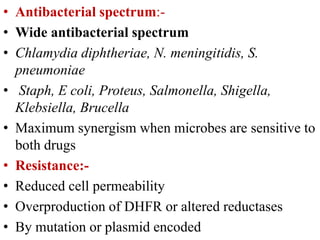
• Antibacterial spectrum:-
• Wide antibacterial spectrum
• Chlamydia diphtheriae, N. meningitidis, S.
pneumoniae
• Staph, E coli, Proteus, Salmonella, Shigella,
Klebsiella, Brucella
• Maximum synergism when microbes are sensitive to
both drugs
• Resistance:-
• Reduced cell permeability
• Overproduction of DHFR or altered reductases
• By mutation or plasmid encoded
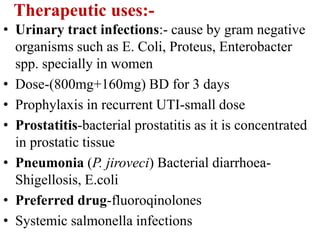
Therapeutic uses:-
• Urinary tract infections:- cause by gram negative
organisms such as E. Coli, Proteus, Enterobacter
spp. specially in women
• Dose-(800mg+160mg) BD for 3 days
• Prophylaxis in recurrent UTI-small dose
• Prostatitis-bacterial prostatitis as it is concentrated
in prostatic tissue
• Pneumonia (P. jiroveci) Bacterial diarrhoea-
Shigellosis, E.coli
• Preferred drug-fluoroqinolones
• Systemic salmonella infections
• Bacterial Respiratory tract infections- Acute &
chronic bronchitis due to s. pneumoniae, H
influenzae.
• Also effective against-maxillary sinusitis & otitis
media
• Typhoid fever- effective but fluoroquinolones
DOC
• Nocardiosis:-infection due to Nocardia spp.
• Chancroid:-cause by H.ducreyi.DOC is
Azithromycin as cotrimoxazole is equally effective
Adverse effects
• Megaloblastic anaemia
• Leukopenia, Granulocytopenia
• Drug fever, nausea, vomiting
• Renal damage, vasculitis
• Occasional CNS disturbances
Question paper discussion
Q1.Explain why:- (2M)
• Combination of sulfamethoxazole with trimethoprime
exhibits supradditive synergism
Q2.Classify sulfonamides and describe their mechanism of
action,side effects and therapeutic uses.discuss the rational of
combination of sulfamethoxazole & trimethoprim (15M)
Q3.Discuss the rational of using:- (4M)
Sulfamethoxazole with Trimethoprim
4.Write short notes on:- Cotrimoxazole
Quinolones
• Nalidixic acid-The first quinolone is a urinary antiseptic
but doesn’t contain fluorine
• It is useful in the treatment of uncomplicated UTI due to
gram-negative bacteria and diarrhea due to Shigella or
Salmonella.
• Fluoroquinolones -synthetic fluorinated analogues of
nalidixic acid
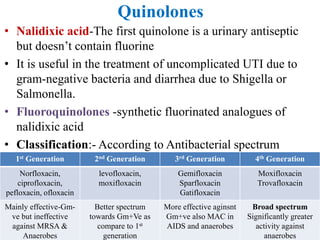
• Classification:- According to Antibacterial spectrum
1st Generation 2nd Generation 3rd Generation 4th Generation
Norfloxacin,
ciprofloxacin,
pefloxacin, ofloxacin
levofloxacin,
moxifloxacin
Gemifloxacin
Sparfloxacin
Gatifloxacin
Moxifloxacin
Trovafloxacin
Mainly effective-Gm-
ve but ineffective
against MRSA &
Anaerobes
Better spectrum
towards Gm+Ve as
compare to 1st
generation
More effective aginsnt
Gm+ve also MAC in
AIDS and anaerobes
Broad spectrum
Significantly greater
activity against
anaerobes
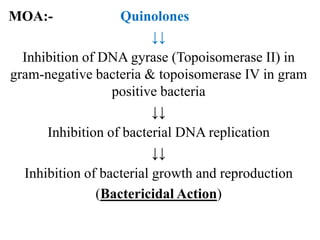
MOA:- Quinolones
↓↓
Inhibition of DNA gyrase (Topoisomerase II) in
gram-negative bacteria & topoisomerase IV in gram
positive bacteria
↓↓
Inhibition of bacterial DNA replication
↓↓
Inhibition of bacterial growth and reproduction
(Bactericidal Action)
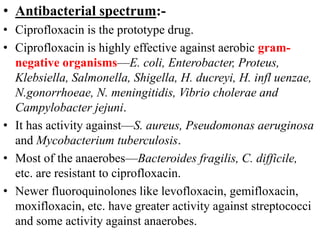
• Antibacterial spectrum:-
• Ciprofloxacin is the prototype drug.
• Ciprofloxacin is highly effective against aerobic gram-
negative organisms—E. coli, Enterobacter, Proteus,
Klebsiella, Salmonella, Shigella, H. ducreyi, H. infl uenzae,
N.gonorrhoeae, N. meningitidis, Vibrio cholerae and
Campylobacter jejuni.
• It has activity against—S. aureus, Pseudomonas aeruginosa
and Mycobacterium tuberculosis.
• Most of the anaerobes—Bacteroides fragilis, C. difficile,
etc. are resistant to ciprofloxacin.
• Newer fluoroquinolones like levofloxacin, gemifloxacin,
moxifloxacin, etc. have greater activity against streptococci
and some activity against anaerobes.
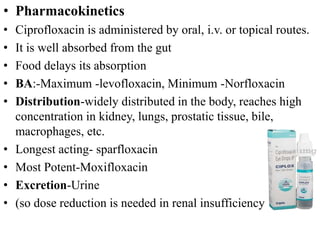
• Pharmacokinetics
• Ciprofloxacin is administered by oral, i.v. or topical routes.
• It is well absorbed from the gut
• Food delays its absorption
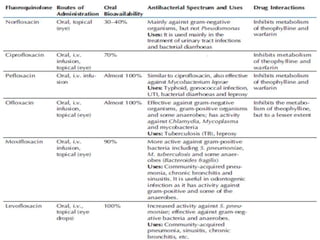
• BA:-Maximum -levofloxacin, Minimum -Norfloxacin
• Distribution-widely distributed in the body, reaches high
concentration in kidney, lungs, prostatic tissue, bile,
macrophages, etc.
• Longest acting- sparfloxacin
• Most Potent-Moxifloxacin
• Excretion-Urine
• (so dose reduction is needed in renal insufficiency
Side effects
• The common adverse effects are related to GI tract,
e.g. nausea, vomiting and abdominal discomfort.
• CNS effects:- include headache, dizziness, insomnia,
confusion, hallucinations and convulsions.
• Hypersensitivity reactions include skin rashes,
urticaria, itching, eosinophilia and photosensitivity
• Tenosynovitis and tendon rupture can occur,
especially in athletes.
• Moxifloxacin can cause prolongation of QT interval.
• Fluoroquinolones are contraindicated in pregnancy.
• Fluoroquinolones -caused cartilage damage in
animals, hence should be avoided in young children.
Drug interactions
• Ciprofloxacin × Theophylline, warfarin
Ciprofloxacin-inhibit theophylline & warfarin
metabolism leading to ↑Cp (toxicity)
• Fluoroquinolones × NSAIDs (potentiate the CNS
side effects of fluoroquinolones) confusion,
irritability and rarely convulsions may occur
• Fluoroquinolones × Tetracyclines, antacids,
ferrous salts and sucralfate
• ↓absorption of fluoroquinolones
Therapeutic uses
• UTI:- preferred over(superior) co-trimoxazole as
they are effective against gram-negative bacilli
such as E.coli, proteus & Enterobacter.
• Bacterial prostatitis-effective as they
concentrated in prostatic tissue (not responding to
co-trimoxazole)
• ciprofloxacin-750mg b.d. for 3 weeks
• Bacterial diarrhoeas:-caused
E.coli,shigella,salmonella
• Drugs-Norfloxacin, ciprofloxacin (3-5days)
• Travellers diarrhoea-(due to enterotoxins
produced by E.coli)-as effective as co-trimoxazole
• Typhoid fever(Enteric fever)- caused by
salmonella typhi
• DOC-Ciprofloxacin (750mg orally BD-for 10days)
• Other drugs-ofloxacin, levofloxacin
• Advantage:- prevents bacterial relapse
• STD(sextually transmitted disease):-
• Gonococcal infection- cause by N.gonorrhoea
• DOC-ceftriaxone (due to resistance)
• Chancroid-ciprofloxacin
• Chlamydial cervicitis & urethritis-
levofloxacin/ofloxacin
• Anthrax-ciprofloxacin (prophylaxis of anthrax)
• Skin,soft tissue and bone infections- due to S.
aureus & gram-Negative bacilli
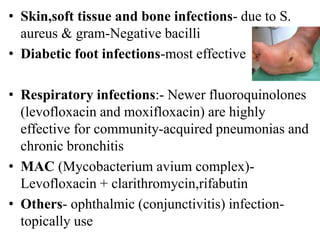
• Diabetic foot infections-most effective
• Respiratory infections:- Newer fluoroquinolones
(levofloxacin and moxifloxacin) are highly
effective for community-acquired pneumonias and
chronic bronchitis
• MAC (Mycobacterium avium complex)-
Levofloxacin + clarithromycin,rifabutin
• Others- ophthalmic (conjunctivitis) infection-
topically use
Question paper discussion
Q1.Fluoroquinolones (4M)
Q2.Classify quinolones. Discuss the Pharmacological
effects, side effects and clinical uses of ciprofloxacin
(8M/15M)
Q3.Discuss the therapeutic uses and Adverse effects
of: (4M)
A. Ciprofloxacin
B. Fluoroquinolones

Sulfonamides,CO-TRIMOXAZOLE,QUINOLONES

  • 1.
  • 2.
    Anti-metabolites • Drug interfereswith endogenous metabolites • Includes:- • Sulfonamides • Trimethoprim & iclaprim • Pyrimethamine
  • 3.
    • These arefirst synthetic antibacterial agents, • Not Antibiotics (because antibiotics are obtained from some fungi or bacteria) • Used for coccal infection in 1935 • They are bacteriostatic because it inhibits bacterial synthesis of folic acid • They continue to occupy a small space in therapy • Current utility- limited (Narrow spectrum) Rapid emergence of bacterial resistance superseded by more effective antibiotics (Excpt-combination with trimethoprim & pyrimethamine)  Physically – available as white powder, mildly acidic, form water soluble salts with bases.
  • 4.
    -:History:-  “Prontosil red”dyes (Sulfonamido chrysoidine) protected mice from streptococcal infection (Gerhard Domagk1935)  Nobel Prize in medicine 1938  Cure of staphylococcal septicaemia in an infant (Foerster, 1933) by prontosil  Sulfanilamide, active metabolite of prontosil (Colebrook and Kenny, 1936)  Metabolites prontosil Sulfanilamide(p-amino benzene sulfonamide)
  • 5.
    • Derivatives ofSulfanilamide (p-aminobenzene sulfonamide) • Contain- “Sulfonamido” Ring (S02NH2) attached to aniline • Structurally related to PABA Chemistry Sulfonamido Ring Or Sulfanilamide group Aromatic Ring p- amino group responsible for Antibacterial properties 1 2 3 4
  • 6.
    The amino group& sulphonyl groups on the benzene ring are essential & should be in 1,4 position Additional of substitutions on it decreases or abolish activity This group is also present in other non- bacterial compounds like - Sulphonureas - Benzothiazids - Furosemide - Acetazolamide
  • 7.
    SULPHONAMIDES Systemically used Locally Used Bothaction Sulfasalazines Short acting (t1/2=6-8 hrs.) •Sulfadiazine Intermediate acting (8-12 hrs.) •Sulfamethoxazole Long acting (About 7 days) •Sulfadoxine •Sulfamethopyrazine For Skin •Silver sulfadiazine •Mafenide For Eye •Sulfacetamide sod.
  • 8.
    Mechanismof action • (PABA)is a precursor of folic acid, which is essential for the growth and multiplication of many bacteria • Sulfonamides are structurally similar to PABA, so they compete with PABA for the enzyme dihydrofolate synthetase • Inhibit bacterial growth without affecting normal cells Tetrahydrofolic acid(THFA) Nucleic bases Amino acids RNA,DNA Dihydrofolate synthetase Dihydrofolate reductase Sulphonamides  Sulfonamides therefore are reversible inhibitors of folic acid synthesis and bacteriostatic not bacteriocidal. Dihydrofolic acid (DHFA) PABA
  • 9.
    Antibacterial Spectrum • Narrowspectrum Antibiotics-due to development of resistance (Most Bacteria) • Susceptible organisms include – Strep. Pyogenes (septic infections) – Strep. pneumoniae (pneumonia) – Haemophilus influenzae (meningitis) – H. ducreyi (chancroid) – Toxoplasma – Plasmodium sp. Resistance to-staphylococci, Enterococci, Pseudomonas • MIC-0.1 µg/ml for C. trachomatis • 4 to 64 µg/ml for E. coli
  • 10.
    Mainly given orally Absorption-Rapidlyabsorbed from stomach and small intestine.(70-100% absorption orally) Distribution-Widely distributed to tissues and body fluids ( including CNS, CSF ), placenta and fetus. Absorbed sulfonamides bind to serum protein ( approx. 70% ) Displacement reaction- with bilirubin (↑conc.) Metabolism →liver (acetylation). Major metabolite –acetylated product (no antibacterial action, but toxicity retained) Excretion- in the urine Pharmacokinetics
  • 11.
    Therapeutic Uses A.TOPICAL 1. Opthalmology:-ocular infections(conjunctivitis) Sulfacetamide 10- 30% (eye drop or ointment) 2. Ulcerative colitis:- Sulfasalazine ( sulfapyridine+ 5- amino salicylate )-( orally, not absorbed ) 3. Infected burns:-  Drugs-Mafenide acetate ( sulfamylon cream ),Silver sulfadiazine  Effective against p.aeruginosa  Less effective against staphyllococci
  • 12.
    B. ORAL 1. Pneumocystiscarinii pneumonia ** 2. Nocardiosis-sulfadiazine (apart from amphicillin,Erythromycine,) 3. Toxoplasmosis-DOC (Sulfadiazine+pyrimethamine) 4. RTIs ( H. influenza; S. pneumonia ) 6. Acute otitis media in children 7. Prostatitis 8. Shigellosis 9. Falciparum malaria (chloroquine resistant) Fansidar ( sulfadoxine+ pyrimethamine )
  • 13.
    Adverse effects • Urinarytract disturbances-acetylated product less soluble in acidic urine leading to Crystalluria, haematuria, obstruction Rx- 1.more water intake 2. Alkalizing urine • Haemolytic anaemia- pt with G6PD deficiency - Granulocytopenia etc • Fever, skin rashes, dermatitis, photosensitivity, urticaria, nausea, vomiting, diarrhoea • Hypersensitivity (allergic) reactions like skin rashes, Stevens-Johnson syndrome • Cyanosis due to methaemoglobenemia
  • 14.
  • 15.
    Kernicterus:- neonate BBBnot fully developed Sulfonamides displace bilirubin from protein binding site Deposited in basal ganglia(subthalmic nucleus) Free bilirubin passed to BBB Cause toxic Encephalopathy
  • 16.
    Drug interactions Sulphonylureas Oral anticoagulants Hydantoins Sulfonamides Sulfonamides Potentiatethe action of those drugs Sulfonamides Aspirin, NSAID’s Sulfonamides displaced by this drugs
  • 17.
    Co-trimoxazole • WHO approveFixed dose Combination of Sulfamethoxazole with trimethoprim (5:1 gives 20:1 Cp) • Sequential inhibition of enzymatic pathway Synergistic combination (Supra-additive effect) MOA:- Tetrahydrofolic acid Nucleic bases Amino acids RNA,DNA Dihydrofolate synthetase Dihydrofolate reductase Sulfamethoxazole Trimethoprim Dihydrofolic acid PABA Bacteriostatic action Bacteriostatic action Combination-Bactericidal action
  • 18.
    Rational of combinationof sulfamethoxazole & trimethoprim 1.Individually both are bacteriostatic but the combination becomes bactericidal 2.Combination therapy ↓MIC of both the agents resulted in widens the spectrum 3.↓chances of development of bacterial resistance 4.Individual agents have similar t1/2(10hrs)
  • 19.
    • Antibacterial spectrum:- •Wide antibacterial spectrum • Chlamydia diphtheriae, N. meningitidis, S. pneumoniae • Staph, E coli, Proteus, Salmonella, Shigella, Klebsiella, Brucella • Maximum synergism when microbes are sensitive to both drugs • Resistance:- • Reduced cell permeability • Overproduction of DHFR or altered reductases • By mutation or plasmid encoded
  • 20.
    Therapeutic uses:- • Urinarytract infections:- cause by gram negative organisms such as E. Coli, Proteus, Enterobacter spp. specially in women • Dose-(800mg+160mg) BD for 3 days • Prophylaxis in recurrent UTI-small dose • Prostatitis-bacterial prostatitis as it is concentrated in prostatic tissue • Pneumonia (P. jiroveci) Bacterial diarrhoea- Shigellosis, E.coli • Preferred drug-fluoroqinolones • Systemic salmonella infections
  • 21.
    • Bacterial Respiratorytract infections- Acute & chronic bronchitis due to s. pneumoniae, H influenzae. • Also effective against-maxillary sinusitis & otitis media • Typhoid fever- effective but fluoroquinolones DOC • Nocardiosis:-infection due to Nocardia spp. • Chancroid:-cause by H.ducreyi.DOC is Azithromycin as cotrimoxazole is equally effective
  • 22.
    Adverse effects • Megaloblasticanaemia • Leukopenia, Granulocytopenia • Drug fever, nausea, vomiting • Renal damage, vasculitis • Occasional CNS disturbances
  • 23.
    Question paper discussion Q1.Explainwhy:- (2M) • Combination of sulfamethoxazole with trimethoprime exhibits supradditive synergism Q2.Classify sulfonamides and describe their mechanism of action,side effects and therapeutic uses.discuss the rational of combination of sulfamethoxazole & trimethoprim (15M) Q3.Discuss the rational of using:- (4M) Sulfamethoxazole with Trimethoprim 4.Write short notes on:- Cotrimoxazole
  • 24.
    Quinolones • Nalidixic acid-Thefirst quinolone is a urinary antiseptic but doesn’t contain fluorine • It is useful in the treatment of uncomplicated UTI due to gram-negative bacteria and diarrhea due to Shigella or Salmonella. • Fluoroquinolones -synthetic fluorinated analogues of nalidixic acid • Classification:- According to Antibacterial spectrum 1st Generation 2nd Generation 3rd Generation 4th Generation Norfloxacin, ciprofloxacin, pefloxacin, ofloxacin levofloxacin, moxifloxacin Gemifloxacin Sparfloxacin Gatifloxacin Moxifloxacin Trovafloxacin Mainly effective-Gm- ve but ineffective against MRSA & Anaerobes Better spectrum towards Gm+Ve as compare to 1st generation More effective aginsnt Gm+ve also MAC in AIDS and anaerobes Broad spectrum Significantly greater activity against anaerobes
  • 25.
    MOA:- Quinolones ↓↓ Inhibition ofDNA gyrase (Topoisomerase II) in gram-negative bacteria & topoisomerase IV in gram positive bacteria ↓↓ Inhibition of bacterial DNA replication ↓↓ Inhibition of bacterial growth and reproduction (Bactericidal Action)
  • 26.
    • Antibacterial spectrum:- •Ciprofloxacin is the prototype drug. • Ciprofloxacin is highly effective against aerobic gram- negative organisms—E. coli, Enterobacter, Proteus, Klebsiella, Salmonella, Shigella, H. ducreyi, H. infl uenzae, N.gonorrhoeae, N. meningitidis, Vibrio cholerae and Campylobacter jejuni. • It has activity against—S. aureus, Pseudomonas aeruginosa and Mycobacterium tuberculosis. • Most of the anaerobes—Bacteroides fragilis, C. difficile, etc. are resistant to ciprofloxacin. • Newer fluoroquinolones like levofloxacin, gemifloxacin, moxifloxacin, etc. have greater activity against streptococci and some activity against anaerobes.
  • 27.
    • Pharmacokinetics • Ciprofloxacinis administered by oral, i.v. or topical routes. • It is well absorbed from the gut • Food delays its absorption • BA:-Maximum -levofloxacin, Minimum -Norfloxacin • Distribution-widely distributed in the body, reaches high concentration in kidney, lungs, prostatic tissue, bile, macrophages, etc. • Longest acting- sparfloxacin • Most Potent-Moxifloxacin • Excretion-Urine • (so dose reduction is needed in renal insufficiency
  • 29.
    Side effects • Thecommon adverse effects are related to GI tract, e.g. nausea, vomiting and abdominal discomfort. • CNS effects:- include headache, dizziness, insomnia, confusion, hallucinations and convulsions. • Hypersensitivity reactions include skin rashes, urticaria, itching, eosinophilia and photosensitivity • Tenosynovitis and tendon rupture can occur, especially in athletes. • Moxifloxacin can cause prolongation of QT interval. • Fluoroquinolones are contraindicated in pregnancy. • Fluoroquinolones -caused cartilage damage in animals, hence should be avoided in young children.
  • 30.
    Drug interactions • Ciprofloxacin× Theophylline, warfarin Ciprofloxacin-inhibit theophylline & warfarin metabolism leading to ↑Cp (toxicity) • Fluoroquinolones × NSAIDs (potentiate the CNS side effects of fluoroquinolones) confusion, irritability and rarely convulsions may occur • Fluoroquinolones × Tetracyclines, antacids, ferrous salts and sucralfate • ↓absorption of fluoroquinolones
  • 31.
    Therapeutic uses • UTI:-preferred over(superior) co-trimoxazole as they are effective against gram-negative bacilli such as E.coli, proteus & Enterobacter. • Bacterial prostatitis-effective as they concentrated in prostatic tissue (not responding to co-trimoxazole) • ciprofloxacin-750mg b.d. for 3 weeks • Bacterial diarrhoeas:-caused E.coli,shigella,salmonella • Drugs-Norfloxacin, ciprofloxacin (3-5days) • Travellers diarrhoea-(due to enterotoxins produced by E.coli)-as effective as co-trimoxazole
  • 32.
    • Typhoid fever(Entericfever)- caused by salmonella typhi • DOC-Ciprofloxacin (750mg orally BD-for 10days) • Other drugs-ofloxacin, levofloxacin • Advantage:- prevents bacterial relapse • STD(sextually transmitted disease):- • Gonococcal infection- cause by N.gonorrhoea • DOC-ceftriaxone (due to resistance) • Chancroid-ciprofloxacin • Chlamydial cervicitis & urethritis- levofloxacin/ofloxacin • Anthrax-ciprofloxacin (prophylaxis of anthrax)
  • 33.
    • Skin,soft tissueand bone infections- due to S. aureus & gram-Negative bacilli • Diabetic foot infections-most effective • Respiratory infections:- Newer fluoroquinolones (levofloxacin and moxifloxacin) are highly effective for community-acquired pneumonias and chronic bronchitis • MAC (Mycobacterium avium complex)- Levofloxacin + clarithromycin,rifabutin • Others- ophthalmic (conjunctivitis) infection- topically use
  • 34.
    Question paper discussion Q1.Fluoroquinolones(4M) Q2.Classify quinolones. Discuss the Pharmacological effects, side effects and clinical uses of ciprofloxacin (8M/15M) Q3.Discuss the therapeutic uses and Adverse effects of: (4M) A. Ciprofloxacin B. Fluoroquinolones

Editor's Notes

  • #13 Nocardiosis-bacteria found in soil and wate. It can affect the lungs, brain, and skin. It is most common in people with weakened immune systems who have difficulty fighting off infections Toxoplasmosis- results from infection with a common parasite found in cat faeces and contaminated food. Toxoplasma gondii parasite
  • #18 Trimethoprim-large vol of distribution & attend lower plasma concentration Combination-↓MIC-wide spectrum of activity
  • #26 Nicking .formation of negative supercoils and resealing of strands of DNA-Top-II Nicking & separation of daughter DNA strand following DNA replication-Top-IV
  • #27 Strep.pneumoniae,anerobic infection,leprosy-not effective ciprox