Aminoglycosides
1
Learning objectives
• What are aminoglycosides and their distinctive features?
• Classification
• Pharmacokinetics
• Mechanism of action
• Resistance
• Spectrum
• Indications
• Adverse effects
• Drug-drug interaction
• contraindications 2
Introduction
• Consist of two or more amino sugars attached by glycoside
linkage to hexose ring.
• Streptomycin was the first to be discovered in 1944
• Actinomycetes –Streptomyces griseus
• Source: various species of Streptomyces
• Interfere with protein synthesis
• Bactericidal
• Used to treat serious infections caused by aerobic Gram –ve
bacteria
• Sulfate salt
• All exhibit ototoxicity and nephrotoxicity
3
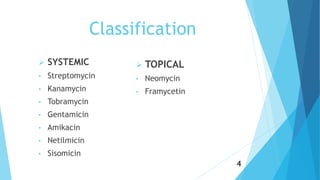
Classification
 SYSTEMIC
• Streptomycin
• Kanamycin
• Tobramycin
• Gentamicin
• Amikacin
• Netilmicin
• Sisomicin
 TOPICAL
• Neomycin
• Framycetin
4
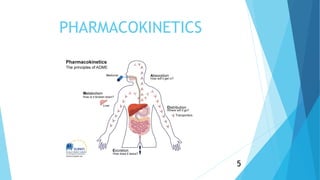
PHARMACOKINETICS
5
Pharmacokinetics
• ABSORPTION: Polycationic(very high charge),highly polar, not
absorbed or destroyed by GIT, Usually given subcutaneously, IM,
IV and sometimes Intrathecally. Topical application are also
available.
Bactericidal effect is conc. dependent.
• Distribution: Mainly distributed into extracellular fluid. Poorly
penetrate into CSF.Some of them cross the placental barrier.
• METABOLISM: They are not metabolized in the body.
• Half life: 2-3hrs
• EXCRETION: Excreted as such in urine by glomerular filtration.
Accumulation occur with renal failure. 6
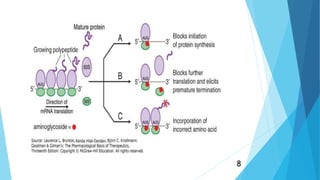
Mechanism of Action
• Initially they penetrate bacterial cell wall to reach
periplasmic space through porin channel
• Further transport across cytoplasmic membrane takes
place by oxygen dependent active transport
mechanism
• Bind with 30s ribosomal subunit.
• Protein synthesis is inhibited by 3 ways.
 Interference with initiation complex of peptide
formation
 Misreading of mRNA
 Breakup of polysomes into nonfunctional
monosomes/inhibiting translocation
7
8
9
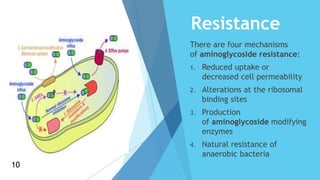
Resistance
There are four mechanisms
of aminoglycoside resistance:
1. Reduced uptake or
decreased cell permeability
2. Alterations at the ribosomal
binding sites
3. Production
of aminoglycoside modifying
enzymes
4. Natural resistance of
anaerobic bacteria
10
10
Spectrum
 Delibratory designed for Gram –ve coverage
• Pseudomonas aeruginosa
• Klebsiella
• Proteus
• E.coli
• Yersinia pestis
 Gram +ve
• Cocci
• Staphylococci
• Staphylococcus aureus 11
 Gram +ve anaerobes
• Resistant to anaerobes except clostridia
 Mycobacterium tuberculosis
• Streptomycin is 1st line treatment
12
Indications
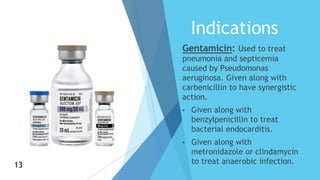
Gentamicin: Used to treat
pneumonia and septicemia
caused by Pseudomonas
aeruginosa. Given along with
carbenicillin to have synergistic
action.
• Given along with
benzylpenicillin to treat
bacterial endocarditis.
• Given along with
metronidazole or clindamycin
to treat anaerobic infection.13
13
• Cephalosporin/ureidopenicillin/t
icarcillin is combined with
gentamycin to treat infection
caused by Gram –ve bacteria.
• Applied locally to treat wounds,
infections and burns.
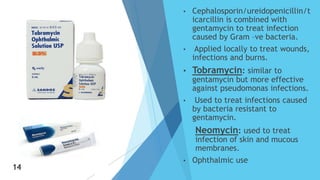
• Tobramycin: similar to
gentamycin but more effective
against pseudomonas infections.
• Used to treat infections caused
by bacteria resistant to
gentamycin.
 Neomycin: used to treat
infection of skin and mucous
membranes.
• Ophthalmic use14
14
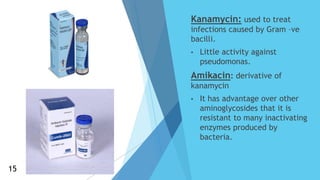
Kanamycin: used to treat
infections caused by Gram –ve
bacilli.
• Little activity against
pseudomonas.
Amikacin: derivative of
kanamycin
• It has advantage over other
aminoglycosides that it is
resistant to many inactivating
enzymes produced by
bacteria.
15
15
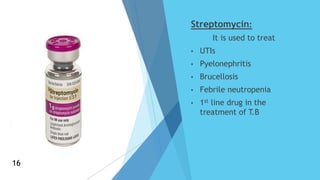
Streptomycin:
It is used to treat
• UTIs
• Pyelonephritis
• Brucellosis
• Febrile neutropenia
• 1st line drug in the
treatment of T.B
1616
Adverse Effects
 Ototoxicity: It is of 2
types
1. Vestibular damage
2. Cochlear damage
It is due to VIII cranial
nerve damage.
Drug accumulate in
endolymph and perilymph of
inner ear which can lead to
progressive damage to
vestibular & cochlear hear
cells.
17
17
• Kanamycin, Amikacin, Netilmicin and Neomycin may
effect the auditory functions, which leads to tinnitus,
high frequency hearing loss and deafness.
• Gentamycin and Streptomycin mainly effect the
vestibular function. There is nausea, vomiting and
difficulty in standing, vertigo, nystagmus(involuntary
movements of eyeball).
• Tobramycin effect both.
Risk factors:
 elderly
 Co-current use of other ototoxic drugs i.e. vancomycin,
loop diuretics
 Pre-existing auditory impairment
 Increase conc.of drug in plasma
18
Nephrotoxicity: Aminoglycosides
get concentrated in renal cortex.
Retention of aminoglycosides by
proximal tubular cells disrupt
calcium mediated transport process
and result in kidney damage ranging
from mild, reversible renal
impairment to severe acute tubular
necrosis which can be irreversible.
• Gentamicin, Neomycin, Amikacin
are nephrotoxic.
• Neomycin is more nephrotoxic.
19
19
Neurotoxicity: These drugs
cause neuromuscular blockade
which leads to skeletal muscle
weakness and respiratory
depression.
• Neuromuscular blockade is
due to Gentamycin and
Amikacin.
• They inhibit pre-synaptic
release of Ach.
• They inhibit post-synaptic
nicotinic receptors.
• Displace Calcium from NM
junction
20
20
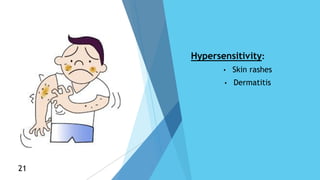
Hypersensitivity:
• Skin rashes
• Dermatitis
21
21
Drug-Drug interaction
• Neuromuscular blockage may increase when amino
glycosides are given to patients who have received
anesthetics (halogenated hydrocarbon).
• Frusemide potentiate the ototoxic and nephrotoxic
effects of aminoglycosides.
• Neomycin destroys the vitamin K producing bacteria in
the gut. It thus potentiate the effects of oral
anticoagulants.
22
Contraindications
• Pregnancy: as they cross placenta and can cause fetal
abnormalities.
• Co-current administration of nephrotoxic drugs should be
avoided.
• Neuromuscular blocking agents should not be given along
with aminoglycosides because this will lead to respiratory
depression.
• With other ototoxic drugs
• Elderly patient
23
24
25

Aminoglycosides

  • 1.
  • 2.
    Learning objectives • Whatare aminoglycosides and their distinctive features? • Classification • Pharmacokinetics • Mechanism of action • Resistance • Spectrum • Indications • Adverse effects • Drug-drug interaction • contraindications 2
  • 3.
    Introduction • Consist oftwo or more amino sugars attached by glycoside linkage to hexose ring. • Streptomycin was the first to be discovered in 1944 • Actinomycetes –Streptomyces griseus • Source: various species of Streptomyces • Interfere with protein synthesis • Bactericidal • Used to treat serious infections caused by aerobic Gram –ve bacteria • Sulfate salt • All exhibit ototoxicity and nephrotoxicity 3
  • 4.
    Classification  SYSTEMIC • Streptomycin •Kanamycin • Tobramycin • Gentamicin • Amikacin • Netilmicin • Sisomicin  TOPICAL • Neomycin • Framycetin 4
  • 5.
  • 6.
    Pharmacokinetics • ABSORPTION: Polycationic(veryhigh charge),highly polar, not absorbed or destroyed by GIT, Usually given subcutaneously, IM, IV and sometimes Intrathecally. Topical application are also available. Bactericidal effect is conc. dependent. • Distribution: Mainly distributed into extracellular fluid. Poorly penetrate into CSF.Some of them cross the placental barrier. • METABOLISM: They are not metabolized in the body. • Half life: 2-3hrs • EXCRETION: Excreted as such in urine by glomerular filtration. Accumulation occur with renal failure. 6
  • 7.
    Mechanism of Action •Initially they penetrate bacterial cell wall to reach periplasmic space through porin channel • Further transport across cytoplasmic membrane takes place by oxygen dependent active transport mechanism • Bind with 30s ribosomal subunit. • Protein synthesis is inhibited by 3 ways.  Interference with initiation complex of peptide formation  Misreading of mRNA  Breakup of polysomes into nonfunctional monosomes/inhibiting translocation 7
  • 8.
  • 9.
  • 10.
    Resistance There are fourmechanisms of aminoglycoside resistance: 1. Reduced uptake or decreased cell permeability 2. Alterations at the ribosomal binding sites 3. Production of aminoglycoside modifying enzymes 4. Natural resistance of anaerobic bacteria 10 10
  • 11.
    Spectrum  Delibratory designedfor Gram –ve coverage • Pseudomonas aeruginosa • Klebsiella • Proteus • E.coli • Yersinia pestis  Gram +ve • Cocci • Staphylococci • Staphylococcus aureus 11
  • 12.
     Gram +veanaerobes • Resistant to anaerobes except clostridia  Mycobacterium tuberculosis • Streptomycin is 1st line treatment 12
  • 13.
    Indications Gentamicin: Used totreat pneumonia and septicemia caused by Pseudomonas aeruginosa. Given along with carbenicillin to have synergistic action. • Given along with benzylpenicillin to treat bacterial endocarditis. • Given along with metronidazole or clindamycin to treat anaerobic infection.13 13
  • 14.
    • Cephalosporin/ureidopenicillin/t icarcillin iscombined with gentamycin to treat infection caused by Gram –ve bacteria. • Applied locally to treat wounds, infections and burns. • Tobramycin: similar to gentamycin but more effective against pseudomonas infections. • Used to treat infections caused by bacteria resistant to gentamycin.  Neomycin: used to treat infection of skin and mucous membranes. • Ophthalmic use14 14
  • 15.
    Kanamycin: used totreat infections caused by Gram –ve bacilli. • Little activity against pseudomonas. Amikacin: derivative of kanamycin • It has advantage over other aminoglycosides that it is resistant to many inactivating enzymes produced by bacteria. 15 15
  • 16.
    Streptomycin: It is usedto treat • UTIs • Pyelonephritis • Brucellosis • Febrile neutropenia • 1st line drug in the treatment of T.B 1616
  • 17.
    Adverse Effects  Ototoxicity:It is of 2 types 1. Vestibular damage 2. Cochlear damage It is due to VIII cranial nerve damage. Drug accumulate in endolymph and perilymph of inner ear which can lead to progressive damage to vestibular & cochlear hear cells. 17 17
  • 18.
    • Kanamycin, Amikacin,Netilmicin and Neomycin may effect the auditory functions, which leads to tinnitus, high frequency hearing loss and deafness. • Gentamycin and Streptomycin mainly effect the vestibular function. There is nausea, vomiting and difficulty in standing, vertigo, nystagmus(involuntary movements of eyeball). • Tobramycin effect both. Risk factors:  elderly  Co-current use of other ototoxic drugs i.e. vancomycin, loop diuretics  Pre-existing auditory impairment  Increase conc.of drug in plasma 18
  • 19.
    Nephrotoxicity: Aminoglycosides get concentratedin renal cortex. Retention of aminoglycosides by proximal tubular cells disrupt calcium mediated transport process and result in kidney damage ranging from mild, reversible renal impairment to severe acute tubular necrosis which can be irreversible. • Gentamicin, Neomycin, Amikacin are nephrotoxic. • Neomycin is more nephrotoxic. 19 19
  • 20.
    Neurotoxicity: These drugs causeneuromuscular blockade which leads to skeletal muscle weakness and respiratory depression. • Neuromuscular blockade is due to Gentamycin and Amikacin. • They inhibit pre-synaptic release of Ach. • They inhibit post-synaptic nicotinic receptors. • Displace Calcium from NM junction 20 20
  • 21.
  • 22.
    Drug-Drug interaction • Neuromuscularblockage may increase when amino glycosides are given to patients who have received anesthetics (halogenated hydrocarbon). • Frusemide potentiate the ototoxic and nephrotoxic effects of aminoglycosides. • Neomycin destroys the vitamin K producing bacteria in the gut. It thus potentiate the effects of oral anticoagulants. 22
  • 23.
    Contraindications • Pregnancy: asthey cross placenta and can cause fetal abnormalities. • Co-current administration of nephrotoxic drugs should be avoided. • Neuromuscular blocking agents should not be given along with aminoglycosides because this will lead to respiratory depression. • With other ototoxic drugs • Elderly patient 23
  • 24.
  • 25.