Miscellaneous Antimicrobials
Dr.Arka Mondal
Assistant Professor
(Pharmacology)
-:LINCOSAMIDE ANTIBIOTICS:-
• Derivatives of amino acid & a sulfur containing galactosidase
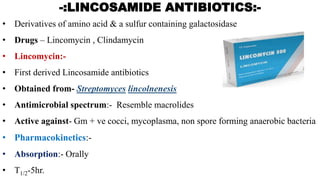
• Drugs – Lincomycin , Clindamycin
• Lincomycin:-
• First derived Lincosamide antibiotics
• Obtained from- Streptomyces lincolnenesis
• Antimicrobial spectrum:- Resemble macrolides
• Active against- Gm + ve cocci, mycoplasma, non spore forming anaerobic bacteria
• Pharmacokinetics:-
• Absorption:- Orally
• T1/2-5hr.
• Excretion:- Bile
• MOA:- Inhibit Protein synthesis by binding to 50S ribosomal subunit
• Less potent & higher incidence of Diarrhoea, colitis, Death
• Thus replaced by Clindamycin
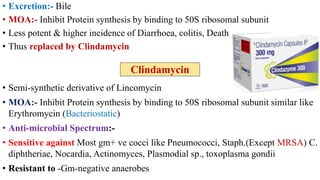
• Semi-synthetic derivative of Lincomycin
• MOA:- Inhibit Protein synthesis by binding to 50S ribosomal subunit similar like
Erythromycin (Bacteriostatic)
• Anti-microbial Spectrum:-
• Sensitive against Most gm+ ve cocci like Pneumococci, Staph.(Except MRSA) C.
diphtheriae, Nocardia, Actinomyces, Plasmodial sp., toxoplasma gondii
• Resistant to -Gm-negative anaerobes
Clindamycin
• Resistance develop due to- Methylation of bacterial RNA in 50S unit
• Pharmacokinetics:-
Absorption-orally
T1/2-3hr.
Distribution- widely in body fluid, bone, phagocytes
Cross placental barrier
PPB- 90%
Metabolism-liver (N-dimethyl-clindamycin)
Excretion-urine, bile
In severe hepatic failure (dose adjustment)
• Therapeutic use:-
Skin and Soft-Tissue Infections:-
Especially in patients with β-lactam allergies, in Acne (as topically)
In gas gangrene by toxin-producing bacteria (e.g., streptococci, staphylococci,
clostridia)→ as Adjuvant therapy
Respiratory Tract Infections:-
Lung abscess, pleural space infections due to susceptible organisms
In AIDS patients:-
(1.) For P. jiroveci pneumonia-(Clindamycin + Primaquine)
(2.) For toxoplasmosis-(Clindamycin + Pyrimethamine)
Others:-
Prophylaxis of Bacterial endocarditis –in pt. allergic to penicillin
Pelvic, abdominal abscess
Bacterial vaginosis-vaginally
Osteomyelitis-use due to excellent bone penetration (as a alternative drug)
• Adverse effects:-
• Pseudomembranous colitis (superinfection) –due to toxin release by growth of
clost. difficile which alter gut flora
• Presented with diarrhoea with blood and mucus in the stools, fever, Abdominal
pain
• Rx- stoppage of drug
• Treated with metronidazole
• Skin rashes,
• Safe during pregnancy
GLYCOPEPTIDE ANTIBIOTICS:-
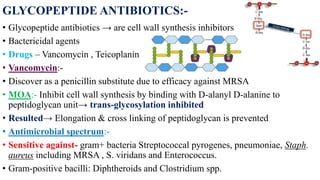
• Glycopeptide antibiotics → are cell wall synthesis inhibitors
• Bactericidal agents
• Drugs – Vancomycin , Teicoplanin
• Vancomycin:-
• Discover as a penicillin substitute due to efficacy against MRSA
• MOA:- Inhibit cell wall synthesis by binding with D-alanyl D-alanine to
peptidoglycan unit→ trans-glycosylation inhibited
• Resulted→ Elongation & cross linking of peptidoglycan is prevented
• Antimicrobial spectrum:-
• Sensitive against- gram+ bacteria Streptococcal pyrogenes, pneumoniae, Staph.
aureus including MRSA , S. viridans and Enterococcus.
• Gram-positive bacilli: Diphtheroids and Clostridium spp.
• Pharmacokinetics:-
• Absorption-poor so not preferred orally (Except-pseudomembranous colitis)
• T1/2-6hr.
• Distribution:-enters various body fluid like pleural, Pericardial, bile, CNS (in
meningitis)
• Metabolism- Liver
• Excretion- kidney
• USES:-
• MRSA infection (pneumonia, endocarditis, soft tissue abscess) →DOC
• Pseudomembranous colitis- not responding to Metronidazole (DOC)
Dose -125-250mg QID
• Enterococcus endocarditis→ Vancomycin+ Aminoglycoside
Adverse effect:-
• Systemic toxicity is high
• Skin rashes & ↓BP during IV injection (due to histamine release)
• Pain & phlebitis at site of injection
• “Red man syndrome or Red Neck syndrome” –orange discoloration of skin,
fluid, mucosal surface
• Upon Rapid i.v. injection→ due to histamine release
• Symptoms:- Chills, fever, urticaria, intense flushing
Treatment:- prevented by prolonging the infusion period by 1-2hrs.
• Nephrotoxicity
• Dose dependent ototoxicity
• Teicoplanin:-
• Chemical structure ,mechanism spectrum same as vancomycin
• More active against enterococcus sp. than vancomycin
• Highly bound to plasma protein
• T1/2-50hr.
• Used by i.v. or i.m. route in MRSA , MSSA
• Active against Vancomycin resistant enterococci (VRE)
• Safer than vancomycin
• Telavancin:-
• Semisynthetic derivatives of vancomycin
• Effective against→ VRSA
• MOA-same to vancomycin ‘
• Teratogenic & t1/2-8hr.
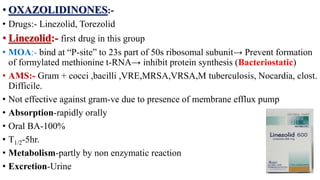
• OXAZOLIDINONES:-
• Drugs:- Linezolid, Torezolid
• Linezolid:- first drug in this group
• MOA:- bind at “P-site” to 23s part of 50s ribosomal subunit→ Prevent formation
of formylated methionine t-RNA→ inhibit protein synthesis (Bacteriostatic)
• AMS:- Gram + cocci ,bacilli ,VRE,MRSA,VRSA,M tuberculosis, Nocardia, clost.
Difficile.
• Not effective against gram-ve due to presence of membrane efflux pump
• Absorption-rapidly orally
• Oral BA-100%
• T1/2-5hr.
• Metabolism-partly by non enzymatic reaction
• Excretion-Urine
• USE:-
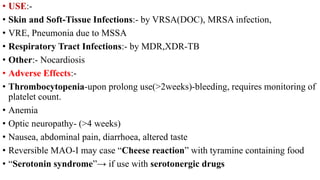
• Skin and Soft-Tissue Infections:- by VRSA(DOC), MRSA infection,
• VRE, Pneumonia due to MSSA
• Respiratory Tract Infections:- by MDR,XDR-TB
• Other:- Nocardiosis
• Adverse Effects:-
• Thrombocytopenia-upon prolong use(>2weeks)-bleeding, requires monitoring of
platelet count.
• Anemia
• Optic neuropathy- (>4 weeks)
• Nausea, abdominal pain, diarrhoea, altered taste
• Reversible MAO-I may case “Cheese reaction” with tyramine containing food
• “Serotonin syndrome”→ if use with serotonergic drugs
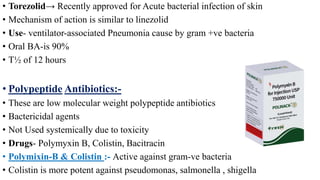
• Torezolid→ Recently approved for Acute bacterial infection of skin
• Mechanism of action is similar to linezolid
• Use- ventilator-associated Pneumonia cause by gram +ve bacteria
• Oral BA-is 90%
• T½ of 12 hours
• Polypeptide Antibiotics:-
• These are low molecular weight polypeptide antibiotics
• Bactericidal agents
• Not Used systemically due to toxicity
• Drugs- Polymyxin B, Colistin, Bacitracin
• Polymixin-B & Colistin :- Active against gram-ve bacteria
• Colistin is more potent against pseudomonas, salmonella , shigella
• MOA:- Both the agents have high affinity for phospholipids of cell membrane
• In gram-ve bacteria cell membrane cause distortion ion, Amino acids etc leak out.
sensitive bacteria take up more of antibiotic.
• USE:-
• Skin, eye & ear infections:- due to gram negative bacteria as a combination
therapy with other antimicrobial agents
• Diarrhoea – orally due to gram-negative organism like salmonella, shigella, E.
Coli
• Adverse effect:- GI symptoms on oral administration
• Bacitracin:-
• Polypeptide & topical antibiotics
• MOA:- Responsible for transfer of subunit of peptidoglycan to growing cell wall
• Inhibit cell wall synthesis (Bactericidal effect)
• ↑↑ efflux of ions by binding to cell membrane
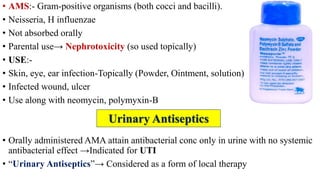
• AMS:- Gram-positive organisms (both cocci and bacilli).
• Neisseria, H influenzae
• Not absorbed orally
• Parental use→ Nephrotoxicity (so used topically)
• USE:-
• Skin, eye, ear infection-Topically (Powder, Ointment, solution)
• Infected wound, ulcer
• Use along with neomycin, polymyxin-B
• Orally administered AMA attain antibacterial conc only in urine with no systemic
antibacterial effect →Indicated for UTI
• “Urinary Antiseptics”→ Considered as a form of local therapy
Urinary Antiseptics
• UTI:- Common(female) health problem in community & nosocomial setting
• Affects bladder, urethra, kidney, ureter
• Types- Upper or lower (most common)
• Lower UTI (uncomplicated):- urethra, Bladder, prostate
• Symptoms:- burning sensation (>3 time a day) , pain, frequency of micturition
bacteria multiplication due to low pH, high urea content
• Causative Organism:-Gram negative (bacilli-E.coli) common
• Others- Klebsiella, Proteus, Pseudomonas
• Risk factor-Catheterization during caesarian section, Traumatic injury to urethra
• Drug treatment should be base on organism causing UTI
• Pharmacotherapy:-
• Urinary antiseptics:- Nitrofurantoin, Methenamine
• URINARY ANALGESIC:- Phenazopyridine
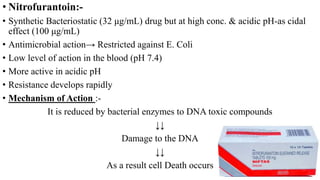
• Nitrofurantoin:-
• Synthetic Bacteriostatic (32 μg/mL) drug but at high conc. & acidic pH-as cidal
effect (100 μg/mL)
• Antimicrobial action→ Restricted against E. Coli
• Low level of action in the blood (pH 7.4)
• More active in acidic pH
• Resistance develops rapidly
• Mechanism of Action :-
It is reduced by bacterial enzymes to DNA toxic compounds
↓↓
Damage to the DNA
↓↓
As a result cell Death occurs
• Pharmacokinetics:-
• Absorption:- Good Orally
• Excretion:- 50% is urine.(rate depends on creatinine clearance)
• t1/2-1hr.
• Probenecid →↓↓Excretion
• Urine becomes brown after a gap.
• Contraindication:- Pregnant, neonates and renal disorders
• Adverse effect–Nausea, vomiting, diarrhoea(common)
• Rare- acute pneumonitis, peripheral neuritis, hepatotoxicity.
• USES:-
• Lower UTI (uncomplicated)- 50-100mg QID for 2 wks. with meals & at Bedtime
• For long term prophylaxis 50-100mg HS for long period along with vit. C or
juices.
• Methenamine:-
• Urinary antiseptic and prodrug
• MOA:- At acidic pH activate by generating formaldehyde which inhibit bacteria
• Acidification of urine is needed for their action
• Rarely used drug
• No tissue action
• Ineffective in upper UTI
• USES:- 2nd line drug for acute lower UTI.
• Adverse effect:-
• Gastritis, Rashes, Albuminuria
• CNS symptoms- occasionally
• Urinary analgesic:-
• Phenazopyridine:-
• Orange dye which exerts analgesic action
• Symptomatic relief of burning symptoms
• Doesn’t have antibacterial property
• Adverse effect- Nausea, epigastric pain
• Others Antimicrobials:-
1. Cotrimoxazole:- use declined
• Empirically in UTI & recurrent cystitis (Women)
• Contraindicated in pregnancy
2. Quinolones:- Ciprofloxacin & Ofloxacin (Highly effective)
• Highly effective against Gm-ve bacilli & low cost
• Norfloxacin-chronic UTI & can be given in pregnancy
3. Ampicillin/Amoxicillin:-
• Acute Infection- Amoxicillin+ Clavulanic acid(Parental)
• Acute Pyelonephritis:- Amoxicillin+ Clavulanic acid+ Gentamicin
• Safe in pregnancy
4. Cephalosporins:- ↑used in women with nosocomial Klebsiella and Proteus
infections
Safe in pregnancy
• Cephalexin- as alternative drug for Prophylaxis of recurrent cystitis
5. Gentamicin:- acute pyelonephritis along with others
• Effective against → Pseudomonas
• Prophylaxis of UTI:-
• Cotrimoxazole (480mg), Nitrofurantoin (100mg), Norfloxacin (400mg),
Cephalexin (250mg)→ OD,HS
Thank You

Miscellaneous antimicrobial agents

  • 1.
  • 2.
    -:LINCOSAMIDE ANTIBIOTICS:- • Derivativesof amino acid & a sulfur containing galactosidase • Drugs – Lincomycin , Clindamycin • Lincomycin:- • First derived Lincosamide antibiotics • Obtained from- Streptomyces lincolnenesis • Antimicrobial spectrum:- Resemble macrolides • Active against- Gm + ve cocci, mycoplasma, non spore forming anaerobic bacteria • Pharmacokinetics:- • Absorption:- Orally • T1/2-5hr.
  • 3.
    • Excretion:- Bile •MOA:- Inhibit Protein synthesis by binding to 50S ribosomal subunit • Less potent & higher incidence of Diarrhoea, colitis, Death • Thus replaced by Clindamycin • Semi-synthetic derivative of Lincomycin • MOA:- Inhibit Protein synthesis by binding to 50S ribosomal subunit similar like Erythromycin (Bacteriostatic) • Anti-microbial Spectrum:- • Sensitive against Most gm+ ve cocci like Pneumococci, Staph.(Except MRSA) C. diphtheriae, Nocardia, Actinomyces, Plasmodial sp., toxoplasma gondii • Resistant to -Gm-negative anaerobes Clindamycin
  • 4.
    • Resistance developdue to- Methylation of bacterial RNA in 50S unit • Pharmacokinetics:- Absorption-orally T1/2-3hr. Distribution- widely in body fluid, bone, phagocytes Cross placental barrier PPB- 90% Metabolism-liver (N-dimethyl-clindamycin) Excretion-urine, bile In severe hepatic failure (dose adjustment)
  • 5.
    • Therapeutic use:- Skinand Soft-Tissue Infections:- Especially in patients with β-lactam allergies, in Acne (as topically) In gas gangrene by toxin-producing bacteria (e.g., streptococci, staphylococci, clostridia)→ as Adjuvant therapy Respiratory Tract Infections:- Lung abscess, pleural space infections due to susceptible organisms In AIDS patients:- (1.) For P. jiroveci pneumonia-(Clindamycin + Primaquine) (2.) For toxoplasmosis-(Clindamycin + Pyrimethamine) Others:- Prophylaxis of Bacterial endocarditis –in pt. allergic to penicillin Pelvic, abdominal abscess
  • 6.
    Bacterial vaginosis-vaginally Osteomyelitis-use dueto excellent bone penetration (as a alternative drug) • Adverse effects:- • Pseudomembranous colitis (superinfection) –due to toxin release by growth of clost. difficile which alter gut flora • Presented with diarrhoea with blood and mucus in the stools, fever, Abdominal pain • Rx- stoppage of drug • Treated with metronidazole • Skin rashes, • Safe during pregnancy
  • 7.
    GLYCOPEPTIDE ANTIBIOTICS:- • Glycopeptideantibiotics → are cell wall synthesis inhibitors • Bactericidal agents • Drugs – Vancomycin , Teicoplanin • Vancomycin:- • Discover as a penicillin substitute due to efficacy against MRSA • MOA:- Inhibit cell wall synthesis by binding with D-alanyl D-alanine to peptidoglycan unit→ trans-glycosylation inhibited • Resulted→ Elongation & cross linking of peptidoglycan is prevented • Antimicrobial spectrum:- • Sensitive against- gram+ bacteria Streptococcal pyrogenes, pneumoniae, Staph. aureus including MRSA , S. viridans and Enterococcus. • Gram-positive bacilli: Diphtheroids and Clostridium spp.
  • 8.
    • Pharmacokinetics:- • Absorption-poorso not preferred orally (Except-pseudomembranous colitis) • T1/2-6hr. • Distribution:-enters various body fluid like pleural, Pericardial, bile, CNS (in meningitis) • Metabolism- Liver • Excretion- kidney • USES:- • MRSA infection (pneumonia, endocarditis, soft tissue abscess) →DOC • Pseudomembranous colitis- not responding to Metronidazole (DOC) Dose -125-250mg QID • Enterococcus endocarditis→ Vancomycin+ Aminoglycoside
  • 9.
    Adverse effect:- • Systemictoxicity is high • Skin rashes & ↓BP during IV injection (due to histamine release) • Pain & phlebitis at site of injection • “Red man syndrome or Red Neck syndrome” –orange discoloration of skin, fluid, mucosal surface • Upon Rapid i.v. injection→ due to histamine release • Symptoms:- Chills, fever, urticaria, intense flushing Treatment:- prevented by prolonging the infusion period by 1-2hrs. • Nephrotoxicity • Dose dependent ototoxicity
  • 10.
    • Teicoplanin:- • Chemicalstructure ,mechanism spectrum same as vancomycin • More active against enterococcus sp. than vancomycin • Highly bound to plasma protein • T1/2-50hr. • Used by i.v. or i.m. route in MRSA , MSSA • Active against Vancomycin resistant enterococci (VRE) • Safer than vancomycin • Telavancin:- • Semisynthetic derivatives of vancomycin • Effective against→ VRSA • MOA-same to vancomycin ‘ • Teratogenic & t1/2-8hr.
  • 11.
    • OXAZOLIDINONES:- • Drugs:-Linezolid, Torezolid • Linezolid:- first drug in this group • MOA:- bind at “P-site” to 23s part of 50s ribosomal subunit→ Prevent formation of formylated methionine t-RNA→ inhibit protein synthesis (Bacteriostatic) • AMS:- Gram + cocci ,bacilli ,VRE,MRSA,VRSA,M tuberculosis, Nocardia, clost. Difficile. • Not effective against gram-ve due to presence of membrane efflux pump • Absorption-rapidly orally • Oral BA-100% • T1/2-5hr. • Metabolism-partly by non enzymatic reaction • Excretion-Urine
  • 12.
    • USE:- • Skinand Soft-Tissue Infections:- by VRSA(DOC), MRSA infection, • VRE, Pneumonia due to MSSA • Respiratory Tract Infections:- by MDR,XDR-TB • Other:- Nocardiosis • Adverse Effects:- • Thrombocytopenia-upon prolong use(>2weeks)-bleeding, requires monitoring of platelet count. • Anemia • Optic neuropathy- (>4 weeks) • Nausea, abdominal pain, diarrhoea, altered taste • Reversible MAO-I may case “Cheese reaction” with tyramine containing food • “Serotonin syndrome”→ if use with serotonergic drugs
  • 13.
    • Torezolid→ Recentlyapproved for Acute bacterial infection of skin • Mechanism of action is similar to linezolid • Use- ventilator-associated Pneumonia cause by gram +ve bacteria • Oral BA-is 90% • T½ of 12 hours • Polypeptide Antibiotics:- • These are low molecular weight polypeptide antibiotics • Bactericidal agents • Not Used systemically due to toxicity • Drugs- Polymyxin B, Colistin, Bacitracin • Polymixin-B & Colistin :- Active against gram-ve bacteria • Colistin is more potent against pseudomonas, salmonella , shigella
  • 14.
    • MOA:- Boththe agents have high affinity for phospholipids of cell membrane • In gram-ve bacteria cell membrane cause distortion ion, Amino acids etc leak out. sensitive bacteria take up more of antibiotic. • USE:- • Skin, eye & ear infections:- due to gram negative bacteria as a combination therapy with other antimicrobial agents • Diarrhoea – orally due to gram-negative organism like salmonella, shigella, E. Coli • Adverse effect:- GI symptoms on oral administration • Bacitracin:- • Polypeptide & topical antibiotics • MOA:- Responsible for transfer of subunit of peptidoglycan to growing cell wall • Inhibit cell wall synthesis (Bactericidal effect) • ↑↑ efflux of ions by binding to cell membrane
  • 15.
    • AMS:- Gram-positiveorganisms (both cocci and bacilli). • Neisseria, H influenzae • Not absorbed orally • Parental use→ Nephrotoxicity (so used topically) • USE:- • Skin, eye, ear infection-Topically (Powder, Ointment, solution) • Infected wound, ulcer • Use along with neomycin, polymyxin-B • Orally administered AMA attain antibacterial conc only in urine with no systemic antibacterial effect →Indicated for UTI • “Urinary Antiseptics”→ Considered as a form of local therapy Urinary Antiseptics
  • 16.
    • UTI:- Common(female)health problem in community & nosocomial setting • Affects bladder, urethra, kidney, ureter • Types- Upper or lower (most common) • Lower UTI (uncomplicated):- urethra, Bladder, prostate • Symptoms:- burning sensation (>3 time a day) , pain, frequency of micturition bacteria multiplication due to low pH, high urea content • Causative Organism:-Gram negative (bacilli-E.coli) common • Others- Klebsiella, Proteus, Pseudomonas • Risk factor-Catheterization during caesarian section, Traumatic injury to urethra • Drug treatment should be base on organism causing UTI • Pharmacotherapy:- • Urinary antiseptics:- Nitrofurantoin, Methenamine • URINARY ANALGESIC:- Phenazopyridine
  • 17.
    • Nitrofurantoin:- • SyntheticBacteriostatic (32 μg/mL) drug but at high conc. & acidic pH-as cidal effect (100 μg/mL) • Antimicrobial action→ Restricted against E. Coli • Low level of action in the blood (pH 7.4) • More active in acidic pH • Resistance develops rapidly • Mechanism of Action :- It is reduced by bacterial enzymes to DNA toxic compounds ↓↓ Damage to the DNA ↓↓ As a result cell Death occurs
  • 18.
    • Pharmacokinetics:- • Absorption:-Good Orally • Excretion:- 50% is urine.(rate depends on creatinine clearance) • t1/2-1hr. • Probenecid →↓↓Excretion • Urine becomes brown after a gap. • Contraindication:- Pregnant, neonates and renal disorders • Adverse effect–Nausea, vomiting, diarrhoea(common) • Rare- acute pneumonitis, peripheral neuritis, hepatotoxicity. • USES:- • Lower UTI (uncomplicated)- 50-100mg QID for 2 wks. with meals & at Bedtime • For long term prophylaxis 50-100mg HS for long period along with vit. C or juices.
  • 19.
    • Methenamine:- • Urinaryantiseptic and prodrug • MOA:- At acidic pH activate by generating formaldehyde which inhibit bacteria • Acidification of urine is needed for their action • Rarely used drug • No tissue action • Ineffective in upper UTI • USES:- 2nd line drug for acute lower UTI. • Adverse effect:- • Gastritis, Rashes, Albuminuria • CNS symptoms- occasionally
  • 20.
    • Urinary analgesic:- •Phenazopyridine:- • Orange dye which exerts analgesic action • Symptomatic relief of burning symptoms • Doesn’t have antibacterial property • Adverse effect- Nausea, epigastric pain • Others Antimicrobials:- 1. Cotrimoxazole:- use declined • Empirically in UTI & recurrent cystitis (Women) • Contraindicated in pregnancy 2. Quinolones:- Ciprofloxacin & Ofloxacin (Highly effective) • Highly effective against Gm-ve bacilli & low cost • Norfloxacin-chronic UTI & can be given in pregnancy
  • 21.
    3. Ampicillin/Amoxicillin:- • AcuteInfection- Amoxicillin+ Clavulanic acid(Parental) • Acute Pyelonephritis:- Amoxicillin+ Clavulanic acid+ Gentamicin • Safe in pregnancy 4. Cephalosporins:- ↑used in women with nosocomial Klebsiella and Proteus infections Safe in pregnancy • Cephalexin- as alternative drug for Prophylaxis of recurrent cystitis 5. Gentamicin:- acute pyelonephritis along with others • Effective against → Pseudomonas • Prophylaxis of UTI:- • Cotrimoxazole (480mg), Nitrofurantoin (100mg), Norfloxacin (400mg), Cephalexin (250mg)→ OD,HS
  • 22.

Editor's Notes

  • #3 Isolated on 1962 from the fermentation product of streptomyces Lincoln.
  • #4 Nocardiosis is a disease caused by bacteria found in soil and water. It can affect the lungs, brain, and skin
  • #5 Gram-negative aerobic species are intrinsically resistant because of poor permeability of the outer membrane
  • #9 Nosocomial infection where other agents r not effective Enterococcus endocarditis→ Vancomycin+ Aminoglycoside due to synergistic effect
  • #10 Red man syndrome due to histamine release
  • #11 Less effective against MSSA than cloxacillin can be increase by use with gentamicin
  • #12 efflux pump pump out the drug so in case of gm+ve bacteria not present this pump not effective against gm-ve
  • #17 Common in female-urethra is close to vagina & rectum