SULFONAMIDES
&
COTRIMOXAZOLE
G Vijay Narasimha Kumar
Asst. Professor,
Dept. of. Pharmacology
Sri Padmavathi School of Pharmacy
INTRODUCTION
• These are a class of anti- biotics which acts by
inhibition/ interrupting the synthesis of
nucleic acids
• Although they interfere in the bio-synthesis of
nucleic acids they are not genotoxic due to it`s
specificity of target
Prontosil rubrum Sulphanilamide
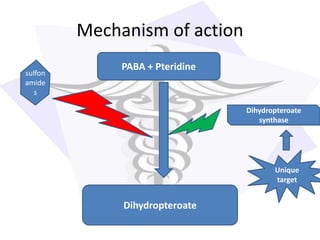
Mechanism of action
PABA + Pteridine
Dihydropteroate
Unique
target
sulfon
amide
s
Dihydropteroate
synthase
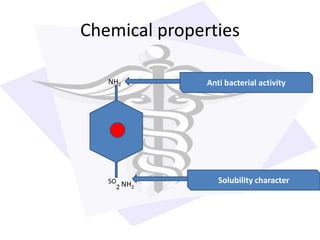
Chemical properties
NH2
SO
2 NH2
Anti bacterial activity
Solubility character
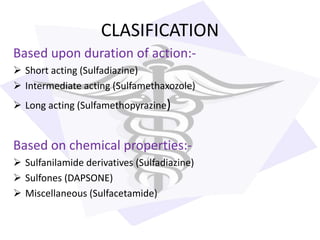
CLASIFICATION
Based upon duration of action:-
 Short acting (Sulfadiazine)
 Intermediate acting (Sulfamethaxozole)
 Long acting (Sulfamethopyrazine)
Based on chemical properties:-
 Sulfanilamide derivatives (Sulfadiazine)
 Sulfones (DAPSONE)
 Miscellaneous (Sulfacetamide)
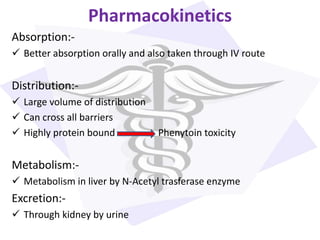
Pharmacokinetics
Absorption:-
 Better absorption orally and also taken through IV route
Distribution:-
 Large volume of distribution
 Can cross all barriers
 Highly protein bound Phenytoin toxicity
Metabolism:-
 Metabolism in liver by N-Acetyl trasferase enzyme
Excretion:-
 Through kidney by urine
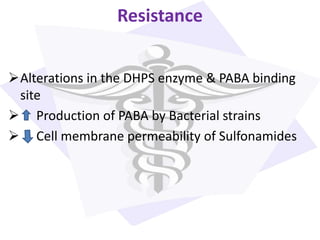
Resistance
Alterations in the DHPS enzyme & PABA binding
site
 Production of PABA by Bacterial strains
 Cell membrane permeability of Sulfonamides
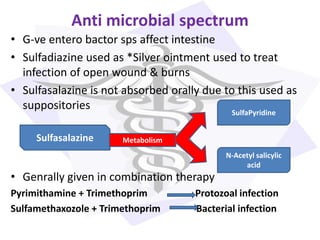
Anti microbial spectrum
• G-ve entero bactor sps affect intestine
• Sulfadiazine used as *Silver ointment used to treat
infection of open wound & burns
• Sulfasalazine is not absorbed orally due to this used as
suppositories
• Genrally given in combination therapy
Pyrimithamine + Trimethoprim Protozoal infection
Sulfamethaxozole + Trimethoprim Bacterial infection
Sulfasalazine
SulfaPyridine
N-Acetyl salicylic
acid
Metabolism
Adverse effects
 Hypersensitivity reactions
Kernicterus
Metabolism
of
sulfonamides
Hapten
Host tissue
protine
Immunogenic but not
antigenic
Antigenic
A
L
Bilirubin
A
L
BilirubinS.A Serum Bilirubin
CNSKernicterus
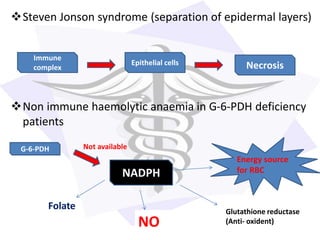
Steven Jonson syndrome (separation of epidermal layers)
Non immune haemolytic anaemia in G-6-PDH deficiency
patients
Immune
complex NecrosisEpithelial cells
NADPH
G-6-PDH Not available
Folate
NO
Glutathione reductase
(Anti- oxident)
Energy source
for RBC
Cotrimoxazole
[TRIMETHOPRIM-SULFAMETHOXAZOLE]
• Introduction
• Sulfamethoxazole is a close congener of sulfisoxazole
• A pyrimidine inhibitor of dihydrofolate reductase, it is
an antibacterial related to PYRIMETHAMINE
• Trimethoprim in combination with sulfamethoxazole
constitutes an important advance in the development
of clinically effective antimicrobial agents
• Popularly this combination is various names such as
cotrimoxazole , Bactrim , Septran
Composition
• Cotrimoxazole is an combination of
trimethoprim and sulphamethoxazole in the
ratio of 1:5
• The reason for selecting these drugs is they
have an equal t1/2 of approximately 10 hours
• Their mechanism of action help in sequential
blockade in the pathway of an obligate
enzymatic reaction in bacteria
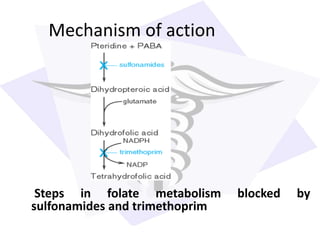
Mechanism of action
Steps in folate metabolism blocked by
sulfonamides and trimethoprim
Antibacterial Spectrum and Efficacy
• Antibacterial spectrum of trimethoprim is similar
to that of sulfamethoxazole
• Resistance can develop easily when the individual
drugs are used alone
• A synergistic interaction between the components
of the preparation is apparent even when
microorganisms are resistant to sulfonamide with
or without moderate resistance to trimethoprim
activity.
 However, a maximal degree of synergism
occurs when microorganisms are sensitive to
both components.
 The activity of trimethoprim-sulfamethoxazole
in vitro depends on the medium in which it is
determined;
 e.g., low concentrations of thymidine almost
completely abolish the antibacterial
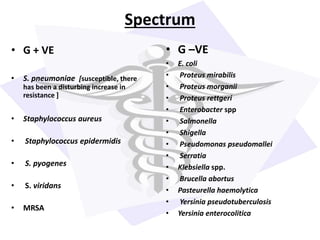
Spectrum
• G + VE
• S. pneumoniae [susceptible, there
has been a disturbing increase in
resistance ]
• Staphylococcus aureus
• Staphylococcus epidermidis
• S. pyogenes
• S. viridans
• MRSA
• G –VE
• E. coli
• Proteus mirabilis
• Proteus morganii
• Proteus rettgeri
• Enterobacter spp
• Salmonella
• Shigella
• Pseudomonas pseudomallei
• Serratia
• Klebsiella spp.
• Brucella abortus
• Pasteurella haemolytica
• Yersinia pseudotuberculosis
• Yersinia enterocolitica
Bacterial Resistance
• Resistance often is due to the acquisition of a
plasmid that codes for an altered
dihydrofolate reductase
Pharmacokinetics
• Absorption ; Orally and intravenously well absorbed
sulfamethoxazole and trimethoprim are closely but not perfectly
matched to achieve a constant ratio of 20:1 in their concentrations
in blood and tissues.
• The ratio in blood is often greater than 20:1, and that in tissues is
frequently less.
• After a single oral dose of the combined preparation,
trimethoprim is absorbed more rapidly than sulfamethoxazole.
• The concurrent administration of the drugs appears to slow the
absorption of sulfamethoxazole.
• Peak blood concentrations of trimethoprim usually occur by 2
hours in most patients, whereas peak concentrations of
sulfamethoxazole occur by 4 hours after a single oral dose.
• The half-lives of trimethoprim and sulfamethoxazole are
approximately 11 and 10 hours, respectively
Pharmacokinetics
• Distribution ; Distributed well in all body fluids
Trimethoprim is distributed and concentrated rapidly
in tissues, and about 40% is bound to plasma protein
in the presence of sulfamethoxazole.
• The volume of distribution of trimethoprim is almost
nine times that of sulfamethoxazole.
• The drug readily enters cerebrospinal fluid and
sputum, About 65% of sulfamethoxazole is bound to
plasma protein
• Metabolism ; By liver
• Execration ; About 60% of administered
trimethoprim and from 25% to 50% of administered
sulfamethoxazole are excreted in the urine in 24
hours
Adverse reactions
• Similar to that of sulphonamides
Therapeutic uses
• Uncomplicated lower urinary tract infections
• Bacterial Respiratory Tract Infections
• Infection by Pneumocystis jiroveci
• In G-VE rods infection's
• Gastrointestinal Infections
• MRSA infections –skin and soft tissue infections
Contraindications'
• Contraindicated to patients with
hypersensitivity
• Sever renal or hepatic insufficiency
• Infants less than 4 weeks
• Megaloblastic anemia pregnancy and lactating
mother's
Available doses
• BACTRIM -TAB [S-400mg T-80 mg] APHL
-TAB [S-100mg T-20mg]
-TAB [S-200mg T-40mg]
• SEPTRAN -TAB [S-400mg T-80 mg] GSK
-TAB [S-100mg T-20mg]
-TAB [S-200mg T-40mg]