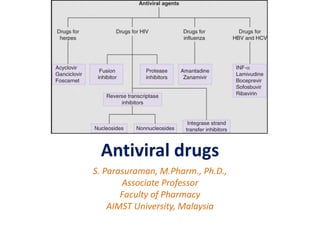
Antiviral drugs
S. Parasuraman, M.Pharm., Ph.D.,
Associate Professor
Faculty of Pharmacy
AIMST University, Malaysia
Learning Outcomes
• 1.7.1 Anti-Herpes Virus
At the end of this session, the student would be able to
discuss the:
– list drugs used for the management of herpes virus infection. (CLO1)
– describe the mechanism of action, pharmacological actions,
pharmacokinetic features, therapeutic uses, adverse effects,
interaction and contraindications of Anti-Herpes virus drugs. (CLO1)
Antiviral Drugs
• Viruses are obligate intracellular parasites. They lack both
a cell wall and a cell membrane, and they do not carry
out metabolic processes.
• Viruses use much of the host’s metabolic machinery, and
few drugs are selective enough to prevent viral
replication without injury to the infected host cells.
Antiviral Drugs
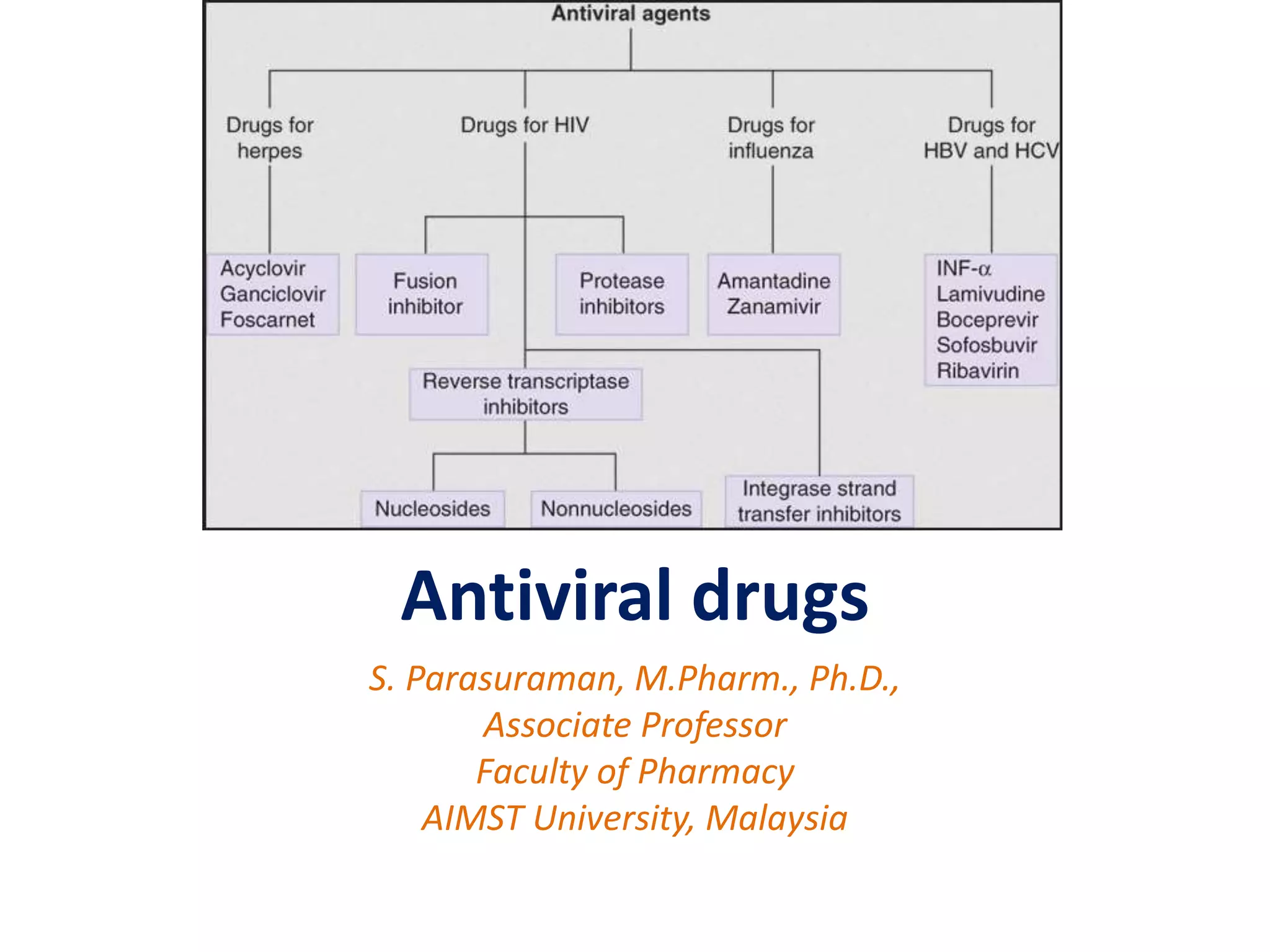
• Anti-Herpes virus: Idoxuridine, Trifluridine, Acyclovir,
Valacyclovir, Famciclovir, Ganciclovir, Valganciclovir,
Cidofovir, Foscarnet, Fomivirsen
• Anti-Influenza virus: Amantadine, Rimantadine,
Oseltamivir, Zanamivir
• Anti-Hepatitis virus/Nonselective antiviral drugs
– Primarily for hepatitis B: Lamivudine, Adefovir dipivoxil,
Tenofovir
– Primarily for hepatitis C: Ribavirin, Interferon α
Antiviral Drugs
• Anti-Retrovirus:
– Nucleoside reverse transcriptase inhibitors (NRTIs):
Zidovudine (AZT), Didanosine, Stavudine, Lamivudine,
Abacavir, Emtricitabine, Tenofovir (Nt RTI)
– Nonnucleoside reverse transcriptase inhibitors (NNRTIs):
Nevirapine, Efavirenz, Delavirdine
– Protease inhibitors: Ritonavir, Atazanavir, Indinavir,
Nelfinavir, Saquinavir, Amprenavir, Lopinavir
– Entry (Fusion) inhibitor: Enfuvirtide
– CCR5 receptor inhibitor: Maraviroc
– Integrase inhibitor: Raltegravir
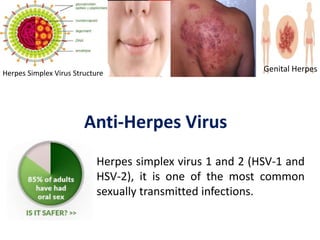
Anti-Herpes Virus
Herpes simplex virus 1 and 2 (HSV-1 and
HSV-2), it is one of the most common
sexually transmitted infections.
Herpes Simplex Virus Structure
Genital Herpes
Anti-Herpes Virus
• At the end of this session, the student would be able
to:
– list drugs used for the management of herpes virus
infection. (CLO1)
– describe the mechanism of action, pharmacological
actions, pharmacokinetic features, therapeutic uses,
adverse effects, interaction and contraindications of Anti-
Herpes virus drugs. (CLO1)
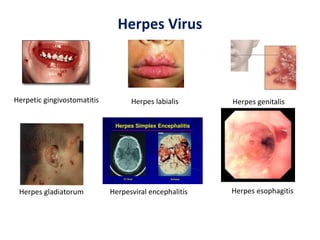
Herpes Virus
Herpetic gingivostomatitis Herpes labialis Herpes genitalis
Herpes gladiatorum Herpesviral encephalitis Herpes esophagitis
Anti-Herpes Virus
Anti-Herpes virus:
Idoxuridine
Trifluridine
Acyclovir
Valacyclovir
Famciclovir
Ganciclovir
Valganciclovir
Cidofovir
Foscarnet
Fomivirsen
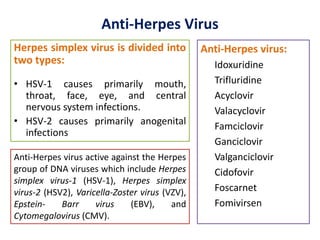
Herpes simplex virus is divided into
two types:
• HSV-1 causes primarily mouth,
throat, face, eye, and central
nervous system infections.
• HSV-2 causes primarily anogenital
infections
Anti-Herpes virus active against the Herpes
group of DNA viruses which include Herpes
simplex virus-1 (HSV-1), Herpes simplex
virus-2 (HSV2), Varicella-Zoster virus (VZV),
Epstein- Barr virus (EBV), and
Cytomegalovirus (CMV).
Anti-Herpes Virus
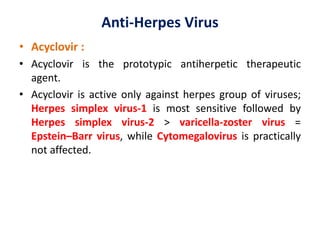
• Acyclovir :
• Acyclovir is the prototypic antiherpetic therapeutic
agent.
• Acyclovir is active only against herpes group of viruses;
Herpes simplex virus-1 is most sensitive followed by
Herpes simplex virus-2 > varicella-zoster virus =
Epstein–Barr virus, while Cytomegalovirus is practically
not affected.
Anti-Herpes Virus
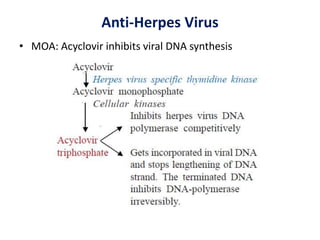
• MOA: Acyclovir inhibits viral DNA synthesis
Anti-Herpes Virus
• Pharmacokinetics: Acyclovir is administered by
intravenous (IV), oral, or topical routes. The drug
distributes well throughout the body, including the
cerebrospinal fluid (CSF). Acyclovir is partially
metabolized to an inactive product. Excretion into the
urine occurs both by glomerular filtration and tubular
secretion.
Anti-Herpes Virus
• Use of acyclovir:
• Genital Herpes simplex (caused by type-2 virus)
• Mucocutaneous H. simplex (caused by type-1 virus)
• H. simplex encephalitis (type-1 virus)
• H. simplex (type I) keratitis
• Herpes zoster
• Chickenpox
Anti-Herpes Virus
• Valacyclovir: The valyl ester, valacyclovir, has greater
oral bioavailability than acyclovir. it is the drug of
choice in herpes zoster.
• Famciclovir: It is an ester prodrug of a guanine
nucleoside analogue penciclovir (the active
metabolite of famciclovir). Famciclovir inhibits H.
simplex, H. zoster but not acyclovir-resistant strains.
Thank you

Anti-herpes virus

  • 1.
    Antiviral drugs S. Parasuraman,M.Pharm., Ph.D., Associate Professor Faculty of Pharmacy AIMST University, Malaysia
  • 2.
    Learning Outcomes • 1.7.1Anti-Herpes Virus At the end of this session, the student would be able to discuss the: – list drugs used for the management of herpes virus infection. (CLO1) – describe the mechanism of action, pharmacological actions, pharmacokinetic features, therapeutic uses, adverse effects, interaction and contraindications of Anti-Herpes virus drugs. (CLO1)
  • 3.
    Antiviral Drugs • Virusesare obligate intracellular parasites. They lack both a cell wall and a cell membrane, and they do not carry out metabolic processes. • Viruses use much of the host’s metabolic machinery, and few drugs are selective enough to prevent viral replication without injury to the infected host cells.
  • 4.
    Antiviral Drugs • Anti-Herpesvirus: Idoxuridine, Trifluridine, Acyclovir, Valacyclovir, Famciclovir, Ganciclovir, Valganciclovir, Cidofovir, Foscarnet, Fomivirsen • Anti-Influenza virus: Amantadine, Rimantadine, Oseltamivir, Zanamivir • Anti-Hepatitis virus/Nonselective antiviral drugs – Primarily for hepatitis B: Lamivudine, Adefovir dipivoxil, Tenofovir – Primarily for hepatitis C: Ribavirin, Interferon α
  • 5.
    Antiviral Drugs • Anti-Retrovirus: –Nucleoside reverse transcriptase inhibitors (NRTIs): Zidovudine (AZT), Didanosine, Stavudine, Lamivudine, Abacavir, Emtricitabine, Tenofovir (Nt RTI) – Nonnucleoside reverse transcriptase inhibitors (NNRTIs): Nevirapine, Efavirenz, Delavirdine – Protease inhibitors: Ritonavir, Atazanavir, Indinavir, Nelfinavir, Saquinavir, Amprenavir, Lopinavir – Entry (Fusion) inhibitor: Enfuvirtide – CCR5 receptor inhibitor: Maraviroc – Integrase inhibitor: Raltegravir
  • 6.
    Anti-Herpes Virus Herpes simplexvirus 1 and 2 (HSV-1 and HSV-2), it is one of the most common sexually transmitted infections. Herpes Simplex Virus Structure Genital Herpes
  • 7.
    Anti-Herpes Virus • Atthe end of this session, the student would be able to: – list drugs used for the management of herpes virus infection. (CLO1) – describe the mechanism of action, pharmacological actions, pharmacokinetic features, therapeutic uses, adverse effects, interaction and contraindications of Anti- Herpes virus drugs. (CLO1)
  • 8.
    Herpes Virus Herpetic gingivostomatitisHerpes labialis Herpes genitalis Herpes gladiatorum Herpesviral encephalitis Herpes esophagitis
  • 9.
    Anti-Herpes Virus Anti-Herpes virus: Idoxuridine Trifluridine Acyclovir Valacyclovir Famciclovir Ganciclovir Valganciclovir Cidofovir Foscarnet Fomivirsen Herpessimplex virus is divided into two types: • HSV-1 causes primarily mouth, throat, face, eye, and central nervous system infections. • HSV-2 causes primarily anogenital infections Anti-Herpes virus active against the Herpes group of DNA viruses which include Herpes simplex virus-1 (HSV-1), Herpes simplex virus-2 (HSV2), Varicella-Zoster virus (VZV), Epstein- Barr virus (EBV), and Cytomegalovirus (CMV).
  • 10.
    Anti-Herpes Virus • Acyclovir: • Acyclovir is the prototypic antiherpetic therapeutic agent. • Acyclovir is active only against herpes group of viruses; Herpes simplex virus-1 is most sensitive followed by Herpes simplex virus-2 > varicella-zoster virus = Epstein–Barr virus, while Cytomegalovirus is practically not affected.
  • 11.
    Anti-Herpes Virus • MOA:Acyclovir inhibits viral DNA synthesis
  • 12.
    Anti-Herpes Virus • Pharmacokinetics:Acyclovir is administered by intravenous (IV), oral, or topical routes. The drug distributes well throughout the body, including the cerebrospinal fluid (CSF). Acyclovir is partially metabolized to an inactive product. Excretion into the urine occurs both by glomerular filtration and tubular secretion.
  • 13.
    Anti-Herpes Virus • Useof acyclovir: • Genital Herpes simplex (caused by type-2 virus) • Mucocutaneous H. simplex (caused by type-1 virus) • H. simplex encephalitis (type-1 virus) • H. simplex (type I) keratitis • H. simplex (type I) keratitis • Herpes zoster • Chickenpox
  • 14.
    Anti-Herpes Virus • Valacyclovir:The valyl ester, valacyclovir, has greater oral bioavailability than acyclovir. it is the drug of choice in herpes zoster. • Famciclovir: It is an ester prodrug of a guanine nucleoside analogue penciclovir (the active metabolite of famciclovir). Famciclovir inhibits H. simplex, H. zoster but not acyclovir-resistant strains.
  • 15.

Editor's Notes

  • #16 https://www.verywellhealth.com/herpes-causes-risk-factors-1068800