Sulfonamides,
Cotrimoxazole
and Quinolones
Sapana Jain
M. Pharm, Quality Assurance
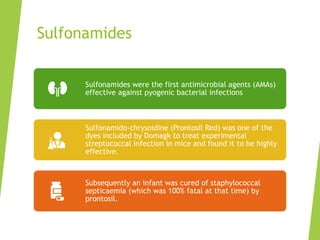
Sulfonamides
Sulfonamides were the first antimicrobial agents (AMAs)
effective against pyogenic bacterial infections
Sulfonamido-chrysoidine (Prontosil Red) was one of the
dyes included by Domagk to treat experimental
streptococcal infection in mice and found it to be highly
effective.
Subsequently an infant was cured of staphylococcal
septicaemia (which was 100% fatal at that time) by
prontosil.
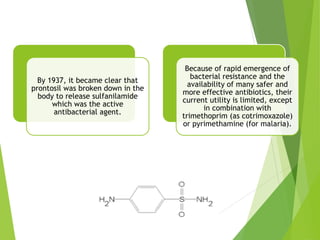
By 1937, it became clear that
prontosil was broken down in the
body to release sulfanilamide
which was the active
antibacterial agent.
Because of rapid emergence of
bacterial resistance and the
availability of many safer and
more effective antibiotics, their
current utility is limited, except
in combination with
trimethoprim (as cotrimoxazole)
or pyrimethamine (for malaria).
Sulphonamides
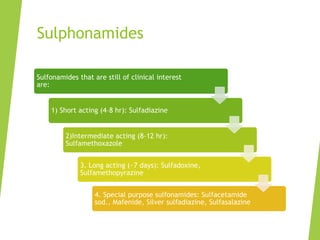
Sulfonamides that are still of clinical interest
are:
1) Short acting (4–8 hr): Sulfadiazine
2)Intermediate acting (8–12 hr):
Sulfamethoxazole
3. Long acting (~7 days): Sulfadoxine,
Sulfamethopyrazine
4. Special purpose sulfonamides: Sulfacetamide
sod., Mafenide, Silver sulfadiazine, Sulfasalazine
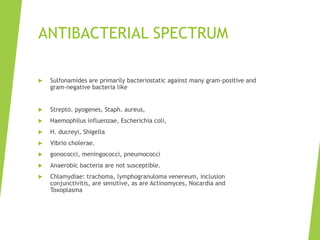
ANTIBACTERIAL SPECTRUM
 Sulfonamides are primarily bacteriostatic against many gram-positive and
gram-negative bacteria like
 Strepto. pyogenes, Staph. aureus,
 Haemophilus influenzae, Escherichia coli,
 H. ducreyi, Shigella
 Vibrio cholerae.
 gonococci, meningococci, pneumococci
 Anaerobic bacteria are not susceptible.
 Chlamydiae: trachoma, lymphogranuloma venereum, inclusion
conjunctivitis, are sensitive, as are Actinomyces, Nocardia and
Toxoplasma
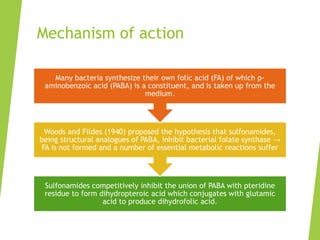
Mechanism of action
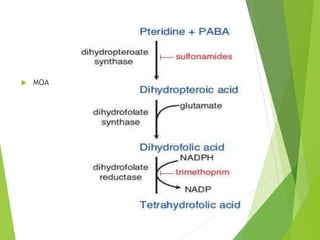
Sulfonamides competitively inhibit the union of PABA with pteridine
residue to form dihydropteroic acid which conjugates with glutamic
acid to produce dihydrofolic acid.
Woods and Fildes (1940) proposed the hypothesis that sulfonamides,
being structural analogues of PABA, inhibit bacterial folate synthase →
FA is not formed and a number of essential metabolic reactions suffer
Many bacteria synthesize their own folic acid (FA) of which p-
aminobenzoic acid (PABA) is a constituent, and is taken up from the
medium.
 MOA
Resistance to
sulfonamides
 Most bacteria are capable of developing
resistance to sulfonamides like
gonococci, pneumococci, Staph. aureus,
meningococci, E. coli, Shigella and some
Strep. pyogenes, Strep. viridans and
anaerobes.
 The resistant mutants either:
 (a) produce increased amounts of PABA,
or
 (b) their folate synthase enzyme has low
affinity for sulfonamides, or
 (c) adopt an alternative pathway in
folate metabolism.
PHARMACOKINETICS
 Sulfonamides are rapidly and nearly
completely absorbed from g.i.t
 The highly protein bound members are
longer acting
 The primary pathway of metabolism of
sulfonamides is acetylation at N4 by
nonmicrosomal acetyl transferase,
primarily in liver
Sulfadiazine
 It is the prototype of the general
purpose sulfonamides that is rapidly
absorbed orally and rapidly excreted in
urine.
 Plasma protein binding is 50%, and it is
20–40% acetylated.
 The acetylated derivative is less soluble
in urine, crystalluria is likely.
 It has good penetrability in brain and
CSF—was the preferred compound for
meningitis.
 Dose: 0.5 g QID to 2 g TDS; SULFADIAZINE
0.5 g tab
Sulfamethoxazole
It has slower oral absorption and
urinary excretion resulting in
intermediate duration of action;
It is the preferred compound for
combining with trimethoprim because
the t½ (10hr)of both is similar.
However, a high fraction is acetylated,
which is relatively insoluble—
crystalluria can occur.
Dose: 1 g BD for 2 days, then 0.5 g BD.
GANTANOL 0.5 g tab
Sulfadoxine, Sulfamethopyrazine
They are used in combination with
pyrimethamine in the treatment of malaria
,Pneumocystis jiroveci (pneumonia in AIDS
patients )and in toxoplasmosis
These are ultralong acting compounds, action
lasting > 1 week because of high plasma protein
binding and slow renal excretion (t½ 5–9 days).
Sulfacetamide
sod.
 It is a highly soluble compound yielding
neutral solution which is only mildly
irritating to the eye in concentrations up
to 30%.
 It is used topically for ocular infections
due to susceptible bacteria and
chlamydia, including ophthalmia
neonatorum caused by Ch.
oculogenitalis.
 It attains high concentrations in anterior
segment and aqueous humour after
topical instillation.
 LOCULA, ALBUCID 10%, 20%, 30% eye
drops, 6% eye oint
Silver sulfadiazine
Used topically as 1% cream, it is active against a large number of
bacteria and fungi, even those resistant to other sulfonamides, e.g.
Pseudomonas.
It slowly releases silver ions which appear to be largely responsible
for the antimicrobial action.
Uses: for preventing infection of burnt surfaces and chronic ulcers.
SILVIRIN 1% cream, ARGENEX 1% cream with chlorhexidine 0.2%.
Sulfasalazine used in ulcerative colitis and rheumatoid arthritis.
ADVERSE
EFFECTS
• Nausea, vomiting and epigastric pain.
• Crystalluria is dose related, but
infrequent now. Precipitation in urine can
be minimized by taking plenty of fluids and
by alkalinizing the urine.
• Hypersensitivity reactions occur in 2–5%
patients. Like rashes, urticaria and drug
fever. Photosensitization is reported.
• Hepatitis, unrelated to dose, occurs in
0.1% patients
USES
 Systemic use of sulfonamides alone (not
combined with trimethoprim or
pyrimethamine) is rare now.
 Combined with trimethoprim (as
cotrimoxazole) sulfamethoxazole is used
for many bacterial infections, P. jiroveci
and nocardiosis .
 Along with pyrimethamine, certain
sulfonamides are used for malaria and
toxoplasmosis
 Ocular sulfacetamide sod. (10–30%) is
alternative in trachoma/inclusion
conjunctivitis.

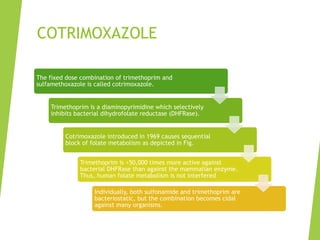
COTRIMOXAZOLE
The fixed dose combination of trimethoprim and
sulfamethoxazole is called cotrimoxazole.
Trimethoprim is a diaminopyrimidine which selectively
inhibits bacterial dihydrofolate reductase (DHFRase).
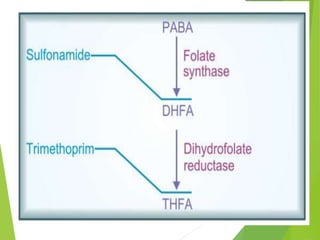
Cotrimoxazole introduced in 1969 causes sequential
block of folate metabolism as depicted in Fig.
Trimethoprim is >50,000 times more active against
bacterial DHFRase than against the mammalian enzyme.
Thus, human folate metabolism is not interfered
Individually, both sulfonamide and trimethoprim are
bacteriostatic, but the combination becomes cidal
against many organisms.
Spectrum
of action
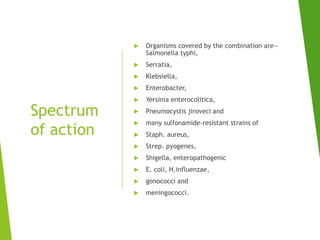
 Organisms covered by the combination are—
Salmonella typhi,
 Serratia,
 Klebsiella,
 Enterobacter,
 Yersinia enterocolitica,
 Pneumocystis jiroveci and
 many sulfonamide-resistant strains of
 Staph. aureus,
 Strep. pyogenes,
 Shigella, enteropathogenic
 E. coli, H.influenzae,
 gonococci and
 meningococci.
Adverse
effects
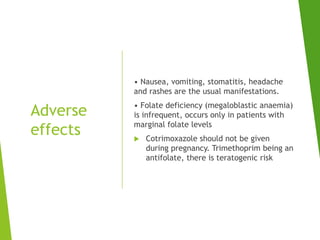
• Nausea, vomiting, stomatitis, headache
and rashes are the usual manifestations.
• Folate deficiency (megaloblastic anaemia)
is infrequent, occurs only in patients with
marginal folate levels
 Cotrimoxazole should not be given
during pregnancy. Trimethoprim being an
antifolate, there is teratogenic risk
Cotrimoxazole
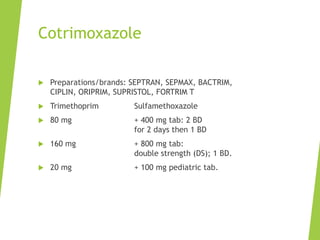
 Preparations/brands: SEPTRAN, SEPMAX, BACTRIM,
CIPLIN, ORIPRIM, SUPRISTOL, FORTRIM T
 Trimethoprim Sulfamethoxazole
 80 mg + 400 mg tab: 2 BD
for 2 days then 1 BD
 160 mg + 800 mg tab:
double strength (DS); 1 BD.
 20 mg + 100 mg pediatric tab.
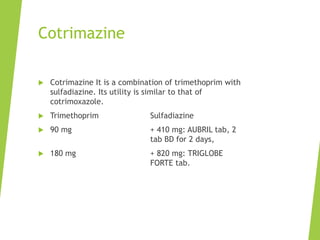
Cotrimazine
 Cotrimazine It is a combination of trimethoprim with
sulfadiazine. Its utility is similar to that of
cotrimoxazole.
 Trimethoprim Sulfadiazine
 90 mg + 410 mg: AUBRIL tab, 2
tab BD for 2 days,
 180 mg + 820 mg: TRIGLOBE
FORTE tab.
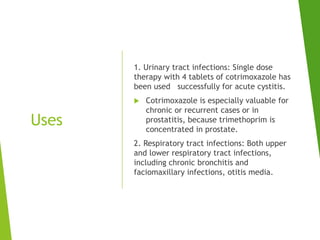
Uses
1. Urinary tract infections: Single dose
therapy with 4 tablets of cotrimoxazole has
been used successfully for acute cystitis.
 Cotrimoxazole is especially valuable for
chronic or recurrent cases or in
prostatitis, because trimethoprim is
concentrated in prostate.
2. Respiratory tract infections: Both upper
and lower respiratory tract infections,
including chronic bronchitis and
faciomaxillary infections, otitis media.
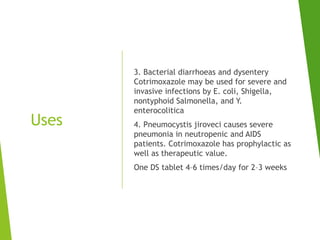
Uses
3. Bacterial diarrhoeas and dysentery
Cotrimoxazole may be used for severe and
invasive infections by E. coli, Shigella,
nontyphoid Salmonella, and Y.
enterocolitica
4. Pneumocystis jiroveci causes severe
pneumonia in neutropenic and AIDS
patients. Cotrimoxazole has prophylactic as
well as therapeutic value.
One DS tablet 4–6 times/day for 2–3 weeks
QUINOLONES
These are synthetic antimicrobials
having a quinolone structure that
are active primarily against gram-
negative bacteria, though the
newer fluorinated compounds also
inhibit gram-positive ones.
The first member Nalidixic acid
introduced in mid-1960s was useful
to treat urinary and g.i. tract
infections ,have limited use
because of low potency, modest
blood and tissue levels, restricted
spectrum and high frequency of
bacterial resistance.
Fluoroquinolones
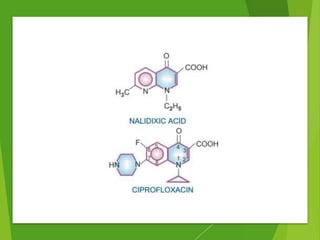
 A breakthrough was achieved in the
early 1980s by fluorination of the
quinolone structure at position 6 and
introduction of a piperazine substitution
at position 7 resulting in derivatives
called fluoroquinolones with high
potency, expanded spectrum, slow
development of resistance, better tissue
penetration and good tolerability
Nalidixic
acid
 It is active against gram-negative
bacteria, especially coliforms: E. coli,
Proteus, Klebsiella, Enterobacter,
Shigella.
 It acts by inhibiting bacterial DNA gyrase
and is bactericidal. Resistance to
nalidixic acid develops rather rapidly
 Adverse effects These are relatively
infrequent, consist mostly of g.i. upset
and rashes.
 Most important toxicity is neurological—
headache, drowsiness, vertigo, visual
disturbances, occasionally seizures
 Nalidixic acid is contraindicated in infants.
 Dose: 0.5–1 g TDS or QID; GRAMONEG 0.5 g tab, 0.3 g/5
ml susp, DIARLOP 0.3 g/5 ml susp
 Uses
 1. Nalidixic acid is primarily used as a urinary antiseptic,
generally as a second line drug in recurrent cases or on
the basis of sensitivity reports.
 2. It has also been employed in diarrhoea caused by
Proteus, E. coli, Shigella or Salmonella, but
norfloxacin/ciproloxacin are more commonly used now
FLUOROQUINOLONES
Norfloxacin,Ciprofloxacin
Ofloxacin, Pefloxacin
Levofloxacin
Gemifloxacin
Sparfloxacin
Prulifloxacin
Moxifloxacin
Lomefloxacin
First generation FQ Second generation FQ
Mechanism
of action
 The FQs inhibit the enzyme bacterial
DNA gyrase.
 The DNA gyrase consists of two A and
two B subunits: FQs bind to A subunit
with high affinity and interfere with its
strand cutting and resealing function.
 In gram-positive bacteria the major
target of FQ action is a similar enzyme
topoisomerase IV
Ciprofloxacin
(prototype)
 It is the most potent first generation FQ
 The MIC of ciprofloxacin against these bacteria is
usually < 0.1 µg/ml,
 Highly susceptible are
 E. coli Neisseria
gonorrhoeae
 K. pneumoniae N. meningitidis
 Enterobacter H. influenzae
 Salmonella typhi H. ducreyi
 Nontyphoid Salmonella Campylobacter
jejuni
 Shigella Yersinia
enterocolitica
 Proteus Vibrio cholerae
Uses
1. Urinary tract infections
2. Gonorrhoea: Initially a single 500 mg dose was nearly 100% curative
3. Chancroid: 500 mg BD for 3 days is a second line alternative drug to
ceftriaxone/ azithromycin
4. Bacterial gastroenteritis:
5. Typhoid: Ciprofloxacin is one of the first choice drugs in typhoid
Ciprofloxacin given in a dose of 750 mg BD for 10 days is recommended.
6. Bone, soft tissue, gynaecological and wound infections: caused by
resistant Staph. and gram-negative bacteria respond to ciprofloxacin
7. Respiratory infections
8. Tuberculosis It is a second line drug which can be used as a component
of combination chemotherapy against multidrug resistant tuberculosis.
9. Gram-negative septicaemias: Parenteral ciprofloxacin may be
combined with a third generation cephalosporin or an aminoglycoside
10. Meningitis: ciprofloxacin has been successfully used in gram-negative
bacterial meningitis, in immunocompromised patients.
Norfloxacin
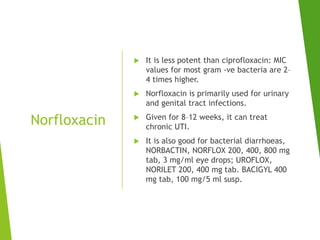
 It is less potent than ciprofloxacin: MIC
values for most gram -ve bacteria are 2–
4 times higher.
 Norfloxacin is primarily used for urinary
and genital tract infections.
 Given for 8–12 weeks, it can treat
chronic UTI.
 It is also good for bacterial diarrhoeas,
NORBACTIN, NORFLOX 200, 400, 800 mg
tab, 3 mg/ml eye drops; UROFLOX,
NORILET 200, 400 mg tab. BACIGYL 400
mg tab, 100 mg/5 ml susp.
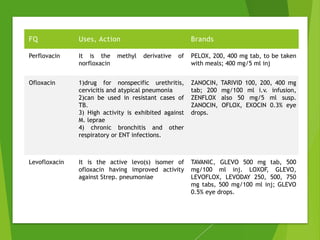
FQ Uses, Action Brands
Perflovacin It is the methyl derivative of
norfloxacin
PELOX, 200, 400 mg tab, to be taken
with meals; 400 mg/5 ml inj
Ofloxacin 1)drug for nonspecific urethritis,
cervicitis and atypical pneumonia
2)can be used in resistant cases of
TB.
3) High activity is exhibited against
M. leprae
4) chronic bronchitis and other
respiratory or ENT infections.
ZANOCIN, TARIVID 100, 200, 400 mg
tab; 200 mg/100 ml i.v. infusion,
ZENFLOX also 50 mg/5 ml susp.
ZANOCIN, OFLOX, EXOCIN 0.3% eye
drops.
Levofloxacin It is the active levo(s) isomer of
ofloxacin having improved activity
against Strep. pneumoniae
TAVANIC, GLEVO 500 mg tab, 500
mg/100 ml inj. LOXOF, GLEVO,
LEVOFLOX, LEVODAY 250, 500, 750
mg tabs, 500 mg/100 ml inj; GLEVO
0.5% eye drops.
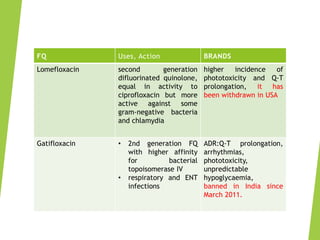
FQ Uses, Action BRANDS
Lomefloxacin second generation
difluorinated quinolone,
equal in activity to
ciprofloxacin but more
active against some
gram-negative bacteria
and chlamydia
higher incidence of
phototoxicity and Q-T
prolongation, it has
been withdrawn in USA
Gatifloxacin • 2nd generation FQ
with higher affinity
for bacterial
topoisomerase IV
• respiratory and ENT
infections
ADR:Q-T prolongation,
arrhythmias,
phototoxicity,
unpredictable
hypoglycaemia,
banned in India since
March 2011.
References
K.D.Tripathi,
Essentials of medical
pharmacology,
Seventh edition

SULPHONAMIDES and Fluoroquinolones.pptx

  • 1.
  • 2.
    Sulfonamides Sulfonamides were thefirst antimicrobial agents (AMAs) effective against pyogenic bacterial infections Sulfonamido-chrysoidine (Prontosil Red) was one of the dyes included by Domagk to treat experimental streptococcal infection in mice and found it to be highly effective. Subsequently an infant was cured of staphylococcal septicaemia (which was 100% fatal at that time) by prontosil.
  • 3.
    By 1937, itbecame clear that prontosil was broken down in the body to release sulfanilamide which was the active antibacterial agent. Because of rapid emergence of bacterial resistance and the availability of many safer and more effective antibiotics, their current utility is limited, except in combination with trimethoprim (as cotrimoxazole) or pyrimethamine (for malaria).
  • 4.
    Sulphonamides Sulfonamides that arestill of clinical interest are: 1) Short acting (4–8 hr): Sulfadiazine 2)Intermediate acting (8–12 hr): Sulfamethoxazole 3. Long acting (~7 days): Sulfadoxine, Sulfamethopyrazine 4. Special purpose sulfonamides: Sulfacetamide sod., Mafenide, Silver sulfadiazine, Sulfasalazine
  • 5.
    ANTIBACTERIAL SPECTRUM  Sulfonamidesare primarily bacteriostatic against many gram-positive and gram-negative bacteria like  Strepto. pyogenes, Staph. aureus,  Haemophilus influenzae, Escherichia coli,  H. ducreyi, Shigella  Vibrio cholerae.  gonococci, meningococci, pneumococci  Anaerobic bacteria are not susceptible.  Chlamydiae: trachoma, lymphogranuloma venereum, inclusion conjunctivitis, are sensitive, as are Actinomyces, Nocardia and Toxoplasma
  • 6.
    Mechanism of action Sulfonamidescompetitively inhibit the union of PABA with pteridine residue to form dihydropteroic acid which conjugates with glutamic acid to produce dihydrofolic acid. Woods and Fildes (1940) proposed the hypothesis that sulfonamides, being structural analogues of PABA, inhibit bacterial folate synthase → FA is not formed and a number of essential metabolic reactions suffer Many bacteria synthesize their own folic acid (FA) of which p- aminobenzoic acid (PABA) is a constituent, and is taken up from the medium.
  • 7.
  • 8.
    Resistance to sulfonamides  Mostbacteria are capable of developing resistance to sulfonamides like gonococci, pneumococci, Staph. aureus, meningococci, E. coli, Shigella and some Strep. pyogenes, Strep. viridans and anaerobes.  The resistant mutants either:  (a) produce increased amounts of PABA, or  (b) their folate synthase enzyme has low affinity for sulfonamides, or  (c) adopt an alternative pathway in folate metabolism.
  • 9.
    PHARMACOKINETICS  Sulfonamides arerapidly and nearly completely absorbed from g.i.t  The highly protein bound members are longer acting  The primary pathway of metabolism of sulfonamides is acetylation at N4 by nonmicrosomal acetyl transferase, primarily in liver
  • 10.
    Sulfadiazine  It isthe prototype of the general purpose sulfonamides that is rapidly absorbed orally and rapidly excreted in urine.  Plasma protein binding is 50%, and it is 20–40% acetylated.  The acetylated derivative is less soluble in urine, crystalluria is likely.  It has good penetrability in brain and CSF—was the preferred compound for meningitis.  Dose: 0.5 g QID to 2 g TDS; SULFADIAZINE 0.5 g tab
  • 11.
    Sulfamethoxazole It has sloweroral absorption and urinary excretion resulting in intermediate duration of action; It is the preferred compound for combining with trimethoprim because the t½ (10hr)of both is similar. However, a high fraction is acetylated, which is relatively insoluble— crystalluria can occur. Dose: 1 g BD for 2 days, then 0.5 g BD. GANTANOL 0.5 g tab
  • 12.
    Sulfadoxine, Sulfamethopyrazine They areused in combination with pyrimethamine in the treatment of malaria ,Pneumocystis jiroveci (pneumonia in AIDS patients )and in toxoplasmosis These are ultralong acting compounds, action lasting > 1 week because of high plasma protein binding and slow renal excretion (t½ 5–9 days).
  • 13.
    Sulfacetamide sod.  It isa highly soluble compound yielding neutral solution which is only mildly irritating to the eye in concentrations up to 30%.  It is used topically for ocular infections due to susceptible bacteria and chlamydia, including ophthalmia neonatorum caused by Ch. oculogenitalis.  It attains high concentrations in anterior segment and aqueous humour after topical instillation.  LOCULA, ALBUCID 10%, 20%, 30% eye drops, 6% eye oint
  • 14.
    Silver sulfadiazine Used topicallyas 1% cream, it is active against a large number of bacteria and fungi, even those resistant to other sulfonamides, e.g. Pseudomonas. It slowly releases silver ions which appear to be largely responsible for the antimicrobial action. Uses: for preventing infection of burnt surfaces and chronic ulcers. SILVIRIN 1% cream, ARGENEX 1% cream with chlorhexidine 0.2%. Sulfasalazine used in ulcerative colitis and rheumatoid arthritis.
  • 15.
    ADVERSE EFFECTS • Nausea, vomitingand epigastric pain. • Crystalluria is dose related, but infrequent now. Precipitation in urine can be minimized by taking plenty of fluids and by alkalinizing the urine. • Hypersensitivity reactions occur in 2–5% patients. Like rashes, urticaria and drug fever. Photosensitization is reported. • Hepatitis, unrelated to dose, occurs in 0.1% patients
  • 16.
    USES  Systemic useof sulfonamides alone (not combined with trimethoprim or pyrimethamine) is rare now.  Combined with trimethoprim (as cotrimoxazole) sulfamethoxazole is used for many bacterial infections, P. jiroveci and nocardiosis .  Along with pyrimethamine, certain sulfonamides are used for malaria and toxoplasmosis  Ocular sulfacetamide sod. (10–30%) is alternative in trachoma/inclusion conjunctivitis.
  • 17.
    COTRIMOXAZOLE The fixed dosecombination of trimethoprim and sulfamethoxazole is called cotrimoxazole. Trimethoprim is a diaminopyrimidine which selectively inhibits bacterial dihydrofolate reductase (DHFRase). Cotrimoxazole introduced in 1969 causes sequential block of folate metabolism as depicted in Fig. Trimethoprim is >50,000 times more active against bacterial DHFRase than against the mammalian enzyme. Thus, human folate metabolism is not interfered Individually, both sulfonamide and trimethoprim are bacteriostatic, but the combination becomes cidal against many organisms.
  • 19.
    Spectrum of action  Organismscovered by the combination are— Salmonella typhi,  Serratia,  Klebsiella,  Enterobacter,  Yersinia enterocolitica,  Pneumocystis jiroveci and  many sulfonamide-resistant strains of  Staph. aureus,  Strep. pyogenes,  Shigella, enteropathogenic  E. coli, H.influenzae,  gonococci and  meningococci.
  • 20.
    Adverse effects • Nausea, vomiting,stomatitis, headache and rashes are the usual manifestations. • Folate deficiency (megaloblastic anaemia) is infrequent, occurs only in patients with marginal folate levels  Cotrimoxazole should not be given during pregnancy. Trimethoprim being an antifolate, there is teratogenic risk
  • 21.
    Cotrimoxazole  Preparations/brands: SEPTRAN,SEPMAX, BACTRIM, CIPLIN, ORIPRIM, SUPRISTOL, FORTRIM T  Trimethoprim Sulfamethoxazole  80 mg + 400 mg tab: 2 BD for 2 days then 1 BD  160 mg + 800 mg tab: double strength (DS); 1 BD.  20 mg + 100 mg pediatric tab.
  • 22.
    Cotrimazine  Cotrimazine Itis a combination of trimethoprim with sulfadiazine. Its utility is similar to that of cotrimoxazole.  Trimethoprim Sulfadiazine  90 mg + 410 mg: AUBRIL tab, 2 tab BD for 2 days,  180 mg + 820 mg: TRIGLOBE FORTE tab.
  • 23.
    Uses 1. Urinary tractinfections: Single dose therapy with 4 tablets of cotrimoxazole has been used successfully for acute cystitis.  Cotrimoxazole is especially valuable for chronic or recurrent cases or in prostatitis, because trimethoprim is concentrated in prostate. 2. Respiratory tract infections: Both upper and lower respiratory tract infections, including chronic bronchitis and faciomaxillary infections, otitis media.
  • 24.
    Uses 3. Bacterial diarrhoeasand dysentery Cotrimoxazole may be used for severe and invasive infections by E. coli, Shigella, nontyphoid Salmonella, and Y. enterocolitica 4. Pneumocystis jiroveci causes severe pneumonia in neutropenic and AIDS patients. Cotrimoxazole has prophylactic as well as therapeutic value. One DS tablet 4–6 times/day for 2–3 weeks
  • 25.
    QUINOLONES These are syntheticantimicrobials having a quinolone structure that are active primarily against gram- negative bacteria, though the newer fluorinated compounds also inhibit gram-positive ones. The first member Nalidixic acid introduced in mid-1960s was useful to treat urinary and g.i. tract infections ,have limited use because of low potency, modest blood and tissue levels, restricted spectrum and high frequency of bacterial resistance.
  • 26.
    Fluoroquinolones  A breakthroughwas achieved in the early 1980s by fluorination of the quinolone structure at position 6 and introduction of a piperazine substitution at position 7 resulting in derivatives called fluoroquinolones with high potency, expanded spectrum, slow development of resistance, better tissue penetration and good tolerability
  • 28.
    Nalidixic acid  It isactive against gram-negative bacteria, especially coliforms: E. coli, Proteus, Klebsiella, Enterobacter, Shigella.  It acts by inhibiting bacterial DNA gyrase and is bactericidal. Resistance to nalidixic acid develops rather rapidly  Adverse effects These are relatively infrequent, consist mostly of g.i. upset and rashes.  Most important toxicity is neurological— headache, drowsiness, vertigo, visual disturbances, occasionally seizures
  • 29.
     Nalidixic acidis contraindicated in infants.  Dose: 0.5–1 g TDS or QID; GRAMONEG 0.5 g tab, 0.3 g/5 ml susp, DIARLOP 0.3 g/5 ml susp  Uses  1. Nalidixic acid is primarily used as a urinary antiseptic, generally as a second line drug in recurrent cases or on the basis of sensitivity reports.  2. It has also been employed in diarrhoea caused by Proteus, E. coli, Shigella or Salmonella, but norfloxacin/ciproloxacin are more commonly used now
  • 30.
  • 31.
    Mechanism of action  TheFQs inhibit the enzyme bacterial DNA gyrase.  The DNA gyrase consists of two A and two B subunits: FQs bind to A subunit with high affinity and interfere with its strand cutting and resealing function.  In gram-positive bacteria the major target of FQ action is a similar enzyme topoisomerase IV
  • 32.
    Ciprofloxacin (prototype)  It isthe most potent first generation FQ  The MIC of ciprofloxacin against these bacteria is usually < 0.1 µg/ml,  Highly susceptible are  E. coli Neisseria gonorrhoeae  K. pneumoniae N. meningitidis  Enterobacter H. influenzae  Salmonella typhi H. ducreyi  Nontyphoid Salmonella Campylobacter jejuni  Shigella Yersinia enterocolitica  Proteus Vibrio cholerae
  • 33.
    Uses 1. Urinary tractinfections 2. Gonorrhoea: Initially a single 500 mg dose was nearly 100% curative 3. Chancroid: 500 mg BD for 3 days is a second line alternative drug to ceftriaxone/ azithromycin 4. Bacterial gastroenteritis: 5. Typhoid: Ciprofloxacin is one of the first choice drugs in typhoid Ciprofloxacin given in a dose of 750 mg BD for 10 days is recommended. 6. Bone, soft tissue, gynaecological and wound infections: caused by resistant Staph. and gram-negative bacteria respond to ciprofloxacin 7. Respiratory infections 8. Tuberculosis It is a second line drug which can be used as a component of combination chemotherapy against multidrug resistant tuberculosis. 9. Gram-negative septicaemias: Parenteral ciprofloxacin may be combined with a third generation cephalosporin or an aminoglycoside 10. Meningitis: ciprofloxacin has been successfully used in gram-negative bacterial meningitis, in immunocompromised patients.
  • 34.
    Norfloxacin  It isless potent than ciprofloxacin: MIC values for most gram -ve bacteria are 2– 4 times higher.  Norfloxacin is primarily used for urinary and genital tract infections.  Given for 8–12 weeks, it can treat chronic UTI.  It is also good for bacterial diarrhoeas, NORBACTIN, NORFLOX 200, 400, 800 mg tab, 3 mg/ml eye drops; UROFLOX, NORILET 200, 400 mg tab. BACIGYL 400 mg tab, 100 mg/5 ml susp.
  • 35.
    FQ Uses, ActionBrands Perflovacin It is the methyl derivative of norfloxacin PELOX, 200, 400 mg tab, to be taken with meals; 400 mg/5 ml inj Ofloxacin 1)drug for nonspecific urethritis, cervicitis and atypical pneumonia 2)can be used in resistant cases of TB. 3) High activity is exhibited against M. leprae 4) chronic bronchitis and other respiratory or ENT infections. ZANOCIN, TARIVID 100, 200, 400 mg tab; 200 mg/100 ml i.v. infusion, ZENFLOX also 50 mg/5 ml susp. ZANOCIN, OFLOX, EXOCIN 0.3% eye drops. Levofloxacin It is the active levo(s) isomer of ofloxacin having improved activity against Strep. pneumoniae TAVANIC, GLEVO 500 mg tab, 500 mg/100 ml inj. LOXOF, GLEVO, LEVOFLOX, LEVODAY 250, 500, 750 mg tabs, 500 mg/100 ml inj; GLEVO 0.5% eye drops.
  • 36.
    FQ Uses, ActionBRANDS Lomefloxacin second generation difluorinated quinolone, equal in activity to ciprofloxacin but more active against some gram-negative bacteria and chlamydia higher incidence of phototoxicity and Q-T prolongation, it has been withdrawn in USA Gatifloxacin • 2nd generation FQ with higher affinity for bacterial topoisomerase IV • respiratory and ENT infections ADR:Q-T prolongation, arrhythmias, phototoxicity, unpredictable hypoglycaemia, banned in India since March 2011.
  • 38.