





Cotrimoxazole
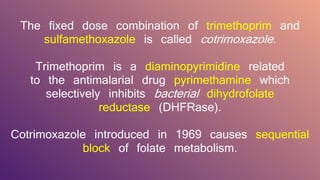
The fixed dose combination of trimethoprim and
sulfamethoxazole is called cotrimoxazole.
Trimethoprim is a diaminopyrimidine related
to the antimalarial drug pyrimethamine which
selectively inhibits bacterial dihydrofolate
reductase (DHFRase).
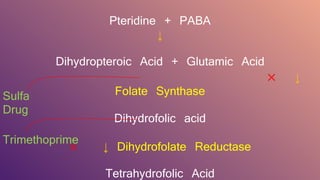
Cotrimoxazole introduced in 1969 causes sequential
block of folate metabolism.
Pteridine + PABA
↓
Dihydropteroic Acid + Glutamic Acid
× ↓
Folate Synthase
Dihydrofolic acid
× ↓ Dihydrofolate Reductase
Tetrahydrofolic Acid
Sulfa
Drug
Trimethoprime
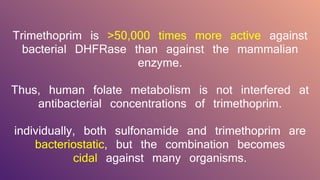
Trimethoprim is >50,000 times more active against
bacterial DHFRase than against the mammalian
enzyme.
Thus, human folate metabolism is not interfered at
antibacterial concentrations of trimethoprim.
individually, both sulfonamide and trimethoprim are
bacteriostatic, but the combination becomes
cidal against many organisms.
Maximum synergism is seen when
the organism is sensitive to both the components,
But even when it is
moderately resistant to one component, the action of
the other may be enhanced.
Sulfamethoxazole was selected for combining
with trimethoprim because both have
nearly the same t½ (- 10 hr).
Optimal synergy in case of
most organisms is exhibited at a concentration
ratio of sulfamethoxazole 20 : trimethoprim I.
The MIC of each component may be reduced by
3-6 times.
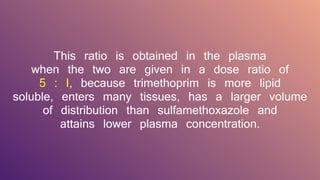
This ratio is obtained in the plasma
when the two are given in a dose ratio of
5 : I, because trimethoprim is more lipid
soluble, enters many tissues, has a larger volume
of distribution than sulfamethoxazole and
attains lower plasma concentration.
However,
trimethoprim crosses blood-brain barrier and placenta,
while sulfamethoxazole has a poorer entry.
Moreover, trimethoprim
is more rapidly absorbed than sulfamethoxazole
hence
concentration ratios may vary with time.
Trimethoprim is 40% plasma protein bound,
while sulfamethoxazole is 65% bound.
Spectrum of action
Antibacterial spectra of
trimethoprim and sulfonamides overlap considerably.
Additional organisms covered by the combination are-
Salmonella typhi,
Serratia,
Klebsiella,
Enterobacter,
Yersinia enterocolitica,
Pneumocystis jiroveci
Many sulphonamide resistant strains
Staph. aureus,
Strep. pyogenes
Shigella,
Eteropathogenic E. coli,
H.inftuenzae,
Gonococci and
Meningococci.
Resistance
Bacteria are capable of acquiring
resistance to trimethoprim mostly through plasmid
mediated acquisition of a DHFRase
having lower affinity for the inhibitor.
Resistance to the combination has been slow to
develop
compared to either drug alone,
but widespread
use of the combination over a long period has
resulted in reduced responsiveness of over 30%
Adverse effects
All adverse effects seen
with sulfonamides can be produced by cotrimoxazole.
Nausea, vomiting, stomatitis, headache and
rashes are the usual manifestations.
Folate deficiency (megaloblastic anaemia)
is infrequent, occurs only in patients with
marginal folate levels.
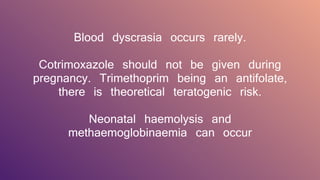
Blood dyscrasia occurs rarely.
Cotrimoxazole should not be given during
pregnancy. Trimethoprim being an antifolate,
there is theoretical teratogenic risk.
Neonatal haemolysis and
methaemoglobinaemia can occur
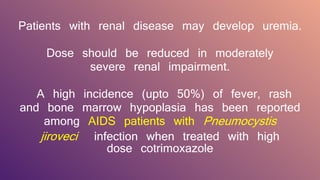
Patients with renal disease may develop uremia.
Dose should be reduced in moderately
severe renal impairment.
A high incidence (upto 50%) of fever, rash
and bone marrow hypoplasia has been reported
among AIDS patients with Pneumocystis
jiroveci infection when treated with high
dose cotrimoxazole
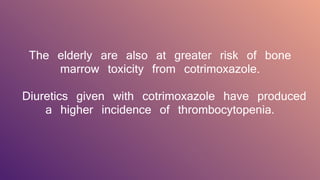
The elderly are also at greater risk of bone
marrow toxicity from cotrimoxazole.
Diuretics given with cotrimoxazole have produced
a higher incidence of thrombocytopenia.
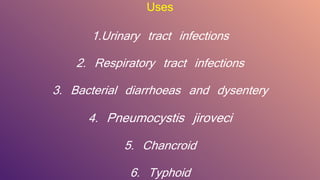
Uses
1.Urinary tract infections
2. Respiratory tract infections
3. Bacterial diarrhoeas and dysentery
4. Pneumocystis jiroveci
5. Chancroid
6. Typhoid
Cotrimoxazole

Cotrimoxazole

  • 1.
  • 2.
    The fixed dosecombination of trimethoprim and sulfamethoxazole is called cotrimoxazole. Trimethoprim is a diaminopyrimidine related to the antimalarial drug pyrimethamine which selectively inhibits bacterial dihydrofolate reductase (DHFRase). Cotrimoxazole introduced in 1969 causes sequential block of folate metabolism.
  • 3.
    Pteridine + PABA ↓ DihydropteroicAcid + Glutamic Acid × ↓ Folate Synthase Dihydrofolic acid × ↓ Dihydrofolate Reductase Tetrahydrofolic Acid Sulfa Drug Trimethoprime
  • 4.
    Trimethoprim is >50,000times more active against bacterial DHFRase than against the mammalian enzyme. Thus, human folate metabolism is not interfered at antibacterial concentrations of trimethoprim. individually, both sulfonamide and trimethoprim are bacteriostatic, but the combination becomes cidal against many organisms.
  • 5.
    Maximum synergism isseen when the organism is sensitive to both the components, But even when it is moderately resistant to one component, the action of the other may be enhanced.
  • 6.
    Sulfamethoxazole was selectedfor combining with trimethoprim because both have nearly the same t½ (- 10 hr). Optimal synergy in case of most organisms is exhibited at a concentration ratio of sulfamethoxazole 20 : trimethoprim I. The MIC of each component may be reduced by 3-6 times.
  • 7.
    This ratio isobtained in the plasma when the two are given in a dose ratio of 5 : I, because trimethoprim is more lipid soluble, enters many tissues, has a larger volume of distribution than sulfamethoxazole and attains lower plasma concentration.
  • 8.
    However, trimethoprim crosses blood-brainbarrier and placenta, while sulfamethoxazole has a poorer entry. Moreover, trimethoprim is more rapidly absorbed than sulfamethoxazole hence concentration ratios may vary with time.
  • 9.
    Trimethoprim is 40%plasma protein bound, while sulfamethoxazole is 65% bound.
  • 10.
    Spectrum of action Antibacterialspectra of trimethoprim and sulfonamides overlap considerably. Additional organisms covered by the combination are- Salmonella typhi, Serratia, Klebsiella, Enterobacter, Yersinia enterocolitica, Pneumocystis jiroveci
  • 11.
    Many sulphonamide resistantstrains Staph. aureus, Strep. pyogenes Shigella, Eteropathogenic E. coli, H.inftuenzae, Gonococci and Meningococci.
  • 12.
    Resistance Bacteria are capableof acquiring resistance to trimethoprim mostly through plasmid mediated acquisition of a DHFRase having lower affinity for the inhibitor. Resistance to the combination has been slow to develop compared to either drug alone, but widespread use of the combination over a long period has resulted in reduced responsiveness of over 30%
  • 13.
    Adverse effects All adverseeffects seen with sulfonamides can be produced by cotrimoxazole. Nausea, vomiting, stomatitis, headache and rashes are the usual manifestations. Folate deficiency (megaloblastic anaemia) is infrequent, occurs only in patients with marginal folate levels.
  • 14.
    Blood dyscrasia occursrarely. Cotrimoxazole should not be given during pregnancy. Trimethoprim being an antifolate, there is theoretical teratogenic risk. Neonatal haemolysis and methaemoglobinaemia can occur
  • 15.
    Patients with renaldisease may develop uremia. Dose should be reduced in moderately severe renal impairment. A high incidence (upto 50%) of fever, rash and bone marrow hypoplasia has been reported among AIDS patients with Pneumocystis jiroveci infection when treated with high dose cotrimoxazole
  • 16.
    The elderly arealso at greater risk of bone marrow toxicity from cotrimoxazole. Diuretics given with cotrimoxazole have produced a higher incidence of thrombocytopenia.
  • 17.
    Uses 1.Urinary tract infections 2.Respiratory tract infections 3. Bacterial diarrhoeas and dysentery 4. Pneumocystis jiroveci 5. Chancroid 6. Typhoid