Anti-microbial Agents-General
Consideration
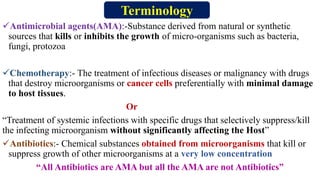
Antimicrobial agents(AMA):-Substance derived from natural or synthetic
sources that kills or inhibits the growth of micro-organisms such as bacteria,
fungi, protozoa
Chemotherapy:- The treatment of infectious diseases or malignancy with drugs
that destroy microorganisms or cancer cells preferentially with minimal damage
to host tissues.
Or
“Treatment of systemic infections with specific drugs that selectively suppress/kill
the infecting microorganism without significantly affecting the Host”
Antibiotics:- Chemical substances obtained from microorganisms that kill or
suppress growth of other microorganisms at a very low concentration
“All Antibiotics are AMA but all the AMA are not Antibiotics”
Terminology
• Term Antibiotic was coined by Selman Waksman in 1942
• Penicillin-first natural antibiotic discovered by “Alexander flemming”
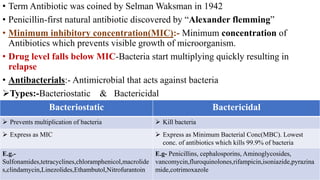
• Minimum inhibitory concentration(MIC):- Minimum concentration of
Antibiotics which prevents visible growth of microorganism.
• Drug level falls below MIC-Bacteria start multiplying quickly resulting in
relapse
• Antibacterials:- Antimicrobial that acts against bacteria
Types:-Bacteriostatic & Bactericidal
Bacteriostatic Bactericidal
 Prevents multiplication of bacteria  Kill bacteria
 Express as MIC  Express as Minimum Bacterial Conc(MBC). Lowest
conc. of antibiotics which kills 99.9% of bacteria
E.g.-
Sulfonamides,tetracyclines,chloramphenicol,macrolide
s,clindamycin,Linezolides,Ethambutol,Nitrofurantoin
E.g- Penicillins, cephalosporins, Aminoglycosides,
vancomycin,fluroquinolones,rifampicin,isoniazide,pyrazina
mide,cotrimoxazole
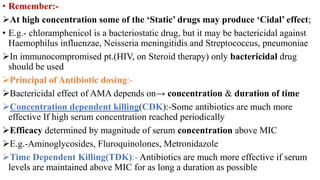
• Remember:-
At high concentration some of the ‘Static’ drugs may produce ‘Cidal’ effect;
• E.g.- chloramphenicol is a bacteriostatic drug, but it may be bactericidal against
Haemophilus influenzae, Neisseria meningitidis and Streptococcus, pneumoniae
In immunocompromised pt.(HIV, on Steroid therapy) only bactericidal drug
should be used
Principal of Antibiotic dosing:-
Bactericidal effect of AMA depends on→ concentration & duration of time
Concentration dependent killing(CDK):-Some antibiotics are much more
effective If high serum concentration reached periodically
Efficacy determined by magnitude of serum concentration above MIC
E.g.-Aminoglycosides, Fluroquinolones, Metronidazole
Time Dependent Killing(TDK):- Antibiotics are much more effective if serum
levels are maintained above MIC for as long a duration as possible
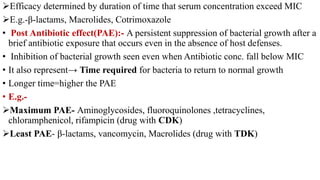
Efficacy determined by duration of time that serum concentration exceed MIC
E.g.-β-lactams, Macrolides, Cotrimoxazole
• Post Antibiotic effect(PAE):- A persistent suppression of bacterial growth after a
brief antibiotic exposure that occurs even in the absence of host defenses.
• Inhibition of bacterial growth seen even when Antibiotic conc. fall below MIC
• It also represent→ Time required for bacteria to return to normal growth
• Longer time=higher the PAE
• E.g.-
Maximum PAE- Aminoglycosides, fluoroquinolones ,tetracyclines,
chloramphenicol, rifampicin (drug with CDK)
Least PAE- β-lactams, vancomycin, Macrolides (drug with TDK)
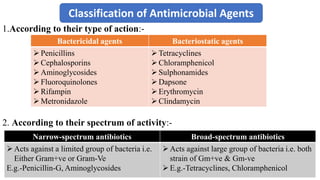
1.According to their type of action:-
2. According to their spectrum of activity:-
Classification of Antimicrobial Agents
Bactericidal agents Bacteriostatic agents
Penicillins
Cephalosporins
Aminoglycosides
Fluoroquinolones
Rifampin
Metronidazole
Tetracyclines
Chloramphenicol
Sulphonamides
Dapsone
Erythromycin
Clindamycin
Narrow-spectrum antibiotics Broad-spectrum antibiotics
Acts against a limited group of bacteria i.e.
Either Gram+ve or Gram-Ve
E.g.-Penicillin-G, Aminoglycosides
Acts against large group of bacteria i.e. both
strain of Gm+ve & Gm-ve
E.g.-Tetracyclines, Chloramphenicol
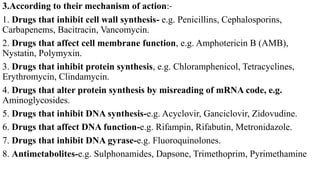
3.According to their mechanism of action:-
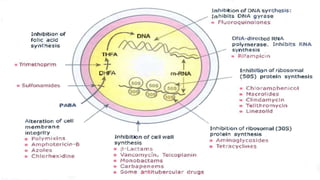
1. Drugs that inhibit cell wall synthesis- e.g. Penicillins, Cephalosporins,
Carbapenems, Bacitracin, Vancomycin.
2. Drugs that affect cell membrane function, e.g. Amphotericin B (AMB),
Nystatin, Polymyxin.
3. Drugs that inhibit protein synthesis, e.g. Chloramphenicol, Tetracyclines,
Erythromycin, Clindamycin.
4. Drugs that alter protein synthesis by misreading of mRNA code, e.g.
Aminoglycosides.
5. Drugs that inhibit DNA synthesis-e.g. Acyclovir, Ganciclovir, Zidovudine.
6. Drugs that affect DNA function-e.g. Rifampin, Rifabutin, Metronidazole.
7. Drugs that inhibit DNA gyrase-e.g. Fluoroquinolones.
8. Antimetabolites-e.g. Sulphonamides, Dapsone, Trimethoprim, Pyrimethamine
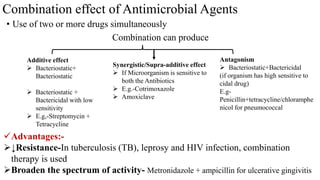
Combination effect of Antimicrobial Agents
• Use of two or more drugs simultaneously
Combination can produce
Additive effect
 Bacteriostatic+
Bacteriostatic
 Bacteriostatic +
Bactericidal with low
sensitivity
 E.g,-Streptomycin +
Tetracycline
Synergistic/Supra-additive effect
 If Microorganism is sensitive to
both the Antibiotics
 E.g.-Cotrimoxazole
 Amoxiclave
Antagonism
 Bacteriostatic+Bactericidal
(if organism has high sensitive to
cidal drug)
E.g-
Penicillin+tetracycline/chloramphe
nicol for pneumococcal
Advantages:-
↓Resistance-In tuberculosis (TB), leprosy and HIV infection, combination
therapy is used
Broaden the spectrum of activity- Metronidazole + ampicillin for ulcerative gingivitis
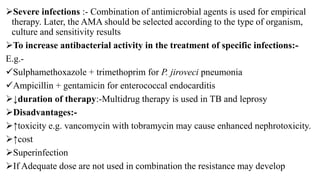
Severe infections :- Combination of antimicrobial agents is used for empirical
therapy. Later, the AMA should be selected according to the type of organism,
culture and sensitivity results
To increase antibacterial activity in the treatment of specific infections:-
E.g.-
Sulphamethoxazole + trimethoprim for P. jiroveci pneumonia
Ampicillin + gentamicin for enterococcal endocarditis
↓duration of therapy:-Multidrug therapy is used in TB and leprosy
Disadvantages:-
↑toxicity e.g. vancomycin with tobramycin may cause enhanced nephrotoxicity.
↑cost
Superinfection
If Adequate dose are not used in combination the resistance may develop
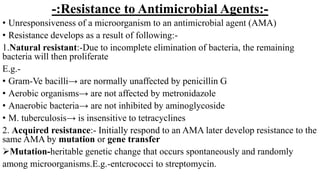
-:Resistance to Antimicrobial Agents:-
• Unresponsiveness of a microorganism to an antimicrobial agent (AMA)
• Resistance develops as a result of following:-
1.Natural resistant:-Due to incomplete elimination of bacteria, the remaining
bacteria will then proliferate
E.g.-
• Gram-Ve bacilli→ are normally unaffected by penicillin G
• Aerobic organisms→ are not affected by metronidazole
• Anaerobic bacteria→ are not inhibited by aminoglycoside
• M. tuberculosis→ is insensitive to tetracyclines
2. Acquired resistance:- Initially respond to an AMA later develop resistance to the
same AMA by mutation or gene transfer
Mutation-heritable genetic change that occurs spontaneously and randomly
among microorganisms.E.g.-entcrococci to streptomycin.
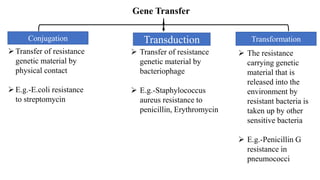
Gene Transfer
Conjugation Transformation
Transduction
Transfer of resistance
genetic material by
physical contact
E.g.-E.coli resistance
to streptomycin
 Transfer of resistance
genetic material by
bacteriophage
 E.g.-Staphylococcus
aureus resistance to
penicillin, Erythromycin
 The resistance
carrying genetic
material that is
released into the
environment by
resistant bacteria is
taken up by other
sensitive bacteria
 E.g.-Penicillin G
resistance in
pneumococci
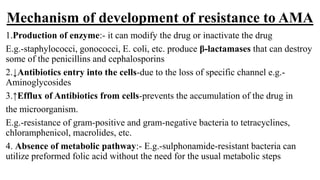
Mechanism of development of resistance to AMA
1.Production of enzyme:- it can modify the drug or inactivate the drug
E.g.-staphylococci, gonococci, E. coli, etc. produce β-lactamases that can destroy
some of the penicillins and cephalosporins
2.↓Antibiotics entry into the cells-due to the loss of specific channel e.g.-
Aminoglycosides
3.↑Efflux of Antibiotics from cells-prevents the accumulation of the drug in
the microorganism.
E.g.-resistance of gram-positive and gram-negative bacteria to tetracyclines,
chloramphenicol, macrolides, etc.
4. Absence of metabolic pathway:- E.g.-sulphonamide-resistant bacteria can
utilize preformed folic acid without the need for the usual metabolic steps
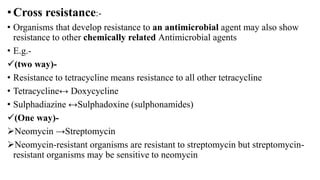
•Cross resistance:-
• Organisms that develop resistance to an antimicrobial agent may also show
resistance to other chemically related Antimicrobial agents
• E.g.-
(two way)-
• Resistance to tetracycline means resistance to all other tetracycline
• Tetracycline↔ Doxycycline
• Sulphadiazine ↔Sulphadoxine (sulphonamides)
(One way)-
Neomycin →Streptomycin
Neomycin-resistant organisms are resistant to streptomycin but streptomycin-
resistant organisms may be sensitive to neomycin
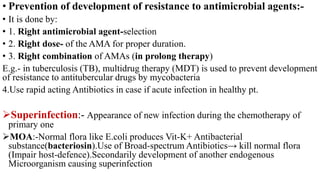
• Prevention of development of resistance to antimicrobial agents:-
• It is done by:
• 1. Right antimicrobial agent-selection
• 2. Right dose- of the AMA for proper duration.
• 3. Right combination of AMAs (in prolong therapy)
E.g.- in tuberculosis (TB), multidrug therapy (MDT) is used to prevent development
of resistance to antitubercular drugs by mycobacteria
4.Use rapid acting Antibiotics in case if acute infection in healthy pt.
Superinfection:- Appearance of new infection during the chemotherapy of
primary one
MOA:-Normal flora like E.coli produces Vit-K+ Antibacterial
substance(bacteriosin).Use of Broad-spectrum Antibiotics→ kill normal flora
(Impair host-defence).Secondarily development of another endogenous
Microorganism causing superinfection
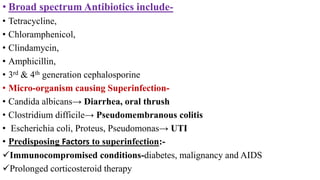
• Broad spectrum Antibiotics include-
• Tetracycline,
• Chloramphenicol,
• Clindamycin,
• Amphicillin,
• 3rd & 4th generation cephalosporine
• Micro-organism causing Superinfection-
• Candida albicans→ Diarrhea, oral thrush
• Clostridium difficile→ Pseudomembranous colitis
• Escherichia coli, Proteus, Pseudomonas→ UTI
• Predisposing Factors to superinfection:-
Immunocompromised conditions-diabetes, malignancy and AIDS
Prolonged corticosteroid therapy
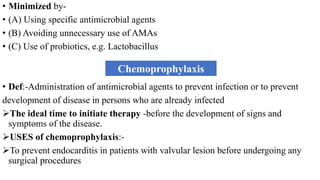
• Minimized by-
• (A) Using specific antimicrobial agents
• (B) Avoiding unnecessary use of AMAs
• (C) Use of probiotics, e.g. Lactobacillus
• Def:-Administration of antimicrobial agents to prevent infection or to prevent
development of disease in persons who are already infected
The ideal time to initiate therapy -before the development of signs and
symptoms of the disease.
USES of chemoprophylaxis:-
To prevent endocarditis in patients with valvular lesion before undergoing any
surgical procedures
Chemoprophylaxis
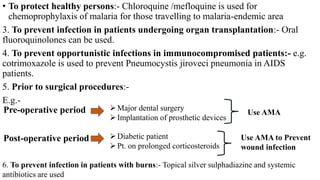
• To protect healthy persons:- Chloroquine /mefloquine is used for
chemoprophylaxis of malaria for those travelling to malaria-endemic area
3. To prevent infection in patients undergoing organ transplantation:- Oral
fluoroquinolones can be used.
4. To prevent opportunistic infections in immunocompromised patients:- e.g.
cotrimoxazole is used to prevent Pneumocystis jiroveci pneumonia in AIDS
patients.
5. Prior to surgical procedures:-
E.g.-
Use AMA
Pre-operative period Major dental surgery
Implantation of prosthetic devices
Post-operative period Diabetic patient
Pt. on prolonged corticosteroids
Use AMA to Prevent
wound infection
6. To prevent infection in patients with burns:- Topical silver sulphadiazine and systemic
antibiotics are used
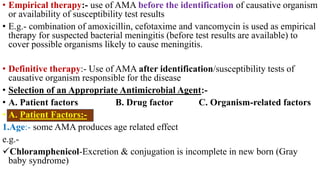
• Empirical therapy:- use of AMA before the identification of causative organism
or availability of susceptibility test results
• E.g.- combination of amoxicillin, cefotaxime and vancomycin is used as empirical
therapy for suspected bacterial meningitis (before test results are available) to
cover possible organisms likely to cause meningitis.
• Definitive therapy:- Use of AMA after identification/susceptibility tests of
causative organism responsible for the disease
• Selection of an Appropriate Antimicrobial Agent:-
• A. Patient factors B. Drug factor C. Organism-related factors
• A. Patient Factors:-
1.Age:- some AMA produces age related effect
e.g.-
Chloramphenicol-Excretion & conjugation is incomplete in new born (Gray
baby syndrome)
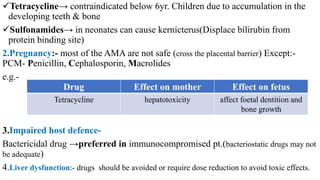
Tetracycline→ contraindicated below 6yr. Children due to accumulation in the
developing teeth & bone
Sulfonamides→ in neonates can cause kernicterus(Displace bilirubin from
protein binding site)
2.Pregnancy:- most of the AMA are not safe (cross the placental barrier) Except:-
PCM- Penicillin, Cephalosporin, Macrolides
e.g.-
3.Impaired host defence-
Bactericidal drug →preferred in immunocompromised pt.(bacteriostatic drugs may not
be adequate)
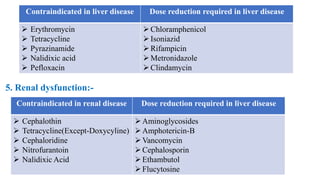
4.Liver dysfunction:- drugs should be avoided or require dose reduction to avoid toxic effects.
Drug Effect on mother Effect on fetus
Tetracycline hepatotoxicity affect foetal dentition and
bone growth
Contraindicated in liver disease Dose reduction required in liver disease
 Erythromycin
 Tetracycline
 Pyrazinamide
 Nalidixic acid
 Pefloxacin
Chloramphenicol
Isoniazid
Rifampicin
Metronidazole
Clindamycin
5. Renal dysfunction:-
Contraindicated in renal disease Dose reduction required in liver disease
 Cephalothin
 Tetracycline(Except-Doxycyline)
 Cephaloridine
 Nitrofurantoin
 Nalidixic Acid
Aminoglycosides
Amphotericin-B
Vancomycin
Cephalosporin
Ethambutol
Flucytosine
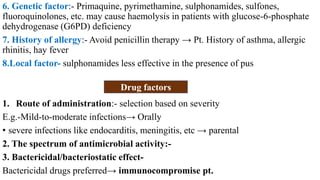
6. Genetic factor:- Primaquine, pyrimethamine, sulphonamides, sulfones,
fluoroquinolones, etc. may cause haemolysis in patients with glucose-6-phosphate
dehydrogenase (G6PD) deficiency
7. History of allergy:- Avoid penicillin therapy → Pt. History of asthma, allergic
rhinitis, hay fever
8.Local factor- sulphonamides less effective in the presence of pus
1. Route of administration:- selection based on severity
E.g.-Mild-to-moderate infections→ Orally
• severe infections like endocarditis, meningitis, etc → parental
2. The spectrum of antimicrobial activity:-
3. Bactericidal/bacteriostatic effect-
Bactericidal drugs preferred→ immunocompromise pt.
Drug factors
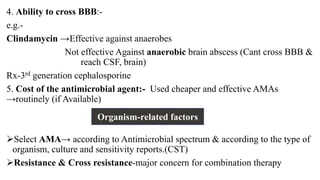
4. Ability to cross BBB:-
e.g.-
Clindamycin →Effective against anaerobes
Not effective Against anaerobic brain abscess (Cant cross BBB &
reach CSF, brain)
Rx-3rd generation cephalosporine
5. Cost of the antimicrobial agent:- Used cheaper and effective AMAs
→routinely (if Available)
Select AMA→ according to Antimicrobial spectrum & according to the type of
organism, culture and sensitivity reports.(CST)
Resistance & Cross resistance-major concern for combination therapy
Organism-related factors
• Sulphonamides
• Quinolones
• β-lactam antibiotics-penicillins, Cephalosporins & others
• Aminoglycosides
• Broad spectrum Antibiotics & Macrolides
• Anti-TB
• Anti-Leprotics
• Anti-viral
• Anti-fungal
• Anti-cancer
Anti-microbial Agents

Antimicrobials General consideration

  • 1.
  • 2.
    Antimicrobial agents(AMA):-Substance derivedfrom natural or synthetic sources that kills or inhibits the growth of micro-organisms such as bacteria, fungi, protozoa Chemotherapy:- The treatment of infectious diseases or malignancy with drugs that destroy microorganisms or cancer cells preferentially with minimal damage to host tissues. Or “Treatment of systemic infections with specific drugs that selectively suppress/kill the infecting microorganism without significantly affecting the Host” Antibiotics:- Chemical substances obtained from microorganisms that kill or suppress growth of other microorganisms at a very low concentration “All Antibiotics are AMA but all the AMA are not Antibiotics” Terminology
  • 3.
    • Term Antibioticwas coined by Selman Waksman in 1942 • Penicillin-first natural antibiotic discovered by “Alexander flemming” • Minimum inhibitory concentration(MIC):- Minimum concentration of Antibiotics which prevents visible growth of microorganism. • Drug level falls below MIC-Bacteria start multiplying quickly resulting in relapse • Antibacterials:- Antimicrobial that acts against bacteria Types:-Bacteriostatic & Bactericidal Bacteriostatic Bactericidal  Prevents multiplication of bacteria  Kill bacteria  Express as MIC  Express as Minimum Bacterial Conc(MBC). Lowest conc. of antibiotics which kills 99.9% of bacteria E.g.- Sulfonamides,tetracyclines,chloramphenicol,macrolide s,clindamycin,Linezolides,Ethambutol,Nitrofurantoin E.g- Penicillins, cephalosporins, Aminoglycosides, vancomycin,fluroquinolones,rifampicin,isoniazide,pyrazina mide,cotrimoxazole
  • 4.
    • Remember:- At highconcentration some of the ‘Static’ drugs may produce ‘Cidal’ effect; • E.g.- chloramphenicol is a bacteriostatic drug, but it may be bactericidal against Haemophilus influenzae, Neisseria meningitidis and Streptococcus, pneumoniae In immunocompromised pt.(HIV, on Steroid therapy) only bactericidal drug should be used Principal of Antibiotic dosing:- Bactericidal effect of AMA depends on→ concentration & duration of time Concentration dependent killing(CDK):-Some antibiotics are much more effective If high serum concentration reached periodically Efficacy determined by magnitude of serum concentration above MIC E.g.-Aminoglycosides, Fluroquinolones, Metronidazole Time Dependent Killing(TDK):- Antibiotics are much more effective if serum levels are maintained above MIC for as long a duration as possible
  • 5.
    Efficacy determined byduration of time that serum concentration exceed MIC E.g.-β-lactams, Macrolides, Cotrimoxazole • Post Antibiotic effect(PAE):- A persistent suppression of bacterial growth after a brief antibiotic exposure that occurs even in the absence of host defenses. • Inhibition of bacterial growth seen even when Antibiotic conc. fall below MIC • It also represent→ Time required for bacteria to return to normal growth • Longer time=higher the PAE • E.g.- Maximum PAE- Aminoglycosides, fluoroquinolones ,tetracyclines, chloramphenicol, rifampicin (drug with CDK) Least PAE- β-lactams, vancomycin, Macrolides (drug with TDK)
  • 6.
    1.According to theirtype of action:- 2. According to their spectrum of activity:- Classification of Antimicrobial Agents Bactericidal agents Bacteriostatic agents Penicillins Cephalosporins Aminoglycosides Fluoroquinolones Rifampin Metronidazole Tetracyclines Chloramphenicol Sulphonamides Dapsone Erythromycin Clindamycin Narrow-spectrum antibiotics Broad-spectrum antibiotics Acts against a limited group of bacteria i.e. Either Gram+ve or Gram-Ve E.g.-Penicillin-G, Aminoglycosides Acts against large group of bacteria i.e. both strain of Gm+ve & Gm-ve E.g.-Tetracyclines, Chloramphenicol
  • 7.
    3.According to theirmechanism of action:- 1. Drugs that inhibit cell wall synthesis- e.g. Penicillins, Cephalosporins, Carbapenems, Bacitracin, Vancomycin. 2. Drugs that affect cell membrane function, e.g. Amphotericin B (AMB), Nystatin, Polymyxin. 3. Drugs that inhibit protein synthesis, e.g. Chloramphenicol, Tetracyclines, Erythromycin, Clindamycin. 4. Drugs that alter protein synthesis by misreading of mRNA code, e.g. Aminoglycosides. 5. Drugs that inhibit DNA synthesis-e.g. Acyclovir, Ganciclovir, Zidovudine. 6. Drugs that affect DNA function-e.g. Rifampin, Rifabutin, Metronidazole. 7. Drugs that inhibit DNA gyrase-e.g. Fluoroquinolones. 8. Antimetabolites-e.g. Sulphonamides, Dapsone, Trimethoprim, Pyrimethamine
  • 9.
    Combination effect ofAntimicrobial Agents • Use of two or more drugs simultaneously Combination can produce Additive effect  Bacteriostatic+ Bacteriostatic  Bacteriostatic + Bactericidal with low sensitivity  E.g,-Streptomycin + Tetracycline Synergistic/Supra-additive effect  If Microorganism is sensitive to both the Antibiotics  E.g.-Cotrimoxazole  Amoxiclave Antagonism  Bacteriostatic+Bactericidal (if organism has high sensitive to cidal drug) E.g- Penicillin+tetracycline/chloramphe nicol for pneumococcal Advantages:- ↓Resistance-In tuberculosis (TB), leprosy and HIV infection, combination therapy is used Broaden the spectrum of activity- Metronidazole + ampicillin for ulcerative gingivitis
  • 10.
    Severe infections :-Combination of antimicrobial agents is used for empirical therapy. Later, the AMA should be selected according to the type of organism, culture and sensitivity results To increase antibacterial activity in the treatment of specific infections:- E.g.- Sulphamethoxazole + trimethoprim for P. jiroveci pneumonia Ampicillin + gentamicin for enterococcal endocarditis ↓duration of therapy:-Multidrug therapy is used in TB and leprosy Disadvantages:- ↑toxicity e.g. vancomycin with tobramycin may cause enhanced nephrotoxicity. ↑cost Superinfection If Adequate dose are not used in combination the resistance may develop
  • 11.
    -:Resistance to AntimicrobialAgents:- • Unresponsiveness of a microorganism to an antimicrobial agent (AMA) • Resistance develops as a result of following:- 1.Natural resistant:-Due to incomplete elimination of bacteria, the remaining bacteria will then proliferate E.g.- • Gram-Ve bacilli→ are normally unaffected by penicillin G • Aerobic organisms→ are not affected by metronidazole • Anaerobic bacteria→ are not inhibited by aminoglycoside • M. tuberculosis→ is insensitive to tetracyclines 2. Acquired resistance:- Initially respond to an AMA later develop resistance to the same AMA by mutation or gene transfer Mutation-heritable genetic change that occurs spontaneously and randomly among microorganisms.E.g.-entcrococci to streptomycin.
  • 12.
    Gene Transfer Conjugation Transformation Transduction Transferof resistance genetic material by physical contact E.g.-E.coli resistance to streptomycin  Transfer of resistance genetic material by bacteriophage  E.g.-Staphylococcus aureus resistance to penicillin, Erythromycin  The resistance carrying genetic material that is released into the environment by resistant bacteria is taken up by other sensitive bacteria  E.g.-Penicillin G resistance in pneumococci
  • 13.
    Mechanism of developmentof resistance to AMA 1.Production of enzyme:- it can modify the drug or inactivate the drug E.g.-staphylococci, gonococci, E. coli, etc. produce β-lactamases that can destroy some of the penicillins and cephalosporins 2.↓Antibiotics entry into the cells-due to the loss of specific channel e.g.- Aminoglycosides 3.↑Efflux of Antibiotics from cells-prevents the accumulation of the drug in the microorganism. E.g.-resistance of gram-positive and gram-negative bacteria to tetracyclines, chloramphenicol, macrolides, etc. 4. Absence of metabolic pathway:- E.g.-sulphonamide-resistant bacteria can utilize preformed folic acid without the need for the usual metabolic steps
  • 14.
    •Cross resistance:- • Organismsthat develop resistance to an antimicrobial agent may also show resistance to other chemically related Antimicrobial agents • E.g.- (two way)- • Resistance to tetracycline means resistance to all other tetracycline • Tetracycline↔ Doxycycline • Sulphadiazine ↔Sulphadoxine (sulphonamides) (One way)- Neomycin →Streptomycin Neomycin-resistant organisms are resistant to streptomycin but streptomycin- resistant organisms may be sensitive to neomycin
  • 15.
    • Prevention ofdevelopment of resistance to antimicrobial agents:- • It is done by: • 1. Right antimicrobial agent-selection • 2. Right dose- of the AMA for proper duration. • 3. Right combination of AMAs (in prolong therapy) E.g.- in tuberculosis (TB), multidrug therapy (MDT) is used to prevent development of resistance to antitubercular drugs by mycobacteria 4.Use rapid acting Antibiotics in case if acute infection in healthy pt. Superinfection:- Appearance of new infection during the chemotherapy of primary one MOA:-Normal flora like E.coli produces Vit-K+ Antibacterial substance(bacteriosin).Use of Broad-spectrum Antibiotics→ kill normal flora (Impair host-defence).Secondarily development of another endogenous Microorganism causing superinfection
  • 16.
    • Broad spectrumAntibiotics include- • Tetracycline, • Chloramphenicol, • Clindamycin, • Amphicillin, • 3rd & 4th generation cephalosporine • Micro-organism causing Superinfection- • Candida albicans→ Diarrhea, oral thrush • Clostridium difficile→ Pseudomembranous colitis • Escherichia coli, Proteus, Pseudomonas→ UTI • Predisposing Factors to superinfection:- Immunocompromised conditions-diabetes, malignancy and AIDS Prolonged corticosteroid therapy
  • 17.
    • Minimized by- •(A) Using specific antimicrobial agents • (B) Avoiding unnecessary use of AMAs • (C) Use of probiotics, e.g. Lactobacillus • Def:-Administration of antimicrobial agents to prevent infection or to prevent development of disease in persons who are already infected The ideal time to initiate therapy -before the development of signs and symptoms of the disease. USES of chemoprophylaxis:- To prevent endocarditis in patients with valvular lesion before undergoing any surgical procedures Chemoprophylaxis
  • 18.
    • To protecthealthy persons:- Chloroquine /mefloquine is used for chemoprophylaxis of malaria for those travelling to malaria-endemic area 3. To prevent infection in patients undergoing organ transplantation:- Oral fluoroquinolones can be used. 4. To prevent opportunistic infections in immunocompromised patients:- e.g. cotrimoxazole is used to prevent Pneumocystis jiroveci pneumonia in AIDS patients. 5. Prior to surgical procedures:- E.g.- Use AMA Pre-operative period Major dental surgery Implantation of prosthetic devices Post-operative period Diabetic patient Pt. on prolonged corticosteroids Use AMA to Prevent wound infection 6. To prevent infection in patients with burns:- Topical silver sulphadiazine and systemic antibiotics are used
  • 19.
    • Empirical therapy:-use of AMA before the identification of causative organism or availability of susceptibility test results • E.g.- combination of amoxicillin, cefotaxime and vancomycin is used as empirical therapy for suspected bacterial meningitis (before test results are available) to cover possible organisms likely to cause meningitis. • Definitive therapy:- Use of AMA after identification/susceptibility tests of causative organism responsible for the disease • Selection of an Appropriate Antimicrobial Agent:- • A. Patient factors B. Drug factor C. Organism-related factors • A. Patient Factors:- 1.Age:- some AMA produces age related effect e.g.- Chloramphenicol-Excretion & conjugation is incomplete in new born (Gray baby syndrome)
  • 20.
    Tetracycline→ contraindicated below6yr. Children due to accumulation in the developing teeth & bone Sulfonamides→ in neonates can cause kernicterus(Displace bilirubin from protein binding site) 2.Pregnancy:- most of the AMA are not safe (cross the placental barrier) Except:- PCM- Penicillin, Cephalosporin, Macrolides e.g.- 3.Impaired host defence- Bactericidal drug →preferred in immunocompromised pt.(bacteriostatic drugs may not be adequate) 4.Liver dysfunction:- drugs should be avoided or require dose reduction to avoid toxic effects. Drug Effect on mother Effect on fetus Tetracycline hepatotoxicity affect foetal dentition and bone growth
  • 21.
    Contraindicated in liverdisease Dose reduction required in liver disease  Erythromycin  Tetracycline  Pyrazinamide  Nalidixic acid  Pefloxacin Chloramphenicol Isoniazid Rifampicin Metronidazole Clindamycin 5. Renal dysfunction:- Contraindicated in renal disease Dose reduction required in liver disease  Cephalothin  Tetracycline(Except-Doxycyline)  Cephaloridine  Nitrofurantoin  Nalidixic Acid Aminoglycosides Amphotericin-B Vancomycin Cephalosporin Ethambutol Flucytosine
  • 22.
    6. Genetic factor:-Primaquine, pyrimethamine, sulphonamides, sulfones, fluoroquinolones, etc. may cause haemolysis in patients with glucose-6-phosphate dehydrogenase (G6PD) deficiency 7. History of allergy:- Avoid penicillin therapy → Pt. History of asthma, allergic rhinitis, hay fever 8.Local factor- sulphonamides less effective in the presence of pus 1. Route of administration:- selection based on severity E.g.-Mild-to-moderate infections→ Orally • severe infections like endocarditis, meningitis, etc → parental 2. The spectrum of antimicrobial activity:- 3. Bactericidal/bacteriostatic effect- Bactericidal drugs preferred→ immunocompromise pt. Drug factors
  • 23.
    4. Ability tocross BBB:- e.g.- Clindamycin →Effective against anaerobes Not effective Against anaerobic brain abscess (Cant cross BBB & reach CSF, brain) Rx-3rd generation cephalosporine 5. Cost of the antimicrobial agent:- Used cheaper and effective AMAs →routinely (if Available) Select AMA→ according to Antimicrobial spectrum & according to the type of organism, culture and sensitivity reports.(CST) Resistance & Cross resistance-major concern for combination therapy Organism-related factors
  • 24.
    • Sulphonamides • Quinolones •β-lactam antibiotics-penicillins, Cephalosporins & others • Aminoglycosides • Broad spectrum Antibiotics & Macrolides • Anti-TB • Anti-Leprotics • Anti-viral • Anti-fungal • Anti-cancer Anti-microbial Agents