RNA
RESEARCH TEAM
1) Diwas Koirala
2) Karishma Singh
3) Nirjal Bhandari
4) Pranjal Ghimire
5) Prastuthi Dhakal
Under the supervision of Mr
DRU and Mr TG.
ACKNOWLEDGEMENT
We would like to showcase our special gratitude towards our UGSS
BIOLOGY department for providing us this opportunity to enhance
our knowledge on the given topic and present it in-front of you all.
Contents
INTRODUCTION
AND CHARACTERS TYPES
FUNCTIONS CONCLUSION
1
3
2
4
“Genes are like the collection of
story where DNA is the language
that the story is written in.”
INTRODUCTION
1
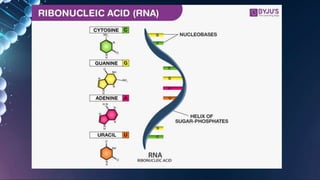
Ribonucleic acid (abbreviated RNA) is a nucleic acid present in
all living cells that has structural similarities to DNA.
Unlike DNA, however, RNA is most often single-stranded
An RNA molecule has a backbone made of alternating phosphate
groups and the sugar ribose, rather than the deoxyribose found in
DNA.
RNA carries genetic information that is translated by
ribosomes into various proteins necessary for cellular
processes.
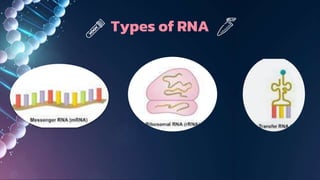
mRNA, rRNA, and tRNA are the three main types of RNA
involved in protein synthesis.
RNA also serves as the primary genetic material for viruses.
RNA plays an important role not only in regulating genes but
also in mediatin cellular defense against infection by RNA
viruses
CHARACTERISTICS
2
● Single stranded molecule but double stranded in
some cases like REO virus.
● Contains about 70-12000 ribonucleotides
● Major backbone - Ribose sugar and phosphate
● Presence of all nitrogenous base except
thymine.
● Each strand has 3’ and 5’ ends
TYPES OF RNA
3
Types of RNA
Ribosomal RNA (rRNA)
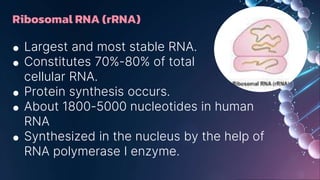
● Largest and most stable RNA.
● Constitutes 70%-80% of total
cellular RNA.
● Protein synthesis occurs.
● About 1800-5000 nucleotides in human
RNA
● Synthesized in the nucleus by the help of
RNA polymerase I enzyme.
Messenger RNA (mRNA)
● Most unstable and longest type.
● Constitutes 3-10% of total RNA.
● Formed from DNA by using RNA polymerase
II enzyme.
● Carried the message from DNA in the form of
codons to make specific type of protein.
Transfer RNA(tRNAs)
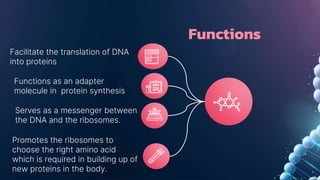
Functions
Facilitate the translation of DNA
into proteins
Functions as an adapter
molecule in protein synthesis
Serves as a messenger between
the DNA and the ribosomes.
Promotes the ribosomes to
choose the right amino acid
which is required in building up of
new proteins in the body.
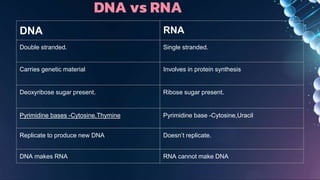
DNA vs RNA
DNA RNA
Double stranded. Single stranded.
Carries genetic material Involves in protein synthesis
Deoxyribose sugar present. Ribose sugar present.
Pyrimidine bases -Cytosine.Thymine Pyrimidine base -Cytosine,Uracil
Replicate to produce new DNA Doesn’t replicate.
DNA makes RNA RNA cannot make DNA
CONCLUSION
AND SUMMMARY
4
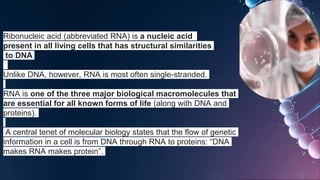
Ribonucleic acid (abbreviated RNA) is a nucleic acid
present in all living cells that has structural similarities
to DNA
Unlike DNA, however, RNA is most often single-stranded.
RNA is one of the three major biological macromolecules that
are essential for all known forms of life (along with DNA and
proteins).
A central tenet of molecular biology states that the flow of genetic
information in a cell is from DNA through RNA to proteins: “DNA
makes RNA makes protein”.
REFERENCES
● Basic biology grade 12 - Delli Ram
Uprety, Lok Hari Pandey, Tara
Gurung
● https://www.wikipedia.com
● https://brainly.com
THANK
YOU!!!

RNA PRESENTATION.pptx

  • 1.
  • 2.
    RESEARCH TEAM 1) DiwasKoirala 2) Karishma Singh 3) Nirjal Bhandari 4) Pranjal Ghimire 5) Prastuthi Dhakal Under the supervision of Mr DRU and Mr TG.
  • 3.
    ACKNOWLEDGEMENT We would liketo showcase our special gratitude towards our UGSS BIOLOGY department for providing us this opportunity to enhance our knowledge on the given topic and present it in-front of you all.
  • 4.
  • 5.
    “Genes are likethe collection of story where DNA is the language that the story is written in.”
  • 6.
  • 7.
    Ribonucleic acid (abbreviatedRNA) is a nucleic acid present in all living cells that has structural similarities to DNA. Unlike DNA, however, RNA is most often single-stranded An RNA molecule has a backbone made of alternating phosphate groups and the sugar ribose, rather than the deoxyribose found in DNA. RNA carries genetic information that is translated by ribosomes into various proteins necessary for cellular processes. mRNA, rRNA, and tRNA are the three main types of RNA involved in protein synthesis. RNA also serves as the primary genetic material for viruses. RNA plays an important role not only in regulating genes but also in mediatin cellular defense against infection by RNA viruses
  • 8.
  • 9.
    ● Single strandedmolecule but double stranded in some cases like REO virus. ● Contains about 70-12000 ribonucleotides ● Major backbone - Ribose sugar and phosphate ● Presence of all nitrogenous base except thymine. ● Each strand has 3’ and 5’ ends
  • 11.
  • 12.
  • 13.
    Ribosomal RNA (rRNA) ●Largest and most stable RNA. ● Constitutes 70%-80% of total cellular RNA. ● Protein synthesis occurs. ● About 1800-5000 nucleotides in human RNA ● Synthesized in the nucleus by the help of RNA polymerase I enzyme.
  • 14.
    Messenger RNA (mRNA) ●Most unstable and longest type. ● Constitutes 3-10% of total RNA. ● Formed from DNA by using RNA polymerase II enzyme. ● Carried the message from DNA in the form of codons to make specific type of protein.
  • 16.
  • 17.
    Functions Facilitate the translationof DNA into proteins Functions as an adapter molecule in protein synthesis Serves as a messenger between the DNA and the ribosomes. Promotes the ribosomes to choose the right amino acid which is required in building up of new proteins in the body.
  • 18.
    DNA vs RNA DNARNA Double stranded. Single stranded. Carries genetic material Involves in protein synthesis Deoxyribose sugar present. Ribose sugar present. Pyrimidine bases -Cytosine.Thymine Pyrimidine base -Cytosine,Uracil Replicate to produce new DNA Doesn’t replicate. DNA makes RNA RNA cannot make DNA
  • 19.
  • 20.
    Ribonucleic acid (abbreviatedRNA) is a nucleic acid present in all living cells that has structural similarities to DNA Unlike DNA, however, RNA is most often single-stranded. RNA is one of the three major biological macromolecules that are essential for all known forms of life (along with DNA and proteins). A central tenet of molecular biology states that the flow of genetic information in a cell is from DNA through RNA to proteins: “DNA makes RNA makes protein”.
  • 21.
    REFERENCES ● Basic biologygrade 12 - Delli Ram Uprety, Lok Hari Pandey, Tara Gurung ● https://www.wikipedia.com ● https://brainly.com
  • 22.