

Translation
Aman Ullah
B.Sc. Med. Lab. Technology
M. Phil. Microbiology
Certificate in Health Professional
Education
Lecturer, Department of Medical Lab.
Technology
Institute of Paramedical Sciences,
Khyber Medical University, Peshawar,
Pakistan
Translation
• Translation is the whole process by which the
nucleotide sequence of an mRNA is used to
order and to join the amino acids in a
polypeptide chain
The Three Roles of RNA
in Translation
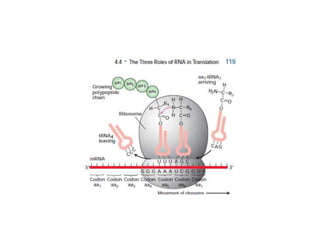
1. Messenger RNA (mRNA) carries the genetic
information transcribed from DNA in the form of a
series of three nucleotide sequences, called codons,
each of which specifies a particular amino acid
2. Transfer RNA (tRNA) is the key to deciphering the
codons in mRNA
3. The correct tRNA with its attached amino acid is
selected at each step because each specific tRNA
molecule contains a three-nucleotide sequence, an
anticodon, that can base-pair with its complementary
codon in the mRNA
The Three Roles of RNA
in Translation
3. Ribosomal RNA (rRNA) associates with a set
of proteins to form ribosomes
• These complex structures, which physically
move along an mRNA molecule, catalyze the
assembly of amino acids into polypeptide
chains
• They also bind tRNAs and various accessory
proteins necessary for protein synthesis
Messenger RNA Carries Information from DNA
in a Three-Letter Genetic Code
• The genetic code used by cells is a triplet code, with
every three-nucleotide sequence, or codon, being
“read” from a specified starting point in the mRNA
• Of the 64 possible codons in the genetic code, 61
specify individual amino acids and three are stop
codons
• Most amino acids are encoded by more than one
codon
• Only two—methionine and tryptophan—have a single
codon; at the other extreme, leucine, serine, and
arginine are each specified by six different codons
Messenger RNA Carries Information from DNA
in a Three-Letter Genetic Code
• Synthesis of all polypeptide chains in prokaryotic and
eukaryotic cells begins with the amino acid methionine
• In most mRNAs, the start (initiator) codon specifying this
amino terminal methionine is AUG
• In a few bacterial mRNAs, GUG is used as the initiator
codon, and CUG occasionally is used as an initiator codon
for methionine in eukaryotes
• The three codons UAA, UGA, and UAG do not specify amino
acids but constitute stop (termination) codons that mark
the carboxyl terminus of polypeptide chains in almost all
cells
• The sequence of codons that runs from a specific start
codon to a stop codon is called a reading frame
The Folded Structure of tRNA Promotes
Its Decoding Functions
• Translation, or decoding, of the four-nucleotide
language of DNA and mRNA into the 20–amino
acid language of proteins requires tRNAs and
enzymes called aminoacyl-tRNA synthetases
• To participate in protein synthesis, a tRNA
molecule must become chemically linked to a
particular amino acid via a high-energy bond,
forming an aminoacyl-tRNA; the anticodon in the
tRNA then base-pairs with a codon in mRNA so
that the activated amino acid can be added to the
growing polypeptide chain
The Folded Structure of tRNA Promotes
Its Decoding Functions
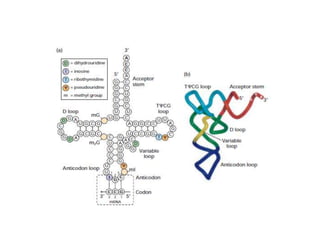
• tRNA molecules, are 70–80 nucleotides long
• tRNA molecules fold into a similar stem-loop arrangement that
resembles a cloverleaf when drawn in two dimensions
• The four stems are short double helices stabilized by Watson-Crick
base pairing; three of the four stems have loops containing seven or
eight bases at their ends, while the remaining, unlooped stem
contains the free 3 and 5 ends of the chain.
• The three nucleotides composing the anticodon are located at the
center of the middle loop, in an accessible position that facilitates
codon-anticodon base pairing
• In all tRNAs, the 3 end of the unlooped amino acid acceptor stem
has the sequence CCA, which in most cases is added after synthesis
and processing of the tRNA are complete
Nonstandard Base Pairing Often Occurs Between
Codons and Anticodons
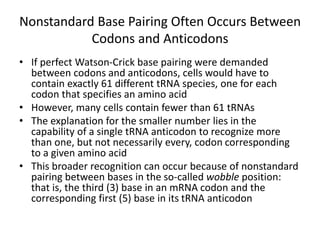
• If perfect Watson-Crick base pairing were demanded
between codons and anticodons, cells would have to
contain exactly 61 different tRNA species, one for each
codon that specifies an amino acid
• However, many cells contain fewer than 61 tRNAs
• The explanation for the smaller number lies in the
capability of a single tRNA anticodon to recognize more
than one, but not necessarily every, codon corresponding
to a given amino acid
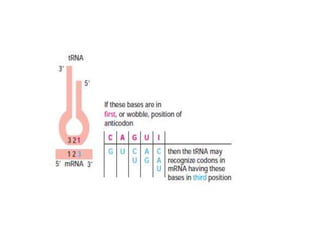
• This broader recognition can occur because of nonstandard
pairing between bases in the so-called wobble position:
that is, the third (3) base in an mRNA codon and the
corresponding first (5) base in its tRNA anticodon
Nonstandard Base Pairing Often Occurs Between
Codons and Anticodons
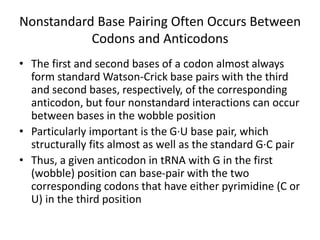
• The first and second bases of a codon almost always
form standard Watson-Crick base pairs with the third
and second bases, respectively, of the corresponding
anticodon, but four nonstandard interactions can occur
between bases in the wobble position
• Particularly important is the G·U base pair, which
structurally fits almost as well as the standard G·C pair
• Thus, a given anticodon in tRNA with G in the first
(wobble) position can base-pair with the two
corresponding codons that have either pyrimidine (C or
U) in the third position
Nonstandard Base Pairing Often Occurs Between
Codons and Anticodons
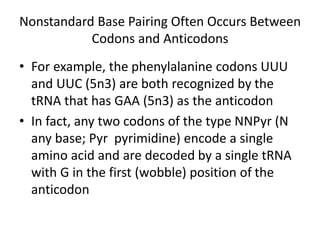
• For example, the phenylalanine codons UUU
and UUC (5n3) are both recognized by the
tRNA that has GAA (5n3) as the anticodon
• In fact, any two codons of the type NNPyr (N
any base; Pyr pyrimidine) encode a single
amino acid and are decoded by a single tRNA
with G in the first (wobble) position of the
anticodon
Aminoacyl-tRNA Synthetases Activate Amino
Acids by Covalently Linking Them to tRNAs
• Attachment of the appropriate amino acid to a tRNA, is
catalyzed by a specific aminoacyl-tRNA synthetase
• Each of the 20 different synthetases recognizes one
amino acid and all its compatible, or cognate, tRNAs
• These coupling enzymes link an amino acid to the free
2 or 3 hydroxyl of the adenosine at the 3 terminus of
tRNA molecules by an ATP-requiring reaction
• In this reaction, the amino acid is linked to the tRNA by
a high energy bond and thus is said to be activated
Aminoacyl-tRNA Synthetases Activate Amino
Acids by Covalently Linking Them to tRNAs
• The energy of this bond subsequently drives
formation of the peptide bonds linking adjacent
amino acids in a growing polypeptide chain
• Because some amino acids are so similar
structurally, aminoacyl-tRNA synthetases
sometimes make mistakes
• These are corrected, however, by the enzymes
themselves, which have a proofreading activity
Ribosomes Are Protein-Synthesizing
Machines
• The efficiency of translation is greatly increased
by the binding of the mRNA and the individual
aminoacyl-tRNAs to the most abundant RNA-
protein complex in the cell, the ribosome, which
directs elongation of a polypeptide at a rate of
three to five amino acids added per second
• During translation, a ribosome moves along an
mRNA chain, interacting with various protein
factors and tRNAs and very likely undergoing
large conformational changes
Stepwise Synthesis of Proteins
on Ribosomes
• The complex process of translation can be
divided into three stages—initiation,
elongation, and termination
Methionyl-tRNAi Met Recognizes the AUG
Start Codon
• the AUG codon for methionine functions as the start codon in the
vast majority of mRNAs
• A critical aspect of translation initiation is to begin protein synthesis
at the start codon, thereby establishing the correct reading frame
for the entire mRNA
• Both prokaryotes and eukaryotes contain two different methionine
tRNAs: tRNAiMet can initiate protein synthesis, and tRNAMet can
incorporate methionine only into a growing protein chain
• The same aminoacyl-tRNA synthetase (MetRS) charges both tRNAs
with methionine
• But only Met-tRNAi Met (i.e., activated methionine attached to
tRNAiMet) can bind at the appropriate site on the small ribosomal
subunit, the P site, to begin synthesis of a polypeptide chain
• The regular Met-tRNAMet and all other charged tRNAs bind only to
another ribosomal site, the A site
Translation Initiation Usually Occurs Near the
First AUG Closest to the 5 End of an mRNA
• During the first stage of translation, a ribosome
assembles, complexed with an mRNA and an activated
initiator tRNA, which is correctly positioned at the start
codon
• Large and small ribosomal subunits not actively
engaged in translation are kept apart by binding of two
initiation factors, designated eIF3 and eIF6 in
eukaryotes
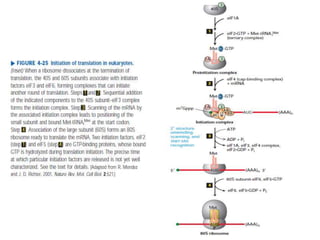
• A translation preinitiation complex is formed when the
40S subunit–eIF3 complex is bound by eIF1A and a
ternary complex of the MettRNAiMet, eIF2, and GTP
Translation Initiation Usually Occurs Near the
First AUG Closest to the 5 End of an mRNA
• During translation initiation, the 5 cap of an mRNA to be
translated is bound by the eIF4E subunit of the eIF4
capbinding complex
• The mRNA-eIF4 complex then associates with the
preinitiation complex through an interaction of the eIF4G
subunit and eIF3, forming the initiation complex
• The initiation complex then probably slides along, or scans,
the associated mRNA as the helicase activity of eIF4A uses
energy from ATP hydrolysis to unwind the RNA secondary
structure
• Scanning stops when the tRNAi Met anticodon recognizes
the start codon, which is the first AUG downstream from
the 5 end in most eukaryotic mRNAs
Translation Initiation Usually Occurs Near the
First AUG Closest to the 5 End of an mRNA
• Recognition of the start codon leads to hydrolysis of
the GTP associated with eIF2, an irreversible step that
prevents further scanning
• Selection of the initiating AUG is facilitated by specific
surrounding nucleotides called the Kozak sequence
• Once the small ribosomal subunit with its bound Met-
tRNAi Met is correctly positioned at the start codon,
union with the large (60S) ribosomal subunit completes
formation of an 80S ribosome.
• This requires the action of another factor (eIF5) and
hydrolysis of a GTP associated with it
During Chain Elongation Each Incoming
Aminoacyl-tRNA Moves Through
Three Ribosomal Sites
• The correctly positioned eukaryotic 80S ribosome–
MettRNAiMet complex is now ready to begin the task
of stepwise addition of amino acids by the in-frame
translation of the mRNA
• A set of special proteins, termed elongation factors
(EFs), are required to carry out this process of chain
elongation
• The key steps in elongation are entry of each
succeeding aminoacyl-tRNA, formation of a peptide
bond, and the movement, or translocation, of the
ribosome one codon at a time along the mRNA
During Chain Elongation Each Incoming
Aminoacyl-tRNA Moves Through
Three Ribosomal Sites
• At the completion of translation initiation, as
noted already, Met-tRNAiMet is bound to the P
site on the assembled 80S ribosome
• This region of the ribosome is called the P site
because the tRNA chemically linked to the
growing polypeptide chain is located here
• The second aminoacyl-tRNA is brought into the
ribosome as a ternary complex in association
with EF1GTP and becomes bound to the A site, so
named because it is where aminoacylated tRNAs
bind
During Chain Elongation Each Incoming
Aminoacyl-tRNA Moves Through
Three Ribosomal Sites
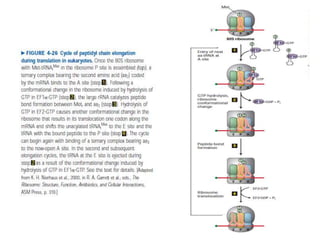
• If the anticodon of the incoming (second) aminoacyl-
tRNA correctly base-pairs with the second codon of the
mRNA, the GTP in the associated EF1GTP is hydrolyzed
• The hydrolysis of GTP promotes a conformational
change in the ribosome that leads to tight binding of
the aminoacyl-tRNA in the A site and release of the
resulting EF1GDP complex
• This conformational change also positions the
aminoacylated 3 end of the tRNA in the A site in close
proximity to the 3 end of the Met-tRNAiMet in the P
site
During Chain Elongation Each Incoming
Aminoacyl-tRNA Moves Through
Three Ribosomal Sites
• With the initiating Met-tRNAi Met at the P site and the
second aminoacyl-tRNA tightly bound at the A site, the
amino group of the second amino acid reacts with the
“activated” methionine on the initiator tRNA, forming a
peptide bond
• Following peptide bond synthesis, the ribosome is
translocated along the mRNA a distance equal to one
codon
• This translocation step is promoted by hydrolysis of the GTP
in eukaryotic EF2GTP
• As a result of translocation, tRNAiMet, now without its
activated methionine, is moved to the E (exit) site on the
ribosome; concurrently, the second tRNA, now covalently
bound to a dipeptide, is moved to the P site
During Chain Elongation Each Incoming
Aminoacyl-tRNA Moves Through
Three Ribosomal Sites
• Translocation thus returns the ribosome conformation
to a state in which the A site is open and able to accept
another aminoacylated tRNA complexed with EF1GTP,
beginning another cycle of chain elongation
• In subsequent cycles, the conformational change that
occurs in step 2 ejects the unacylated tRNA from the E
site
• As the nascent polypeptide chain becomes longer, it
threads through a channel in the large ribosomal
subunit, exiting at a position opposite the side that
interacts with the small subunit
Translation Is Terminated by Release Factors
When a Stop Codon Is Reached
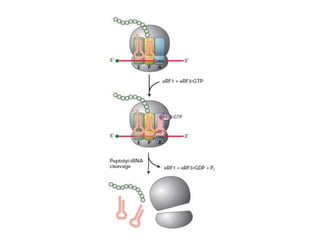
• The final stage of translation, like initiation and
elongation, requires highly specific molecular signals
that decide the fateof the mRNA–ribosome–tRNA-
peptidyl complex
• Two types of specific protein release factors (RFs) have
been discovered
• Eukaryotic eRF1, whose shape is similar to that of
tRNAs, apparently acts by binding to the ribosomal A
site and recognizing stop codons directly
• The eRF3GTP acts in concert with eRF1 to promote
cleavage of the peptidyl-tRNA, thus releasing the
completed protein chain
Translation Is Terminated by Release Factors
When a Stop Codon Is Reached
• Bacteria have two release factors (RF1 and RF2) that
are functionally analogous to eRF1 and a GTP-binding
factor (RF3) that is analogous to eRF3
• After its release from the ribosome, a newly
synthesized protein folds into its native three-
dimensional conformation, a process facilitated by
other proteins called chaperones
• Additional release factors then promote dissociation of
the ribosome, freeing the subunits, mRNA, and
terminal tRNA for another round of translation
Questions/Suggestions
khurramthalwi@hotamail.com

Translation

  • 1.
    Translation Aman Ullah B.Sc. Med.Lab. Technology M. Phil. Microbiology Certificate in Health Professional Education Lecturer, Department of Medical Lab. Technology Institute of Paramedical Sciences, Khyber Medical University, Peshawar, Pakistan
  • 2.
    Translation • Translation isthe whole process by which the nucleotide sequence of an mRNA is used to order and to join the amino acids in a polypeptide chain
  • 3.
    The Three Rolesof RNA in Translation 1. Messenger RNA (mRNA) carries the genetic information transcribed from DNA in the form of a series of three nucleotide sequences, called codons, each of which specifies a particular amino acid 2. Transfer RNA (tRNA) is the key to deciphering the codons in mRNA 3. The correct tRNA with its attached amino acid is selected at each step because each specific tRNA molecule contains a three-nucleotide sequence, an anticodon, that can base-pair with its complementary codon in the mRNA
  • 4.
    The Three Rolesof RNA in Translation 3. Ribosomal RNA (rRNA) associates with a set of proteins to form ribosomes • These complex structures, which physically move along an mRNA molecule, catalyze the assembly of amino acids into polypeptide chains • They also bind tRNAs and various accessory proteins necessary for protein synthesis
  • 6.
    Messenger RNA CarriesInformation from DNA in a Three-Letter Genetic Code • The genetic code used by cells is a triplet code, with every three-nucleotide sequence, or codon, being “read” from a specified starting point in the mRNA • Of the 64 possible codons in the genetic code, 61 specify individual amino acids and three are stop codons • Most amino acids are encoded by more than one codon • Only two—methionine and tryptophan—have a single codon; at the other extreme, leucine, serine, and arginine are each specified by six different codons
  • 7.
    Messenger RNA CarriesInformation from DNA in a Three-Letter Genetic Code • Synthesis of all polypeptide chains in prokaryotic and eukaryotic cells begins with the amino acid methionine • In most mRNAs, the start (initiator) codon specifying this amino terminal methionine is AUG • In a few bacterial mRNAs, GUG is used as the initiator codon, and CUG occasionally is used as an initiator codon for methionine in eukaryotes • The three codons UAA, UGA, and UAG do not specify amino acids but constitute stop (termination) codons that mark the carboxyl terminus of polypeptide chains in almost all cells • The sequence of codons that runs from a specific start codon to a stop codon is called a reading frame
  • 8.
    The Folded Structureof tRNA Promotes Its Decoding Functions • Translation, or decoding, of the four-nucleotide language of DNA and mRNA into the 20–amino acid language of proteins requires tRNAs and enzymes called aminoacyl-tRNA synthetases • To participate in protein synthesis, a tRNA molecule must become chemically linked to a particular amino acid via a high-energy bond, forming an aminoacyl-tRNA; the anticodon in the tRNA then base-pairs with a codon in mRNA so that the activated amino acid can be added to the growing polypeptide chain
  • 9.
    The Folded Structureof tRNA Promotes Its Decoding Functions • tRNA molecules, are 70–80 nucleotides long • tRNA molecules fold into a similar stem-loop arrangement that resembles a cloverleaf when drawn in two dimensions • The four stems are short double helices stabilized by Watson-Crick base pairing; three of the four stems have loops containing seven or eight bases at their ends, while the remaining, unlooped stem contains the free 3 and 5 ends of the chain. • The three nucleotides composing the anticodon are located at the center of the middle loop, in an accessible position that facilitates codon-anticodon base pairing • In all tRNAs, the 3 end of the unlooped amino acid acceptor stem has the sequence CCA, which in most cases is added after synthesis and processing of the tRNA are complete
  • 11.
    Nonstandard Base PairingOften Occurs Between Codons and Anticodons • If perfect Watson-Crick base pairing were demanded between codons and anticodons, cells would have to contain exactly 61 different tRNA species, one for each codon that specifies an amino acid • However, many cells contain fewer than 61 tRNAs • The explanation for the smaller number lies in the capability of a single tRNA anticodon to recognize more than one, but not necessarily every, codon corresponding to a given amino acid • This broader recognition can occur because of nonstandard pairing between bases in the so-called wobble position: that is, the third (3) base in an mRNA codon and the corresponding first (5) base in its tRNA anticodon
  • 12.
    Nonstandard Base PairingOften Occurs Between Codons and Anticodons • The first and second bases of a codon almost always form standard Watson-Crick base pairs with the third and second bases, respectively, of the corresponding anticodon, but four nonstandard interactions can occur between bases in the wobble position • Particularly important is the G·U base pair, which structurally fits almost as well as the standard G·C pair • Thus, a given anticodon in tRNA with G in the first (wobble) position can base-pair with the two corresponding codons that have either pyrimidine (C or U) in the third position
  • 13.
    Nonstandard Base PairingOften Occurs Between Codons and Anticodons • For example, the phenylalanine codons UUU and UUC (5n3) are both recognized by the tRNA that has GAA (5n3) as the anticodon • In fact, any two codons of the type NNPyr (N any base; Pyr pyrimidine) encode a single amino acid and are decoded by a single tRNA with G in the first (wobble) position of the anticodon
  • 15.
    Aminoacyl-tRNA Synthetases ActivateAmino Acids by Covalently Linking Them to tRNAs • Attachment of the appropriate amino acid to a tRNA, is catalyzed by a specific aminoacyl-tRNA synthetase • Each of the 20 different synthetases recognizes one amino acid and all its compatible, or cognate, tRNAs • These coupling enzymes link an amino acid to the free 2 or 3 hydroxyl of the adenosine at the 3 terminus of tRNA molecules by an ATP-requiring reaction • In this reaction, the amino acid is linked to the tRNA by a high energy bond and thus is said to be activated
  • 16.
    Aminoacyl-tRNA Synthetases ActivateAmino Acids by Covalently Linking Them to tRNAs • The energy of this bond subsequently drives formation of the peptide bonds linking adjacent amino acids in a growing polypeptide chain • Because some amino acids are so similar structurally, aminoacyl-tRNA synthetases sometimes make mistakes • These are corrected, however, by the enzymes themselves, which have a proofreading activity
  • 17.
    Ribosomes Are Protein-Synthesizing Machines •The efficiency of translation is greatly increased by the binding of the mRNA and the individual aminoacyl-tRNAs to the most abundant RNA- protein complex in the cell, the ribosome, which directs elongation of a polypeptide at a rate of three to five amino acids added per second • During translation, a ribosome moves along an mRNA chain, interacting with various protein factors and tRNAs and very likely undergoing large conformational changes
  • 18.
    Stepwise Synthesis ofProteins on Ribosomes • The complex process of translation can be divided into three stages—initiation, elongation, and termination
  • 19.
    Methionyl-tRNAi Met Recognizesthe AUG Start Codon • the AUG codon for methionine functions as the start codon in the vast majority of mRNAs • A critical aspect of translation initiation is to begin protein synthesis at the start codon, thereby establishing the correct reading frame for the entire mRNA • Both prokaryotes and eukaryotes contain two different methionine tRNAs: tRNAiMet can initiate protein synthesis, and tRNAMet can incorporate methionine only into a growing protein chain • The same aminoacyl-tRNA synthetase (MetRS) charges both tRNAs with methionine • But only Met-tRNAi Met (i.e., activated methionine attached to tRNAiMet) can bind at the appropriate site on the small ribosomal subunit, the P site, to begin synthesis of a polypeptide chain • The regular Met-tRNAMet and all other charged tRNAs bind only to another ribosomal site, the A site
  • 20.
    Translation Initiation UsuallyOccurs Near the First AUG Closest to the 5 End of an mRNA • During the first stage of translation, a ribosome assembles, complexed with an mRNA and an activated initiator tRNA, which is correctly positioned at the start codon • Large and small ribosomal subunits not actively engaged in translation are kept apart by binding of two initiation factors, designated eIF3 and eIF6 in eukaryotes • A translation preinitiation complex is formed when the 40S subunit–eIF3 complex is bound by eIF1A and a ternary complex of the MettRNAiMet, eIF2, and GTP
  • 21.
    Translation Initiation UsuallyOccurs Near the First AUG Closest to the 5 End of an mRNA • During translation initiation, the 5 cap of an mRNA to be translated is bound by the eIF4E subunit of the eIF4 capbinding complex • The mRNA-eIF4 complex then associates with the preinitiation complex through an interaction of the eIF4G subunit and eIF3, forming the initiation complex • The initiation complex then probably slides along, or scans, the associated mRNA as the helicase activity of eIF4A uses energy from ATP hydrolysis to unwind the RNA secondary structure • Scanning stops when the tRNAi Met anticodon recognizes the start codon, which is the first AUG downstream from the 5 end in most eukaryotic mRNAs
  • 22.
    Translation Initiation UsuallyOccurs Near the First AUG Closest to the 5 End of an mRNA • Recognition of the start codon leads to hydrolysis of the GTP associated with eIF2, an irreversible step that prevents further scanning • Selection of the initiating AUG is facilitated by specific surrounding nucleotides called the Kozak sequence • Once the small ribosomal subunit with its bound Met- tRNAi Met is correctly positioned at the start codon, union with the large (60S) ribosomal subunit completes formation of an 80S ribosome. • This requires the action of another factor (eIF5) and hydrolysis of a GTP associated with it
  • 24.
    During Chain ElongationEach Incoming Aminoacyl-tRNA Moves Through Three Ribosomal Sites • The correctly positioned eukaryotic 80S ribosome– MettRNAiMet complex is now ready to begin the task of stepwise addition of amino acids by the in-frame translation of the mRNA • A set of special proteins, termed elongation factors (EFs), are required to carry out this process of chain elongation • The key steps in elongation are entry of each succeeding aminoacyl-tRNA, formation of a peptide bond, and the movement, or translocation, of the ribosome one codon at a time along the mRNA
  • 25.
    During Chain ElongationEach Incoming Aminoacyl-tRNA Moves Through Three Ribosomal Sites • At the completion of translation initiation, as noted already, Met-tRNAiMet is bound to the P site on the assembled 80S ribosome • This region of the ribosome is called the P site because the tRNA chemically linked to the growing polypeptide chain is located here • The second aminoacyl-tRNA is brought into the ribosome as a ternary complex in association with EF1GTP and becomes bound to the A site, so named because it is where aminoacylated tRNAs bind
  • 26.
    During Chain ElongationEach Incoming Aminoacyl-tRNA Moves Through Three Ribosomal Sites • If the anticodon of the incoming (second) aminoacyl- tRNA correctly base-pairs with the second codon of the mRNA, the GTP in the associated EF1GTP is hydrolyzed • The hydrolysis of GTP promotes a conformational change in the ribosome that leads to tight binding of the aminoacyl-tRNA in the A site and release of the resulting EF1GDP complex • This conformational change also positions the aminoacylated 3 end of the tRNA in the A site in close proximity to the 3 end of the Met-tRNAiMet in the P site
  • 27.
    During Chain ElongationEach Incoming Aminoacyl-tRNA Moves Through Three Ribosomal Sites • With the initiating Met-tRNAi Met at the P site and the second aminoacyl-tRNA tightly bound at the A site, the amino group of the second amino acid reacts with the “activated” methionine on the initiator tRNA, forming a peptide bond • Following peptide bond synthesis, the ribosome is translocated along the mRNA a distance equal to one codon • This translocation step is promoted by hydrolysis of the GTP in eukaryotic EF2GTP • As a result of translocation, tRNAiMet, now without its activated methionine, is moved to the E (exit) site on the ribosome; concurrently, the second tRNA, now covalently bound to a dipeptide, is moved to the P site
  • 28.
    During Chain ElongationEach Incoming Aminoacyl-tRNA Moves Through Three Ribosomal Sites • Translocation thus returns the ribosome conformation to a state in which the A site is open and able to accept another aminoacylated tRNA complexed with EF1GTP, beginning another cycle of chain elongation • In subsequent cycles, the conformational change that occurs in step 2 ejects the unacylated tRNA from the E site • As the nascent polypeptide chain becomes longer, it threads through a channel in the large ribosomal subunit, exiting at a position opposite the side that interacts with the small subunit
  • 30.
    Translation Is Terminatedby Release Factors When a Stop Codon Is Reached • The final stage of translation, like initiation and elongation, requires highly specific molecular signals that decide the fateof the mRNA–ribosome–tRNA- peptidyl complex • Two types of specific protein release factors (RFs) have been discovered • Eukaryotic eRF1, whose shape is similar to that of tRNAs, apparently acts by binding to the ribosomal A site and recognizing stop codons directly • The eRF3GTP acts in concert with eRF1 to promote cleavage of the peptidyl-tRNA, thus releasing the completed protein chain
  • 31.
    Translation Is Terminatedby Release Factors When a Stop Codon Is Reached • Bacteria have two release factors (RF1 and RF2) that are functionally analogous to eRF1 and a GTP-binding factor (RF3) that is analogous to eRF3 • After its release from the ribosome, a newly synthesized protein folds into its native three- dimensional conformation, a process facilitated by other proteins called chaperones • Additional release factors then promote dissociation of the ribosome, freeing the subunits, mRNA, and terminal tRNA for another round of translation
  • 33.