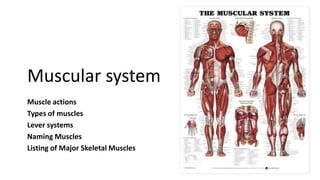
Muscular system
Muscle actions
Types of muscles
Lever systems
Naming Muscles
Listing of Major Skeletal Muscles
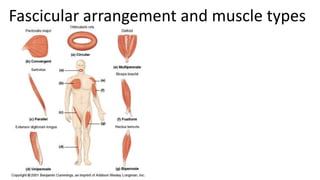
Fascicular arrangement and muscle types
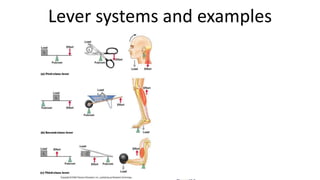
Lever systems and examples
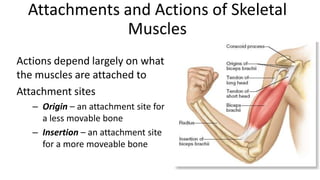
Attachments and Actions of Skeletal
Muscles
Actions depend largely on what
the muscles are attached to
Attachment sites
– Origin – an attachment site for
a less movable bone
– Insertion – an attachment site
for a more moveable bone
Attachments and Actions (cont.)
Movement usually produced by a group of muscles
Prime mover – muscle responsible for most of the
movement
Synergists – muscles that help the prime mover by
stabilizing joints
Antagonist (agonist) – produces movement opposite to
prime mover
Relaxes when prime mover contracts
Attachments and Actions
Body Movements
Flexion – bending a body
part

Extension – straightening a
body part
Hyperextension – extending
a body part past the
normal anatomical
position

Dorsiflexion – pointing the
toes up

Plantar flexion – pointing
the toes down

Abduction – moving a body
part away from the
anatomical position
Adduction – moving a body
part toward the
anatomical position
Attachments and Actions:
Body Movements
Circumduction – moving a
body part in a circle
Pronation – turning the palm
of the hand down
Supination – turning the palm
of the hand up

Inversion – turning the sole of
the foot medially

Eversion – turning the sole of the
foot laterally
Retraction – moving a body part
posteriorly
Protraction – moving a body part
anteriorly
Attachments and Actions:
Body Movements (cont.)
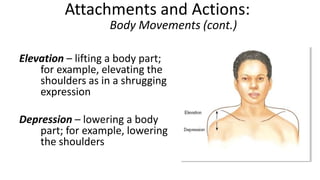
Elevation – lifting a body part;
for example, elevating the
shoulders as in a shrugging
expression
Depression – lowering a body
part; for example, lowering
the shoulders
Major Skeletal Muscles
The muscle name indicates
Location
Size
Action
Shape
OR
Number of attachments of
the muscle

As you study muscles, you
will find it easier to
remember them if you
think about what the
name describes.
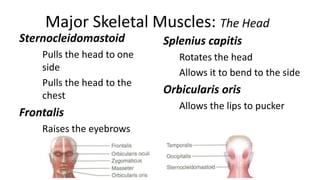
Major Skeletal Muscles: The Head
Sternocleidomastoid
Pulls the head to one
side
Pulls the head to the
chest

Frontalis
Raises the eyebrows

Splenius capitis
Rotates the head
Allows it to bend to the side

Orbicularis oris
Allows the lips to pucker
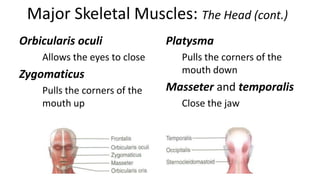
Major Skeletal Muscles: The Head (cont.)
Orbicularis oculi
Allows the eyes to close

Zygomaticus
Pulls the corners of the
mouth up

Platysma
Pulls the corners of the
mouth down

Masseter and temporalis
Close the jaw
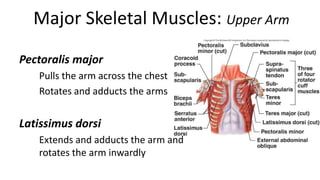
Major Skeletal Muscles: Upper Arm
Pectoralis major
Pulls the arm across the chest
Rotates and adducts the arms

Latissimus dorsi
Extends and adducts the arm and
rotates the arm inwardly
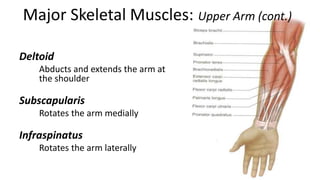
Major Skeletal Muscles: Upper Arm (cont.)
Deltoid
Abducts and extends the arm at
the shoulder

Subscapularis
Rotates the arm medially

Infraspinatus
Rotates the arm laterally
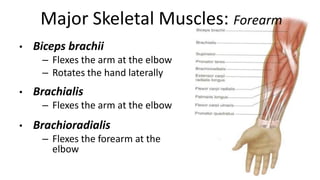
Major Skeletal Muscles: Forearm
•

Biceps brachii
– Flexes the arm at the elbow
– Rotates the hand laterally

•

Brachialis
– Flexes the arm at the elbow

•

Brachioradialis
– Flexes the forearm at the
elbow
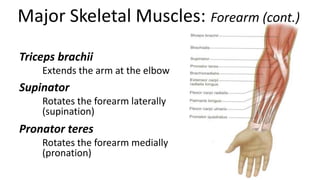
Major Skeletal Muscles: Forearm (cont.)
Triceps brachii
Extends the arm at the elbow

Supinator
Rotates the forearm laterally
(supination)

Pronator teres
Rotates the forearm medially
(pronation)
Major Skeletal Muscles:
Wrist, Hand, and Fingers
Flexor carpi radialis and flexor
carpi ulnaris
Flex and abduct the wrist

Palmaris longus
Flexes the wrist

Flexor digitorum profundus
Flexes the distal joints of the fingers,
but not the thumb
Major Skeletal Muscles:
Wrist, Hand, and Fingers (cont.)
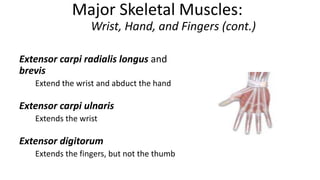
Extensor carpi radialis longus and
brevis
Extend the wrist and abduct the hand

Extensor carpi ulnaris
Extends the wrist

Extensor digitorum
Extends the fingers, but not the thumb
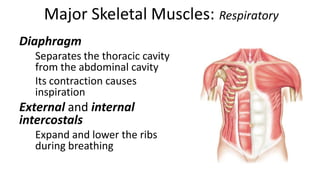
Major Skeletal Muscles: Respiratory
Diaphragm
Separates the thoracic cavity
from the abdominal cavity
Its contraction causes
inspiration

External and internal
intercostals
Expand and lower the ribs
during breathing
Major Skeletal Muscles: Abdominal
External and internal obliques
Compress the abdominal wall

Transverse abdominis
Also compresses the abdominal wall

Rectus abdominis
Flexes the vertebral column
Compresses the abdominal wall

Click for View of
Abdominal Muscles
Major Skeletal Muscles: Pectoral Girdle
Trapezius
Raises the arms
Pulls the shoulders downward

Pectoralis minor
Pulls the scapula downward
Raises the ribs

Click for View of
Pectoral Girdle
Muscles
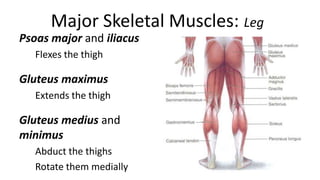
Major Skeletal Muscles: Leg
Psoas major and iliacus
Flexes the thigh

Gluteus maximus
Extends the thigh

Gluteus medius and
minimus
Abduct the thighs
Rotate them medially
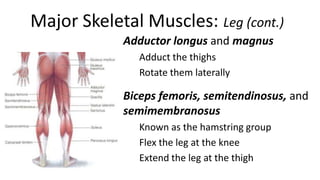
Major Skeletal Muscles: Leg (cont.)
Adductor longus and magnus
Adduct the thighs
Rotate them laterally

Biceps femoris, semitendinosus, and
semimembranosus
Known as the hamstring group
Flex the leg at the knee
Extend the leg at the thigh
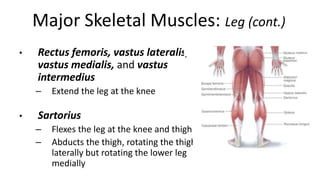
Major Skeletal Muscles: Leg (cont.)
•

Rectus femoris, vastus lateralis,
vastus medialis, and vastus
intermedius
–

•

Extend the leg at the knee

Sartorius
–
–

Flexes the leg at the knee and thigh
Abducts the thigh, rotating the thigh
laterally but rotating the lower leg
medially
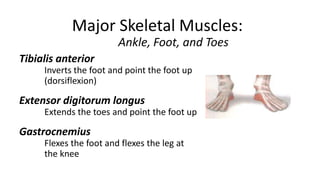
Major Skeletal Muscles:
Ankle, Foot, and Toes
Tibialis anterior
Inverts the foot and point the foot up
(dorsiflexion)

Extensor digitorum longus
Extends the toes and point the foot up

Gastrocnemius
Flexes the foot and flexes the leg at
the knee
Major Skeletal Muscles:
Ankle, Foot, and Toes (cont.)

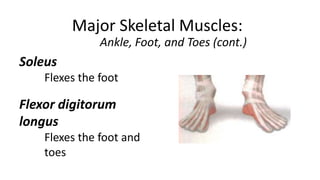
Soleus
Flexes the foot

Flexor digitorum
longus
Flexes the foot and
toes
Diseases and Disorders of the Muscular System
Disease

Description

Botulism

Affects the gastrointestinal tract and various muscle
groups

Fibromyalgia

Fairly common condition that causes chronic pain
primarily in joints, muscles, and tendons
Inherited disorder characterized by muscle weakness and
a loss of muscle tissue
Autoimmune condition in which patients experience
muscle weakness

Muscular Dystrophy

Myasthenia gravis
Diseases and Disorders of the Muscular System
(cont.)

Disease

Description

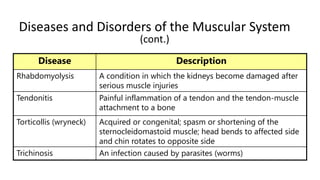
Rhabdomyolysis

A condition in which the kidneys become damaged after
serious muscle injuries

Tendonitis

Painful inflammation of a tendon and the tendon-muscle
attachment to a bone

Torticollis (wryneck)

Acquired or congenital; spasm or shortening of the
sternocleidomastoid muscle; head bends to affected side
and chin rotates to opposite side

Trichinosis

An infection caused by parasites (worms)
Muscular system

Muscular system

  • 1.
    Muscular system Muscle actions Typesof muscles Lever systems Naming Muscles Listing of Major Skeletal Muscles
  • 2.
  • 3.
  • 4.
    Attachments and Actionsof Skeletal Muscles Actions depend largely on what the muscles are attached to Attachment sites – Origin – an attachment site for a less movable bone – Insertion – an attachment site for a more moveable bone
  • 5.
    Attachments and Actions(cont.) Movement usually produced by a group of muscles Prime mover – muscle responsible for most of the movement Synergists – muscles that help the prime mover by stabilizing joints Antagonist (agonist) – produces movement opposite to prime mover Relaxes when prime mover contracts
  • 6.
    Attachments and Actions BodyMovements Flexion – bending a body part Extension – straightening a body part Hyperextension – extending a body part past the normal anatomical position Dorsiflexion – pointing the toes up Plantar flexion – pointing the toes down Abduction – moving a body part away from the anatomical position Adduction – moving a body part toward the anatomical position
  • 7.
    Attachments and Actions: BodyMovements Circumduction – moving a body part in a circle Pronation – turning the palm of the hand down Supination – turning the palm of the hand up Inversion – turning the sole of the foot medially Eversion – turning the sole of the foot laterally Retraction – moving a body part posteriorly Protraction – moving a body part anteriorly
  • 8.
    Attachments and Actions: BodyMovements (cont.) Elevation – lifting a body part; for example, elevating the shoulders as in a shrugging expression Depression – lowering a body part; for example, lowering the shoulders
  • 9.
    Major Skeletal Muscles Themuscle name indicates Location Size Action Shape OR Number of attachments of the muscle As you study muscles, you will find it easier to remember them if you think about what the name describes.
  • 10.
    Major Skeletal Muscles:The Head Sternocleidomastoid Pulls the head to one side Pulls the head to the chest Frontalis Raises the eyebrows Splenius capitis Rotates the head Allows it to bend to the side Orbicularis oris Allows the lips to pucker
  • 11.
    Major Skeletal Muscles:The Head (cont.) Orbicularis oculi Allows the eyes to close Zygomaticus Pulls the corners of the mouth up Platysma Pulls the corners of the mouth down Masseter and temporalis Close the jaw
  • 12.
    Major Skeletal Muscles:Upper Arm Pectoralis major Pulls the arm across the chest Rotates and adducts the arms Latissimus dorsi Extends and adducts the arm and rotates the arm inwardly
  • 13.
    Major Skeletal Muscles:Upper Arm (cont.) Deltoid Abducts and extends the arm at the shoulder Subscapularis Rotates the arm medially Infraspinatus Rotates the arm laterally
  • 14.
    Major Skeletal Muscles:Forearm • Biceps brachii – Flexes the arm at the elbow – Rotates the hand laterally • Brachialis – Flexes the arm at the elbow • Brachioradialis – Flexes the forearm at the elbow
  • 15.
    Major Skeletal Muscles:Forearm (cont.) Triceps brachii Extends the arm at the elbow Supinator Rotates the forearm laterally (supination) Pronator teres Rotates the forearm medially (pronation)
  • 16.
    Major Skeletal Muscles: Wrist,Hand, and Fingers Flexor carpi radialis and flexor carpi ulnaris Flex and abduct the wrist Palmaris longus Flexes the wrist Flexor digitorum profundus Flexes the distal joints of the fingers, but not the thumb
  • 17.
    Major Skeletal Muscles: Wrist,Hand, and Fingers (cont.) Extensor carpi radialis longus and brevis Extend the wrist and abduct the hand Extensor carpi ulnaris Extends the wrist Extensor digitorum Extends the fingers, but not the thumb
  • 18.
    Major Skeletal Muscles:Respiratory Diaphragm Separates the thoracic cavity from the abdominal cavity Its contraction causes inspiration External and internal intercostals Expand and lower the ribs during breathing
  • 19.
    Major Skeletal Muscles:Abdominal External and internal obliques Compress the abdominal wall Transverse abdominis Also compresses the abdominal wall Rectus abdominis Flexes the vertebral column Compresses the abdominal wall Click for View of Abdominal Muscles
  • 20.
    Major Skeletal Muscles:Pectoral Girdle Trapezius Raises the arms Pulls the shoulders downward Pectoralis minor Pulls the scapula downward Raises the ribs Click for View of Pectoral Girdle Muscles
  • 21.
    Major Skeletal Muscles:Leg Psoas major and iliacus Flexes the thigh Gluteus maximus Extends the thigh Gluteus medius and minimus Abduct the thighs Rotate them medially
  • 22.
    Major Skeletal Muscles:Leg (cont.) Adductor longus and magnus Adduct the thighs Rotate them laterally Biceps femoris, semitendinosus, and semimembranosus Known as the hamstring group Flex the leg at the knee Extend the leg at the thigh
  • 23.
    Major Skeletal Muscles:Leg (cont.) • Rectus femoris, vastus lateralis, vastus medialis, and vastus intermedius – • Extend the leg at the knee Sartorius – – Flexes the leg at the knee and thigh Abducts the thigh, rotating the thigh laterally but rotating the lower leg medially
  • 24.
    Major Skeletal Muscles: Ankle,Foot, and Toes Tibialis anterior Inverts the foot and point the foot up (dorsiflexion) Extensor digitorum longus Extends the toes and point the foot up Gastrocnemius Flexes the foot and flexes the leg at the knee
  • 25.
    Major Skeletal Muscles: Ankle,Foot, and Toes (cont.) Soleus Flexes the foot Flexor digitorum longus Flexes the foot and toes
  • 26.
    Diseases and Disordersof the Muscular System Disease Description Botulism Affects the gastrointestinal tract and various muscle groups Fibromyalgia Fairly common condition that causes chronic pain primarily in joints, muscles, and tendons Inherited disorder characterized by muscle weakness and a loss of muscle tissue Autoimmune condition in which patients experience muscle weakness Muscular Dystrophy Myasthenia gravis
  • 27.
    Diseases and Disordersof the Muscular System (cont.) Disease Description Rhabdomyolysis A condition in which the kidneys become damaged after serious muscle injuries Tendonitis Painful inflammation of a tendon and the tendon-muscle attachment to a bone Torticollis (wryneck) Acquired or congenital; spasm or shortening of the sternocleidomastoid muscle; head bends to affected side and chin rotates to opposite side Trichinosis An infection caused by parasites (worms)