Muscle Tissue 2

Nerve impulse (action potential)
Motor units
Neuromuscular junctions
Physiology of Muscle contraction (sliding filament theory)
Nerve impulse
Necessary for muscle contraction
Also known as action potential

Momentary change in electrical potential due to rapid
changes in ion concentration
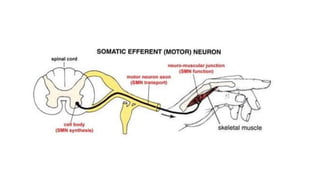
Motor neuron
Neuron with cell body located in the brain or spinal cord
Ends at neuromuscular junction / synaptic end bulb

Motor unit
The functional unit of a skeletal muscle
Consists of a motor neuron and the muscle fibers it stimulates
muscles with large ratio motor units (1 neuron: many muscle
fibers) provide powerful contractions but cannot provide delicate
control
muscles with small ratio motor units (1 neuron: few muscle fibers)
provide delicate control for very precise movements
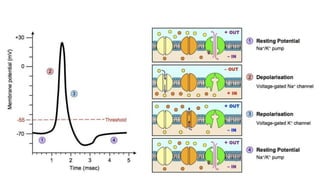
Resting potential
Ion pumps actively maintain concentration
gradients
[Na + ] much higher outside cell
[K + ] much higher inside cell
3 Na + transported out for every 2 K + transported in
Results in net – 70 mV charge inside nerve cell; cell
is polarized
Action potential
Nerve impulse
Na + channels open, Na + rush in to nerve axon
Internal cell environment no longer polarized
K + channels open; K + rush out of nerve
Repolarizes cell
Process travels down length of cell axon
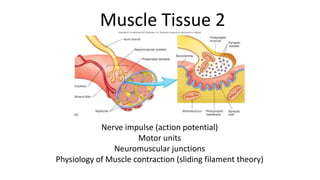
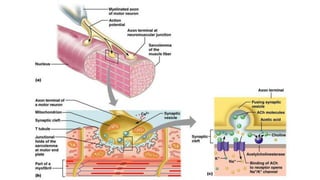
Neuromuscular junction
Meeting point at which motor neuron meets muscle fiber

Synapse
Region of communication between two neurons or a neuron
and a target cell

Neurotransmitter
Chemical that crosses synaptic cleft (gap) allowing for
communication between two cells
Acetylcholine (ACh) is the neurotransmitter released from
synaptic end bulb of motor neurons
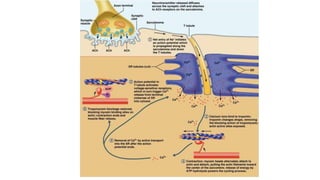
Nerve impulse initiates contraction
Nerve impulse arrives at NMJ
Acetylcholine (Ach) released via exocytosis across synaptic cleft
ACh stimulates Na + / K+ ion channels to open, muscle cell depolarizes
Depolarization of sarcolemma causes Ca2+ release

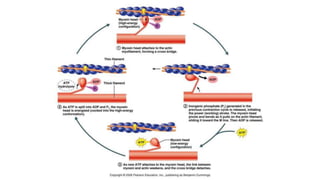
Ca2+ allows myosin / actin crossbridge and ultimately, sarcomere
shortening
Key players of muscle contraction
Myosin
~300 molecules comprise each thick filament
Imagine two golf club twisted together

Actin
Thin filament molecules extending from anchoring points in the Z
disc

Titin
Extends from Z disc to M line
One of largest molecules known to exist; molar mass = 3million
grams
Key players of muscle contraction
Tropomyosin
Part of thin filament; blocks sites where actin / myosin bind

Troponin
Holds tropomyosin in position.
When Ca2+ is present, troponin changes shape (conformational
change)
Linked to tropomyosin, actin/mysoin binding site is uncovered
when Ca2+ is present in sarcoplasm.

Myomesin
Forms M line of sarcomere
Sarcomere regions
Z line (disc)
Lateral terminus of sarcomere; separate adjacent
sarcomeres

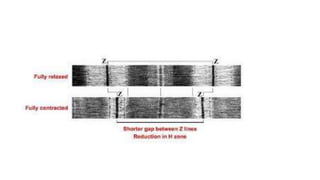
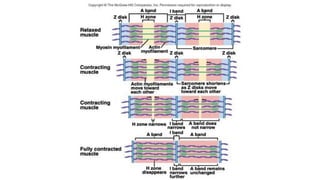
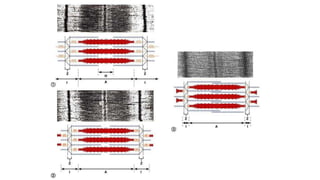
A band
Region where thick filaments present; darker
appearance
some overlap of thin filament in relaxed sarcomere
more overlap of thin filament in contracted sarcomere
Sarcomere regions
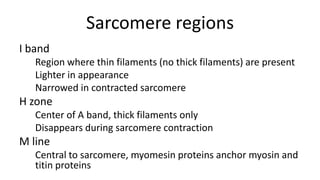
I band
Region where thin filaments (no thick filaments) are present
Lighter in appearance
Narrowed in contracted sarcomere

H zone
Center of A band, thick filaments only
Disappears during sarcomere contraction

M line
Central to sarcomere, myomesin proteins anchor myosin and
titin proteins
Muscle tissue 2

Muscle tissue 2

  • 1.
    Muscle Tissue 2 Nerveimpulse (action potential) Motor units Neuromuscular junctions Physiology of Muscle contraction (sliding filament theory)
  • 2.
    Nerve impulse Necessary formuscle contraction Also known as action potential Momentary change in electrical potential due to rapid changes in ion concentration
  • 3.
    Motor neuron Neuron withcell body located in the brain or spinal cord Ends at neuromuscular junction / synaptic end bulb Motor unit The functional unit of a skeletal muscle Consists of a motor neuron and the muscle fibers it stimulates muscles with large ratio motor units (1 neuron: many muscle fibers) provide powerful contractions but cannot provide delicate control muscles with small ratio motor units (1 neuron: few muscle fibers) provide delicate control for very precise movements
  • 7.
    Resting potential Ion pumpsactively maintain concentration gradients [Na + ] much higher outside cell [K + ] much higher inside cell 3 Na + transported out for every 2 K + transported in Results in net – 70 mV charge inside nerve cell; cell is polarized
  • 8.
    Action potential Nerve impulse Na+ channels open, Na + rush in to nerve axon Internal cell environment no longer polarized K + channels open; K + rush out of nerve Repolarizes cell Process travels down length of cell axon
  • 13.
    Neuromuscular junction Meeting pointat which motor neuron meets muscle fiber Synapse Region of communication between two neurons or a neuron and a target cell Neurotransmitter Chemical that crosses synaptic cleft (gap) allowing for communication between two cells Acetylcholine (ACh) is the neurotransmitter released from synaptic end bulb of motor neurons
  • 16.
    Nerve impulse initiatescontraction Nerve impulse arrives at NMJ Acetylcholine (Ach) released via exocytosis across synaptic cleft ACh stimulates Na + / K+ ion channels to open, muscle cell depolarizes Depolarization of sarcolemma causes Ca2+ release Ca2+ allows myosin / actin crossbridge and ultimately, sarcomere shortening
  • 23.
    Key players ofmuscle contraction Myosin ~300 molecules comprise each thick filament Imagine two golf club twisted together Actin Thin filament molecules extending from anchoring points in the Z disc Titin Extends from Z disc to M line One of largest molecules known to exist; molar mass = 3million grams
  • 24.
    Key players ofmuscle contraction Tropomyosin Part of thin filament; blocks sites where actin / myosin bind Troponin Holds tropomyosin in position. When Ca2+ is present, troponin changes shape (conformational change) Linked to tropomyosin, actin/mysoin binding site is uncovered when Ca2+ is present in sarcoplasm. Myomesin Forms M line of sarcomere
  • 30.
    Sarcomere regions Z line(disc) Lateral terminus of sarcomere; separate adjacent sarcomeres A band Region where thick filaments present; darker appearance some overlap of thin filament in relaxed sarcomere more overlap of thin filament in contracted sarcomere
  • 31.
    Sarcomere regions I band Regionwhere thin filaments (no thick filaments) are present Lighter in appearance Narrowed in contracted sarcomere H zone Center of A band, thick filaments only Disappears during sarcomere contraction M line Central to sarcomere, myomesin proteins anchor myosin and titin proteins