Anup Muni Bajracharya
Nucleic acids are organic compounds composed
of nucleotide monomers linked together, so it is
polynucleotide chains.
Nucleotides are joined to one another by
covalent bonds between the phosphate of one
and the sugar of another. These linkages are
called phosphodiester linkages.
The two main classes of nucleic acids are
deoxyribonucleic acid (DNA) and ribonucleic
acid (RNA).
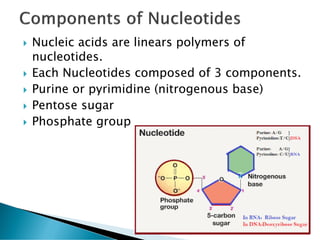
๏ฝ Nucleic acids are linears polymers of
nucleotides.
๏ฝ Each Nucleotides composed of 3 components.
๏ฝ Purine or pyrimidine (nitrogenous base)
๏ฝ Pentose sugar
๏ฝ Phosphate group
A nitrogenous base is an organic molecule that
contains the element nitrogen and acts as a
base in chemical reactions.
The nitrogen bases are also called nucleobases
because they play a major role as building
blocks of the nucleic acids deoxyribonucleic
acid (DNA) and ribonucleic acid (RNA).
There are two kinds of nitrogen-containing
bases - purines and pyrimidines.
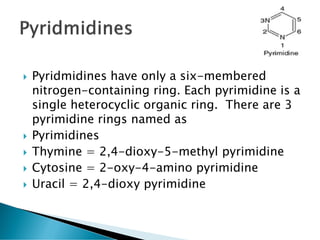
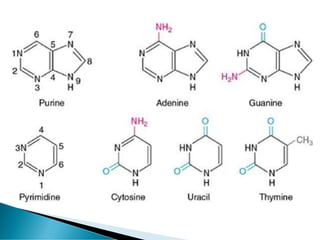
๏ฝ Pyridmidines have only a six-membered
nitrogen-containing ring. Each pyrimidine is a
single heterocyclic organic ring. There are 3
pyrimidine rings named as
๏ฝ Pyrimidines
๏ฝ Thymine = 2,4-dioxy-5-methyl pyrimidine
๏ฝ Cytosine = 2-oxy-4-amino pyrimidine
๏ฝ Uracil = 2,4-dioxy pyrimidine
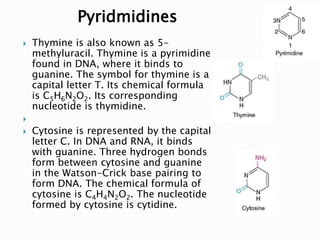
๏ฝ Thymine is also known as 5-
methyluracil. Thymine is a pyrimidine
found in DNA, where it binds to
guanine. The symbol for thymine is a
capital letter T. Its chemical formula
is C5H6N2O2. Its corresponding
nucleotide is thymidine.
๏ฝ
๏ฝ Cytosine is represented by the capital
letter C. In DNA and RNA, it binds
with guanine. Three hydrogen bonds
form between cytosine and guanine
in the Watson-Crick base pairing to
form DNA. The chemical formula of
cytosine is C4H4N2O2. The nucleotide
formed by cytosine is cytidine.
Pyridmidines
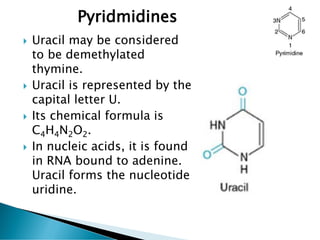
๏ฝ Uracil may be considered
to be demethylated
thymine.
๏ฝ Uracil is represented by the
capital letter U.
๏ฝ Its chemical formula is
C4H4N2O2.
๏ฝ In nucleic acids, it is found
in RNA bound to adenine.
Uracil forms the nucleotide
uridine.
Pyridmidines
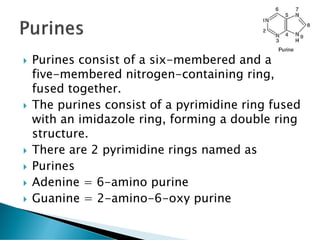
๏ฝ Purines consist of a six-membered and a
five-membered nitrogen-containing ring,
fused together.
๏ฝ The purines consist of a pyrimidine ring fused
with an imidazole ring, forming a double ring
structure.
๏ฝ There are 2 pyrimidine rings named as
๏ฝ Purines
๏ฝ Adenine = 6-amino purine
๏ฝ Guanine = 2-amino-6-oxy purine
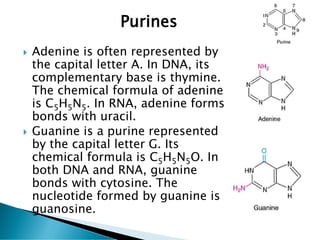
๏ฝ Adenine is often represented by
the capital letter A. In DNA, its
complementary base is thymine.
The chemical formula of adenine
is Cโ€‹5H5N5. In RNA, adenine forms
bonds with uracil.
๏ฝ Guanine is a purine represented
by the capital letter G. Its
chemical formula is C5H5N5O. In
both DNA and RNA, guanine
bonds with cytosine. The
nucleotide formed by guanine is
guanosine.
Purines
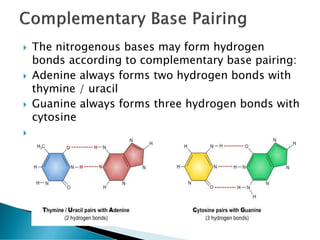
๏ฝ The nitrogenous bases may form hydrogen
bonds according to complementary base pairing:
๏ฝ Adenine always forms two hydrogen bonds with
thymine / uracil
๏ฝ Guanine always forms three hydrogen bonds with
cytosine
๏ฝ
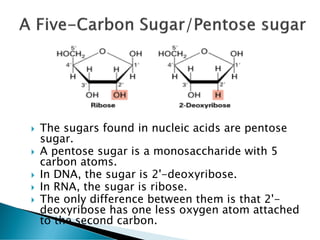
๏ฝ The sugars found in nucleic acids are pentose
sugar.
๏ฝ A pentose sugar is a monosaccharide with 5
carbon atoms.
๏ฝ In DNA, the sugar is 2'-deoxyribose.
๏ฝ In RNA, the sugar is ribose.
๏ฝ The only difference between them is that 2'-
deoxyribose has one less oxygen atom attached
to the second carbon.
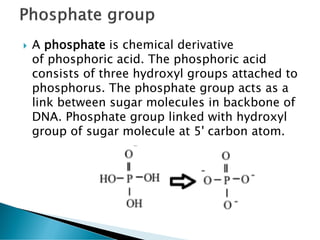
๏ฝ A phosphate is chemical derivative
of phosphoric acid. The phosphoric acid
consists of three hydroxyl groups attached to
phosphorus. The phosphate group acts as a
link between sugar molecules in backbone of
DNA. Phosphate group linked with hydroxyl
group of sugar molecule at 5' carbon atom.
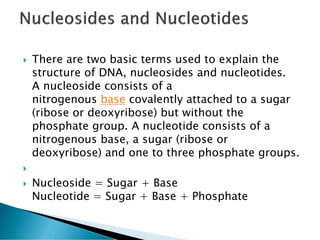
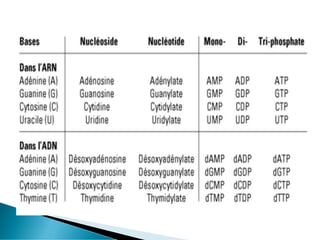
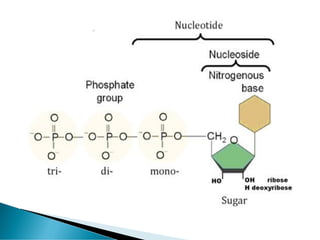
๏ฝ There are two basic terms used to explain the
structure of DNA, nucleosides and nucleotides.
A nucleoside consists of a
nitrogenous base covalently attached to a sugar
(ribose or deoxyribose) but without the
phosphate group. A nucleotide consists of a
nitrogenous base, a sugar (ribose or
deoxyribose) and one to three phosphate groups.
๏ฝ
๏ฝ Nucleoside = Sugar + Base
Nucleotide = Sugar + Base + Phosphate
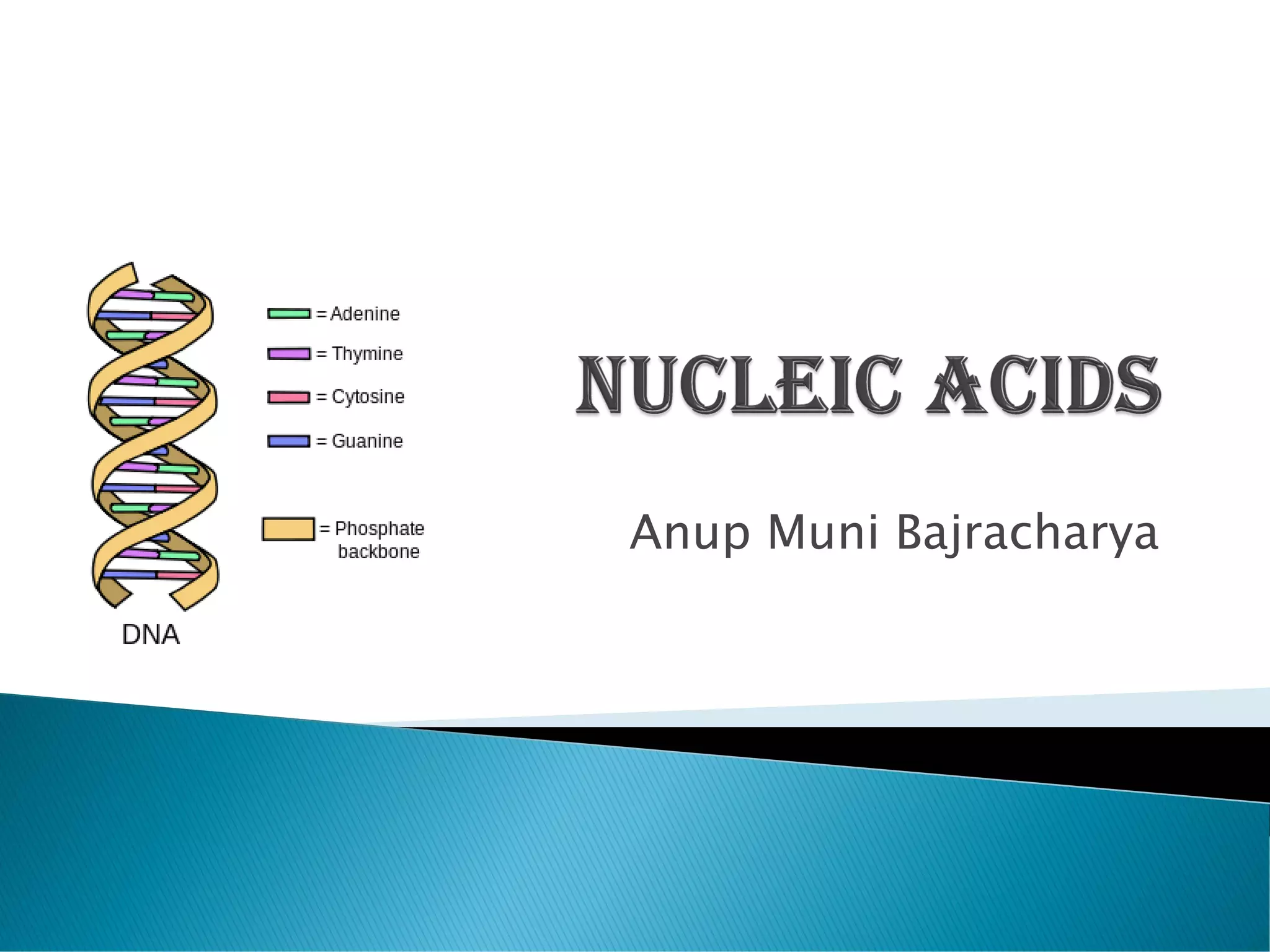
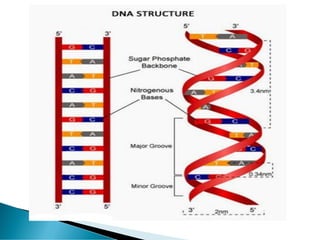
๏ฝ Francis Crick and James Watson proposed DNA in
1953.
๏ฝ The double helical model of DNA is made up of 2
connected chains of nucleotides forming a ladder-
like structure i.e it contains two polynucleotide
strands wound around each other.
๏ฝ Side of ladder are made of alternating phosphate and
deoxyribose molecules i.e the backbone of each
consists of alternating deoxyribose and phosphate
groups.
๏ฝ The phosphate group bonded to the 5' carbon atom
of one deoxyribose is covalently bonded to the 3'
carbon of the next.
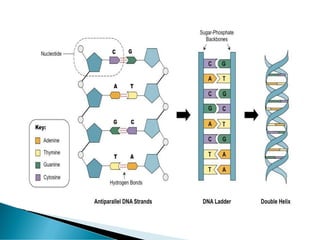
๏ฝ The two strands are "antiparallel"; that is, one strand
runs 5โ€ฒ to 3โ€ฒ while the other runs 3โ€ฒ to 5โ€ฒ.
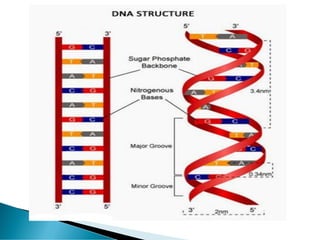
๏ฝ The DNA strands are assembled in the 5โ€ฒ to
3โ€ฒ direction and, by convention, we "read"
them the same way
๏ฝ Rung or step of ladder made up of pair of
nitrogen bases bonded by hydrogen bonds
๏ฝ Each base forms hydrogen bonds with the
one directly opposite it, forming base
pairs (also called nucleotide pairs).
๏ฝ 3.4 ร… separate the planes in which adjacent
base pairs are located.
๏ฝ The double helix makes a complete turn in just
over 10 nucleotide pairs, so each turn takes a
little more (35.7 ร… to be exact) than the 34 ร…
shown in the diagram.
๏ฝ There is an average of 25 hydrogen bonds within
each complete turn of the double helix providing
a stability of binding about as strong as what
a covalent bond would provide.
๏ฝ The diameter of the helix is 20 ร….
๏ฝ The helix can be virtually any length; when fully
stretched, some DNA molecules are as much as 5
cm (2 inches!) long.
๏ฝ .
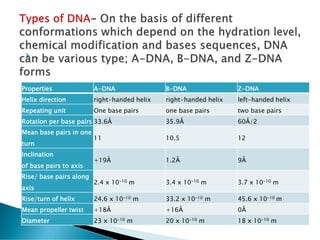
Properties A-DNA B-DNA Z-DNA
Helix direction right-handed helix right-handed helix left-handed helix
Repeating unit One base pairs one base pairs two base pairs
Rotation per base pairs 33.6ร… 35.9ร… 60ร…/2
Mean base pairs in one
turn
11 10.5 12
Inclination
of base pairs to axis
+19ร… 1.2ร… 9ร…
Rise/ base pairs along
axis
2.4 x 10⁻¹⁰ m 3.4 x 10⁻¹⁰ m 3.7 x 10⁻¹⁰ m
Rise/turn of helix 24.6 x 10⁻¹⁰ m 33.2 x 10⁻¹⁰ m 45.6 x 10⁻¹⁰ m
Mean propeller twist +18ร… +16ร… 0ร…
Diameter 23 x 10-10 m 20 x 10-10 m 18 x 10-10 m
๏ฝ RNA molecules are single-stranded nucleic
acids composed of nucleotides.
๏ฝ RNA plays a major role in protein synthesis as it
is involved in the transcription, decoding,
and translation of the genetic code to
produce proteins.
๏ฝ RNA stands for ribonucleic acid and like DNA,
RNA nucleotides contain three components:
๏ฝ A Nitrogenous Base
๏ฝ A Five-Carbon Sugar
๏ฝ A Phosphate Group
๏ฝ RNA nitrogenous bases include adenine
(A), guanine (G), cytosine (C) and uracil (U).
๏ฝ The five-carbon (pentose) sugar in RNA is
ribose.
๏ฝ RNA molecules are polymers of nucleotides
joined to one another by covalent bonds
between the phosphate of one nucleotide and
the sugar of another. These linkages are
called phosphodiester linkages.
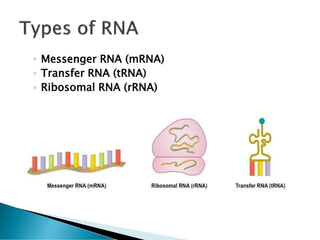
โ—ฆ Messenger RNA (mRNA)
โ—ฆ Transfer RNA (tRNA)
โ—ฆ Ribosomal RNA (rRNA)
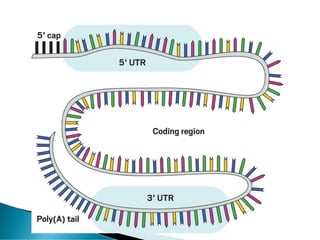
๏ฝ mRNA accounts for just 5% of the total RNA in
the cell.
๏ฝ It carries the genetic code copied from the
DNA during transcription in the form of triplets
of nucleotides called codons.
๏ฝ Each codon specifies a particular amino acid,
which polymerization forms the protein.
๏ฝ It plays an important role in the transcription
of DNA.
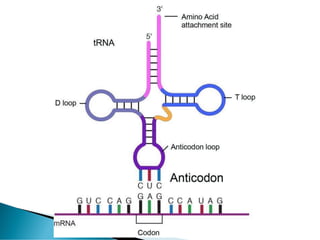
๏ฝ tRNA is the smallest of the 3 types of RNA having
about 75-95 nucleotides.
๏ฝ tRNAs are an essential component of translation,
where their main function is the transfer of
amino acids during protein synthesis. Therefore
they are called transfer RNAs.
๏ฝ Each of the 20 amino acids has a specific tRNA
that binds with it and transfers it to the growing
polypeptide chain.
๏ฝ tRNAs also act as adapters in the translation of
the genetic sequence of mRNA into proteins.
Therefore they are also called adapter molecules.
๏ฝ It plays an important role in the translation
portion of protein synthesis.
๏ฝ rRNAs are found in the ribosomes and account for
80% of the total RNA present in the cell.
๏ฝ Ribosomes are composed of a large subunit called
the 50S and a small subunit called the 30S, each
of which has its own rRNA molecules.
๏ฝ Different rRNAs present in the ribosomes include
small rRNAs and large rRNAs, which denote their
presence in the small and large subunits of the
ribosome.
๏ฝ rRNAs combine with proteins in the cytoplasm to
form ribosomes, which act as the site of protein
synthesis and has the enzymes needed for the
process.
Nucleic acids

Nucleic acids

  • 1.
  • 2.
    Nucleic acids areorganic compounds composed of nucleotide monomers linked together, so it is polynucleotide chains. Nucleotides are joined to one another by covalent bonds between the phosphate of one and the sugar of another. These linkages are called phosphodiester linkages. The two main classes of nucleic acids are deoxyribonucleic acid (DNA) and ribonucleic acid (RNA).
  • 3.
    ๏ฝ Nucleic acidsare linears polymers of nucleotides. ๏ฝ Each Nucleotides composed of 3 components. ๏ฝ Purine or pyrimidine (nitrogenous base) ๏ฝ Pentose sugar ๏ฝ Phosphate group
  • 4.
    A nitrogenous baseis an organic molecule that contains the element nitrogen and acts as a base in chemical reactions. The nitrogen bases are also called nucleobases because they play a major role as building blocks of the nucleic acids deoxyribonucleic acid (DNA) and ribonucleic acid (RNA). There are two kinds of nitrogen-containing bases - purines and pyrimidines.
  • 5.
    ๏ฝ Pyridmidines haveonly a six-membered nitrogen-containing ring. Each pyrimidine is a single heterocyclic organic ring. There are 3 pyrimidine rings named as ๏ฝ Pyrimidines ๏ฝ Thymine = 2,4-dioxy-5-methyl pyrimidine ๏ฝ Cytosine = 2-oxy-4-amino pyrimidine ๏ฝ Uracil = 2,4-dioxy pyrimidine
  • 6.
    ๏ฝ Thymine isalso known as 5- methyluracil. Thymine is a pyrimidine found in DNA, where it binds to guanine. The symbol for thymine is a capital letter T. Its chemical formula is C5H6N2O2. Its corresponding nucleotide is thymidine. ๏ฝ ๏ฝ Cytosine is represented by the capital letter C. In DNA and RNA, it binds with guanine. Three hydrogen bonds form between cytosine and guanine in the Watson-Crick base pairing to form DNA. The chemical formula of cytosine is C4H4N2O2. The nucleotide formed by cytosine is cytidine. Pyridmidines
  • 7.
    ๏ฝ Uracil maybe considered to be demethylated thymine. ๏ฝ Uracil is represented by the capital letter U. ๏ฝ Its chemical formula is C4H4N2O2. ๏ฝ In nucleic acids, it is found in RNA bound to adenine. Uracil forms the nucleotide uridine. Pyridmidines
  • 8.
    ๏ฝ Purines consistof a six-membered and a five-membered nitrogen-containing ring, fused together. ๏ฝ The purines consist of a pyrimidine ring fused with an imidazole ring, forming a double ring structure. ๏ฝ There are 2 pyrimidine rings named as ๏ฝ Purines ๏ฝ Adenine = 6-amino purine ๏ฝ Guanine = 2-amino-6-oxy purine
  • 9.
    ๏ฝ Adenine isoften represented by the capital letter A. In DNA, its complementary base is thymine. The chemical formula of adenine is Cโ€‹5H5N5. In RNA, adenine forms bonds with uracil. ๏ฝ Guanine is a purine represented by the capital letter G. Its chemical formula is C5H5N5O. In both DNA and RNA, guanine bonds with cytosine. The nucleotide formed by guanine is guanosine. Purines
  • 11.
    ๏ฝ The nitrogenousbases may form hydrogen bonds according to complementary base pairing: ๏ฝ Adenine always forms two hydrogen bonds with thymine / uracil ๏ฝ Guanine always forms three hydrogen bonds with cytosine ๏ฝ
  • 12.
    ๏ฝ The sugarsfound in nucleic acids are pentose sugar. ๏ฝ A pentose sugar is a monosaccharide with 5 carbon atoms. ๏ฝ In DNA, the sugar is 2'-deoxyribose. ๏ฝ In RNA, the sugar is ribose. ๏ฝ The only difference between them is that 2'- deoxyribose has one less oxygen atom attached to the second carbon.
  • 13.
    ๏ฝ A phosphateis chemical derivative of phosphoric acid. The phosphoric acid consists of three hydroxyl groups attached to phosphorus. The phosphate group acts as a link between sugar molecules in backbone of DNA. Phosphate group linked with hydroxyl group of sugar molecule at 5' carbon atom.
  • 14.
    ๏ฝ There aretwo basic terms used to explain the structure of DNA, nucleosides and nucleotides. A nucleoside consists of a nitrogenous base covalently attached to a sugar (ribose or deoxyribose) but without the phosphate group. A nucleotide consists of a nitrogenous base, a sugar (ribose or deoxyribose) and one to three phosphate groups. ๏ฝ ๏ฝ Nucleoside = Sugar + Base Nucleotide = Sugar + Base + Phosphate
  • 17.
    ๏ฝ Francis Crickand James Watson proposed DNA in 1953. ๏ฝ The double helical model of DNA is made up of 2 connected chains of nucleotides forming a ladder- like structure i.e it contains two polynucleotide strands wound around each other. ๏ฝ Side of ladder are made of alternating phosphate and deoxyribose molecules i.e the backbone of each consists of alternating deoxyribose and phosphate groups. ๏ฝ The phosphate group bonded to the 5' carbon atom of one deoxyribose is covalently bonded to the 3' carbon of the next. ๏ฝ The two strands are "antiparallel"; that is, one strand runs 5โ€ฒ to 3โ€ฒ while the other runs 3โ€ฒ to 5โ€ฒ.
  • 19.
    ๏ฝ The DNAstrands are assembled in the 5โ€ฒ to 3โ€ฒ direction and, by convention, we "read" them the same way ๏ฝ Rung or step of ladder made up of pair of nitrogen bases bonded by hydrogen bonds ๏ฝ Each base forms hydrogen bonds with the one directly opposite it, forming base pairs (also called nucleotide pairs). ๏ฝ 3.4 ร… separate the planes in which adjacent base pairs are located.
  • 21.
    ๏ฝ The doublehelix makes a complete turn in just over 10 nucleotide pairs, so each turn takes a little more (35.7 ร… to be exact) than the 34 ร… shown in the diagram. ๏ฝ There is an average of 25 hydrogen bonds within each complete turn of the double helix providing a stability of binding about as strong as what a covalent bond would provide. ๏ฝ The diameter of the helix is 20 ร…. ๏ฝ The helix can be virtually any length; when fully stretched, some DNA molecules are as much as 5 cm (2 inches!) long.
  • 23.
    ๏ฝ . Properties A-DNAB-DNA Z-DNA Helix direction right-handed helix right-handed helix left-handed helix Repeating unit One base pairs one base pairs two base pairs Rotation per base pairs 33.6ร… 35.9ร… 60ร…/2 Mean base pairs in one turn 11 10.5 12 Inclination of base pairs to axis +19ร… 1.2ร… 9ร… Rise/ base pairs along axis 2.4 x 10⁻¹⁰ m 3.4 x 10⁻¹⁰ m 3.7 x 10⁻¹⁰ m Rise/turn of helix 24.6 x 10⁻¹⁰ m 33.2 x 10⁻¹⁰ m 45.6 x 10⁻¹⁰ m Mean propeller twist +18ร… +16ร… 0ร… Diameter 23 x 10-10 m 20 x 10-10 m 18 x 10-10 m
  • 24.
    ๏ฝ RNA moleculesare single-stranded nucleic acids composed of nucleotides. ๏ฝ RNA plays a major role in protein synthesis as it is involved in the transcription, decoding, and translation of the genetic code to produce proteins. ๏ฝ RNA stands for ribonucleic acid and like DNA, RNA nucleotides contain three components: ๏ฝ A Nitrogenous Base ๏ฝ A Five-Carbon Sugar ๏ฝ A Phosphate Group
  • 25.
    ๏ฝ RNA nitrogenousbases include adenine (A), guanine (G), cytosine (C) and uracil (U). ๏ฝ The five-carbon (pentose) sugar in RNA is ribose. ๏ฝ RNA molecules are polymers of nucleotides joined to one another by covalent bonds between the phosphate of one nucleotide and the sugar of another. These linkages are called phosphodiester linkages.
  • 26.
    โ—ฆ Messenger RNA(mRNA) โ—ฆ Transfer RNA (tRNA) โ—ฆ Ribosomal RNA (rRNA)
  • 27.
    ๏ฝ mRNA accountsfor just 5% of the total RNA in the cell. ๏ฝ It carries the genetic code copied from the DNA during transcription in the form of triplets of nucleotides called codons. ๏ฝ Each codon specifies a particular amino acid, which polymerization forms the protein. ๏ฝ It plays an important role in the transcription of DNA.
  • 29.
    ๏ฝ tRNA isthe smallest of the 3 types of RNA having about 75-95 nucleotides. ๏ฝ tRNAs are an essential component of translation, where their main function is the transfer of amino acids during protein synthesis. Therefore they are called transfer RNAs. ๏ฝ Each of the 20 amino acids has a specific tRNA that binds with it and transfers it to the growing polypeptide chain. ๏ฝ tRNAs also act as adapters in the translation of the genetic sequence of mRNA into proteins. Therefore they are also called adapter molecules. ๏ฝ It plays an important role in the translation portion of protein synthesis.
  • 31.
    ๏ฝ rRNAs arefound in the ribosomes and account for 80% of the total RNA present in the cell. ๏ฝ Ribosomes are composed of a large subunit called the 50S and a small subunit called the 30S, each of which has its own rRNA molecules. ๏ฝ Different rRNAs present in the ribosomes include small rRNAs and large rRNAs, which denote their presence in the small and large subunits of the ribosome. ๏ฝ rRNAs combine with proteins in the cytoplasm to form ribosomes, which act as the site of protein synthesis and has the enzymes needed for the process.