Proteins
Wilhelmina Annie Mensah
Dept. Of Med. Bchem.
UGMS , Ghana
109/11/15
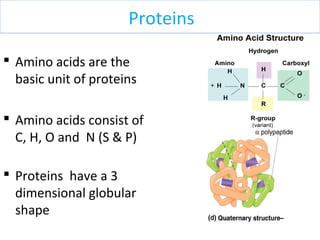
 Amino acids are the
basic unit of proteins
 Amino acids consist of
C, H, O and N (S & P)
 Proteins have a 3
dimensional globular
shape
Proteins
• Peptide bonds
connect amino acids
to form polypeptide
chains
• One or more
polypeptide chains
make up a protein
Proteins Structure
309/11/15
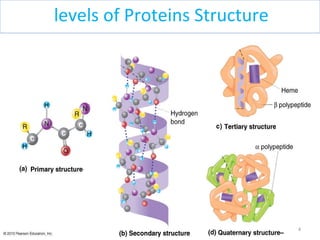
levels of Proteins Structure
409/11/15
Functions of Proteins
1. Transport of substances in the
body . E.g. Haemoglobin transports
oxygen.
509/11/15
Functions of Proteins
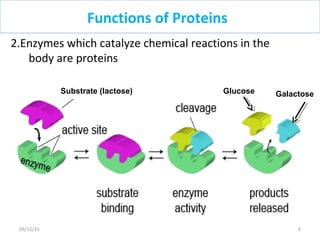
2.Enzymes which catalyze chemical reactions in the
body are proteins
Substrate (lactose) Glucose Galactose
609/11/15
Functions of Proteins
3.Defence function .e.g Immunoglobulins(antibodies)
709/11/15
Functions of Proteins
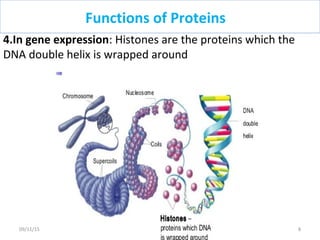
4.In gene expression: Histones are the proteins which the
DNA double helix is wrapped around
809/11/15
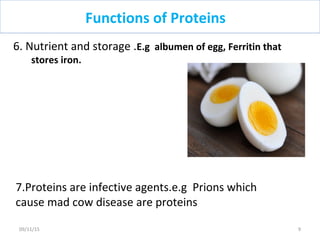
6. Nutrient and storage .E.g albumen of egg, Ferritin that
stores iron.
Functions of Proteins
7.Proteins are infective agents.e.g Prions which
cause mad cow disease are proteins
909/11/15
8.Some toxins are proteins E.g Enterotoxin of cholera
microorganism.
9.Some proteins provide structural strength and
elasticity to the organs and vascular system. E.g
Collagen and elastin of bone matrix and ligaments.
10. Some proteins are components of structures of
tissues. E.g α-keratin is present in hair and
epidermis
Functions of Proteins
1009/11/15
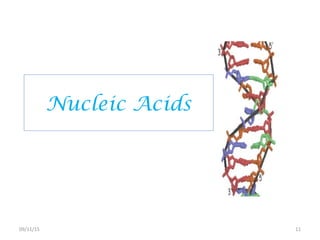
Nucleic Acids
1109/11/15
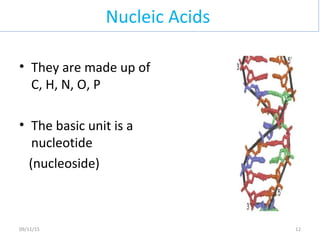
• They are made up of
C, H, N, O, P
• The basic unit is a
nucleotide
(nucleoside)
Nucleic Acids
1209/11/15
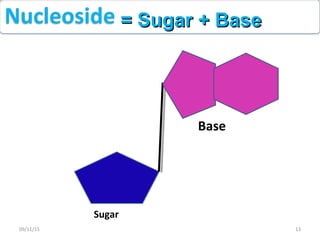
Sugar
Base
= Sugar + Base= Sugar + Base
1309/11/15
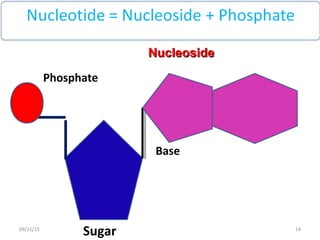
Sugar
Base
Phosphate
NucleosideNucleoside
1409/11/15
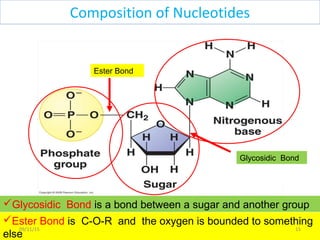
Glycosidic Bond is a bond between a sugar and another group
Ester Bond
Glycosidic Bond
Ester Bond is C-O-R and the oxygen is bounded to something
else
1509/11/15
Composition of Nucleotides
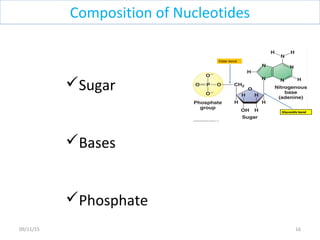
Sugar
Bases
Phosphate
1609/11/15
Composition of Nucleotides
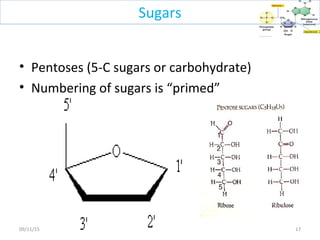
• Pentoses (5-C sugars or carbohydrate)
• Numbering of sugars is “primed”
1709/11/15
Sugars
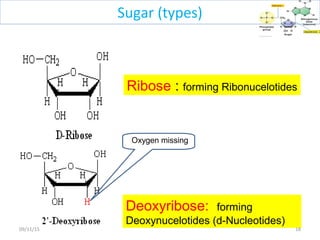
Ribose : forming Ribonucelotides
Deoxyribose: forming
Deoxynucelotides (d-Nucleotides)
Oxygen missing
1809/11/15
Sugar (types)
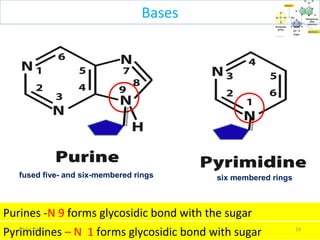
fused five- and six-membered rings
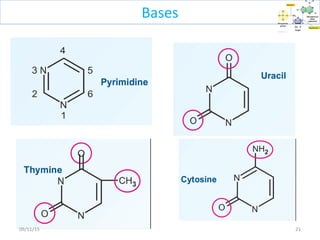
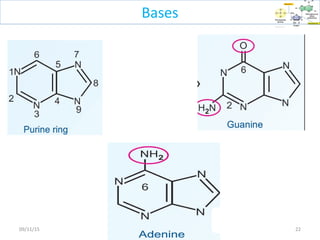
Pyrimidines – N 1 forms glycosidic bond with sugar
Purines -N 9 forms glycosidic bond with the sugar
six membered rings
1909/11/15
Bases
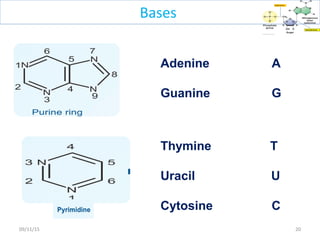
Adenine A
Guanine G
Thymine T
Uracil U
Cytosine C
2009/11/15
Bases
2109/11/15
Bases
2209/11/15
Bases
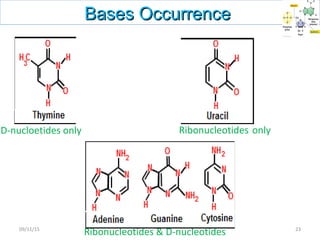
Bases OccurrenceBases Occurrence
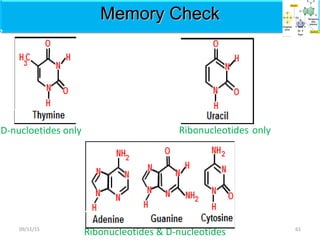
Ribonucleotides only
Ribonucleotides & D-nucleotides
D-nucloetides only
2309/11/15
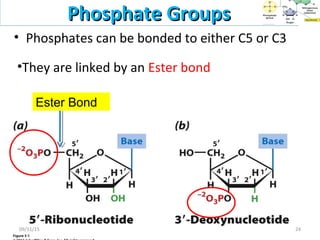
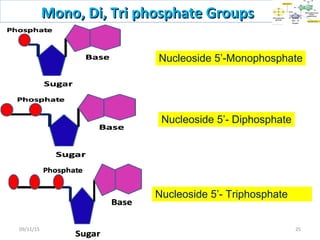
• Phosphates can be bonded to either C5 or C3
Phosphate GroupsPhosphate Groups
Ester Bond
•They are linked by an Ester bond
2409/11/15
Mono, Di, Tri phosphate GroupsMono, Di, Tri phosphate Groups
Nucleoside 5’-Monophosphate
Nucleoside 5’- Diphosphate
Nucleoside 5’- Triphosphate
2509/11/15
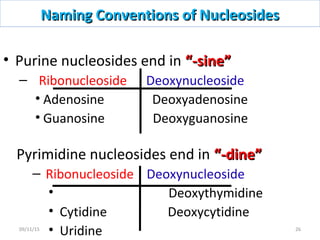
• Purine nucleosides end in “-sine”“-sine”
– Ribonucleoside Deoxynucleoside
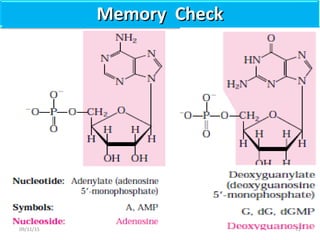
• Adenosine Deoxyadenosine
• Guanosine Deoxyguanosine
Naming Conventions of NucleosidesNaming Conventions of Nucleosides
Pyrimidine nucleosides end in “-dine”“-dine”
– Ribonucleoside Deoxynucleoside
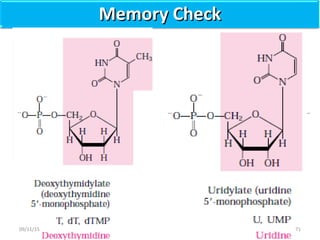
• Deoxythymidine
• Cytidine Deoxycytidine
• Uridine 2609/11/15
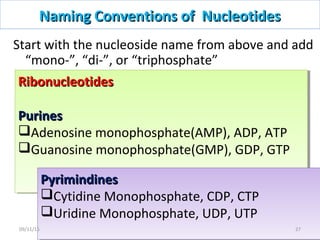
Start with the nucleoside name from above and add
“mono-”, “di-”, or “triphosphate”
Naming Conventions of NucleotidesNaming Conventions of Nucleotides
RibonucleotidesRibonucleotides
PurinesPurines
Adenosine monophosphate(AMP), ADP, ATP
Guanosine monophosphate(GMP), GDP, GTP
RibonucleotidesRibonucleotides
PurinesPurines
Adenosine monophosphate(AMP), ADP, ATP
Guanosine monophosphate(GMP), GDP, GTP
PyrimindinesPyrimindines
Cytidine Monophosphate, CDP, CTP
Uridine Monophosphate, UDP, UTP
PyrimindinesPyrimindines
Cytidine Monophosphate, CDP, CTP
Uridine Monophosphate, UDP, UTP
2709/11/15
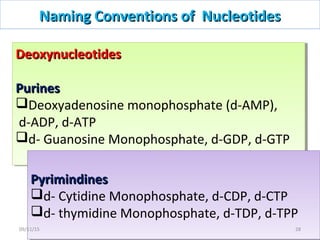
Naming Conventions of NucleotidesNaming Conventions of Nucleotides
DeoxynucleotidesDeoxynucleotides
PurinesPurines
Deoxyadenosine monophosphate (d-AMP),
d-ADP, d-ATP
d- Guanosine Monophosphate, d-GDP, d-GTP
DeoxynucleotidesDeoxynucleotides
PurinesPurines
Deoxyadenosine monophosphate (d-AMP),
d-ADP, d-ATP
d- Guanosine Monophosphate, d-GDP, d-GTP
PyrimindinesPyrimindines
d- Cytidine Monophosphate, d-CDP, d-CTP
d- thymidine Monophosphate, d-TDP, d-TPP
PyrimindinesPyrimindines
d- Cytidine Monophosphate, d-CDP, d-CTP
d- thymidine Monophosphate, d-TDP, d-TPP
2809/11/15
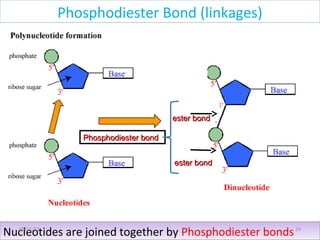
Nucleotides are joined together by Phosphodiester bondsNucleotides are joined together by Phosphodiester bonds
ester bondester bond
Phosphodiester bondPhosphodiester bond
2909/11/15
Phosphodiester Bond (linkages)
Voet, Voet & Pratt 2013 Fig 3.3a,b
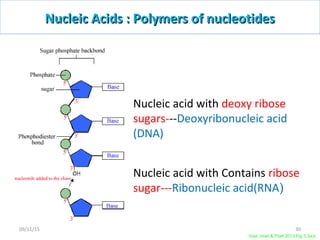
Nucleic Acids : Polymers of nucleotidesNucleic Acids : Polymers of nucleotides
Nucleic acid with deoxy ribose
sugars---Deoxyribonucleic acid
(DNA)
Nucleic acid with Contains ribose
sugar---Ribonucleic acid(RNA)
3009/11/15
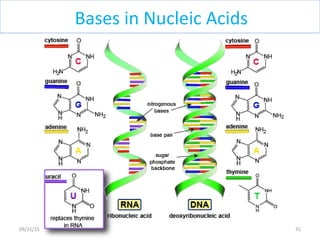
Bases in Nucleic Acids
3109/11/15
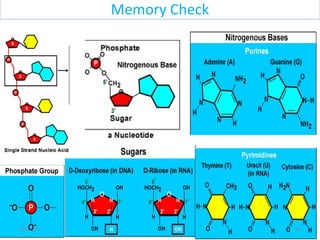
Memory Check
3209/11/15
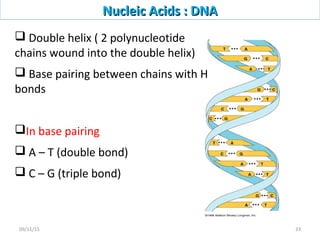
 Double helix ( 2 polynucleotide
chains wound into the double helix)
 Base pairing between chains with H
bonds
In base pairing
 A – T (double bond)
 C – G (triple bond)
Nucleic Acids : DNANucleic Acids : DNA
3309/11/15
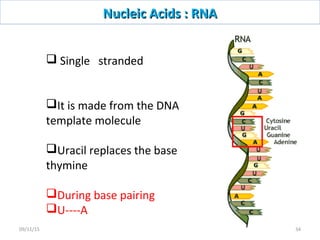
 Single stranded
It is made from the DNA
template molecule
Uracil replaces the base
thymine
During base pairing
U----A
Nucleic Acids : RNANucleic Acids : RNA
3409/11/15
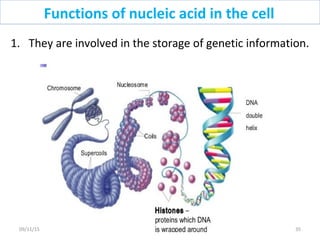
1. They are involved in the storage of genetic information.
Functions of nucleic acid in the cell
3509/11/15
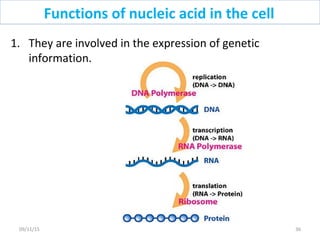
1. They are involved in the expression of genetic
information.
Functions of nucleic acid in the cell
3609/11/15
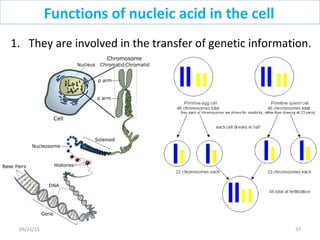
Functions of nucleic acid in the cell
1. They are involved in the transfer of genetic information.
3709/11/15
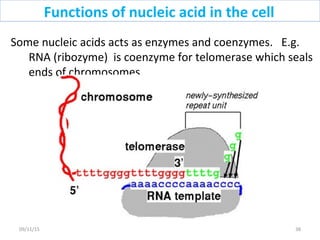
Some nucleic acids acts as enzymes and coenzymes. E.g.
RNA (ribozyme) is coenzyme for telomerase which seals
ends of chromosomes.
Functions of nucleic acid in the cell
3809/11/15
Nucleoside Derivatives and their functions
Adenosine derivatives
Guanosine derivative
Cytidine derivatives
Uridine derivatives
3909/11/15
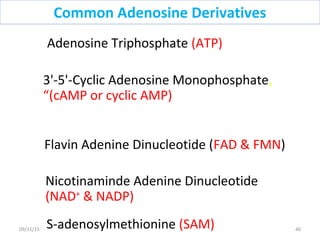
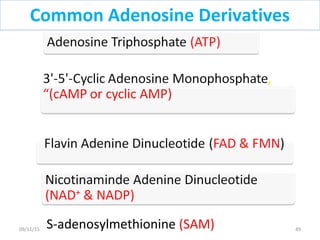
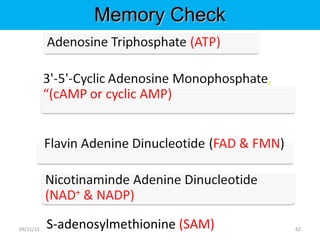
Adenosine Triphosphate (ATP)
3'-5'-Cyclic Adenosine Monophosphate,
“(cAMP or cyclic AMP)
Flavin Adenine Dinucleotide (FAD & FMN)
Nicotinaminde Adenine Dinucleotide
(NAD+
& NADP)
S-adenosylmethionine (SAM)
Common Adenosine Derivatives
4009/11/15
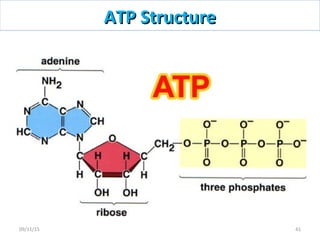
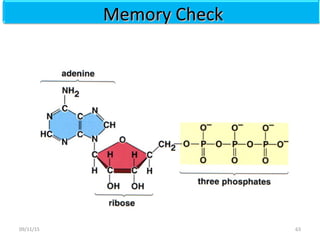
ATP StructureATP Structure
4109/11/15
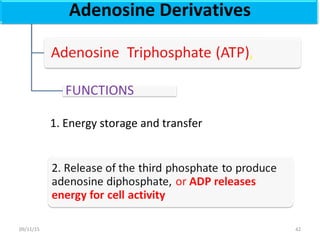
Adenosine Derivatives
1. Energy storage and transfer
4209/11/15
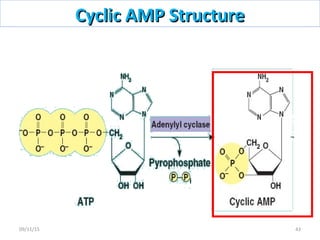
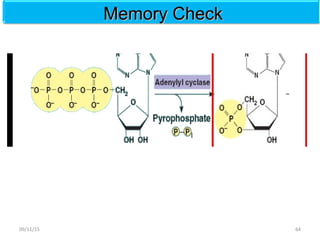
Cyclic AMP StructureCyclic AMP Structure
4309/11/15
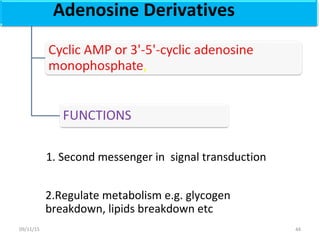
Adenosine Derivatives
1. Second messenger in signal transduction
2.Regulate metabolism e.g. glycogen
breakdown, lipids breakdown etc
4409/11/15
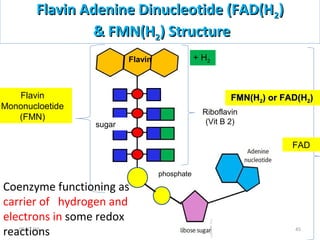
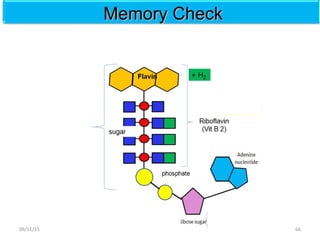
Flavin Adenine Dinucleotide (FAD(HFlavin Adenine Dinucleotide (FAD(H22))
& FMN(H& FMN(H22) Structure) Structure
Flavin
Mononucloetide
(FMN)
Flavin
Coenzyme functioning as
carrier of hydrogen and
electrons in some redox
reactions
sugar
+ H2
Riboflavin
(Vit B 2)
FAD
FMN(HFMN(H22) or FAD(H) or FAD(H22))
phosphate
4509/11/15
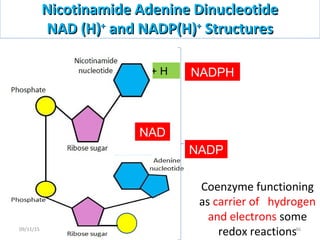
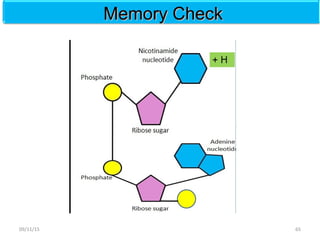
Nicotinamide Adenine DinucleotideNicotinamide Adenine Dinucleotide
NAD (H)NAD (H)++
and NADP(H)and NADP(H)++
StructuresStructures
+ H
Coenzyme functioning
as carrier of hydrogen
and electrons some
redox reactions
NADP
NADPH
NAD
4609/11/15
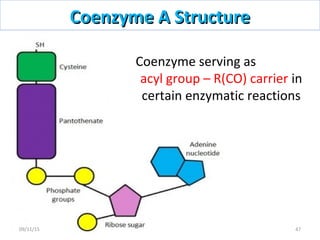
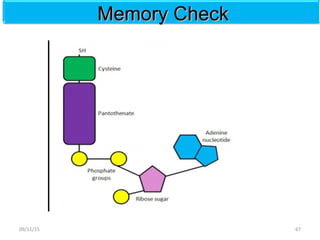
Coenzyme A StructureCoenzyme A Structure
Coenzyme serving as
acyl group – R(CO) carrier in
certain enzymatic reactions
4709/11/15
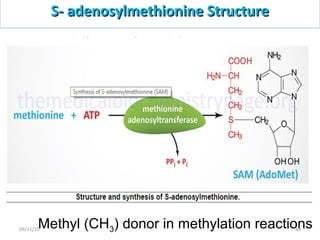
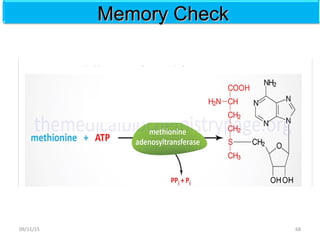
S- adenosylmethionine StructureS- adenosylmethionine Structure
Methyl (CH3) donor in methylation reactions4809/11/15
S-adenosylmethionine (SAM)
Common Adenosine Derivatives
4909/11/15
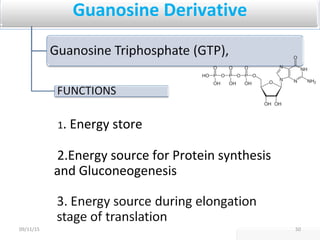
Guanosine Derivative
1. Energy store
2.Energy source for Protein synthesis
and Gluconeogenesis
5009/11/15
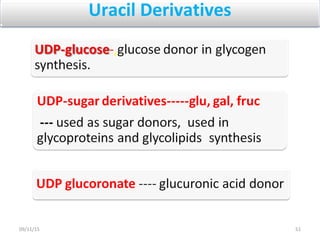
Uracil Derivatives
5109/11/15
Cytidine Derivatives
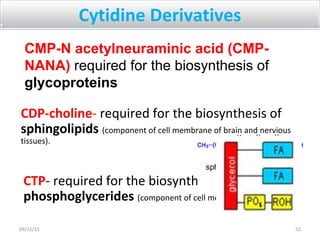
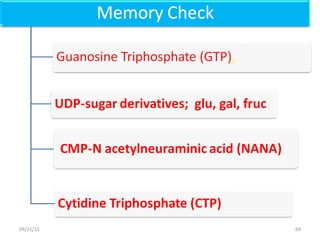
CMP-N acetylneuraminic acid (CMP-
NANA) required for the biosynthesis of
glycoproteins
CDP-choline- required for the biosynthesis of
sphingolipids (component of cell membrane of brain and nervious
tissues).
CTP- required for the biosynthesis of
phosphoglycerides (component of cell membrane)
sphingosine
5209/11/15
Synthetic Analogues of Nucleotides
5309/11/15
Synthetic Analogues of Nucleotides:
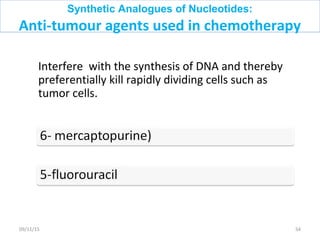
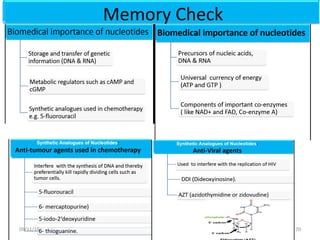
Anti-tumour agents used in chemotherapy
Interfere with the synthesis of DNA and thereby
preferentially kill rapidly dividing cells such as
tumor cells.
5409/11/15
Synthetic Analogues of Nucleotides:
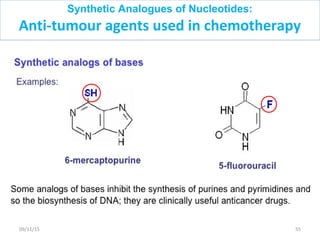
Anti-tumour agents used in chemotherapy
5509/11/15
Synthetic Analogues of Nucleotides:
Anti-Viral agents
Used to interfere with the replication of
viruses by terminating DNA synthesis
5609/11/15
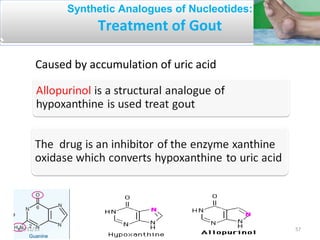
Synthetic Analogues of Nucleotides:
Treatment of Gout
Caused by accumulation of uric acid
5709/11/15
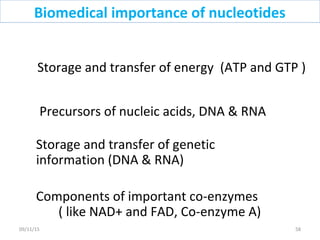
Precursors of nucleic acids, DNA & RNA
Components of important co-enzymes
( like NAD+ and FAD, Co-enzyme A)
Storage and transfer of energy (ATP and GTP )
Storage and transfer of genetic
information (DNA & RNA)
5809/11/15
Biomedical importance of nucleotides
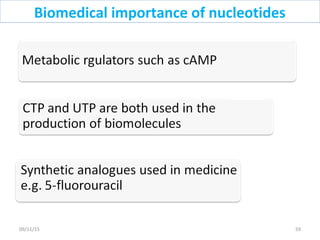
5909/11/15
Biomedical importance of nucleotides
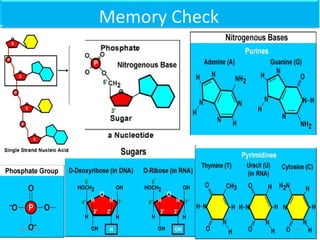
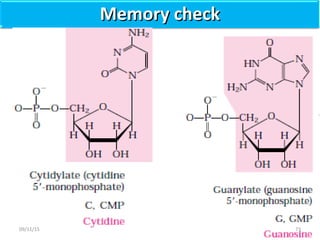
Memory Check
6009/11/15
Memory CheckMemory Check
Ribonucleotides only
Ribonucleotides & D-nucleotides
D-nucloetides only
6109/11/15
S-adenosylmethionine (SAM)
Memory CheckMemory Check
6209/11/15
Memory CheckMemory Check
6309/11/15
Memory CheckMemory Check
6409/11/15
Memory CheckMemory Check
6509/11/15
Memory CheckMemory Check
6609/11/15
Memory CheckMemory Check
6709/11/15
Memory CheckMemory Check
6809/11/15
6909/11/15
Memory Check
7009/11/15
Memory CheckMemory Check
7109/11/15
Memory CheckMemory Check
7209/11/15
Memory checkMemory check
7309/11/15
7409/11/15
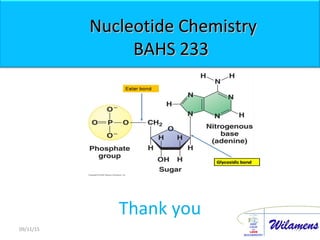
Nucleotide ChemistryNucleotide Chemistry
BAHS 233BAHS 233
Thank you
7509/11/15
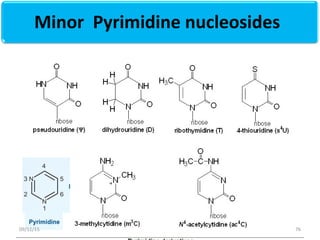
Minor Pyrimidine nucleosides
7609/11/15
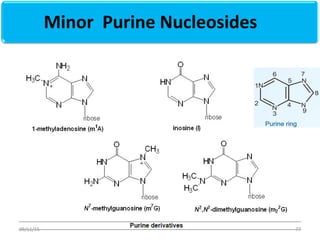
Minor Purine Nucleosides
7709/11/15

Proteins and nucleic acids