HISTORY OF THE
ATOM
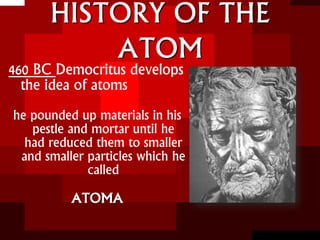
460 BC Democritus develops
the idea of atoms
he pounded up materials in his
pestle and mortar until he
had reduced them to smaller
and smaller particles which he
called
ATOMA
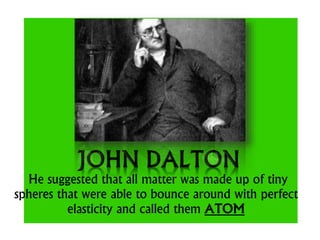
He suggested that all matter was made up of tiny
spheres that were able to bounce around with perfect
elasticity and called them ATOM
Atom, tiny basic building block of matter. All the
material on Earth is composed of various
combinations of atoms. An atom consists of a cloud
of electrons surrounding a small, dense nucleus of
protons and neutrons.
Atoms are the smallest particles of a chemical
element that still exhibit all the chemical properties
unique to that element. A row of 100 million atoms
would be only about a centimetre long.
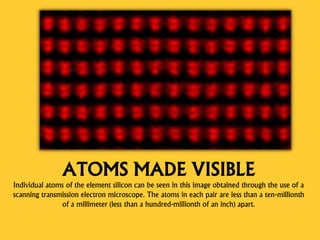
ATOMS MADE VISIBLE
Individual atoms of the element silicon can be seen in this image obtained through the use of a
scanning transmission electron microscope. The atoms in each pair are less than a ten-millionth
of a millimeter (less than a hundred-millionth of an inch) apart.
Atoms are made of smaller particles, called electrons,
protons, and neutrons. An atom consists of a cloud of
electrons surrounding a small, dense nucleus of
protons and neutrons. Electrons and protons have a
property called electric charge, which affects the way
they interact with each other and with other
electrically charged particles
An atom consists of a cloud of electrons
surrounding a small, dense nucleus of protons
and neutrons. The nucleus contains nearly all
of the mass of the atom, but it occupies only
a tiny fraction of the space inside the atom.
The diameter of a typical nucleus is only
about 1 × 10-14 m (4 × 10-13 in), or about
1/100,000 of the diameter of the entire atom.
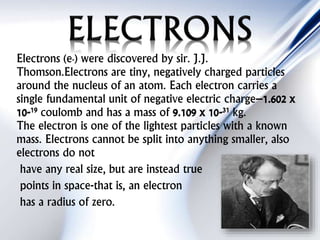
Electrons (e-) were discovered by sir. J.J.
Thomson.Electrons are tiny, negatively charged particles
around the nucleus of an atom. Each electron carries a
single fundamental unit of negative electric charge–1.602 x
10-19 coulomb and has a mass of 9.109 x 10⁻³¹ kg.
The electron is one of the lightest particles with a known
mass. Electrons cannot be split into anything smaller, also
electrons do not
have any real size, but are instead true
points in space-that is, an electron
has a radius of zero.
Proton (p+) was discovered by E.Goldstein. Proton
has 1 unit mass. Proton Protons have a positive
electrical charge of 1.602 x 10⁻¹⁹ coulomb. This
charge is equal but opposite to the negative
charge of the electron. A proton’s mass is about
1,840 times the mass of an electron.
Protons carry a positive charge of +1, exactly the
opposite electric charge as electrons. The number
of protons in the nucleus determines the total
quantity of positive charge in the atom.
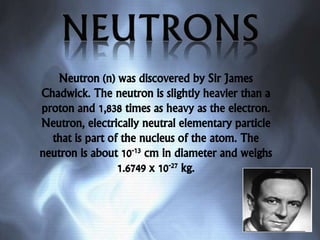
Neutron (n) was discovered by Sir James
Chadwick. The neutron is slightly heavier than a
proton and 1,838 times as heavy as the electron.
Neutron, electrically neutral elementary particle
that is part of the nucleus of the atom. The
neutron is about 10-13 cm in diameter and weighs
1.6749 x 10⁻²⁷ kg.
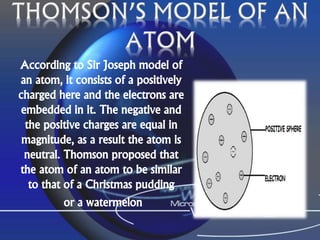
According to Sir Joseph model of
an atom, it consists of a positively
charged here and the electrons are
embedded in it. The negative and
the positive charges are equal in
magnitude, as a result the atom is
neutral. Thomson proposed that
the atom of an atom to be similar
to that of a Christmas pudding
or a watermelon
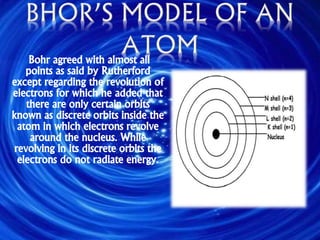
Bohr agreed with almost all
points as said by Rutherford
except regarding the revolution of
electrons for which he added that
there are only certain orbits
known as discrete orbits inside the
atom in which electrons revolve
around the nucleus. While
revolving in its discrete orbits the
electrons do not radiate energy.
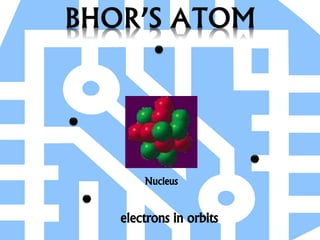
electrons in orbits
Nucleus
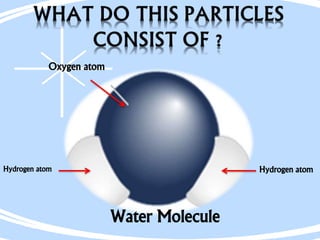
Water Molecule
Hydrogen atom Hydrogen atom
Oxygen atom
Isotope, one of two or more species of atom
having the same atomic number, hence
constituting the same element, but differing in
mass number. The nucleus, and mass number is
the sum total of the protons plus the neutrons
in the nucleus, isotopes of the same element
differ from one another only in the number of
neutrons in their nuclei.
STRUCTURE OF AN ATOM

STRUCTURE OF AN ATOM

  • 2.
    HISTORY OF THE ATOM 460BC Democritus develops the idea of atoms he pounded up materials in his pestle and mortar until he had reduced them to smaller and smaller particles which he called ATOMA
  • 3.
    He suggested thatall matter was made up of tiny spheres that were able to bounce around with perfect elasticity and called them ATOM
  • 4.
    Atom, tiny basicbuilding block of matter. All the material on Earth is composed of various combinations of atoms. An atom consists of a cloud of electrons surrounding a small, dense nucleus of protons and neutrons. Atoms are the smallest particles of a chemical element that still exhibit all the chemical properties unique to that element. A row of 100 million atoms would be only about a centimetre long.
  • 5.
    ATOMS MADE VISIBLE Individualatoms of the element silicon can be seen in this image obtained through the use of a scanning transmission electron microscope. The atoms in each pair are less than a ten-millionth of a millimeter (less than a hundred-millionth of an inch) apart.
  • 6.
    Atoms are madeof smaller particles, called electrons, protons, and neutrons. An atom consists of a cloud of electrons surrounding a small, dense nucleus of protons and neutrons. Electrons and protons have a property called electric charge, which affects the way they interact with each other and with other electrically charged particles
  • 7.
    An atom consistsof a cloud of electrons surrounding a small, dense nucleus of protons and neutrons. The nucleus contains nearly all of the mass of the atom, but it occupies only a tiny fraction of the space inside the atom. The diameter of a typical nucleus is only about 1 × 10-14 m (4 × 10-13 in), or about 1/100,000 of the diameter of the entire atom.
  • 8.
    Electrons (e-) werediscovered by sir. J.J. Thomson.Electrons are tiny, negatively charged particles around the nucleus of an atom. Each electron carries a single fundamental unit of negative electric charge–1.602 x 10⁻¹⁹ coulomb and has a mass of 9.109 x 10⁻³¹ kg. The electron is one of the lightest particles with a known mass. Electrons cannot be split into anything smaller, also electrons do not have any real size, but are instead true points in space-that is, an electron has a radius of zero.
  • 9.
    Proton (p+) wasdiscovered by E.Goldstein. Proton has 1 unit mass. Proton Protons have a positive electrical charge of 1.602 x 10⁻¹⁹ coulomb. This charge is equal but opposite to the negative charge of the electron. A proton’s mass is about 1,840 times the mass of an electron. Protons carry a positive charge of +1, exactly the opposite electric charge as electrons. The number of protons in the nucleus determines the total quantity of positive charge in the atom.
  • 10.
    Neutron (n) wasdiscovered by Sir James Chadwick. The neutron is slightly heavier than a proton and 1,838 times as heavy as the electron. Neutron, electrically neutral elementary particle that is part of the nucleus of the atom. The neutron is about 10-13 cm in diameter and weighs 1.6749 x 10⁻²⁷ kg.
  • 11.
    According to SirJoseph model of an atom, it consists of a positively charged here and the electrons are embedded in it. The negative and the positive charges are equal in magnitude, as a result the atom is neutral. Thomson proposed that the atom of an atom to be similar to that of a Christmas pudding or a watermelon
  • 12.
    Bohr agreed withalmost all points as said by Rutherford except regarding the revolution of electrons for which he added that there are only certain orbits known as discrete orbits inside the atom in which electrons revolve around the nucleus. While revolving in its discrete orbits the electrons do not radiate energy.
  • 13.
  • 14.
    Water Molecule Hydrogen atomHydrogen atom Oxygen atom
  • 15.
    Isotope, one oftwo or more species of atom having the same atomic number, hence constituting the same element, but differing in mass number. The nucleus, and mass number is the sum total of the protons plus the neutrons in the nucleus, isotopes of the same element differ from one another only in the number of neutrons in their nuclei.