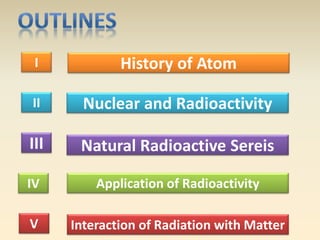
I 
II 
III 
IV 
History of Atom 
Nuclear and Radioactivity 
Natural Radioactive Sereis 
Application of Radioactivity 
V Interaction of Radiation with Matter
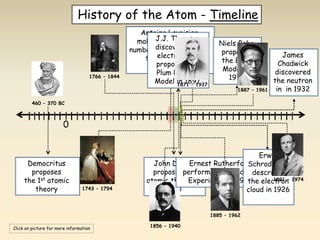
460 – 370 BC 
Democritus 
proposes 
the 1st atomic 
theory 
History of the Atom - Timeline 
Antoine Lavoisier 
makes a substantial 
number of contributions 
J.J. Thomson 
discovers the 
electron and 
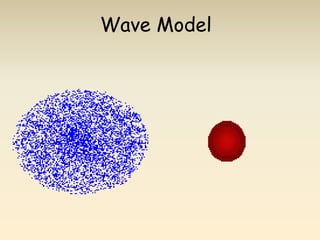
proposes the 
Plum Pudding 
Model in 1897 1871 – 1937 
to the field of 
Chemistry 
1766 – 1844 
John Dalton 
proposes his 
atomic theory in 
1743 – 1794 1803 
0 
1856 – 1940 
Niels Bohr 
proposes 
the Bohr 
Model in 
1913 
1887 – 1961 
Ernest Rutherford 
performs the Gold Foil 
Experiment in 1909 
1885 – 1962 
James 
Chadwick 
discovered 
the neutron 
in in 1932 
Erwin 
Schrodinger 
describes 
the electron 
cloud in 1926 
1891 – 1974 
1700s 
1800s 
1900s 
Click on picture for more information
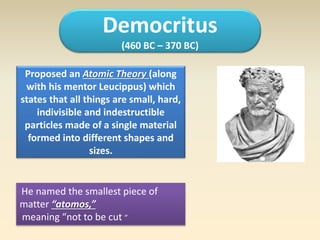
Democritus 
(460 BC – 370 BC) 
Proposed an Atomic Theory (along 
with his mentor Leucippus) which 
states that all things are small, hard, 
indivisible and indestructible 
particles made of a single material 
formed into different shapes and 
sizes. 
He named the smallest piece of 
matter “atomos,” 
meaning “not to be cut ”
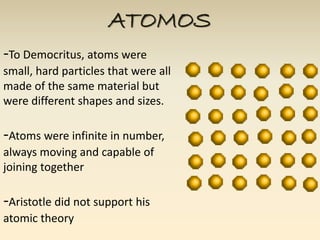
ATOMOS 
-To Democritus, atoms were 
small, hard particles that were all 
made of the same material but 
were different shapes and sizes. 
-Atoms were infinite in number, 
always moving and capable of 
joining together 
-Aristotle did not support his 
atomic theory
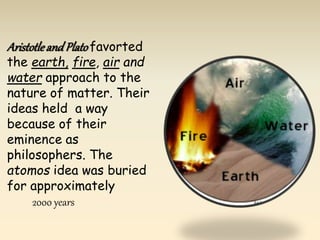
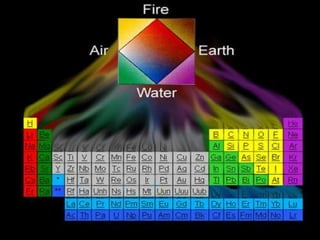
Aristotle and Plato favorted 
the earth, fire, air and 
water approach to the 
nature of matter. Their 
ideas held a way 
because of their 
eminence as 
philosophers. The 
atomos idea was buried 
for approximately 
2000 years
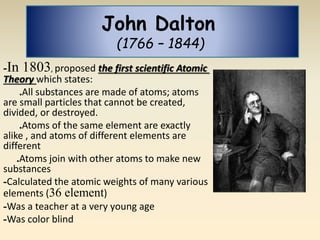
John Dalton 
(1766 – 1844) 
-In 1803, proposed the first scientific Atomic 
Theory which states: 
.All substances are made of atoms; atoms 
are small particles that cannot be created, 
divided, or destroyed. 
.Atoms of the same element are exactly 
alike , and atoms of different elements are 
different 
.Atoms join with other atoms to make new 
substances 
-Calculated the atomic weights of many various 
elements (36 element) 
-Was a teacher at a very young age 
-Was color blind
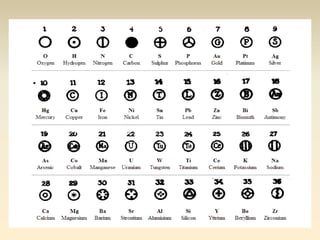
John Dalton’s Periodic Table
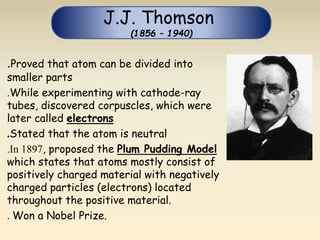
J.J. Thomson 
(1856 – 1940) 
.Proved that atom can be divided into 
smaller parts 
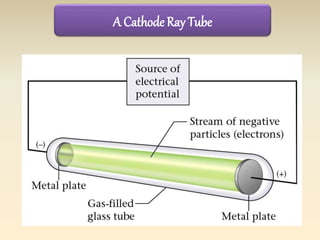
.While experimenting with cathode-ray 
tubes, discovered corpuscles, which were 
later called electrons 
.Stated that the atom is neutral 
.In 1897, proposed the Plum Pudding Model 
which states that atoms mostly consist of 
positively charged material with negatively 
charged particles (electrons) located 
throughout the positive material. 
. Won a Nobel Prize.
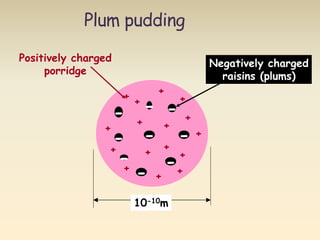
Plum pudding 
+ 
+ 
- 
- - 
+ 
- 
- 
+ 
- 
- 
- 
- 
10-10m 
+ 
+ 
+ 
+ 
+ 
+ 
+ 
+ 
+ 
+ 
+ 
+ 
Positively charged 
porridge 
Negatively charged 
raisins (plums)
A Cathode Ray Tube
Ernest Rutherford 
(1871 – 1937) 
In 1909, performed the Gold Foil Experiment 
and suggested the following characteristics of the 
atom: 
o It consists of a small core, or nucleus, that 
contains most of the mass of the atom 
o This nucleus is made up of particles called 
protons, which have a positive charge 
o The protons are surrounded by negatively 
charged electrons, but most of the atom is 
actually empty space 
 Did extensive work on radioactivity (alpha & beta 
particles, gamma rays/waves) and was referred to 
as the “Father of Nuclear Physics” 
 Won a Nobel Prize 
 Was a student of J.J. Thomson 
 Was on the New Zealand $100 bill
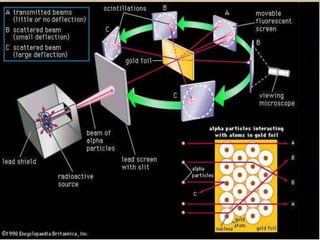
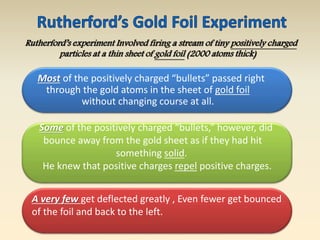
Rutherford’s experiment Involved firing a stream of tiny positively charged 
particles at a thin sheet of gold foil (2000 atoms thick) 
Most of the positively charged “bullets” passed right 
through the gold atoms in the sheet of gold foil 
without changing course at all. 
Some of the positively charged “bullets,” however, did 
bounce away from the gold sheet as if they had hit 
something solid. 
He knew that positive charges repel positive charges. 
A very few get deflected greatly , Even fewer get bounced 
of the foil and back to the left.
-The atom similar to the solar system (the central 
core around which the great distances negatively 
charged electrons) 
-The atom mostly vacuum (because The atom is 
not solid and the size is too small for the size of the 
nucleus The atom) 
-The mass of the atom is concentrated in the 
nucleus (because the mass of the electrons is very 
small compared to the mass of the nucleus of 
protons and neutrons components)
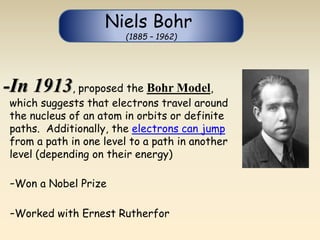
Niels Bohr 
(1885 – 1962) 
-In 1913, proposed the Bohr Model, 
which suggests that electrons travel around 
the nucleus of an atom in orbits or definite 
paths. Additionally, the electrons can jump 
from a path in one level to a path in another 
level (depending on their energy) 
-Won a Nobel Prize 
-Worked with Ernest Rutherfor
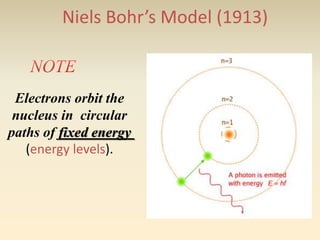
Niels Bohr’s Model (1913) 
Electrons orbit the 
nucleus in circular 
paths of fixed energy 
(energy levels).
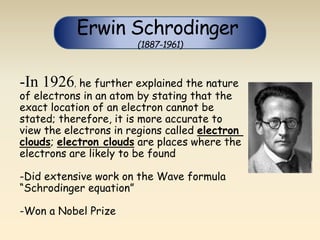
Erwin Schrodinger 
(1887-1961) 
-In 1926, he further explained the nature 
of electrons in an atom by stating that the 
exact location of an electron cannot be 
stated; therefore, it is more accurate to 
view the electrons in regions called electron 
clouds; electron clouds are places where the 
electrons are likely to be found 
-Did extensive work on the Wave formula 
“Schrodinger equation” 
-Won a Nobel Prize
Wave Model
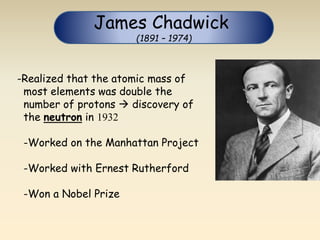
James Chadwick 
-Realized that the atomic mass of 
most elements was double the 
number of protons  discovery of 
the neutron in 1932 
-Worked on the Manhattan Project 
-Worked with Ernest Rutherford 
-Won a Nobel Prize 
(1891 – 1974)
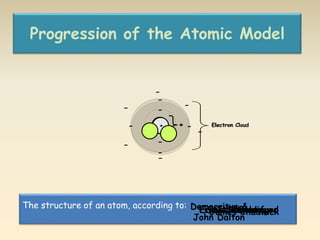
Progression of the Atomic Model 
- 
- 
- 
- + 
- 
++ EElleeccttrroonn CClloouudd 
- 
- 
The structure of an atom, according to: Democritus & 
ErrJnJw.eNaiJnsme. t iS elTsRsc h uhBCotromhhoheadsrrdoinfwngoiercdrk 
John Dalton 
+ 
- 
- - 
- 
- 
- 
- 
- 
- 
- 
-
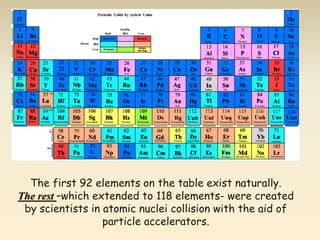
The first 92 elements on the table exist naturally. 
The rest –which extended to 118 elements- were created 
by scientists in atomic nuclei collision with the aid of 
particle accelerators.
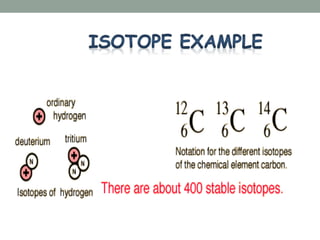
Isotopes 
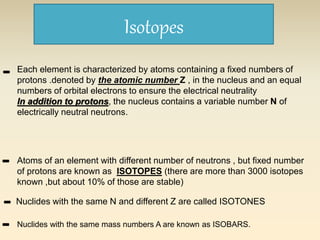
- Each element is characterized by atoms containing a fixed numbers of 
protons .denoted by the atomic number Z , in the nucleus and an equal 
numbers of orbital electrons to ensure the electrical neutrality 
In addition to protons, the nucleus contains a variable number N of 
electrically neutral neutrons. 
Atoms of an element with different number of neutrons , but fixed number 
of protons are known as ISOTOPES (there are more than 3000 isotopes 
known ,but about 10% of those are stable) 
- 
- 
- 
Nuclides with the same N and different Z are called ISOTONES 
Nuclides with the same mass numbers A are known as ISOBARS.
Isotopes 
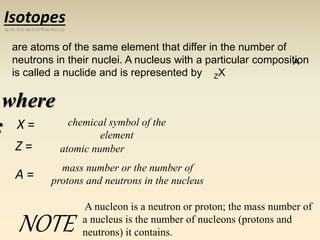
are atoms of the same element that differ in the number of 
neutrons in their nuclei. A nucleus with a particular composition 
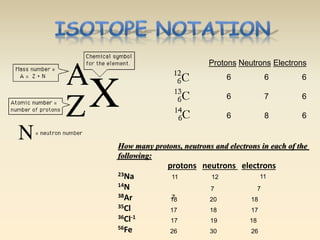
A 
is called a nuclide and is represented by X 
Zwhere 
: X = 
Z = 
A = 
chemical symbol of the 
element 
atomic number 
mass number or the number of 
protons and neutrons in the nucleus 
A nucleon is a neutron or proton; the mass number of 
a nucleus is the number of nucleons (protons and 
neutrons) it contains. 
NOTE
How many protons, neutrons and electrons in each of the 
following: 
protons neutrons electrons 
23Na 
14N 
38Ar 
35Cl 
36Cl-1 
56Fe 
Protons Neutrons Electrons 
6 6 6 
6 7 6 
6 8 6 
11 12 
7 
11 
7 7 
18 20 18 
17 18 17 
17 19 18 
26 30 26
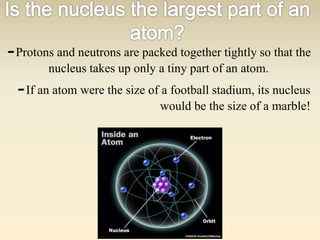
-Protons and neutrons are packed together tightly so that the 
nucleus takes up only a tiny part of an atom. 
-If an atom were the size of a football stadium, its nucleus 
would be the size of a marble!
Despite taking little space, the nucleus contains 
almost all the mass of the atom.
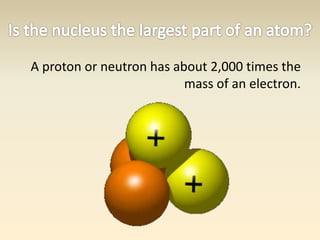
A proton or neutron has about 2,000 times the 
mass of an electron.
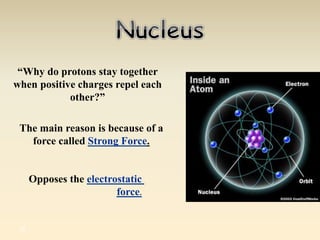
“Why do protons stay together 
when positive charges repel each 
35 
other?” 
The main reason is because of a 
force called Strong Force. 
Opposes the electrostatic 
force.
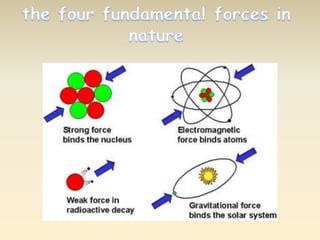
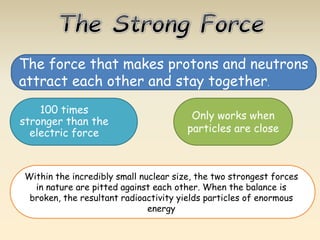
The force that makes protons and neutrons 
attract each other and stay together. 
100 times 
stronger than the 
electric force 
Only works when 
particles are close 
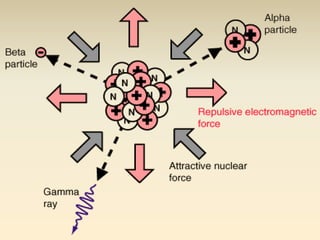
Within the incredibly small nuclear size, the two strongest forces 
in nature are pitted against each other. When the balance is 
broken, the resultant radioactivity yields particles of enormous 
energy
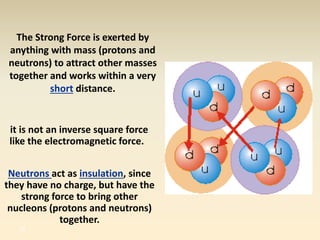
The Strong Force is exerted by 
anything with mass (protons and 
neutrons) to attract other masses 
together and works within a very 
short distance. 
it is not an inverse square force 
like the electromagnetic force. 
Neutrons act as insulation, since 
they have no charge, but have the 
strong force to bring other 
nucleons (protons and neutrons) 
39 
together.
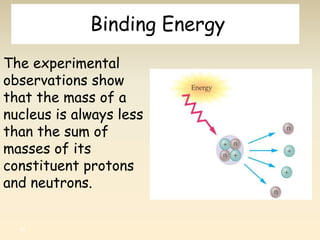
Binding Energy 
The experimental 
observations show 
that the mass of a 
nucleus is always less 
than the sum of 
masses of its 
constituent protons 
and neutrons. 
40
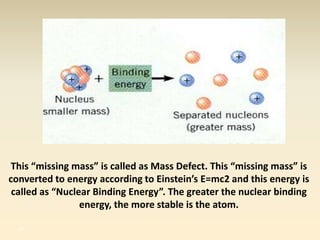
This “missing mass” is called as Mass Defect. This “missing mass” is 
converted to energy according to Einstein’s E=mc2 and this energy is 
called as “Nuclear Binding Energy”. The greater the nuclear binding 
41 
energy, the more stable is the atom.
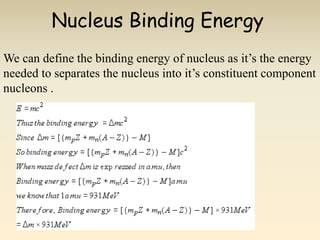
Nucleus Binding Energy 
We can define the binding energy of nucleus as it’s the energy 
needed to separates the nucleus into it’s constituent component 
nucleons .
43
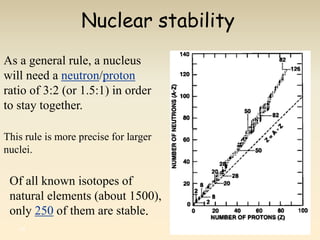
Nuclear stability 
As a general rule, a nucleus 
will need a neutron/proton 
ratio of 3:2 (or 1.5:1) in order 
to stay together. 
This rule is more precise for larger 
nuclei. 
Of all known isotopes of 
natural elements (about 1500), 
only 250 of them are stable. 
44
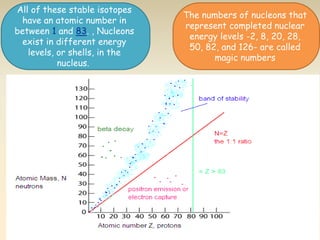
All of these stable isotopes 
have an atomic number in 
between 1 and 83. , Nucleons 
exist in different energy 
45 
levels, or shells, in the 
nucleus. 
The numbers of nucleons that 
represent completed nuclear 
energy levels -2, 8, 20, 28, 
50, 82, and 126- are called 
magic numbers
46 
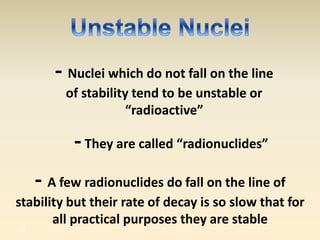
- Nuclei which do not fall on the line 
of stability tend to be unstable or 
“radioactive” 
- They are called “radionuclides” 
- A few radionuclides do fall on the line of 
stability but their rate of decay is so slow that for 
all practical purposes they are stable
Unstable Nuclei 
 Radionuclides undergo a process called radioactive 
transformation 
 In this process, the nucleus emits particles to adjust 
its neutron (N) to proton (Z) ratio 
 This change in the N to Z ratio tends to move the 
radionuclide toward the line of stability
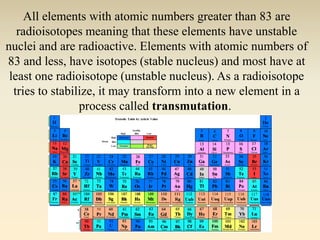
All elements with atomic numbers greater than 83 are 
radioisotopes meaning that these elements have unstable 
nuclei and are radioactive. Elements with atomic numbers of 
83 and less, have isotopes (stable nucleus) and most have at 
least one radioisotope (unstable nucleus). As a radioisotope 
tries to stabilize, it may transform into a new element in a 
process called transmutation.
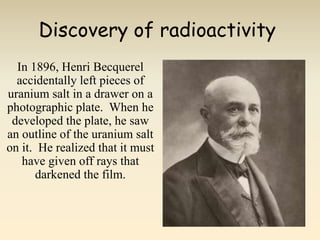
Discovery of radioactivity 
In 1896, Henri Becquerel 
accidentally left pieces of 
uranium salt in a drawer on a 
photographic plate. When he 
developed the plate, he saw 
an outline of the uranium salt 
on it. He realized that it must 
have given off rays that 
darkened the film.
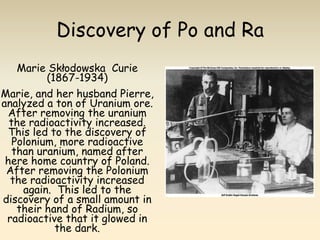
Discovery of Po and Ra 
Marie Skłodowska Curie 
(1867-1934) 
Marie, and her husband Pierre, 
analyzed a ton of Uranium ore. 
After removing the uranium 
the radioactivity increased. 
This led to the discovery of 
Polonium, more radioactive 
than uranium, named after 
here home country of Poland. 
After removing the Polonium 
the radioactivity increased 
again. This led to the 
discovery of a small amount in 
their hand of Radium, so 
radioactive that it glowed in 
the dark.
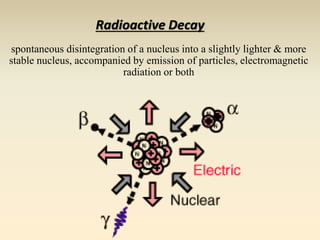
Radioactive Decay 
spontaneous disintegration of a nucleus into a slightly lighter & more 
stable nucleus, accompanied by emission of particles, electromagnetic 
radiation or both
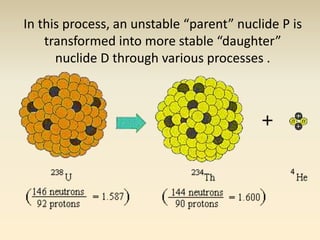
In this process, an unstable “parent” nuclide P is 
transformed into more stable “daughter” 
nuclide D through various processes .
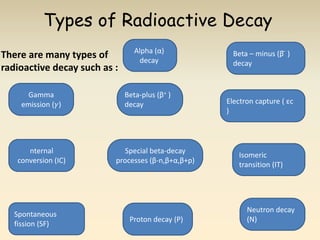
Types of Radioactive Decay 
There are many types of 
radioactive decay such as : 
Alpha (α) 
decay 
Beta – minus (β̄ ) 
decay 
Gamma 
emission (훾) 
Beta-plus (β+ ) 
decay Electron capture ( εc 
) 
nternal 
conversion (IC) 
Isomeric 
transition (IT) 
Special beta-decay 
processes (β-n,β+α,β+p) 
Neutron decay 
Proton decay (P) (N) 
Spontaneous 
fission (SF)
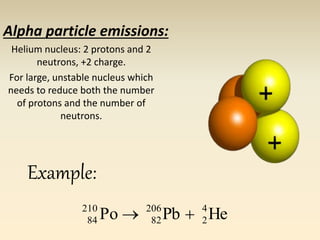
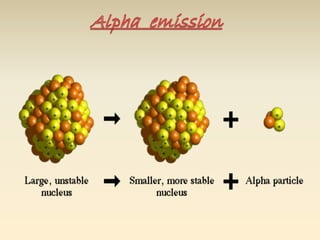
Alpha particle emissions: 
Helium nucleus: 2 protons and 2 
neutrons, +2 charge. 
For large, unstable nucleus which 
needs to reduce both the number 
of protons and the number of 
neutrons. 
210 
84   
Pο Pb He 4 
2 
206 
82 
Example:
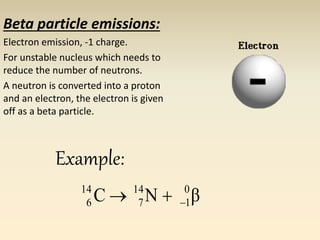
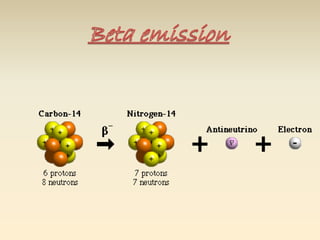
Beta particle emissions: 
Electron emission, -1 charge. 
For unstable nucleus which needs to 
reduce the number of neutrons. 
A neutron is converted into a proton 
and an electron, the electron is given 
off as a beta particle. 
14 
6    
C N β 0 
1 
14 
7 
Example:
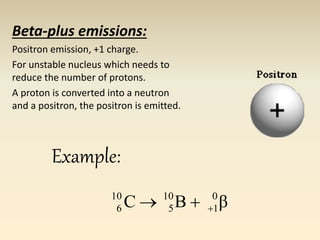
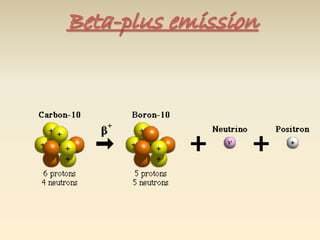
Beta-plus emissions: 
Positron emission, +1 charge. 
For unstable nucleus which needs to 
reduce the number of protons. 
A proton is converted into a neutron 
and a positron, the positron is emitted. 
10 
6    
C B β 0 
1 
10 
5 
Example:
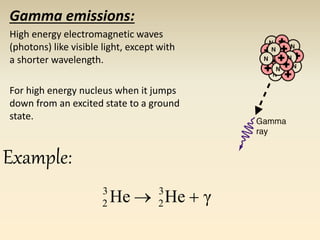
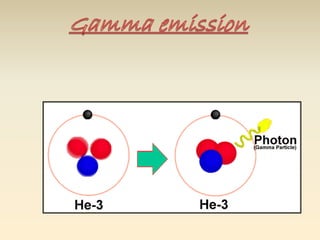
Gamma emissions: 
High energy electromagnetic waves 
(photons) like visible light, except with 
a shorter wavelength. 
For high energy nucleus when it jumps 
down from an excited state to a ground 
state. 
3 
2   
He He γ 3 
2 
Example:
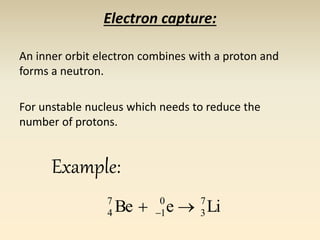
Electron capture: 
An inner orbit electron combines with a proton and 
forms a neutron. 
For unstable nucleus which needs to reduce the 
number of protons. 
7 
4    
Be e Li 7 
3 
0 
1 
Example:
Electron capture •
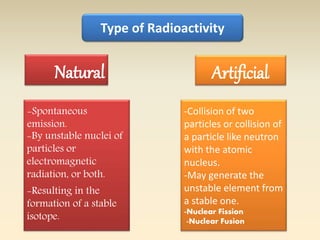
Type of Radioactivity 
Natural Artificiall 
-Collision of two 
particles or collision of 
a particle like neutron 
with the atomic 
nucleus. 
-May generate the 
unstable element from 
a stable one. 
-Nuclear Fission 
-Nuclear Fusion 
-Spontaneous 
emission. 
-By unstable nuclei of 
particles or 
electromagnetic 
radiation, or both. 
-Resulting in the 
formation of a stable 
isotope.
What is a 
radioactive 
series ? 
And How many 
series?
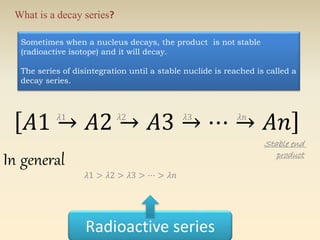
What is a decay series? 
Sometimes when a nucleus decays, the product is not stable 
(radioactive isotope) and it will decay. 
The series of disintegration until a stable nuclide is reached is called a 
decay series. 
퐴1 → 퐴2 → 퐴3 → ⋯ → 퐴푛 휆1 휆2 휆3 휆푛 
Radioactive series 
Stable end 
product In general 
휆1 > 휆2 > 휆3 > ⋯ > 휆푛
How many series? 
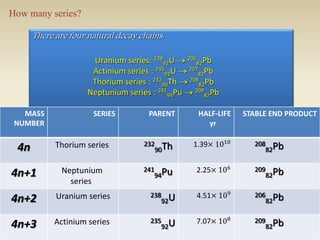
There are four natural decay chains: 
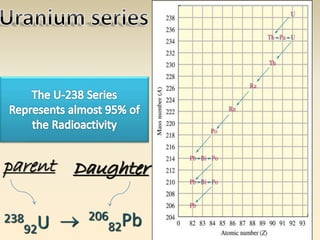
Uranium series: 238 
92U  206 
82Pb 
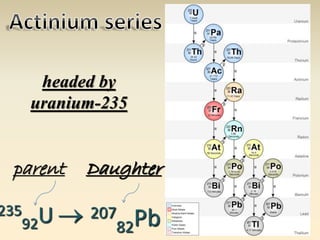
Actinium series : 235 
92U  207 
82Pb 
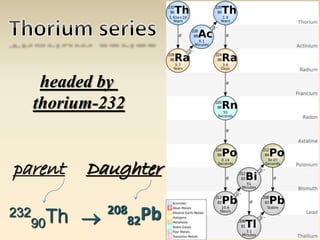
Thorium series : 232 
90Th  208 
82Pb 
Neptunium series : 241 
94Pu  209 
82Pb 
HALF-LIFE STABLE END PRODUCT 
yr 
MASS SERIES PARENT 
NUMBER 
208 
82Pb 232 1.39× 10¹⁰ 
90Th 4n Thorium series 
209 
82Pb 241 2.25× 10⁶ 
94Pu Neptunium 
series 
4n+1 
206 
82Pb 238 4.51× 10⁹ 
92U 4n+2 Uranium series 
209 
82Pb 235 7.07× 10⁸ 
92U 4n+3 Actinium series
70 annexeh@yahoo.co.in
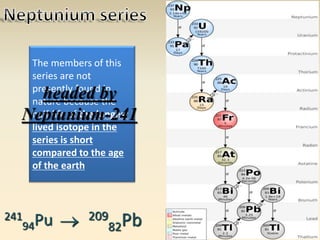
The members of this 
series are not 
presently headed found by 
in 
nature because the 
half-life of the longest 
lived isotope in the 
series is short 
compared to the age 
of the earth 
Neptunium-241 
241 
94Pu  209 
82Pb
In fact 
Three radioactive series were recognized (Uranium , Actinium and 
Thorium) 
In which 
heavy elements loss mass and changed their 
atomic number in successive steps. 
The changes ending only when the element 
became a stable isotope of lead
Radioactivity 
series 
Uranium, Actinium , and Thorium occur in three natural decay 
series, headed by uranium-238, uranium-235, 
Importance 
and thorium-232, respectively 
The Radionuclides in these three series are 
approximately in a state of equilibrium, in which 
the activities of all radionuclides within each 
series are nearly equal. 
In Nature
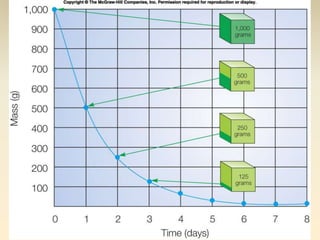
• If the half life of the parent is longer than that of the 
daughter , then after a certain time a condition of 
equilibrium will be achieved . 
• that is the ratio of the daughter activity to the parent 
activity will become constant . 
• In addition the decay rate of the nuclide is then 
governed by the half life or disintegration rate of the 
parent
headed by 
uranium-238 
parent Daughter 
238 
92U  206 
82Pb
headed by 
uranium-235 
parent Daughter 
235 
92U  207 
82Pb
headed by 
thorium-232 
parent 
232 
90Th 
Daughter 
 208 
82Pb
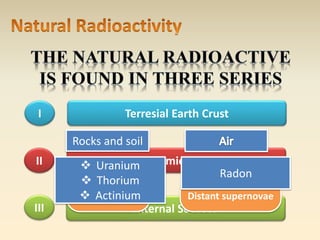
I Terresial Earth Crust 
Rocks and soil 
II Cosmic Ray 
Distant supernovae 
 Uranium 
 Thorium 
 Actinium 
III Internal Sources 
Radon
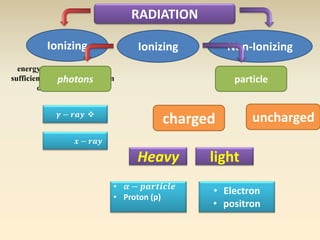
RADIATION 
Ionizing Non-Ionizing 
Heavy 
• Electron 
• positron 
• 휶 − 풑풂풓풕풊풄풍풆 
• Proton (p) 
light 
energy transferred may be 
sufficient to knock an electron 
out of an atom. 
Ionizing 
photons particle 
휸 − 풓풂풚  
풙 − 풓풂풚 
charged uncharged
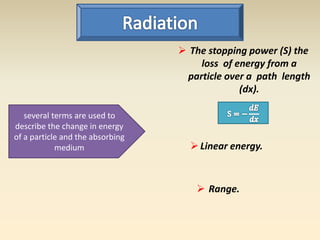
several terms are used to 
describe the change in energy 
of a particle and the absorbing 
medium 
 The stopping power (S) the 
loss of energy from a 
particle over a path length 
(dx). 
 Linear energy. 
 Range.
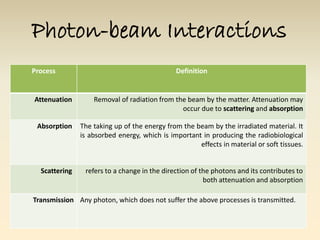
Photon-beam Interactions 
Process Definition 
Attenuation Removal of radiation from the beam by the matter. Attenuation may 
occur due to scattering and absorption 
Absorption The taking up of the energy from the beam by the irradiated material. It 
is absorbed energy, which is important in producing the radiobiological 
effects in material or soft tissues. 
Scattering refers to a change in the direction of the photons and its contributes to 
both attenuation and absorption 
Transmission Any photon, which does not suffer the above processes is transmitted.
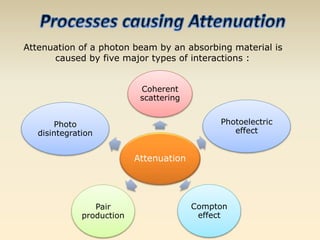
Attenuation of a photon beam by an absorbing material is 
caused by five major types of interactions : 
Coherent 
scattering 
Attenuation 
Photoelectric 
effect 
Compton 
effect 
Pair 
production 
Photo 
disintegration
Interaction of light charged 
with matter particles 
 Interaction of electron with matter 
When the energetic electrons penetrate the target material 
The electron lose their kinetic energy by to mechanisms 
Collision loss Radiative loss 
 Inelastic collisions 
 Elastic collisions
 Inelastic collisions Of electrons 
• when the incident electron penetrate the 
target atom , the electron lose their energy . 
• The interaction with bound atomic electron 
 elastic collisions Of electrons 
In this collision , the electron collides with a particle of 
identical mass (atomic number) but in this case there is no 
lose in the energy.
 Radiative collisions of electron 
When an energetic electron penetrates the 
target material (atom) and losses very lose to 
the nucleus in the target material . 
It is deviated by the electromagnetic 
interaction so the incident electron losses 
much kinatic energy and the proton will be 
emitted .
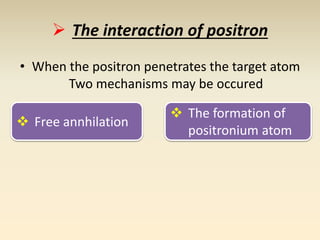
 The interaction of positron 
• When the positron penetrates the target atom 
Two mechanisms may be occured 
 Free annhilation 
 The formation of 
positronium atom
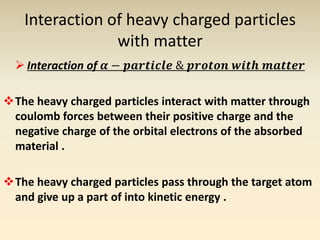
Interaction of heavy charged particles 
with matter 
 Interaction of 휶 − 풑풂풓풕풊풄풍풆 & 풑풓풐풕풐풏 풘풊풕풉 풎풂풕풕풆풓 
The heavy charged particles interact with matter through 
coulomb forces between their positive charge and the 
negative charge of the orbital electrons of the absorbed 
material . 
The heavy charged particles pass through the target atom 
and give up a part of into kinetic energy .
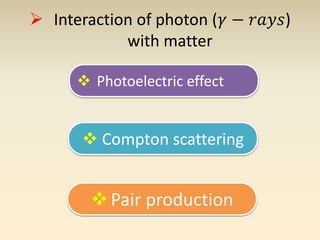
 Interaction of photon (훾 − 푟푎푦푠) 
with matter 
 Photoelectric effect 
 Compton scattering 
 Pair production
Photoelectric 
effect 
When the 훾 − 푟푎푦 푠 푠푡푟푖푐푘푒푠 abound 
electron of the target material , so the 
electron absorbs all the energy of the 
incident 훾 − 푟푎푦푠 푤ℎ푖푐ℎ it is enough 
to eject the electron from into orbit and 
completely leave the atom 
 the kinetic energy to the photo-electron. 
. = w 
K E h흊 _ 
W = The binding energy of the electron 
and ½ mν2 is the kinetic energy of the 
photo electron. Fig. : The photo electric effect 
훾 − 푟푎푦 푎푟푒 푐표푚푝푙푒푡푒푙푦 푑푖푠푎푝푝푒푎푟푒
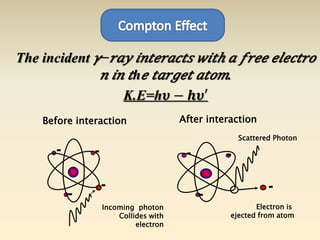
The incident 훾−푟푎푦 푖푛푡푒푟푎푐푡푠 푤푖푡ℎ 푎 푓푟푒푒 푒푙푒푐푡푟표 
푛 푖푛 푡h푒 푡푎푟푔푒푡 푎푡표푚. 
K.E=h흊 − 풉흊′ 
Before interaction After interaction 
- - 
- 
Incoming photon 
Collides with 
electron 
- 
- - 
- 
Scattered Photon 
- 
Electron is 
ejected from atom
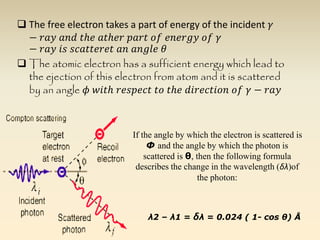
 The free electron takes a part of energy of the incident 훾 
− 푟푎푦 푎푛푑 푡ℎ푒 푎푡ℎ푒푟 푝푎푟푡 표푓 푒푛푒푟푔푦 표푓 훾 
− 푟푎푦 푖푠 푠푐푎푡푡푒푟푒푡 푎푛 푎푛푔푙푒 휃 
 The atomic electron has a sufficient energy which lead to 
the ejection of this electron from atom and it is scattered 
by an angle 휙 푤푖푡ℎ 푟푒푠푝푒푐푡 푡표 푡ℎ푒 푑푖푟푒푐푡푖표푛 표푓 훾 − 푟푎푦 
If the angle by which the electron is scattered is 
Φ and the angle by which the photon is 
scattered is θ, then the following formula 
describes the change in the wavelength (δλ)of 
the photon: 
λ2 – λ1 = δλ = 0.024 ( 1- cos θ) Å
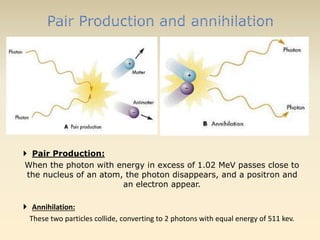
 Pair Production: 
When the photon with energy in excess of 1.02 MeV passes close to 
the nucleus of an atom, the photon disappears, and a positron and 
an electron appear. 
 Annihilation: 
These two particles collide, converting to 2 photons with equal energy of 511 kev.
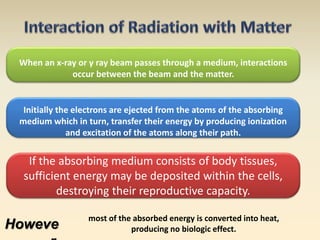
When an x-ray or γ ray beam passes through a medium, interactions 
occur between the beam and the matter. 
Initially the electrons are ejected from the atoms of the absorbing 
medium which in turn, transfer their energy by producing ionization 
and excitation of the atoms along their path. 
If the absorbing medium consists of body tissues, 
sufficient energy may be deposited within the cells, 
destroying their reproductive capacity. 
Howeve 
r, 
most of the absorbed energy is converted into heat, 
producing no biologic effect.
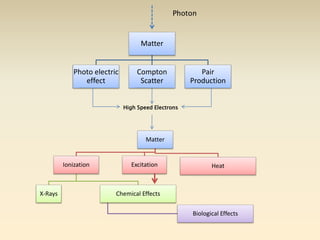
Matter 
Photo electric 
effect 
Compton 
Scatter 
Pair 
Photon 
Production 
Matter 
Ionization 
Excitation Heat 
X-Rays Chemical Effects 
Biological Effects 
High Speed Electrons
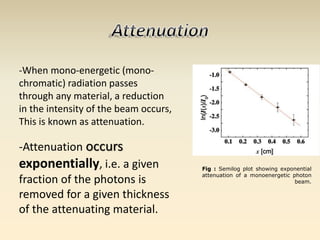
Fig : Semilog plot showing exponential 
attenuation of a monoenergetic photon 
beam. 
-When mono-energetic (mono-chromatic) 
radiation passes 
through any material, a reduction 
in the intensity of the beam occurs, 
This is known as attenuation. 
-Attenuation occurs 
exponentially, i.e. a given 
fraction of the photons is 
removed for a given thickness 
of the attenuating material.
Any 
Questions?
Nuclear physics

Nuclear physics

  • 3.
    I II III IV History of Atom Nuclear and Radioactivity Natural Radioactive Sereis Application of Radioactivity V Interaction of Radiation with Matter
  • 6.
    460 – 370BC Democritus proposes the 1st atomic theory History of the Atom - Timeline Antoine Lavoisier makes a substantial number of contributions J.J. Thomson discovers the electron and proposes the Plum Pudding Model in 1897 1871 – 1937 to the field of Chemistry 1766 – 1844 John Dalton proposes his atomic theory in 1743 – 1794 1803 0 1856 – 1940 Niels Bohr proposes the Bohr Model in 1913 1887 – 1961 Ernest Rutherford performs the Gold Foil Experiment in 1909 1885 – 1962 James Chadwick discovered the neutron in in 1932 Erwin Schrodinger describes the electron cloud in 1926 1891 – 1974 1700s 1800s 1900s Click on picture for more information
  • 7.
    Democritus (460 BC– 370 BC) Proposed an Atomic Theory (along with his mentor Leucippus) which states that all things are small, hard, indivisible and indestructible particles made of a single material formed into different shapes and sizes. He named the smallest piece of matter “atomos,” meaning “not to be cut ”
  • 8.
    ATOMOS -To Democritus,atoms were small, hard particles that were all made of the same material but were different shapes and sizes. -Atoms were infinite in number, always moving and capable of joining together -Aristotle did not support his atomic theory
  • 9.
    Aristotle and Platofavorted the earth, fire, air and water approach to the nature of matter. Their ideas held a way because of their eminence as philosophers. The atomos idea was buried for approximately 2000 years
  • 10.
    John Dalton (1766– 1844) -In 1803, proposed the first scientific Atomic Theory which states: .All substances are made of atoms; atoms are small particles that cannot be created, divided, or destroyed. .Atoms of the same element are exactly alike , and atoms of different elements are different .Atoms join with other atoms to make new substances -Calculated the atomic weights of many various elements (36 element) -Was a teacher at a very young age -Was color blind
  • 11.
  • 12.
    J.J. Thomson (1856– 1940) .Proved that atom can be divided into smaller parts .While experimenting with cathode-ray tubes, discovered corpuscles, which were later called electrons .Stated that the atom is neutral .In 1897, proposed the Plum Pudding Model which states that atoms mostly consist of positively charged material with negatively charged particles (electrons) located throughout the positive material. . Won a Nobel Prize.
  • 13.
    Plum pudding + + - - - + - - + - - - - 10-10m + + + + + + + + + + + + Positively charged porridge Negatively charged raisins (plums)
  • 14.
  • 15.
    Ernest Rutherford (1871– 1937) In 1909, performed the Gold Foil Experiment and suggested the following characteristics of the atom: o It consists of a small core, or nucleus, that contains most of the mass of the atom o This nucleus is made up of particles called protons, which have a positive charge o The protons are surrounded by negatively charged electrons, but most of the atom is actually empty space  Did extensive work on radioactivity (alpha & beta particles, gamma rays/waves) and was referred to as the “Father of Nuclear Physics”  Won a Nobel Prize  Was a student of J.J. Thomson  Was on the New Zealand $100 bill
  • 17.
    Rutherford’s experiment Involvedfiring a stream of tiny positively charged particles at a thin sheet of gold foil (2000 atoms thick) Most of the positively charged “bullets” passed right through the gold atoms in the sheet of gold foil without changing course at all. Some of the positively charged “bullets,” however, did bounce away from the gold sheet as if they had hit something solid. He knew that positive charges repel positive charges. A very few get deflected greatly , Even fewer get bounced of the foil and back to the left.
  • 18.
    -The atom similarto the solar system (the central core around which the great distances negatively charged electrons) -The atom mostly vacuum (because The atom is not solid and the size is too small for the size of the nucleus The atom) -The mass of the atom is concentrated in the nucleus (because the mass of the electrons is very small compared to the mass of the nucleus of protons and neutrons components)
  • 19.
    Niels Bohr (1885– 1962) -In 1913, proposed the Bohr Model, which suggests that electrons travel around the nucleus of an atom in orbits or definite paths. Additionally, the electrons can jump from a path in one level to a path in another level (depending on their energy) -Won a Nobel Prize -Worked with Ernest Rutherfor
  • 20.
    Niels Bohr’s Model(1913) Electrons orbit the nucleus in circular paths of fixed energy (energy levels).
  • 21.
    Erwin Schrodinger (1887-1961) -In 1926, he further explained the nature of electrons in an atom by stating that the exact location of an electron cannot be stated; therefore, it is more accurate to view the electrons in regions called electron clouds; electron clouds are places where the electrons are likely to be found -Did extensive work on the Wave formula “Schrodinger equation” -Won a Nobel Prize
  • 22.
  • 23.
    James Chadwick -Realizedthat the atomic mass of most elements was double the number of protons  discovery of the neutron in 1932 -Worked on the Manhattan Project -Worked with Ernest Rutherford -Won a Nobel Prize (1891 – 1974)
  • 24.
    Progression of theAtomic Model - - - - + - ++ EElleeccttrroonn CClloouudd - - The structure of an atom, according to: Democritus & ErrJnJw.eNaiJnsme. t iS elTsRsc h uhBCotromhhoheadsrrdoinfwngoiercdrk John Dalton + - - - - - - - - - - -
  • 27.
    The first 92elements on the table exist naturally. The rest –which extended to 118 elements- were created by scientists in atomic nuclei collision with the aid of particle accelerators.
  • 28.
    Isotopes - Eachelement is characterized by atoms containing a fixed numbers of protons .denoted by the atomic number Z , in the nucleus and an equal numbers of orbital electrons to ensure the electrical neutrality In addition to protons, the nucleus contains a variable number N of electrically neutral neutrons. Atoms of an element with different number of neutrons , but fixed number of protons are known as ISOTOPES (there are more than 3000 isotopes known ,but about 10% of those are stable) - - - Nuclides with the same N and different Z are called ISOTONES Nuclides with the same mass numbers A are known as ISOBARS.
  • 29.
    Isotopes are atomsof the same element that differ in the number of neutrons in their nuclei. A nucleus with a particular composition A is called a nuclide and is represented by X Zwhere : X = Z = A = chemical symbol of the element atomic number mass number or the number of protons and neutrons in the nucleus A nucleon is a neutron or proton; the mass number of a nucleus is the number of nucleons (protons and neutrons) it contains. NOTE
  • 30.
    How many protons,neutrons and electrons in each of the following: protons neutrons electrons 23Na 14N 38Ar 35Cl 36Cl-1 56Fe Protons Neutrons Electrons 6 6 6 6 7 6 6 8 6 11 12 7 11 7 7 18 20 18 17 18 17 17 19 18 26 30 26
  • 32.
    -Protons and neutronsare packed together tightly so that the nucleus takes up only a tiny part of an atom. -If an atom were the size of a football stadium, its nucleus would be the size of a marble!
  • 33.
    Despite taking littlespace, the nucleus contains almost all the mass of the atom.
  • 34.
    A proton orneutron has about 2,000 times the mass of an electron.
  • 35.
    “Why do protonsstay together when positive charges repel each 35 other?” The main reason is because of a force called Strong Force. Opposes the electrostatic force.
  • 37.
    The force thatmakes protons and neutrons attract each other and stay together. 100 times stronger than the electric force Only works when particles are close Within the incredibly small nuclear size, the two strongest forces in nature are pitted against each other. When the balance is broken, the resultant radioactivity yields particles of enormous energy
  • 39.
    The Strong Forceis exerted by anything with mass (protons and neutrons) to attract other masses together and works within a very short distance. it is not an inverse square force like the electromagnetic force. Neutrons act as insulation, since they have no charge, but have the strong force to bring other nucleons (protons and neutrons) 39 together.
  • 40.
    Binding Energy Theexperimental observations show that the mass of a nucleus is always less than the sum of masses of its constituent protons and neutrons. 40
  • 41.
    This “missing mass”is called as Mass Defect. This “missing mass” is converted to energy according to Einstein’s E=mc2 and this energy is called as “Nuclear Binding Energy”. The greater the nuclear binding 41 energy, the more stable is the atom.
  • 42.
    Nucleus Binding Energy We can define the binding energy of nucleus as it’s the energy needed to separates the nucleus into it’s constituent component nucleons .
  • 43.
  • 44.
    Nuclear stability Asa general rule, a nucleus will need a neutron/proton ratio of 3:2 (or 1.5:1) in order to stay together. This rule is more precise for larger nuclei. Of all known isotopes of natural elements (about 1500), only 250 of them are stable. 44
  • 45.
    All of thesestable isotopes have an atomic number in between 1 and 83. , Nucleons exist in different energy 45 levels, or shells, in the nucleus. The numbers of nucleons that represent completed nuclear energy levels -2, 8, 20, 28, 50, 82, and 126- are called magic numbers
  • 46.
    46 - Nucleiwhich do not fall on the line of stability tend to be unstable or “radioactive” - They are called “radionuclides” - A few radionuclides do fall on the line of stability but their rate of decay is so slow that for all practical purposes they are stable
  • 47.
    Unstable Nuclei Radionuclides undergo a process called radioactive transformation  In this process, the nucleus emits particles to adjust its neutron (N) to proton (Z) ratio  This change in the N to Z ratio tends to move the radionuclide toward the line of stability
  • 48.
    All elements withatomic numbers greater than 83 are radioisotopes meaning that these elements have unstable nuclei and are radioactive. Elements with atomic numbers of 83 and less, have isotopes (stable nucleus) and most have at least one radioisotope (unstable nucleus). As a radioisotope tries to stabilize, it may transform into a new element in a process called transmutation.
  • 50.
    Discovery of radioactivity In 1896, Henri Becquerel accidentally left pieces of uranium salt in a drawer on a photographic plate. When he developed the plate, he saw an outline of the uranium salt on it. He realized that it must have given off rays that darkened the film.
  • 51.
    Discovery of Poand Ra Marie Skłodowska Curie (1867-1934) Marie, and her husband Pierre, analyzed a ton of Uranium ore. After removing the uranium the radioactivity increased. This led to the discovery of Polonium, more radioactive than uranium, named after here home country of Poland. After removing the Polonium the radioactivity increased again. This led to the discovery of a small amount in their hand of Radium, so radioactive that it glowed in the dark.
  • 52.
    Radioactive Decay spontaneousdisintegration of a nucleus into a slightly lighter & more stable nucleus, accompanied by emission of particles, electromagnetic radiation or both
  • 53.
    In this process,an unstable “parent” nuclide P is transformed into more stable “daughter” nuclide D through various processes .
  • 54.
    Types of RadioactiveDecay There are many types of radioactive decay such as : Alpha (α) decay Beta – minus (β̄ ) decay Gamma emission (훾) Beta-plus (β+ ) decay Electron capture ( εc ) nternal conversion (IC) Isomeric transition (IT) Special beta-decay processes (β-n,β+α,β+p) Neutron decay Proton decay (P) (N) Spontaneous fission (SF)
  • 55.
    Alpha particle emissions: Helium nucleus: 2 protons and 2 neutrons, +2 charge. For large, unstable nucleus which needs to reduce both the number of protons and the number of neutrons. 210 84   Pο Pb He 4 2 206 82 Example:
  • 57.
    Beta particle emissions: Electron emission, -1 charge. For unstable nucleus which needs to reduce the number of neutrons. A neutron is converted into a proton and an electron, the electron is given off as a beta particle. 14 6    C N β 0 1 14 7 Example:
  • 59.
    Beta-plus emissions: Positronemission, +1 charge. For unstable nucleus which needs to reduce the number of protons. A proton is converted into a neutron and a positron, the positron is emitted. 10 6    C B β 0 1 10 5 Example:
  • 61.
    Gamma emissions: Highenergy electromagnetic waves (photons) like visible light, except with a shorter wavelength. For high energy nucleus when it jumps down from an excited state to a ground state. 3 2   He He γ 3 2 Example:
  • 63.
    Electron capture: Aninner orbit electron combines with a proton and forms a neutron. For unstable nucleus which needs to reduce the number of protons. 7 4    Be e Li 7 3 0 1 Example:
  • 64.
  • 66.
    Type of Radioactivity Natural Artificiall -Collision of two particles or collision of a particle like neutron with the atomic nucleus. -May generate the unstable element from a stable one. -Nuclear Fission -Nuclear Fusion -Spontaneous emission. -By unstable nuclei of particles or electromagnetic radiation, or both. -Resulting in the formation of a stable isotope.
  • 67.
    What is a radioactive series ? And How many series?
  • 68.
    What is adecay series? Sometimes when a nucleus decays, the product is not stable (radioactive isotope) and it will decay. The series of disintegration until a stable nuclide is reached is called a decay series. 퐴1 → 퐴2 → 퐴3 → ⋯ → 퐴푛 휆1 휆2 휆3 휆푛 Radioactive series Stable end product In general 휆1 > 휆2 > 휆3 > ⋯ > 휆푛
  • 69.
    How many series? There are four natural decay chains: Uranium series: 238 92U  206 82Pb Actinium series : 235 92U  207 82Pb Thorium series : 232 90Th  208 82Pb Neptunium series : 241 94Pu  209 82Pb HALF-LIFE STABLE END PRODUCT yr MASS SERIES PARENT NUMBER 208 82Pb 232 1.39× 10¹⁰ 90Th 4n Thorium series 209 82Pb 241 2.25× 10⁶ 94Pu Neptunium series 4n+1 206 82Pb 238 4.51× 10⁹ 92U 4n+2 Uranium series 209 82Pb 235 7.07× 10⁸ 92U 4n+3 Actinium series
  • 70.
  • 72.
    The members ofthis series are not presently headed found by in nature because the half-life of the longest lived isotope in the series is short compared to the age of the earth Neptunium-241 241 94Pu  209 82Pb
  • 73.
    In fact Threeradioactive series were recognized (Uranium , Actinium and Thorium) In which heavy elements loss mass and changed their atomic number in successive steps. The changes ending only when the element became a stable isotope of lead
  • 74.
    Radioactivity series Uranium,Actinium , and Thorium occur in three natural decay series, headed by uranium-238, uranium-235, Importance and thorium-232, respectively The Radionuclides in these three series are approximately in a state of equilibrium, in which the activities of all radionuclides within each series are nearly equal. In Nature
  • 75.
    • If thehalf life of the parent is longer than that of the daughter , then after a certain time a condition of equilibrium will be achieved . • that is the ratio of the daughter activity to the parent activity will become constant . • In addition the decay rate of the nuclide is then governed by the half life or disintegration rate of the parent
  • 77.
    headed by uranium-238 parent Daughter 238 92U  206 82Pb
  • 79.
    headed by uranium-235 parent Daughter 235 92U  207 82Pb
  • 81.
    headed by thorium-232 parent 232 90Th Daughter  208 82Pb
  • 82.
    I Terresial EarthCrust Rocks and soil II Cosmic Ray Distant supernovae  Uranium  Thorium  Actinium III Internal Sources Radon
  • 86.
    RADIATION Ionizing Non-Ionizing Heavy • Electron • positron • 휶 − 풑풂풓풕풊풄풍풆 • Proton (p) light energy transferred may be sufficient to knock an electron out of an atom. Ionizing photons particle 휸 − 풓풂풚  풙 − 풓풂풚 charged uncharged
  • 87.
    several terms areused to describe the change in energy of a particle and the absorbing medium  The stopping power (S) the loss of energy from a particle over a path length (dx).  Linear energy.  Range.
  • 88.
    Photon-beam Interactions ProcessDefinition Attenuation Removal of radiation from the beam by the matter. Attenuation may occur due to scattering and absorption Absorption The taking up of the energy from the beam by the irradiated material. It is absorbed energy, which is important in producing the radiobiological effects in material or soft tissues. Scattering refers to a change in the direction of the photons and its contributes to both attenuation and absorption Transmission Any photon, which does not suffer the above processes is transmitted.
  • 89.
    Attenuation of aphoton beam by an absorbing material is caused by five major types of interactions : Coherent scattering Attenuation Photoelectric effect Compton effect Pair production Photo disintegration
  • 90.
    Interaction of lightcharged with matter particles  Interaction of electron with matter When the energetic electrons penetrate the target material The electron lose their kinetic energy by to mechanisms Collision loss Radiative loss  Inelastic collisions  Elastic collisions
  • 91.
     Inelastic collisionsOf electrons • when the incident electron penetrate the target atom , the electron lose their energy . • The interaction with bound atomic electron  elastic collisions Of electrons In this collision , the electron collides with a particle of identical mass (atomic number) but in this case there is no lose in the energy.
  • 92.
     Radiative collisionsof electron When an energetic electron penetrates the target material (atom) and losses very lose to the nucleus in the target material . It is deviated by the electromagnetic interaction so the incident electron losses much kinatic energy and the proton will be emitted .
  • 93.
     The interactionof positron • When the positron penetrates the target atom Two mechanisms may be occured  Free annhilation  The formation of positronium atom
  • 94.
    Interaction of heavycharged particles with matter  Interaction of 휶 − 풑풂풓풕풊풄풍풆 & 풑풓풐풕풐풏 풘풊풕풉 풎풂풕풕풆풓 The heavy charged particles interact with matter through coulomb forces between their positive charge and the negative charge of the orbital electrons of the absorbed material . The heavy charged particles pass through the target atom and give up a part of into kinetic energy .
  • 95.
     Interaction ofphoton (훾 − 푟푎푦푠) with matter  Photoelectric effect  Compton scattering  Pair production
  • 96.
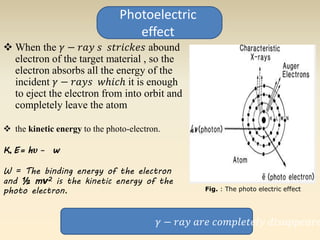
    Photoelectric effect Whenthe 훾 − 푟푎푦 푠 푠푡푟푖푐푘푒푠 abound electron of the target material , so the electron absorbs all the energy of the incident 훾 − 푟푎푦푠 푤ℎ푖푐ℎ it is enough to eject the electron from into orbit and completely leave the atom  the kinetic energy to the photo-electron. . = w K E h흊 _ W = The binding energy of the electron and ½ mν2 is the kinetic energy of the photo electron. Fig. : The photo electric effect 훾 − 푟푎푦 푎푟푒 푐표푚푝푙푒푡푒푙푦 푑푖푠푎푝푝푒푎푟푒
  • 97.
    The incident 훾−푟푎푦푖푛푡푒푟푎푐푡푠 푤푖푡ℎ 푎 푓푟푒푒 푒푙푒푐푡푟표 푛 푖푛 푡h푒 푡푎푟푔푒푡 푎푡표푚. K.E=h흊 − 풉흊′ Before interaction After interaction - - - Incoming photon Collides with electron - - - - Scattered Photon - Electron is ejected from atom
  • 98.
     The freeelectron takes a part of energy of the incident 훾 − 푟푎푦 푎푛푑 푡ℎ푒 푎푡ℎ푒푟 푝푎푟푡 표푓 푒푛푒푟푔푦 표푓 훾 − 푟푎푦 푖푠 푠푐푎푡푡푒푟푒푡 푎푛 푎푛푔푙푒 휃  The atomic electron has a sufficient energy which lead to the ejection of this electron from atom and it is scattered by an angle 휙 푤푖푡ℎ 푟푒푠푝푒푐푡 푡표 푡ℎ푒 푑푖푟푒푐푡푖표푛 표푓 훾 − 푟푎푦 If the angle by which the electron is scattered is Φ and the angle by which the photon is scattered is θ, then the following formula describes the change in the wavelength (δλ)of the photon: λ2 – λ1 = δλ = 0.024 ( 1- cos θ) Å
  • 99.
     Pair Production: When the photon with energy in excess of 1.02 MeV passes close to the nucleus of an atom, the photon disappears, and a positron and an electron appear.  Annihilation: These two particles collide, converting to 2 photons with equal energy of 511 kev.
  • 100.
    When an x-rayor γ ray beam passes through a medium, interactions occur between the beam and the matter. Initially the electrons are ejected from the atoms of the absorbing medium which in turn, transfer their energy by producing ionization and excitation of the atoms along their path. If the absorbing medium consists of body tissues, sufficient energy may be deposited within the cells, destroying their reproductive capacity. Howeve r, most of the absorbed energy is converted into heat, producing no biologic effect.
  • 101.
    Matter Photo electric effect Compton Scatter Pair Photon Production Matter Ionization Excitation Heat X-Rays Chemical Effects Biological Effects High Speed Electrons
  • 102.
    Fig : Semilogplot showing exponential attenuation of a monoenergetic photon beam. -When mono-energetic (mono-chromatic) radiation passes through any material, a reduction in the intensity of the beam occurs, This is known as attenuation. -Attenuation occurs exponentially, i.e. a given fraction of the photons is removed for a given thickness of the attenuating material.
  • 103.