Atomic Structure
TSRSm/EG/2016-17TSRSm/EG/2016-17
The Shri Ram School
Moulsari Campus
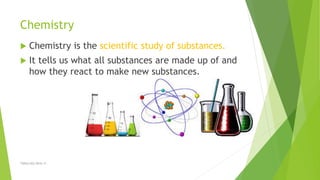
Chemistry
 Chemistry is the scientific study of substances.
 It tells us what all substances are made up of and
how they react to make new substances.
TSRSm/EG/2016-17
Atom
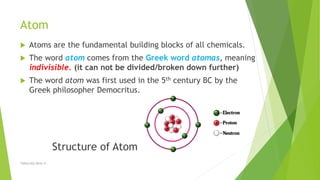
 Atoms are the fundamental building blocks of all chemicals.
 The word atom comes from the Greek word atomas, meaning
indivisible. (it can not be divided/broken down further)
 The word atom was first used in the 5th century BC by the
Greek philosopher Democritus.
Structure of Atom
TSRSm/EG/2016-17
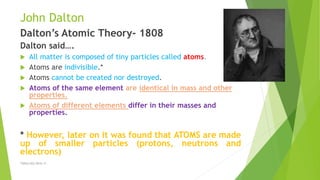
John Dalton
Dalton’s Atomic Theory- 1808
Dalton said….
 All matter is composed of tiny particles called atoms.
 Atoms are indivisible.*
 Atoms cannot be created nor destroyed.
 Atoms of the same element are identical in mass and other
properties.
 Atoms of different elements differ in their masses and
properties.
* However, later on it was found that ATOMS are made
up of smaller particles (protons, neutrons and
electrons)
TSRSm/EG/2016-17
Thomson’s Atomic Model
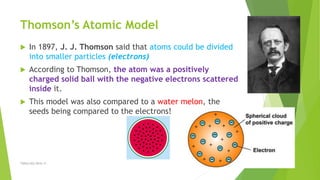
 In 1897, J. J. Thomson said that atoms could be divided
into smaller particles (electrons)
 According to Thomson, the atom was a positively
charged solid ball with the negative electrons scattered
inside it.
 This model was also compared to a water melon, the
seeds being compared to the electrons!
TSRSm/EG/2016-17
Bohr’s Atomic Model
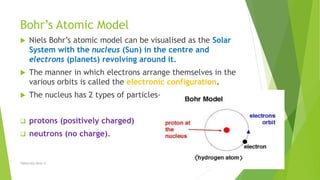
 Niels Bohr’s atomic model can be visualised as the Solar
System with the nucleus (Sun) in the centre and
electrons (planets) revolving around it.
 The manner in which electrons arrange themselves in the
various orbits is called the electronic configuration.
 The nucleus has 2 types of particles-
 protons (positively charged)
 neutrons (no charge).
TSRSm/EG/2016-17
Structure of the Atom
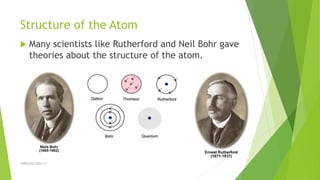
 Many scientists like Rutherford and Neil Bohr gave
theories about the structure of the atom.
TSRSm/EG/2016-17
Modern Definition of an Atom
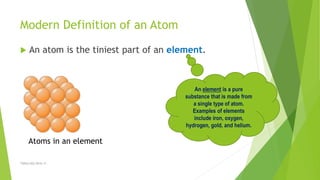
 An atom is the tiniest part of an element.
TSRSm/EG/2016-17
An element is a pure
substance that is made from
a single type of atom.
Examples of elements
include iron, oxygen,
hydrogen, gold, and helium.
Atoms in an element
Atomic Number
Atomic number is the number of protons present in the
nucleus of an atom. E.g. the carbon atom has six protons
so its atomic number is six.
Atomic number = number of Protons (+)
Also, Atomic number = number of Electrons (-)
So, Atomic number= number of protons = number of electrons
TSRSm/EG/2016-17
Mass Number/Atomic Mass
Mass number is the number of protons and neutrons present in
the nucleus of an atom. Mass number is also called Atomic Mass.
E.g. the carbon atom has six protons and six neutrons in its
nucleus. So its mass number is twelve.
Mass number/Atomic mass = number of protons (+) AND number of neutrons
(no charge)
TSRSm/EG/2016-17
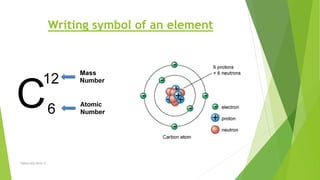
Writing symbol of an element
TSRSm/EG/2016-17
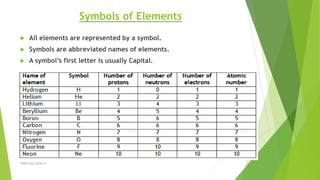
Symbols of Elements
 All elements are represented by a symbol.
 Symbols are abbreviated names of elements.
 A symbol’s first letter is usually Capital.
TSRSm/EG/2016-17
That’s all for now! 
Keep revising.
TSRSm/EG/2016-17

Atomic structure 1

  • 1.
  • 2.
    Chemistry  Chemistry isthe scientific study of substances.  It tells us what all substances are made up of and how they react to make new substances. TSRSm/EG/2016-17
  • 3.
    Atom  Atoms arethe fundamental building blocks of all chemicals.  The word atom comes from the Greek word atomas, meaning indivisible. (it can not be divided/broken down further)  The word atom was first used in the 5th century BC by the Greek philosopher Democritus. Structure of Atom TSRSm/EG/2016-17
  • 4.
    John Dalton Dalton’s AtomicTheory- 1808 Dalton said….  All matter is composed of tiny particles called atoms.  Atoms are indivisible.*  Atoms cannot be created nor destroyed.  Atoms of the same element are identical in mass and other properties.  Atoms of different elements differ in their masses and properties. * However, later on it was found that ATOMS are made up of smaller particles (protons, neutrons and electrons) TSRSm/EG/2016-17
  • 5.
    Thomson’s Atomic Model In 1897, J. J. Thomson said that atoms could be divided into smaller particles (electrons)  According to Thomson, the atom was a positively charged solid ball with the negative electrons scattered inside it.  This model was also compared to a water melon, the seeds being compared to the electrons! TSRSm/EG/2016-17
  • 6.
    Bohr’s Atomic Model Niels Bohr’s atomic model can be visualised as the Solar System with the nucleus (Sun) in the centre and electrons (planets) revolving around it.  The manner in which electrons arrange themselves in the various orbits is called the electronic configuration.  The nucleus has 2 types of particles-  protons (positively charged)  neutrons (no charge). TSRSm/EG/2016-17
  • 7.
    Structure of theAtom  Many scientists like Rutherford and Neil Bohr gave theories about the structure of the atom. TSRSm/EG/2016-17
  • 8.
    Modern Definition ofan Atom  An atom is the tiniest part of an element. TSRSm/EG/2016-17 An element is a pure substance that is made from a single type of atom. Examples of elements include iron, oxygen, hydrogen, gold, and helium. Atoms in an element
  • 9.
    Atomic Number Atomic numberis the number of protons present in the nucleus of an atom. E.g. the carbon atom has six protons so its atomic number is six. Atomic number = number of Protons (+) Also, Atomic number = number of Electrons (-) So, Atomic number= number of protons = number of electrons TSRSm/EG/2016-17
  • 10.
    Mass Number/Atomic Mass Massnumber is the number of protons and neutrons present in the nucleus of an atom. Mass number is also called Atomic Mass. E.g. the carbon atom has six protons and six neutrons in its nucleus. So its mass number is twelve. Mass number/Atomic mass = number of protons (+) AND number of neutrons (no charge) TSRSm/EG/2016-17
  • 11.
    Writing symbol ofan element TSRSm/EG/2016-17
  • 12.
    Symbols of Elements All elements are represented by a symbol.  Symbols are abbreviated names of elements.  A symbol’s first letter is usually Capital. TSRSm/EG/2016-17
  • 13.
    That’s all fornow!  Keep revising. TSRSm/EG/2016-17