STRUCTURE ACTIVITY RELATIONSHIP
OF OPIOD
PRESENTED BY:
DR.SUMIT KUMAR MAHATO
(JUNIOR RESIDENT)
GUIDE: DR. UMASHANKER PRASAD
KESHRI
( ASSOCIATE PROF.)
DEPARTMENT OF
PHARMACOLOGY
RIMS,RANCHI
 The STRUCTURE – ACTIVITY relationship (SAR) is
the relationship between the chemical or 3D structure
of a molecule and its biological activity.
Enables the determination of the chemical groups
responsible for evoking a target biological effect in
the organism
A chemical structure includes molecular
geometry, electronic structure, and crystal
structure of a molecule.
Biological activity is an expression describing
the beneficial or adverse effects of a drug on
living matter.
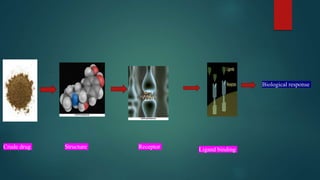
Crude drug Structure Receptor Ligand binding
Biological response
SAR is an advance design to find the relationships between
chemical structure and biological activity of studied
compounds.
Therefore it is the concept of linking chemical structure to a
chemical property or biological activity including toxicity.
The theory of SARs is to produce new drugs with similar
structure and effects as the original one but with having
more potency and improved side-effects.
Moreover, SARs are essential for toxicological studies on a
compound.
SARs have been used since long ago to design chemicals
with the commercially wanted properties and thus they are
important while designing drugs as the chemicals with
desired pharmacological and therapeutic activities are
known.
Factors considered
There are various factors that should be considered while
developing the mechanism of SARs, these are:
the size and shape of the carbon skeleton,
the nature and degree of substitution and
the stereochemistry.
During modifications on a drug analogue,
effects on water solubility,
transport through membranes,
receptor binding,
metabolism and other pharmacokinetics properties
should be considered.
Computer assisted molecular modelling helps to solve
this problem by providing accurate targeting
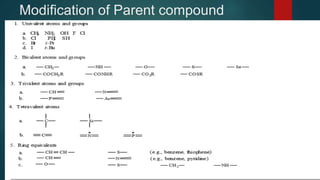
MODIFICATION OF PARENT
COMPOUND
Varying size and shape
Changing the number of methylene groups in chains
and rings
This increases lipophilicity which results in an increased in activity
Water solubility is reduced as well as activity
No selective binding due to micelle formation in aliphatic
compounds
Increasing or decreasing the degree of
unsaturation
A change in the degree of unsaturation causes an
increase in rigidity,
complication of E-Z isomers,
more sensitivity and increased toxicity.
Introducing or removing a ring system
This results to an increase in size, shape changes
and stability of structure with the substitution of C=C
double bonds.
Modification of Parent compound
OPIOID
History:
 first undisputed reference to "poppy juice" is found in the writings of Theophrastus in
the third century B.C. the word opium being derived from the Greek word for "juice"
the drug being obtained from the juice of the poppy Papaver sominiferum
Source
 The term opiate refers to compounds structurally related to products
found in opium, a word derived from opos, the Greek word for “juice,”
natural opiates being derived from the resin of the opium poppy, Papaver
somniferum. Opiates include the natural plant alkaloids, such as
morphine, codeine, thebaine, and many semisynthetic derivatives.
 An opioid is any agent, regardless of structure, that has the functional
and pharmacological properties of an opiate. Endogenous opioids, many
of which are peptides, are naturally occurring ligands for opioid receptors
found in animals.
OPIOID
RECEPTOR The major effects of the opioids are mediated by three major receptor
families. These are designated by the Greek letters µ (mu), κ (kappa),
and δ (delta). Each receptor family exhibits a different specificity for the
drug(s) it binds. The analgesic properties of the opioids are primarily
mediated by the µ receptors.
 All three opioid receptors are members of the G protein–coupled
receptor family and inhibit adenylyl cyclase.
 They are associated with ion channels, increasing postsynaptic K+ effl
ux (hyperpolarization) or reducing presynaptic Ca2+ infl ux, thus
impeding neuronal fi ring and transmitter release.
 Opioids interact stereospecifically with protein receptors on the
membranes of certain cells.
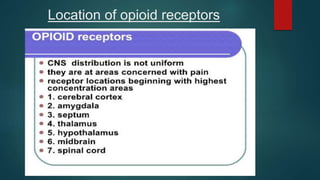
Location of opioid receptors
Endogenous opioid peptides
 Three distinct families of peptides have been identified
 ENKEPHALINS , ENDORPHINS ,DYNORPHIN.
 These are now designated as Proenkephalin (proenkephalin
A),
 Proopiomelanocortin (POMC) and
 Prodynorphin (proenkephalin B).
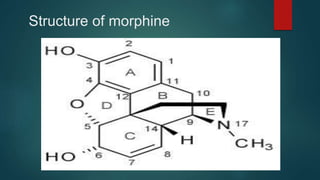
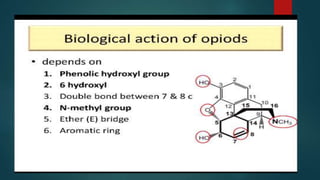
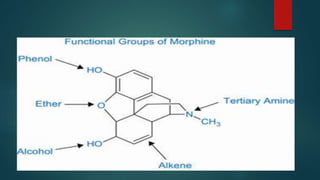
Structure of morphine
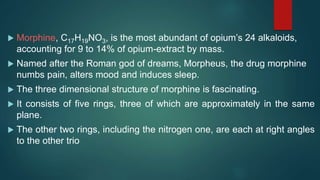
 Morphine, C17H19NO3, is the most abundant of opium’s 24 alkaloids,
accounting for 9 to 14% of opium-extract by mass.
 Named after the Roman god of dreams, Morpheus, the drug morphine
numbs pain, alters mood and induces sleep.
 The three dimensional structure of morphine is fascinating.
 It consists of five rings, three of which are approximately in the same
plane.
 The other two rings, including the nitrogen one, are each at right angles
to the other trio
Mask or remove a functional group
Test the analogue for activity
Determines the importance or other wise of a
functional group for activity
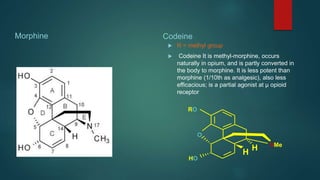
Morphine Codeine
 R = methyl group
 Codeine It is methyl-morphine, occurs
naturally in opium, and is partly converted in
the body to morphine. It is less potent than
morphine (1/10th as analgesic), also less
efficacious; is a partial agonist at μ opioid
receptor
NMe
O
RO
HO
H
H
NMe
O
HO
RO
H
H
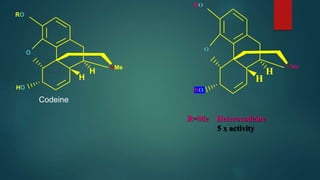
R=Me Heterocodeine
5 x activity
NMe
O
RO
HO
H
H
Codeine
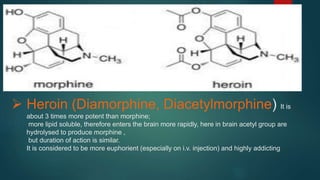
 Heroin (Diamorphine, Diacetylmorphine) It is
about 3 times more potent than morphine;
more lipid soluble, therefore enters the brain more rapidly, here in brain acetyl group are
hydrolysed to produce morphine ,
but duration of action is similar.
It is considered to be more euphorient (especially on i.v. injection) and highly addicting
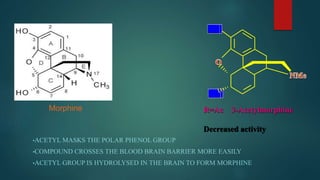
•ACETYL MASKS THE POLAR PHENOL GROUP
•COMPOUND CROSSES THE BLOOD BRAIN BARRIER MORE EASILY
•ACETYL GROUP IS HYDROLYSED IN THE BRAIN TO FORM MORPHINE
R=Ac 3-Acetylmorphine
Decreased activity
Morphine
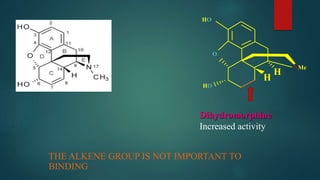
THE ALKENE GROUP IS NOT IMPORTANT TO
BINDING
NMe
O
HO
HO
H
H
Dihydromorphine
Increased activity
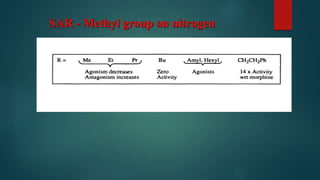
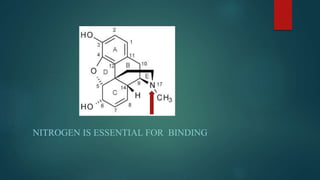
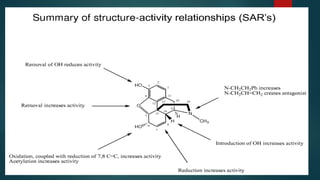
SAR - Methyl group on nitrogen
NITROGEN IS ESSENTIAL FOR BINDING
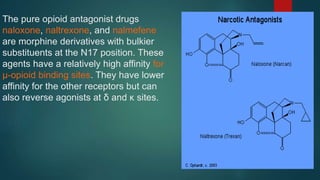
The pure opioid antagonist drugs
naloxone, naltrexone, and nalmefene
are morphine derivatives with bulkier
substituents at the N17 position. These
agents have a relatively high affinity for
μ-opioid binding sites. They have lower
affinity for the other receptors but can
also reverse agonists at δ and κ sites.
CONCLUSSION
 Medicinal chemistry has and will continue to play an important role in
today's society as it deals with development, synthesis and design of
pharmaceutical drugs.
 These results are then used to give us a better way of preventing
and curing diseases.
 Although medicinal chemistry is about creating new drugs, the
properties and quantitative structure activity relationships (QSAR) of
existing drugs is important to see if a combination of these biological
properties can be mixed with a new hit to produce the latest drug
that will help fight against various diseases.
 As the majority of medicinal chemistry is based around the discovery
of new drugs and development, many companies spend a
considerable amount of money in maintaining and improving their
database of information to ensure that each test is run as efficient as
possible.
 Of course, thousands of compounds related to the morphine structure
have been prepared and many without activity, and no compound has
been found to halt the terrible addictive morphine properties.
 When Used correctly, the morphine family is an important class of
analgesics, and their study represents an important contribution to the
understanding of medicinal activity.
THANK YOU


Structure activity relationship main

  • 1.
    STRUCTURE ACTIVITY RELATIONSHIP OFOPIOD PRESENTED BY: DR.SUMIT KUMAR MAHATO (JUNIOR RESIDENT) GUIDE: DR. UMASHANKER PRASAD KESHRI ( ASSOCIATE PROF.) DEPARTMENT OF PHARMACOLOGY RIMS,RANCHI
  • 2.
     The STRUCTURE– ACTIVITY relationship (SAR) is the relationship between the chemical or 3D structure of a molecule and its biological activity. Enables the determination of the chemical groups responsible for evoking a target biological effect in the organism
  • 3.
    A chemical structureincludes molecular geometry, electronic structure, and crystal structure of a molecule. Biological activity is an expression describing the beneficial or adverse effects of a drug on living matter.
  • 4.
    Crude drug StructureReceptor Ligand binding Biological response
  • 5.
    SAR is anadvance design to find the relationships between chemical structure and biological activity of studied compounds. Therefore it is the concept of linking chemical structure to a chemical property or biological activity including toxicity. The theory of SARs is to produce new drugs with similar structure and effects as the original one but with having more potency and improved side-effects.
  • 6.
    Moreover, SARs areessential for toxicological studies on a compound. SARs have been used since long ago to design chemicals with the commercially wanted properties and thus they are important while designing drugs as the chemicals with desired pharmacological and therapeutic activities are known.
  • 7.
    Factors considered There arevarious factors that should be considered while developing the mechanism of SARs, these are: the size and shape of the carbon skeleton, the nature and degree of substitution and the stereochemistry.
  • 8.
    During modifications ona drug analogue, effects on water solubility, transport through membranes, receptor binding, metabolism and other pharmacokinetics properties should be considered. Computer assisted molecular modelling helps to solve this problem by providing accurate targeting
  • 9.
  • 10.
    Varying size andshape Changing the number of methylene groups in chains and rings This increases lipophilicity which results in an increased in activity Water solubility is reduced as well as activity No selective binding due to micelle formation in aliphatic compounds
  • 11.
    Increasing or decreasingthe degree of unsaturation A change in the degree of unsaturation causes an increase in rigidity, complication of E-Z isomers, more sensitivity and increased toxicity. Introducing or removing a ring system This results to an increase in size, shape changes and stability of structure with the substitution of C=C double bonds.
  • 12.
  • 13.
    OPIOID History:  first undisputedreference to "poppy juice" is found in the writings of Theophrastus in the third century B.C. the word opium being derived from the Greek word for "juice" the drug being obtained from the juice of the poppy Papaver sominiferum
  • 14.
  • 15.
     The termopiate refers to compounds structurally related to products found in opium, a word derived from opos, the Greek word for “juice,” natural opiates being derived from the resin of the opium poppy, Papaver somniferum. Opiates include the natural plant alkaloids, such as morphine, codeine, thebaine, and many semisynthetic derivatives.  An opioid is any agent, regardless of structure, that has the functional and pharmacological properties of an opiate. Endogenous opioids, many of which are peptides, are naturally occurring ligands for opioid receptors found in animals.
  • 16.
    OPIOID RECEPTOR The majoreffects of the opioids are mediated by three major receptor families. These are designated by the Greek letters µ (mu), κ (kappa), and δ (delta). Each receptor family exhibits a different specificity for the drug(s) it binds. The analgesic properties of the opioids are primarily mediated by the µ receptors.  All three opioid receptors are members of the G protein–coupled receptor family and inhibit adenylyl cyclase.  They are associated with ion channels, increasing postsynaptic K+ effl ux (hyperpolarization) or reducing presynaptic Ca2+ infl ux, thus impeding neuronal fi ring and transmitter release.  Opioids interact stereospecifically with protein receptors on the membranes of certain cells.
  • 17.
  • 19.
    Endogenous opioid peptides Three distinct families of peptides have been identified  ENKEPHALINS , ENDORPHINS ,DYNORPHIN.  These are now designated as Proenkephalin (proenkephalin A),  Proopiomelanocortin (POMC) and  Prodynorphin (proenkephalin B).
  • 20.
  • 21.
     Morphine, C17H19NO3,is the most abundant of opium’s 24 alkaloids, accounting for 9 to 14% of opium-extract by mass.  Named after the Roman god of dreams, Morpheus, the drug morphine numbs pain, alters mood and induces sleep.  The three dimensional structure of morphine is fascinating.  It consists of five rings, three of which are approximately in the same plane.  The other two rings, including the nitrogen one, are each at right angles to the other trio
  • 24.
    Mask or removea functional group Test the analogue for activity Determines the importance or other wise of a functional group for activity
  • 25.
    Morphine Codeine  R= methyl group  Codeine It is methyl-morphine, occurs naturally in opium, and is partly converted in the body to morphine. It is less potent than morphine (1/10th as analgesic), also less efficacious; is a partial agonist at μ opioid receptor NMe O RO HO H H
  • 26.
    NMe O HO RO H H R=Me Heterocodeine 5 xactivity NMe O RO HO H H Codeine
  • 27.
     Heroin (Diamorphine,Diacetylmorphine) It is about 3 times more potent than morphine; more lipid soluble, therefore enters the brain more rapidly, here in brain acetyl group are hydrolysed to produce morphine , but duration of action is similar. It is considered to be more euphorient (especially on i.v. injection) and highly addicting
  • 28.
    •ACETYL MASKS THEPOLAR PHENOL GROUP •COMPOUND CROSSES THE BLOOD BRAIN BARRIER MORE EASILY •ACETYL GROUP IS HYDROLYSED IN THE BRAIN TO FORM MORPHINE R=Ac 3-Acetylmorphine Decreased activity Morphine
  • 29.
    THE ALKENE GROUPIS NOT IMPORTANT TO BINDING NMe O HO HO H H Dihydromorphine Increased activity
  • 30.
    SAR - Methylgroup on nitrogen
  • 31.
  • 32.
    The pure opioidantagonist drugs naloxone, naltrexone, and nalmefene are morphine derivatives with bulkier substituents at the N17 position. These agents have a relatively high affinity for μ-opioid binding sites. They have lower affinity for the other receptors but can also reverse agonists at δ and κ sites.
  • 34.
    CONCLUSSION  Medicinal chemistryhas and will continue to play an important role in today's society as it deals with development, synthesis and design of pharmaceutical drugs.  These results are then used to give us a better way of preventing and curing diseases.  Although medicinal chemistry is about creating new drugs, the properties and quantitative structure activity relationships (QSAR) of existing drugs is important to see if a combination of these biological properties can be mixed with a new hit to produce the latest drug that will help fight against various diseases.
  • 35.
     As themajority of medicinal chemistry is based around the discovery of new drugs and development, many companies spend a considerable amount of money in maintaining and improving their database of information to ensure that each test is run as efficient as possible.  Of course, thousands of compounds related to the morphine structure have been prepared and many without activity, and no compound has been found to halt the terrible addictive morphine properties.  When Used correctly, the morphine family is an important class of analgesics, and their study represents an important contribution to the understanding of medicinal activity.
  • 36.