Presented by:
Mr. Afroj Shaikh
M.Pharm MNP
 Biological source: Dried latex extruded from
the seedpod of Papaver somniferum
(Papaveraceae)
 First active principle isolated from plant.
 Segnin 1804.
 Geographical source:- Mediterranean region
 Cultivation.
2
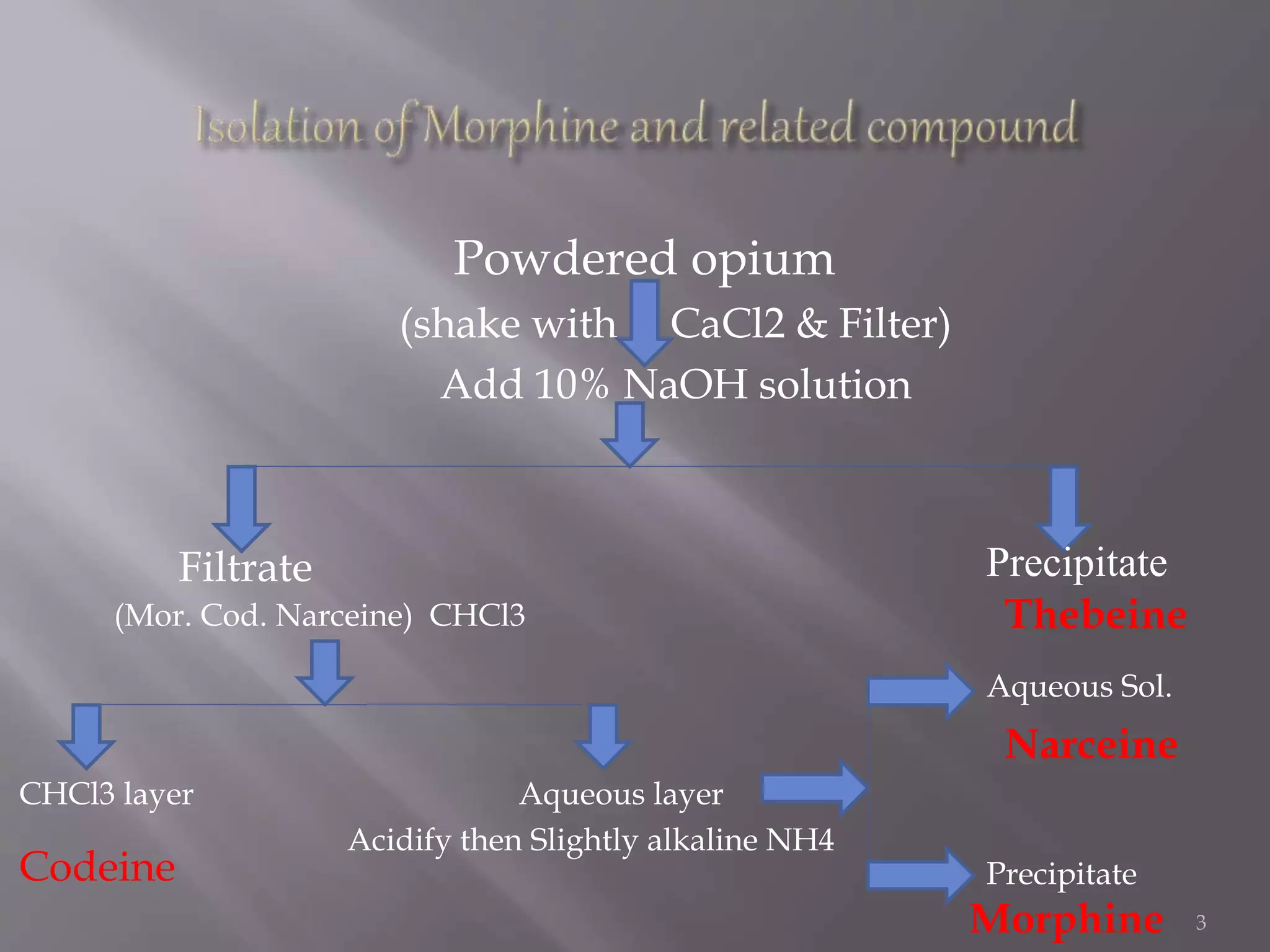
Powdered opium
(shake with CaCl2 & Filter)
Add 10% NaOH solution
Filtrate
(Mor. Cod. Narceine) CHCl3
Precipitate
CHCl3 layer
Codeine
Aqueous layer
Acidify then Slightly alkaline NH4
Aqueous Sol.
Precipitate
Narceine
Morphine
Thebeine
3
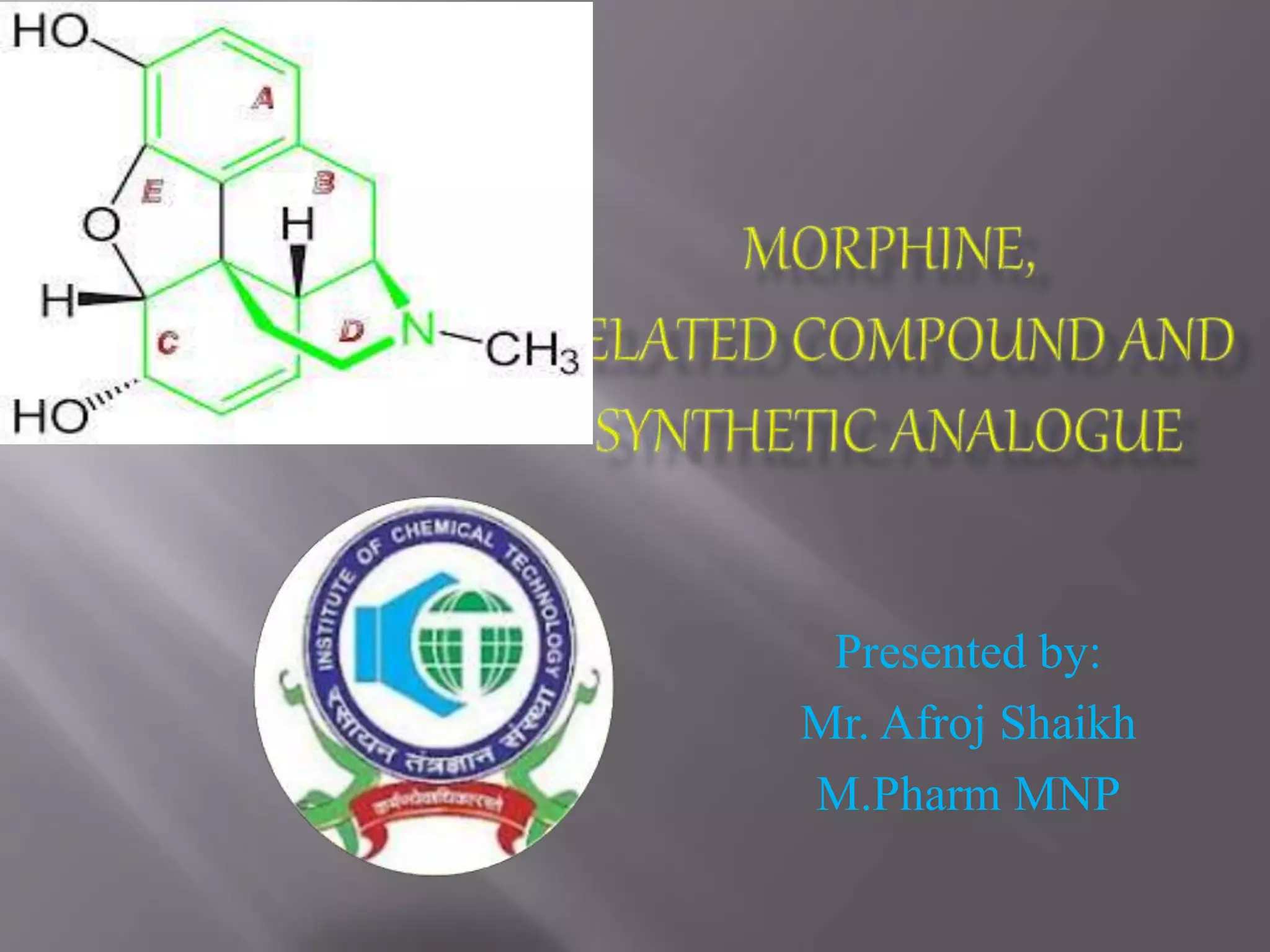
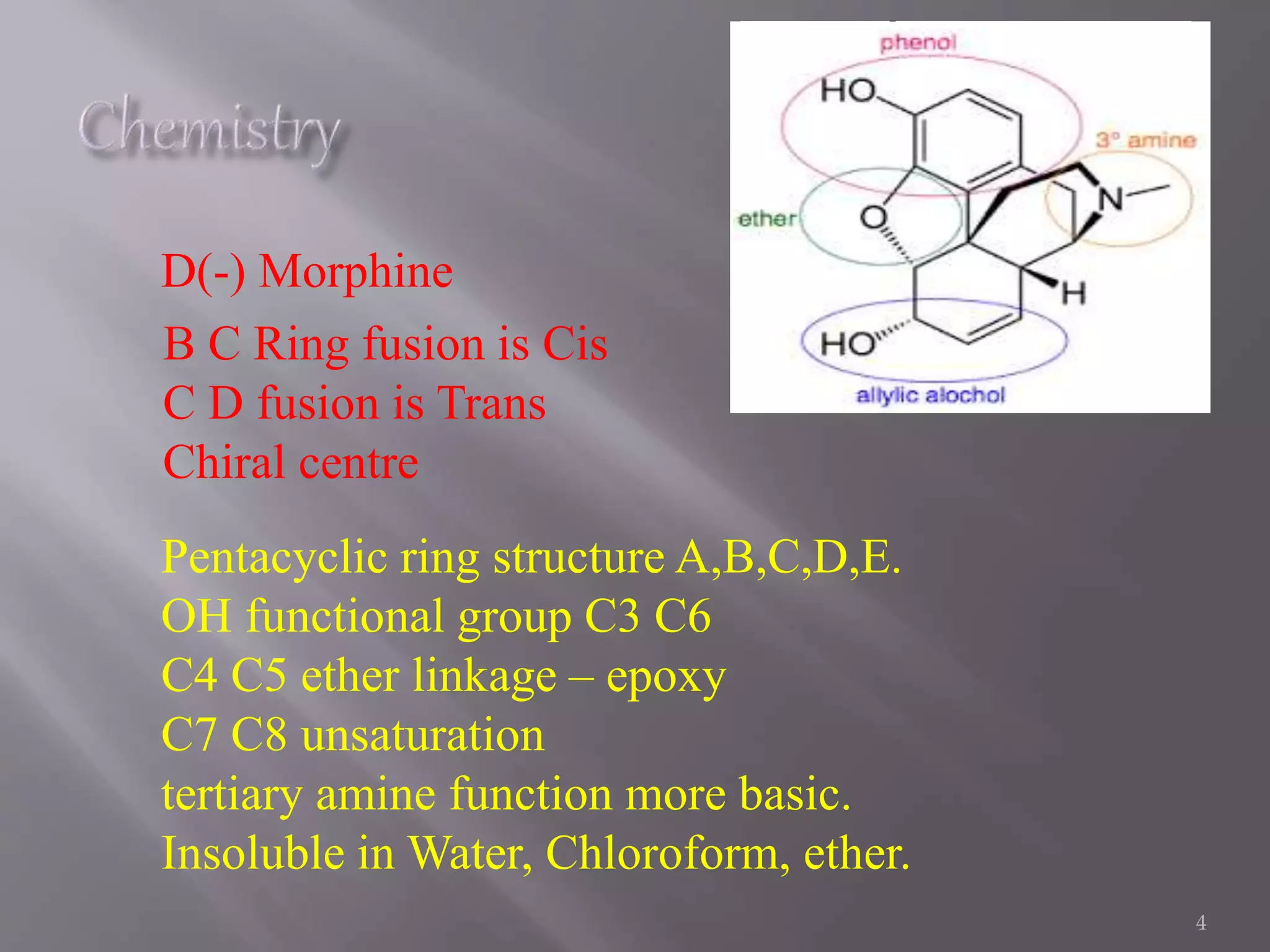
D(-) Morphine
B C Ring fusion is Cis
C D fusion is Trans
Chiral centre
Pentacyclic ring structure A,B,C,D,E.
OH functional group C3 C6
C4 C5 ether linkage – epoxy
C7 C8 unsaturation
tertiary amine function more basic.
Insoluble in Water, Chloroform, ether.
4
 Limited Oral bioavailability
 Lipophilic but less
 Half life- 2-3 hrs.
 Elimination:- urine by glucuronide.
 Metabolism 3 and 6 O glucuronidation & O
methylation to Codeine.
5
 Morphine exerts its major effects by interacting
with opioid receptors in the CNS
 Opioids activate 7- transmembrane GPCRs
located pre-synaptically and post-synaptically
along pain transmission pathways
 It has agonistic action at the μ, k and δ
 μ receptor:- Respiratory depression & analgesia
 k receptor:- Sedation
 δ receptor:- urinary retention and constipation
6
 Based upon
 Phenolic OH group C3
&6 hydroxy
 7-8 unsaturation
 N methyl group
 Ether linkage
 Aromatic ring
7
 Essential for the binding at Kappa or mu
receptor
 Changing to H or O CH3 decreases the activity
OH Morphine
H Activity deceases
O CH3 Codeine
Activity decreases
8
> 5 C (In chain or ring ) Agonist
3-5 C with = /
Small cyclic / Aromatic
ring
Antagonist
Naloxone/Naltrexone
Aryl alkyl Increases 10 fold
 Interact hydrophobically with mu receptor
 Size of substitution on N determines the
potency and activity (Agonistic or
Antagonistic)
9
Removal of OH reduces activity
Removal decreases
activity
Oxidation, acetylation, reduction 7=8 Increases activity
N-CH2=CH2-Ph increases
activity
N-CH2-CH2=CH2 creates
Antagonists
10
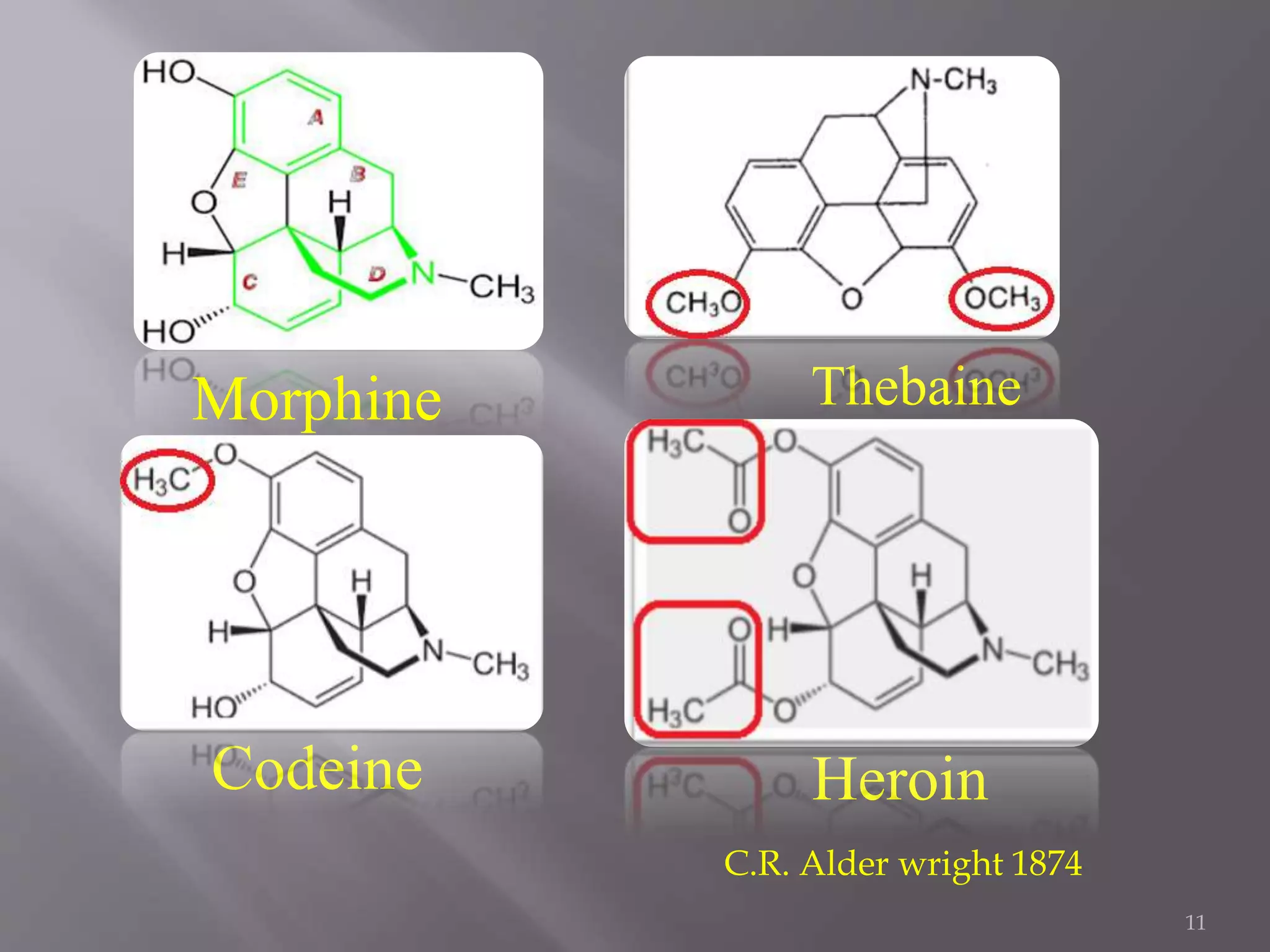
Morphine
Codeine Heroin
Thebaine
C.R. Alder wright 1874
11
Oxymorphone
Hydrocodone
Oxycodone
Hydromorphone 12
 Additional approach
 Addition of the extra ring in the morphine structure
gives active compound
 Simplification approach
 Deletion of the ring from morphine structure gives
active compound.
 Simplification approach is used for synthesis of a
new classes of compounds.
13
 Addition of extra ring
in Morphine gives
Oripavines,
Naltrindole etc.
 Potency is comparable
to morphine but not
used clinically
14
 Removing ring D
 Morphinans
 Useful analgesic
activity
 Oxygen bridge not
essential
 Eg. Dextrallorphan
 It acts as a σ1 receptor
agonist
 It has no significant
affinity for σ2, mu
opioid, or δ- opioid
receptor or serotonin
or NE.
15
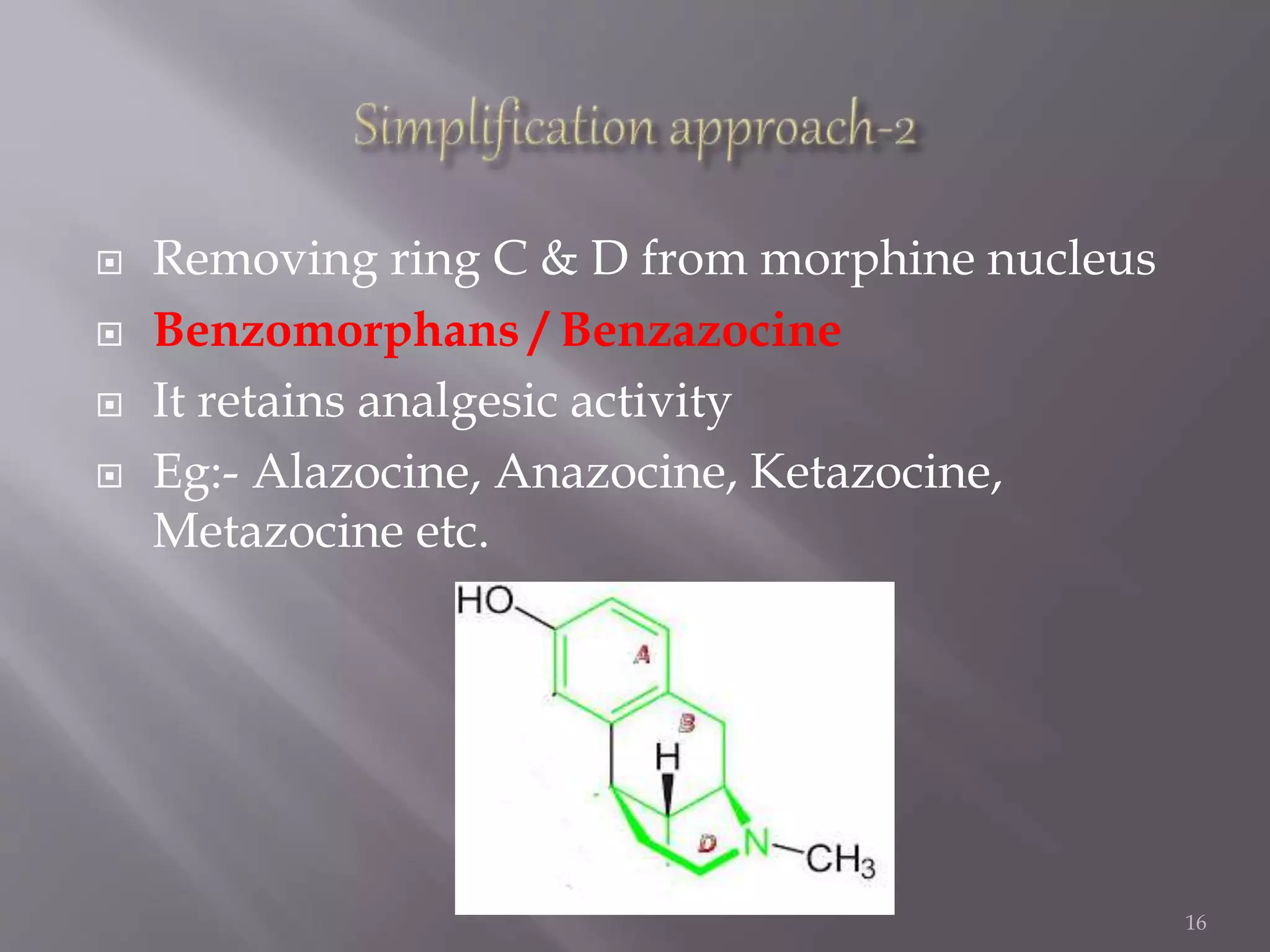
 Removing ring C & D from morphine nucleus
 Benzomorphans / Benzazocine
 It retains analgesic activity
 Eg:- Alazocine, Anazocine, Ketazocine,
Metazocine etc.
16
 Removing ring B, C & D from morphine
nucleus.
 4- Phenyl pepiridine/Mepiridine series.
 It was discovered by chance in 1940 when
chemists were studying analogues of cocaine
for anti spasmodic activity.
 Eg:-Mepiridine, Bemidone,Properidine etc.
17
 Removing ring B, C, D & E from morphine
nucleus. Methadone series.
 Retention Tertiary amine and aromatic function
It is an opioid used to
treat pain & as
maintenance therapy or to
help with detoxification in
people with opioid
dependence.
18
19
20

Morphine and its synthetic analoge

  • 1.
    Presented by: Mr. AfrojShaikh M.Pharm MNP
  • 2.
     Biological source:Dried latex extruded from the seedpod of Papaver somniferum (Papaveraceae)  First active principle isolated from plant.  Segnin 1804.  Geographical source:- Mediterranean region  Cultivation. 2
  • 3.
    Powdered opium (shake withCaCl2 & Filter) Add 10% NaOH solution Filtrate (Mor. Cod. Narceine) CHCl3 Precipitate CHCl3 layer Codeine Aqueous layer Acidify then Slightly alkaline NH4 Aqueous Sol. Precipitate Narceine Morphine Thebeine 3
  • 4.
    D(-) Morphine B CRing fusion is Cis C D fusion is Trans Chiral centre Pentacyclic ring structure A,B,C,D,E. OH functional group C3 C6 C4 C5 ether linkage – epoxy C7 C8 unsaturation tertiary amine function more basic. Insoluble in Water, Chloroform, ether. 4
  • 5.
     Limited Oralbioavailability  Lipophilic but less  Half life- 2-3 hrs.  Elimination:- urine by glucuronide.  Metabolism 3 and 6 O glucuronidation & O methylation to Codeine. 5
  • 6.
     Morphine exertsits major effects by interacting with opioid receptors in the CNS  Opioids activate 7- transmembrane GPCRs located pre-synaptically and post-synaptically along pain transmission pathways  It has agonistic action at the μ, k and δ  μ receptor:- Respiratory depression & analgesia  k receptor:- Sedation  δ receptor:- urinary retention and constipation 6
  • 7.
     Based upon Phenolic OH group C3 &6 hydroxy  7-8 unsaturation  N methyl group  Ether linkage  Aromatic ring 7
  • 8.
     Essential forthe binding at Kappa or mu receptor  Changing to H or O CH3 decreases the activity OH Morphine H Activity deceases O CH3 Codeine Activity decreases 8
  • 9.
    > 5 C(In chain or ring ) Agonist 3-5 C with = / Small cyclic / Aromatic ring Antagonist Naloxone/Naltrexone Aryl alkyl Increases 10 fold  Interact hydrophobically with mu receptor  Size of substitution on N determines the potency and activity (Agonistic or Antagonistic) 9
  • 10.
    Removal of OHreduces activity Removal decreases activity Oxidation, acetylation, reduction 7=8 Increases activity N-CH2=CH2-Ph increases activity N-CH2-CH2=CH2 creates Antagonists 10
  • 11.
  • 12.
  • 13.
     Additional approach Addition of the extra ring in the morphine structure gives active compound  Simplification approach  Deletion of the ring from morphine structure gives active compound.  Simplification approach is used for synthesis of a new classes of compounds. 13
  • 14.
     Addition ofextra ring in Morphine gives Oripavines, Naltrindole etc.  Potency is comparable to morphine but not used clinically 14
  • 15.
     Removing ringD  Morphinans  Useful analgesic activity  Oxygen bridge not essential  Eg. Dextrallorphan  It acts as a σ1 receptor agonist  It has no significant affinity for σ2, mu opioid, or δ- opioid receptor or serotonin or NE. 15
  • 16.
     Removing ringC & D from morphine nucleus  Benzomorphans / Benzazocine  It retains analgesic activity  Eg:- Alazocine, Anazocine, Ketazocine, Metazocine etc. 16
  • 17.
     Removing ringB, C & D from morphine nucleus.  4- Phenyl pepiridine/Mepiridine series.  It was discovered by chance in 1940 when chemists were studying analogues of cocaine for anti spasmodic activity.  Eg:-Mepiridine, Bemidone,Properidine etc. 17
  • 18.
     Removing ringB, C, D & E from morphine nucleus. Methadone series.  Retention Tertiary amine and aromatic function It is an opioid used to treat pain & as maintenance therapy or to help with detoxification in people with opioid dependence. 18
  • 19.
  • 20.