General principles of Structure-
Activity Relationship (SAR)
Contents ….
• Introduction
• History
• Need of SAR
• The size and shape of the carbon skeleton
• The stereochemistry of the lead
• The nature and degree of substitution
• Summary
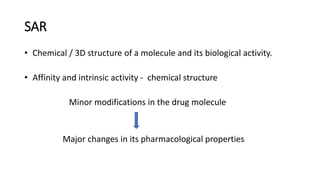
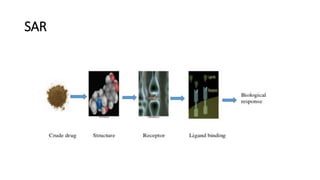
SAR
• Chemical / 3D structure of a molecule and its biological activity.
• Affinity and intrinsic activity - chemical structure
Minor modifications in the drug molecule
Major changes in its pharmacological properties
SAR
History
• Brown and Fraser in 1869
• Compounds containing tertiary amine groups
Muscle relaxants (quaternary ammonium compound)
NEED OF SAR STUDY
• A study of the structure–activity relationship is mainly done by lead
molecule.
• It is used to determine pharmacophore, unwanted side effects
• To develop a new drug that has increased activity
NEED OF SAR STUDY
• To determine some different activity from an existing drug
• To fewer unwanted side effects
• To know the changes in pharmacological properties by performing
minor changes in the drug molecule
These changes may be conveniently classified
as changing
• The size and shape of the carbon skeleton
• The stereochemistry of the lead
• The nature and degree of substitution
1. Changing size and shape
• No of methylene groups in chains and rings
• Increasing or decreasing the degree of unsaturation
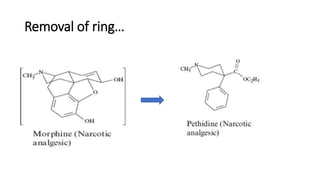
• Introducing or removing a ring system
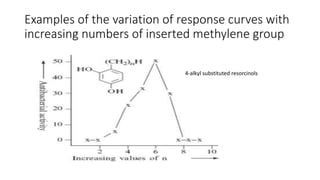
Examples of the variation of response curves with
increasing numbers of inserted methylene group
4-alkyl substituted resorcinols
Number of methylene groups…..
Changing the No of CH2 Change in activity
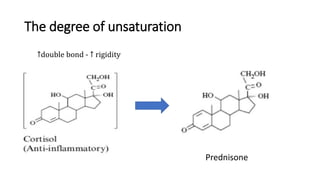
The degree of unsaturation
Prednisone
↑double bond - ↑ rigidity
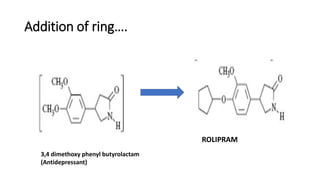
Addition of ring….
ROLIPRAM
3,4 dimethoxy phenyl butyrolactam
(Antidepressant)
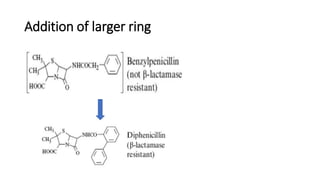
Addition of larger ring
Removal of ring…
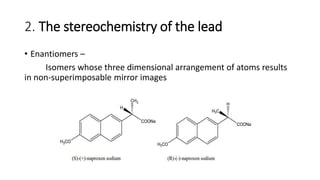
2. The stereochemistry of the lead
• Enantiomers –
Isomers whose three dimensional arrangement of atoms results
in non-superimposable mirror images
The stereochemistry of the lead
• These compounds have identical physical chemical properties
• Rotate plane polarized light to opposite directions
• significant differences –
Absorption (specially active transport)
Serum protein binding and metabolism
Different side effect or toxicity
Variations in the biological activities of
stereoisomers
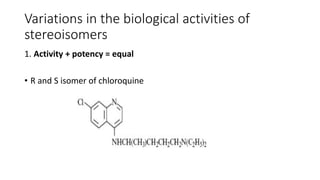
1. Activity + potency = equal
• R and S isomer of chloroquine
Cont……
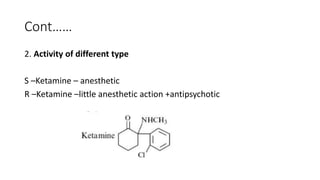
2. Activity of different type
S –Ketamine – anesthetic
R –Ketamine –little anesthetic action +antipsychotic
Cont…….
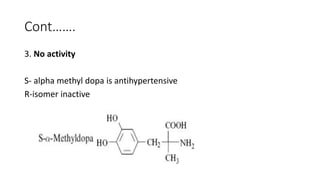
3. No activity
S- alpha methyl dopa is antihypertensive
R-isomer inactive
Cont…….
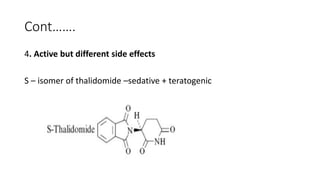
4. Active but different side effects
S – isomer of thalidomide –sedative + teratogenic
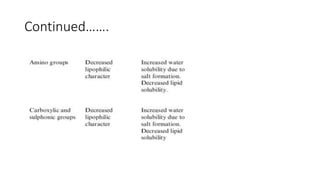
3. Introduction of new substituents
Continued…….
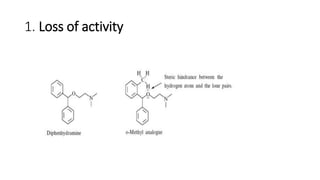
1. Loss of activity
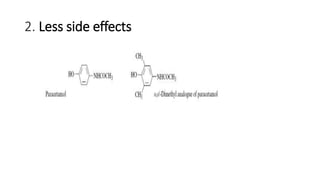
2. Less side effects
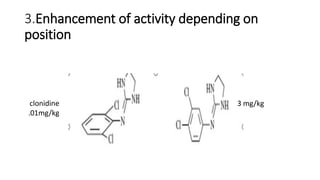
3.Enhancement of activity depending on
position
clonidine
.01mg/kg
3 mg/kg
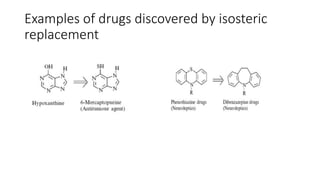
The introduction of a group by replacing an
existing group
• concept of isosteres
- Isosteres are atoms, molecules, or ions of similar size containing the same
number of atoms and valence electrons.
- similar pharmacokinetic and pharmacodynamic properties
Examples of drugs discovered by isosteric
replacement
THANK YOU

General principles of structure activity relationship (sar)

  • 1.
    General principles ofStructure- Activity Relationship (SAR)
  • 2.
    Contents …. • Introduction •History • Need of SAR • The size and shape of the carbon skeleton • The stereochemistry of the lead • The nature and degree of substitution • Summary
  • 3.
    SAR • Chemical /3D structure of a molecule and its biological activity. • Affinity and intrinsic activity - chemical structure Minor modifications in the drug molecule Major changes in its pharmacological properties
  • 4.
  • 5.
    History • Brown andFraser in 1869 • Compounds containing tertiary amine groups Muscle relaxants (quaternary ammonium compound)
  • 6.
    NEED OF SARSTUDY • A study of the structure–activity relationship is mainly done by lead molecule. • It is used to determine pharmacophore, unwanted side effects • To develop a new drug that has increased activity
  • 7.
    NEED OF SARSTUDY • To determine some different activity from an existing drug • To fewer unwanted side effects • To know the changes in pharmacological properties by performing minor changes in the drug molecule
  • 8.
    These changes maybe conveniently classified as changing • The size and shape of the carbon skeleton • The stereochemistry of the lead • The nature and degree of substitution
  • 9.
    1. Changing sizeand shape • No of methylene groups in chains and rings • Increasing or decreasing the degree of unsaturation • Introducing or removing a ring system
  • 10.
    Examples of thevariation of response curves with increasing numbers of inserted methylene group 4-alkyl substituted resorcinols
  • 11.
    Number of methylenegroups….. Changing the No of CH2 Change in activity
  • 12.
    The degree ofunsaturation Prednisone ↑double bond - ↑ rigidity
  • 13.
    Addition of ring…. ROLIPRAM 3,4dimethoxy phenyl butyrolactam (Antidepressant)
  • 14.
  • 15.
  • 16.
    2. The stereochemistryof the lead • Enantiomers – Isomers whose three dimensional arrangement of atoms results in non-superimposable mirror images
  • 17.
    The stereochemistry ofthe lead • These compounds have identical physical chemical properties • Rotate plane polarized light to opposite directions • significant differences – Absorption (specially active transport) Serum protein binding and metabolism Different side effect or toxicity
  • 18.
    Variations in thebiological activities of stereoisomers 1. Activity + potency = equal • R and S isomer of chloroquine
  • 19.
    Cont…… 2. Activity ofdifferent type S –Ketamine – anesthetic R –Ketamine –little anesthetic action +antipsychotic
  • 20.
    Cont……. 3. No activity S-alpha methyl dopa is antihypertensive R-isomer inactive
  • 21.
    Cont……. 4. Active butdifferent side effects S – isomer of thalidomide –sedative + teratogenic
  • 22.
    3. Introduction ofnew substituents
  • 23.
  • 24.
    1. Loss ofactivity
  • 25.
    2. Less sideeffects
  • 26.
    3.Enhancement of activitydepending on position clonidine .01mg/kg 3 mg/kg
  • 27.
    The introduction ofa group by replacing an existing group • concept of isosteres - Isosteres are atoms, molecules, or ions of similar size containing the same number of atoms and valence electrons. - similar pharmacokinetic and pharmacodynamic properties
  • 28.
    Examples of drugsdiscovered by isosteric replacement
  • 29.

Editor's Notes

  • #4  based on altered affinity for one or more receptors
  • #7 suboptimal structure that requires modification to fit better to the target. .A pharmacophore is an abstract description of molecular features which are necessary for molecular recognition of a ligand by a biological macromolecule
  • #11 4-alkyl substituted resorcinols
  • #13 Introduction of double bond increases the rigidity of a structure….