Presentation by:
Prabakaran.A
M.Pharmacy Sem I
DEPARTMENT OFPHARMACEUTICAL CHEMISTRY
C.L.BAID METHA COLLEGEOF PHARMACY
Definition :
• Analog design is usuallydefined as the modification of a drug
molecule or of any bioactive compound in order to prepare a new
molecule showing chemical and biological similarity with the
original model compound
• Finally,it hasto be noticed that analog design deals with the
production of new chemical entities while drug repositioning
targets new uses for old drugs
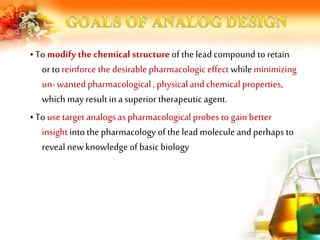
• To modify the chemical structure of the lead compound to retain
or to reinforce the desirable pharmacologic effect while minimizing
un-wanted pharmacological , physical and chemical properties,
which may result in a superior therapeuticagent.
• To use target analogs aspharmacological probes to gainbetter
insight into the pharmacology of the lead molecule and perhaps to
reveal new knowledge of basic biology
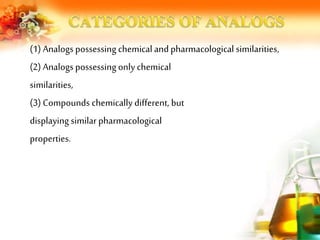
(1) Analogs possessing chemical andpharmacological similarities,
(2) Analogs possessing only chemical
similarities,
(3) Compounds chemically different, but
displaying similarpharmacological
properties.
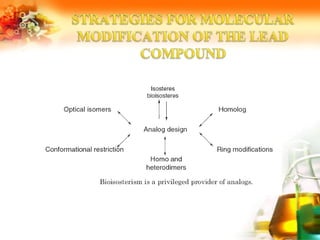
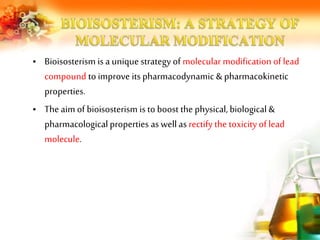
• Bioisosterism is a unique strategy of molecular modification of lead
compound to improve its pharmacodynamic & pharmacokinetic
properties.
• The aim of bioisosterism is to boost the physical, biological &
pharmacological properties aswell as rectify the toxicity of lead
molecule.
• In 1970, Alfred Burgerclassified and subdivided bioisosteres into two broad
categories: Classic and Non-Classic
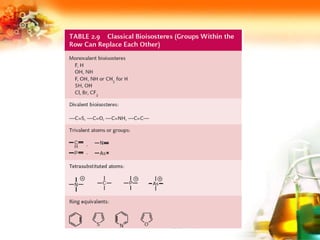
• Classical Bioisosteres are those which have similarstericandelectronic
featuresand have the samenumberofatomsasthesubstituentmoiety for
which they areused as a replacement.
• Classical bioisosteres havebeentraditionally divided into several distinct
categories:
 monovalent atoms orgroups
 divalent atoms or groups
 Trivalent atoms orgroups
 tetrasubstituted atoms; and
 Ring equivalents
 Nonclassical isosteres do notobey the steric and electronic definition of
classical isosteres. A second notable characteristic of nonclassical bioisosteres
is that they do not havethe same number of atoms as the substituent or
moiety for which they areused as a replacement.
 Nonclassical bioisosteres can befurther divided into groups:
(A) rings vs noncyclic structure
(B) exchangeablegroups.
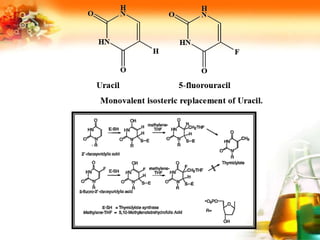
• FluorinevsHydrogenReplacements
Bioisosteric replacement of H in uracilby F gives 5-fluorouracil
(anti-cancer drug).
 StericallyH and F are quite similar with their vander wallsradii
being 1.2 and 1.35A° respectively.
F is most electronegative. H replacement with F alter the biological
activity as fluorine exerts strong field and inductive effects.
 The strong inductive effect of F results in covalent linkagewith
thymidylate synthetase, an enzyme involved in DNA synthesis.
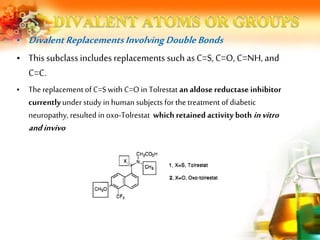
• Divalent ReplacementsInvolvingDoubleBonds
• This subclass includes replacements such asC=S, C=O, C=NH, and
C=C.
• Thereplacement of C=Swith C=Oin Tolrestat an aldose reductaseinhibitor
currentlyunder study in human subjects for the treatment of diabetic
neuropathy, resulted in oxo-Tolrestat which retained activity both invitro
andinvivo
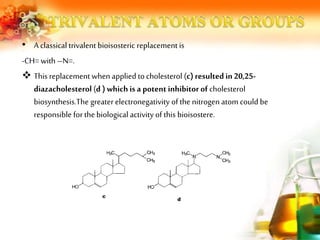
• A classical trivalent bioisosteric replacement is
-CH= with –N=.
 This replacement when applied to cholesterol (c) resulted in 20,25-
diazacholesterol (d ) which is a potent inhibitor of cholesterol
biosynthesis.The greater electronegativity of the nitrogen atom could be
responsible for the biological activity of this bioisostere.
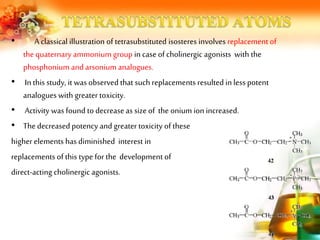
• A classical illustration of tetrasubstituted isosteres involves replacement of
the quaternary ammonium group in case of cholinergic agonists with the
phosphonium and arsonium analogues.
• In this study, it was observedthat suchreplacements resulted in less potent
analogues with greater toxicity.
• Activity was found to decrease as size of the onium ion increased.
• Thedecreased potency and greater toxicity of these
higherelements has diminished interest in
replacements of this type for the development of
direct-acting cholinergic agonists.
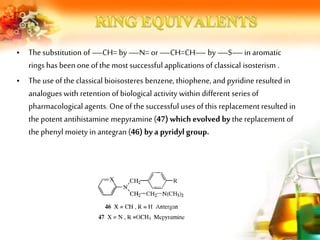
• Thesubstitution of —CH= by —N= or—CH=CH— by —S—in aromatic
rings has beenoneof the most successful applications of classical isosterism .
• Theuse of the classical bioisosteres benzene, thiophene, and pyridine resulted in
analogues with retention of biological activity within different series of
pharmacological agents. One of the successful uses of this replacement resulted in
the potent antihistamine mepyramine (47) which evolved by the replacement of
the phenyl moiety in antegran (46) by a pyridyl group.
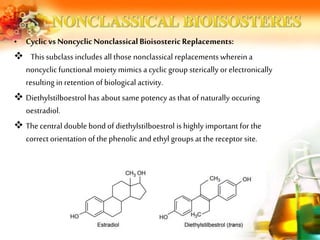
• Cyclic vs NoncyclicNonclassical Bioisosteric Replacements:
 This subclass includes all those nonclassical replacements wherein a
noncyclic functional moiety mimics a cyclic group sterically orelectronically
resulting in retention ofbiological activity.
 Diethylstilboestrol has about same potency as that of naturally occuring
oestradiol.
 Thecentral double bond of diethylstilboestrol is highly important for the
correctorientation ofthe phenolic and ethyl groups at the receptor site.
1. Hydroxyl Group Bioisosteres
2. Carbonyl Group Bioisosteres
3. Carboxylate Group Bioisosteres
4. Amide Group Bioisosteres
5. Thiourea Bioisosteres
6. Halogen Bioisosteres
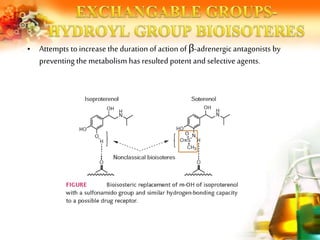
• Attempts to increase the duration of action of β-adrenergic antagonists by
preventing the metabolism has resulted potent and selective agents.
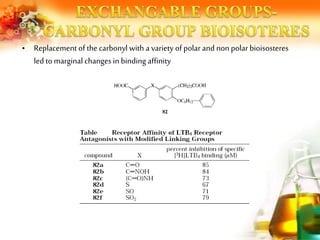
• Replacement of the carbonyl with a variety of polar and non polar bioisosteres
led to marginal changes in binding affinity
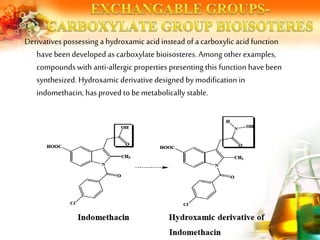
Derivatives possessing a hydroxamic acid instead of a carboxylic acid function
have beendeveloped as carboxylate bioisosteres. Among otherexamples,
compounds with anti-allergic properties presenting this function have been
synthesized. Hydroxamic derivative designed by modification in
indomethacin, has proved to bemetabolically stable.
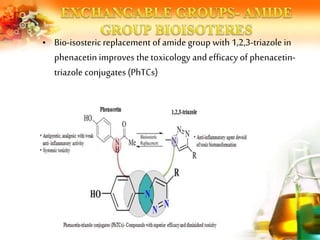
• Bio-isosteric replacement of amide group with 1,2,3-triazole in
phenacetin improves the toxicology and efficacy of phenacetin-
triazole conjugates (PhTCs)
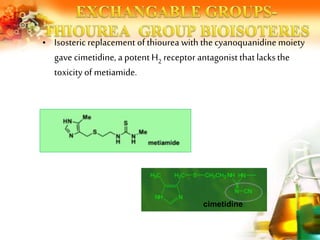
• Isosteric replacement of thiourea with the cyanoquanidine moiety
gave cimetidine, a potent H2 receptor antagonist that lacksthe
toxicity of metiamide.
cimetidine
• Replacements of this type were observed in a series of 1-[(2- hydroxyethoxy)
methyl]-5- benzyluracils that were tested for inhibition of liver uridine
phosphorylase (UrdPase) 35.
• This hypothesis was supported by the observation that replacement of the
chloro atom with stronger electronwithdrawing groups such as the cyano or
the trifluromethyl resulted in less potent analogues
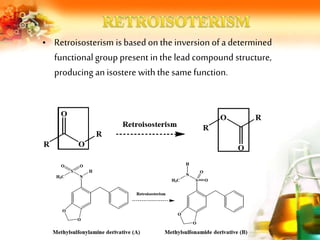
• Retroisosterism is based on the inversion of a determined
functional group present in the lead compound structure,
producing an isostere with the same function.
• Thesynthesis of bioisosteres is the most fruitful and can be considered as the
main provider for analog design.
• Bioisosteres modulate biological activity by virtue of subtle differences in their
physicochemical properties.
• Systematic correlation of physicochemical parameters with observed
biological activity has beenvery effective in highlighting subtle differences
within bioisosteric groups which often increase activity.
• Of significance is the ability of these bioisosteric groups to define some of the
essential requirements of the pharmacophore.
1. Burger, A. A Guide to the Chemical Basis of
Drug Design, NY, EUA,.Wiley, 1983; p. 24-29.
2. Gaikwad PL et al., The Use of Bioisosterism in
Drug Design and Molecular Modification.
American Journal of PharmTech Research 2012
3. Patani GA, LaVoie EJ. Bioisosterism: a rational
approach in drug design. Chem Rev 1996;
96(8):3147 – 76.
Analog design bioisosterism

Analog design bioisosterism

  • 1.
    Presentation by: Prabakaran.A M.Pharmacy SemI DEPARTMENT OFPHARMACEUTICAL CHEMISTRY C.L.BAID METHA COLLEGEOF PHARMACY
  • 2.
    Definition : • Analogdesign is usuallydefined as the modification of a drug molecule or of any bioactive compound in order to prepare a new molecule showing chemical and biological similarity with the original model compound • Finally,it hasto be noticed that analog design deals with the production of new chemical entities while drug repositioning targets new uses for old drugs
  • 3.
    • To modifythe chemical structure of the lead compound to retain or to reinforce the desirable pharmacologic effect while minimizing un-wanted pharmacological , physical and chemical properties, which may result in a superior therapeuticagent. • To use target analogs aspharmacological probes to gainbetter insight into the pharmacology of the lead molecule and perhaps to reveal new knowledge of basic biology
  • 4.
    (1) Analogs possessingchemical andpharmacological similarities, (2) Analogs possessing only chemical similarities, (3) Compounds chemically different, but displaying similarpharmacological properties.
  • 6.
    • Bioisosterism isa unique strategy of molecular modification of lead compound to improve its pharmacodynamic & pharmacokinetic properties. • The aim of bioisosterism is to boost the physical, biological & pharmacological properties aswell as rectify the toxicity of lead molecule.
  • 7.
    • In 1970,Alfred Burgerclassified and subdivided bioisosteres into two broad categories: Classic and Non-Classic • Classical Bioisosteres are those which have similarstericandelectronic featuresand have the samenumberofatomsasthesubstituentmoiety for which they areused as a replacement. • Classical bioisosteres havebeentraditionally divided into several distinct categories:  monovalent atoms orgroups  divalent atoms or groups  Trivalent atoms orgroups  tetrasubstituted atoms; and  Ring equivalents
  • 9.
     Nonclassical isosteresdo notobey the steric and electronic definition of classical isosteres. A second notable characteristic of nonclassical bioisosteres is that they do not havethe same number of atoms as the substituent or moiety for which they areused as a replacement.  Nonclassical bioisosteres can befurther divided into groups: (A) rings vs noncyclic structure (B) exchangeablegroups.
  • 10.
    • FluorinevsHydrogenReplacements Bioisosteric replacementof H in uracilby F gives 5-fluorouracil (anti-cancer drug).  StericallyH and F are quite similar with their vander wallsradii being 1.2 and 1.35A° respectively. F is most electronegative. H replacement with F alter the biological activity as fluorine exerts strong field and inductive effects.  The strong inductive effect of F results in covalent linkagewith thymidylate synthetase, an enzyme involved in DNA synthesis.
  • 12.
    • Divalent ReplacementsInvolvingDoubleBonds •This subclass includes replacements such asC=S, C=O, C=NH, and C=C. • Thereplacement of C=Swith C=Oin Tolrestat an aldose reductaseinhibitor currentlyunder study in human subjects for the treatment of diabetic neuropathy, resulted in oxo-Tolrestat which retained activity both invitro andinvivo
  • 13.
    • A classicaltrivalent bioisosteric replacement is -CH= with –N=.  This replacement when applied to cholesterol (c) resulted in 20,25- diazacholesterol (d ) which is a potent inhibitor of cholesterol biosynthesis.The greater electronegativity of the nitrogen atom could be responsible for the biological activity of this bioisostere.
  • 14.
    • A classicalillustration of tetrasubstituted isosteres involves replacement of the quaternary ammonium group in case of cholinergic agonists with the phosphonium and arsonium analogues. • In this study, it was observedthat suchreplacements resulted in less potent analogues with greater toxicity. • Activity was found to decrease as size of the onium ion increased. • Thedecreased potency and greater toxicity of these higherelements has diminished interest in replacements of this type for the development of direct-acting cholinergic agonists.
  • 15.
    • Thesubstitution of—CH= by —N= or—CH=CH— by —S—in aromatic rings has beenoneof the most successful applications of classical isosterism . • Theuse of the classical bioisosteres benzene, thiophene, and pyridine resulted in analogues with retention of biological activity within different series of pharmacological agents. One of the successful uses of this replacement resulted in the potent antihistamine mepyramine (47) which evolved by the replacement of the phenyl moiety in antegran (46) by a pyridyl group.
  • 16.
    • Cyclic vsNoncyclicNonclassical Bioisosteric Replacements:  This subclass includes all those nonclassical replacements wherein a noncyclic functional moiety mimics a cyclic group sterically orelectronically resulting in retention ofbiological activity.  Diethylstilboestrol has about same potency as that of naturally occuring oestradiol.  Thecentral double bond of diethylstilboestrol is highly important for the correctorientation ofthe phenolic and ethyl groups at the receptor site.
  • 17.
    1. Hydroxyl GroupBioisosteres 2. Carbonyl Group Bioisosteres 3. Carboxylate Group Bioisosteres 4. Amide Group Bioisosteres 5. Thiourea Bioisosteres 6. Halogen Bioisosteres
  • 18.
    • Attempts toincrease the duration of action of β-adrenergic antagonists by preventing the metabolism has resulted potent and selective agents.
  • 19.
    • Replacement ofthe carbonyl with a variety of polar and non polar bioisosteres led to marginal changes in binding affinity
  • 20.
    Derivatives possessing ahydroxamic acid instead of a carboxylic acid function have beendeveloped as carboxylate bioisosteres. Among otherexamples, compounds with anti-allergic properties presenting this function have been synthesized. Hydroxamic derivative designed by modification in indomethacin, has proved to bemetabolically stable.
  • 21.
    • Bio-isosteric replacementof amide group with 1,2,3-triazole in phenacetin improves the toxicology and efficacy of phenacetin- triazole conjugates (PhTCs)
  • 22.
    • Isosteric replacementof thiourea with the cyanoquanidine moiety gave cimetidine, a potent H2 receptor antagonist that lacksthe toxicity of metiamide. cimetidine
  • 23.
    • Replacements ofthis type were observed in a series of 1-[(2- hydroxyethoxy) methyl]-5- benzyluracils that were tested for inhibition of liver uridine phosphorylase (UrdPase) 35. • This hypothesis was supported by the observation that replacement of the chloro atom with stronger electronwithdrawing groups such as the cyano or the trifluromethyl resulted in less potent analogues
  • 24.
    • Retroisosterism isbased on the inversion of a determined functional group present in the lead compound structure, producing an isostere with the same function.
  • 25.
    • Thesynthesis ofbioisosteres is the most fruitful and can be considered as the main provider for analog design. • Bioisosteres modulate biological activity by virtue of subtle differences in their physicochemical properties. • Systematic correlation of physicochemical parameters with observed biological activity has beenvery effective in highlighting subtle differences within bioisosteric groups which often increase activity. • Of significance is the ability of these bioisosteric groups to define some of the essential requirements of the pharmacophore.
  • 26.
    1. Burger, A.A Guide to the Chemical Basis of Drug Design, NY, EUA,.Wiley, 1983; p. 24-29. 2. Gaikwad PL et al., The Use of Bioisosterism in Drug Design and Molecular Modification. American Journal of PharmTech Research 2012 3. Patani GA, LaVoie EJ. Bioisosterism: a rational approach in drug design. Chem Rev 1996; 96(8):3147 – 76.