BIOISOSTERISM
Submitted by
R. ANBARASAN
2ND M.Sc BIOTECHNOLOGY
ANNAMALAI UNIVERSITY
CONTENT
 Introduction
 Isometric replacement
 Utilization
 Classification
 Changes occur
 Reference
INTRODUCTION
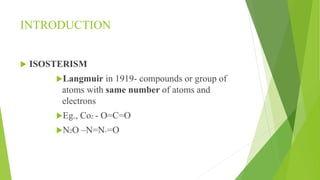
 ISOSTERISM
Langmuir in 1919- compounds or group of
atoms with same number of atoms and
electrons
Eg., Co2, - O=C=O
N2O –N=N+=O
 BIOISOSTERES- Burger defines, “substitute or groups
with chemical or physical similarities
 Produce similar biological properties
 Replacement or modification of functional group with
other having similar properties called bioisosteric
replacement
Why isosteric replacement?
 Greater selectivity
 Less side effects
 Deceased toxicity
 Improved pharmacokinetics
 Increase stability
UTILITY OF BIOISOSTERES
 Improving potency
 Enhancing selectivity
 Altering physical properties
 Reducing or redirecting metabolism
 Eliminating or modifying toxicophores
 Acquiring novel intellectual property
CLASSIFICATION
 Classified into two types:
Classical bioisosteres
Non classical bioisosteres
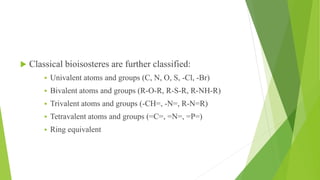
 Classical bioisosteres are further classified:
 Univalent atoms and groups (C, N, O, S, -Cl, -Br)
 Bivalent atoms and groups (R-O-R, R-S-R, R-NH-R)
 Trivalent atoms and groups (-CH=, -N=, R-N=R)
 Tetravalent atoms and groups (=C=, =N=, =P=)
 Ring equivalent
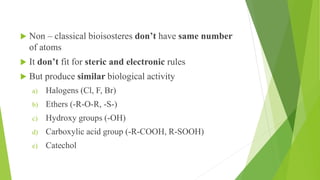
 Non – classical bioisosteres don’t have same number
of atoms
 It don’t fit for steric and electronic rules
 But produce similar biological activity
a) Halogens (Cl, F, Br)
b) Ethers (-R-O-R, -S-)
c) Hydroxy groups (-OH)
d) Carboxylic acid group (-R-COOH, R-SOOH)
e) Catechol
CHANGES OCCUR:
 Some changes resulting from bioisosteric replacement
1. Structural (size, shape, H-bonding)
2. Receptor interactions (lipid or water solubility)
3. Pharmacokinetics (lipophilicity, hydrophilicity, Pka, H-
bonding)
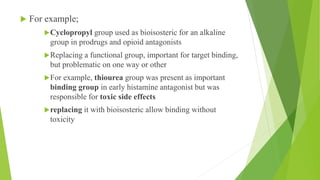
 For example;
Cyclopropyl group used as bioisosteric for an alkaline
group in prodrugs and opioid antagonists
Replacing a functional group, important for target binding,
but problematic on one way or other
For example, thiourea group was present as important
binding group in early histamine antagonist but was
responsible for toxic side effects
replacing it with bioisosteric allow binding without
toxicity
REFERENCE
 Prof. S.V. Amrutkar slideshare in SCRIBD
 www.tubakhanslideshare//slideshare.com
 Graham L.Patrick book An introduction to medical
chemistry

Bioisosterism - Introduction

  • 1.
    BIOISOSTERISM Submitted by R. ANBARASAN 2NDM.Sc BIOTECHNOLOGY ANNAMALAI UNIVERSITY
  • 2.
    CONTENT  Introduction  Isometricreplacement  Utilization  Classification  Changes occur  Reference
  • 3.
    INTRODUCTION  ISOSTERISM Langmuir in1919- compounds or group of atoms with same number of atoms and electrons Eg., Co2, - O=C=O N2O –N=N+=O
  • 4.
     BIOISOSTERES- Burgerdefines, “substitute or groups with chemical or physical similarities  Produce similar biological properties  Replacement or modification of functional group with other having similar properties called bioisosteric replacement
  • 5.
    Why isosteric replacement? Greater selectivity  Less side effects  Deceased toxicity  Improved pharmacokinetics  Increase stability
  • 6.
    UTILITY OF BIOISOSTERES Improving potency  Enhancing selectivity  Altering physical properties  Reducing or redirecting metabolism  Eliminating or modifying toxicophores  Acquiring novel intellectual property
  • 7.
    CLASSIFICATION  Classified intotwo types: Classical bioisosteres Non classical bioisosteres
  • 8.
     Classical bioisosteresare further classified:  Univalent atoms and groups (C, N, O, S, -Cl, -Br)  Bivalent atoms and groups (R-O-R, R-S-R, R-NH-R)  Trivalent atoms and groups (-CH=, -N=, R-N=R)  Tetravalent atoms and groups (=C=, =N=, =P=)  Ring equivalent
  • 9.
     Non –classical bioisosteres don’t have same number of atoms  It don’t fit for steric and electronic rules  But produce similar biological activity a) Halogens (Cl, F, Br) b) Ethers (-R-O-R, -S-) c) Hydroxy groups (-OH) d) Carboxylic acid group (-R-COOH, R-SOOH) e) Catechol
  • 10.
    CHANGES OCCUR:  Somechanges resulting from bioisosteric replacement 1. Structural (size, shape, H-bonding) 2. Receptor interactions (lipid or water solubility) 3. Pharmacokinetics (lipophilicity, hydrophilicity, Pka, H- bonding)
  • 11.
     For example; Cyclopropylgroup used as bioisosteric for an alkaline group in prodrugs and opioid antagonists Replacing a functional group, important for target binding, but problematic on one way or other For example, thiourea group was present as important binding group in early histamine antagonist but was responsible for toxic side effects replacing it with bioisosteric allow binding without toxicity
  • 13.
    REFERENCE  Prof. S.V.Amrutkar slideshare in SCRIBD  www.tubakhanslideshare//slideshare.com  Graham L.Patrick book An introduction to medical chemistry