OPIOID ANALGESICS
Dr. Anshu Dudhe
Professor,
Nagpur college of Pharmacy, Nagpur
NARCOTIC ANALGESICS
AGENTS/OPIOID ANALGESICS
 Analgesia (Pain): It is an illdefined, unpleasant
sensation usually evoked by an external or internal
noxious stimulus.
 Analgesics: These are the drugs tht selectively
relives the pain by acting in CNS or on peripheral
pain mechanism, without significantly altering
consciousness. These are divided into two group
 Opioids/Narcotic/Morphine like Analgesics: Opioid
analgesics are basically opium like alkaloid
obtained from poppy (Papaver somniferum)
capsules.
 Non-opioids/Non-narcotic/ Asprin like Analgesics
OPIOID ANALGESICS
 Opium: The dark brown resinous material
obtained from poppy (Papaver sominiferum). It
contain two types of alkaloids.
 Phenenthrene derivatives: Morphine (10% in
opium), Codeine (0.5% in opium), Thebain (0.2%
in opium),
 Benzoisoquinoline derivative: Papaverine (1%),
Noscapine (6%)
 The natural or synthetic agent that was derived
from morphine was termed as opioids or opiatcs..
 They are often known as norcotic analgesics due
to their ability to produce drug dependence.
 The other actions which are associated with
narcotic analgesics are sedation and constipation.
In therapeutic doses morphine sometimes
produce nausea or vomiting.
 The related compound apomorphine is a
powerful emetic agent
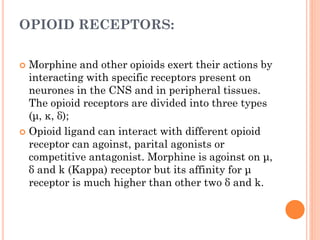
OPIOID RECEPTORS:
 Morphine and other opioids exert their actions by
interacting with specific receptors present on
neurones in the CNS and in peripheral tissues.
The opioid receptors are divided into three types
(μ, κ, δ);
 Opioid ligand can interact with different opioid
receptor can agoinst, parital agonists or
competitive antagonist. Morphine is agoinst on μ,
δ and k (Kappa) receptor but its affinity for μ
receptor is much higher than other two δ and k.
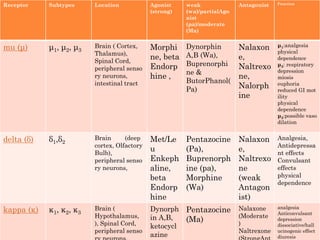
Receptor Subtypes Location Agonist
(strong)
weak
(wa)/partialAgo
nist
(pa)/moderate
(Ma)
Antagonist Function
mu (μ) μ1, μ2, μ3
Brain ( Cortex,
Thalamus),
Spinal Cord,
peripheral senso
ry neurons,
intestinal tract
Morphi
ne, beta
Endorp
hine ,
Dynorphin
A,B (Wa),
Buprenorphi
ne &
ButorPhanol(
Pa)
Nalaxon
e,
Naltrexo
ne,
Nalorph
ine
μ1:analgesia
physical
dependence
μ2: respiratory
depression
miosis
euphoria
reduced GI mot
ility
physical
dependence
μ3:possible vaso
dilation
delta (δ) δ1,δ2
Brain (deep
cortex, Olfactory
Bulb),
peripheral senso
ry neurons,
Met/Le
u
Enkeph
aline,
beta
Endorp
hine
Pentazocine
(Pa),
Buprenorph
ine (pa),
Morphine
(Wa)
Nalaxon
e,
Naltrexo
ne
(weak
Antagon
ist)
Analgesia,
Antidepressa
nt effects
Convulsant
effects
physical
dependence
kappa (κ) κ1, κ2, κ3
Brain (
Hypothalamus,
), Spinal Cord,
peripheral senso
Dynorph
in A,B,
ketocycl
azine
Pentazocine
(Ma)
Nalaxone
(Moderate
)
Naltrexone
analgesia
Anticonvulsant
depression
dissociative/hall
ucinogenic effect
diuresis
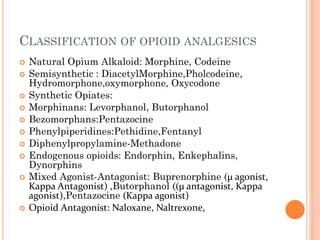
CLASSIFICATION OF OPIOID ANALGESICS
 Natural Opium Alkaloid: Morphine, Codeine
 Semisynthetic : DiacetylMorphine,Pholcodeine,
Hydromorphone,oxymorphone, Oxycodone
 Synthetic Opiates:
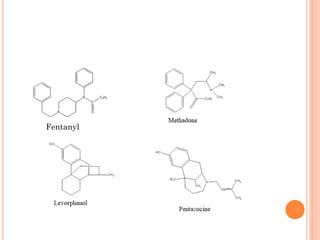
 Morphinans: Levorphanol, Butorphanol
 Bezomorphans:Pentazocine
 Phenylpiperidines:Pethidine,Fentanyl
 Diphenylpropylamine-Methadone
 Endogenous opioids: Endorphin, Enkephalins,
Dynorphins
 Mixed Agonist-Antagonist: Buprenorphine (μ agonist,
Kappa Antagonist) ,Butorphanol ((μ antagonist, Kappa
agonist),Pentazocine (Kappa agonist)
 Opioid Antagonist: Naloxane, Naltrexone,
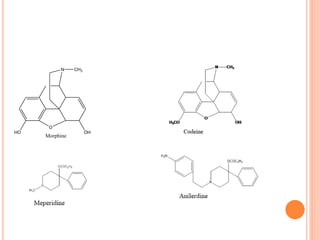
O
N
OH
HO
CH3
Morphine
Fentanyl
STRUCTURE ACTIVITY
RELATIONSHIP
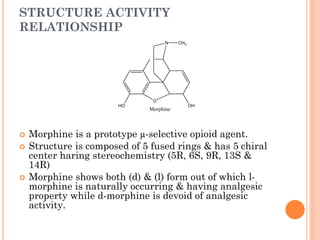
 Morphine is a prototype µ-selective opioid agent.
 Structure is composed of 5 fused rings & has 5 chiral
center haring stereochemistry (5R, 6S, 9R, 13S &
14R)
 Morphine shows both (d) & (l) form out of which l-
morphine is naturally occurring & having analgesic
property while d-morphine is devoid of analgesic
activity.
O
N
OH
HO
CH3
Morphine
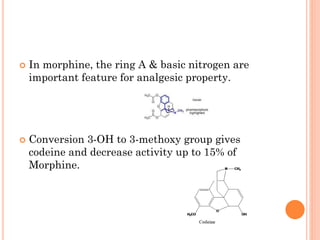
 In morphine, the ring A & basic nitrogen are
important feature for analgesic property.
 Conversion 3-OH to 3-methoxy group gives
codeine and decrease activity up to 15% of
Morphine.
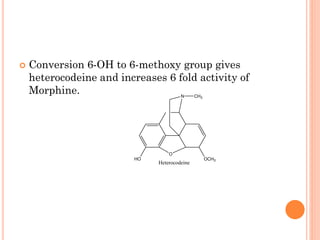
 Conversion 6-OH to 6-methoxy group gives
heterocodeine and increases 6 fold activity of
Morphine.
O
N
OCH3
HO
CH3
Heterocodeine
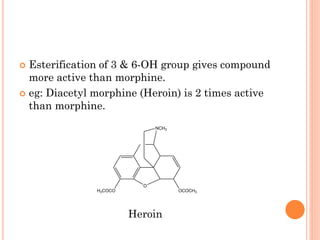
 Esterification of 3 & 6-OH group gives compound
more active than morphine.
 eg: Diacetyl morphine (Heroin) is 2 times active
than morphine.
Heroin
O
NCH3
OCOCH3
H3COCO
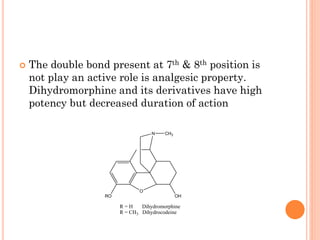
 The double bond present at 7th & 8th position is
not play an active role is analgesic property.
Dihydromorphine and its derivatives have high
potency but decreased duration of action
O
N
OH
RO
CH3
R = H Dihydromorphine
R = CH3 Dihydrocodeine
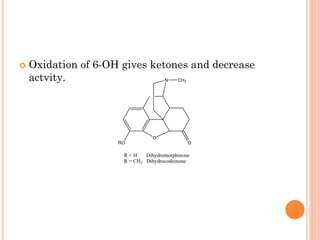
 Oxidation of 6-OH gives ketones and decrease
actvity.
O
N
O
RO
CH3
R = H Dihydromorphinone
R = CH3 Dihydrocodeinone
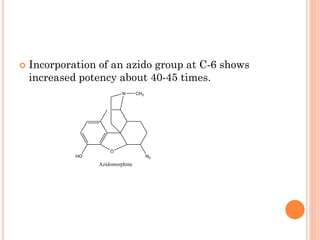
 Incorporation of an azido group at C-6 shows
increased potency about 40-45 times.
Azidomorphine
O
N
N3
HO
CH3
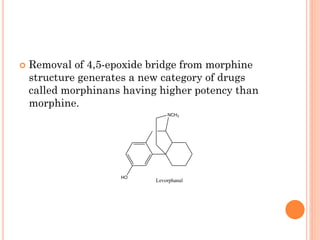
 Removal of 4,5-epoxide bridge from morphine
structure generates a new category of drugs
called morphinans having higher potency than
morphine.
Levorphanal
NCH3
HO
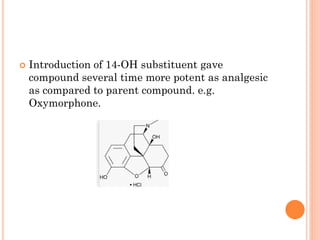
 Introduction of 14-OH substituent gave
compound several time more potent as analgesic
as compared to parent compound. e.g.
Oxymorphone.
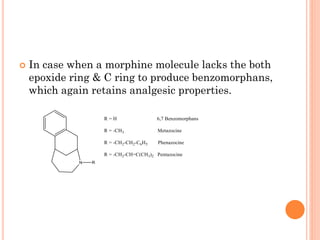
 In case when a morphine molecule lacks the both
epoxide ring & C ring to produce benzomorphans,
which again retains analgesic properties.
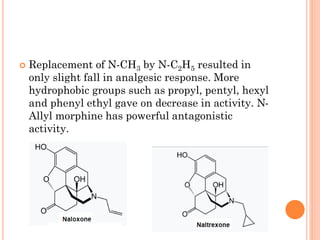
 Replacement of N-CH3 by N-C2H5 resulted in
only slight fall in analgesic response. More
hydrophobic groups such as propyl, pentyl, hexyl
and phenyl ethyl gave on decrease in activity. N-
Allyl morphine has powerful antagonistic
activity.
MORPHINE
 Morphine is principal alkaloid in opium and is widely
used till date.
 Morphine is still obtained from opium as the
laboratory synthesis of morphine is difficult. Codeine
is other alkaloid occurring in opium its amount is too
small to be commercial importance. Thus it is
commercially prepared from morphine by methylating
phenolic OH group at 3 position. Morphine is
powerful analgesic and narcotic. It depress CNS and
it also decresases gastric motility. It increases smooth
muscles tone.
 Morphine is used for symptomatic relief of moderate
to severe pain especially that associated with cancer
and for post operative pain. It is used as hypnotic,
suppression of cough and relief of anxiety. Morphine
is also used in the treatment of diarrhea.
CODEINE
 Codeine has less addiction property than
morphine probably due to decreased potency.
 Approximately 5% of codeine is metabolized to
morphine via O-demethylation. The enzyme
responsible for the O-demethylation of codeine is
cytochrome P450 (CYP) 2D6. Codeine is used a
weak analgesic (1/10 as Morphine.
 it is used in the form of syrup as codeine
phosphate for the relief of cough and as a tablet
for relief of mild to moderate pain.
MEPERIDINE HYDROCHLORIDE
(PETHIDINE)
 Meperidine was found to have low potency at the
receptor compared with morphine (0.2%)
.Meperidine is used for antispasmodic activity.
Meperidine quickly penetrates the blood-brain
barrier and thus has a quick onset of activity and
a high abuse potential.
 Pethidine is an opioid pain-relief medicine
Pethidine is now less frequently used because
newer, safer opioids are available. Pethidine is
sometimes to used to reduce labour pain in
childbirth.
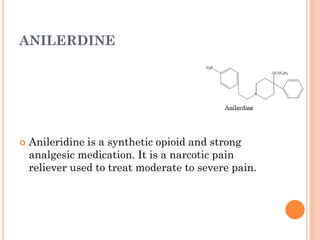
ANILERDINE
 Anileridine is a synthetic opioid and strong
analgesic medication. It is a narcotic pain
reliever used to treat moderate to severe pain.
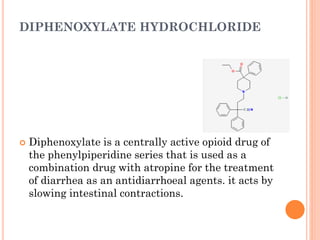
DIPHENOXYLATE HYDROCHLORIDE
 Diphenoxylate is a centrally active opioid drug of
the phenylpiperidine series that is used as a
combination drug with atropine for the treatment
of diarrhea as an antidiarrhoeal agents. it acts by
slowing intestinal contractions.
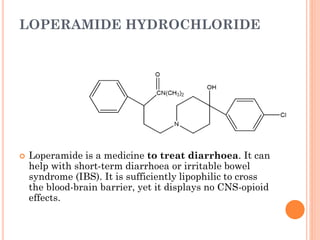
LOPERAMIDE HYDROCHLORIDE
 Loperamide is a medicine to treat diarrhoea. It can
help with short-term diarrhoea or irritable bowel
syndrome (IBS). It is sufficiently lipophilic to cross
the blood-brain barrier, yet it displays no CNS-opioid
effects.
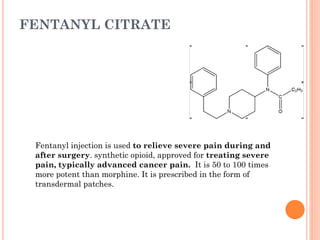
FENTANYL CITRATE
Fentanyl injection is used to relieve severe pain during and
after surgery. synthetic opioid, approved for treating severe
pain, typically advanced cancer pain. It is 50 to 100 times
more potent than morphine. It is prescribed in the form of
transdermal patches.
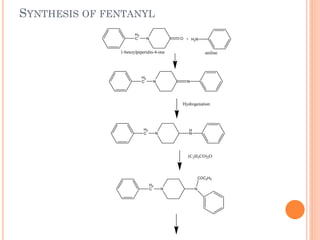
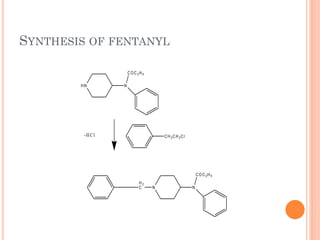
SYNTHESIS OF FENTANYL
H2
C N O + H2N
H2
C N N
Hydrogenation
1-benzylpiperidin-4-one aniline
H2
C N
H
N
(C2H5CO)2O
H2
C N N
COC2H5
SYNTHESIS OF FENTANYL
HN N
C O C 2H 5
C H 2C H 2C l
-HCl
N N
C O C 2H 5
H 2
C
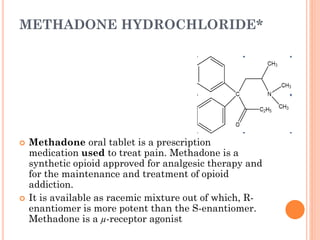
METHADONE HYDROCHLORIDE*
 Methadone oral tablet is a prescription
medication used to treat pain. Methadone is a
synthetic opioid approved for analgesic therapy and
for the maintenance and treatment of opioid
addiction.
 It is available as racemic mixture out of which, R-
enantiomer is more potent than the S-enantiomer.
Methadone is a µ-receptor agonist
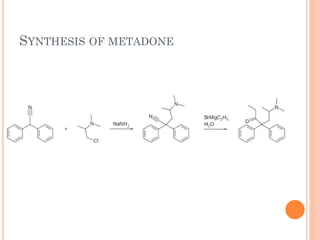
SYNTHESIS OF METADONE
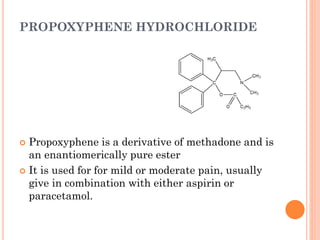
PROPOXYPHENE HYDROCHLORIDE
 Propoxyphene is a derivative of methadone and is
an enantiomerically pure ester
 It is used for for mild or moderate pain, usually
give in combination with either aspirin or
paracetamol.
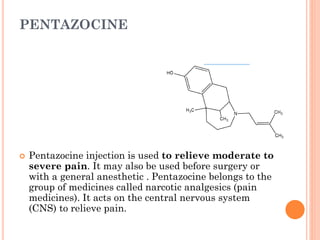
PENTAZOCINE
 Pentazocine injection is used to relieve moderate to
severe pain. It may also be used before surgery or
with a general anesthetic . Pentazocine belongs to the
group of medicines called narcotic analgesics (pain
medicines). It acts on the central nervous system
(CNS) to relieve pain.
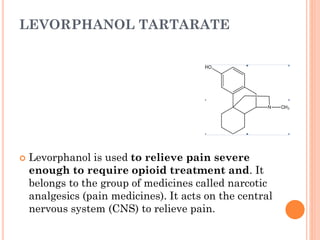
LEVORPHANOL TARTARATE
 Levorphanol is used to relieve pain severe
enough to require opioid treatment and. It
belongs to the group of medicines called narcotic
analgesics (pain medicines). It acts on the central
nervous system (CNS) to relieve pain.
MODE OF ACTION OF OPIOID ANALGESICS
 All 3 types of opioid receptors (μ, κ, δ) show their
action by G-protein coupled receptors located
mostly on prejunctional neurones.
 They generally produces inhibitory modulation
by decreasing release of the junctional
transmitters (NA, DA,5-HT,GABA and
Glutamate)
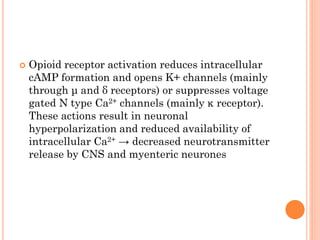
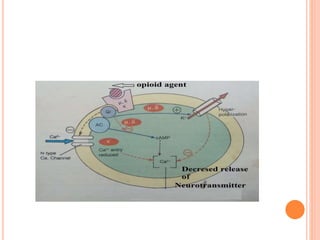
 Opioid receptor activation reduces intracellular
cAMP formation and opens K+ channels (mainly
through μ and δ receptors) or suppresses voltage
gated N type Ca2+ channels (mainly κ receptor).
These actions result in neuronal
hyperpolarization and reduced availability of
intracellular Ca2+ → decreased neurotransmitter
release by CNS and myenteric neurones
NARCOTIC ANTAGONISTS
 These are the agents which clinically cancel or
reverse most of the action of the opioid drugs.
They are used therapeutically in the treatment of
the overdose with opioids. These are classified as
 CLASSIFICATION
 Agonist-antagonists (κ analgesics)
 Nalorphine, Pentazocine, Butorphanol,
Levallorphan
 Partial/weak μ agonist + κ antagonist
 Buprenorphine
 Pure antagonists
 Naloxone, Naltrexone, Nalmefene
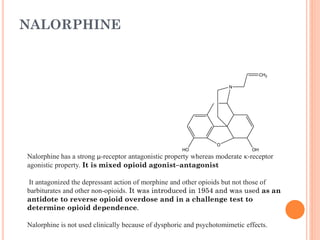
NALORPHINE
O
N
OH
HO
CH2
Nalorphine has a strong µ-receptor antagonistic property whereas moderate κ-receptor
agonistic property. It is mixed opioid agonist–antagonist
It antagonized the depressant action of morphine and other opioids but not those of
barbiturates and other non-opioids. It was introduced in 1954 and was used as an
antidote to reverse opioid overdose and in a challenge test to
determine opioid dependence.
Nalorphine is not used clinically because of dysphoric and psychotomimetic effects.
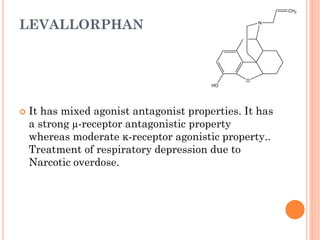
LEVALLORPHAN
 It has mixed agonist antagonist properties. It has
a strong µ-receptor antagonistic property
whereas moderate κ-receptor agonistic property..
Treatment of respiratory depression due to
Narcotic overdose.
O
N
HO
CH2
NALOXONE
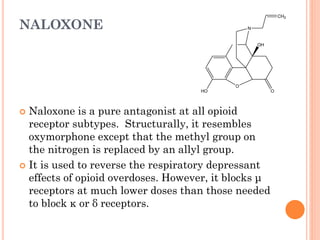
 Naloxone is a pure antagonist at all opioid
receptor subtypes. Structurally, it resembles
oxymorphone except that the methyl group on
the nitrogen is replaced by an allyl group.
 It is used to reverse the respiratory depressant
effects of opioid overdoses. However, it blocks μ
receptors at much lower doses than those needed
to block κ or δ receptors.
O
N
HO
CH2
O
OH

opioid Analgesics.pdf

  • 1.
    OPIOID ANALGESICS Dr. AnshuDudhe Professor, Nagpur college of Pharmacy, Nagpur
  • 2.
    NARCOTIC ANALGESICS AGENTS/OPIOID ANALGESICS Analgesia (Pain): It is an illdefined, unpleasant sensation usually evoked by an external or internal noxious stimulus.  Analgesics: These are the drugs tht selectively relives the pain by acting in CNS or on peripheral pain mechanism, without significantly altering consciousness. These are divided into two group  Opioids/Narcotic/Morphine like Analgesics: Opioid analgesics are basically opium like alkaloid obtained from poppy (Papaver somniferum) capsules.  Non-opioids/Non-narcotic/ Asprin like Analgesics
  • 3.
    OPIOID ANALGESICS  Opium:The dark brown resinous material obtained from poppy (Papaver sominiferum). It contain two types of alkaloids.  Phenenthrene derivatives: Morphine (10% in opium), Codeine (0.5% in opium), Thebain (0.2% in opium),  Benzoisoquinoline derivative: Papaverine (1%), Noscapine (6%)  The natural or synthetic agent that was derived from morphine was termed as opioids or opiatcs..
  • 4.
     They areoften known as norcotic analgesics due to their ability to produce drug dependence.  The other actions which are associated with narcotic analgesics are sedation and constipation. In therapeutic doses morphine sometimes produce nausea or vomiting.  The related compound apomorphine is a powerful emetic agent
  • 5.
    OPIOID RECEPTORS:  Morphineand other opioids exert their actions by interacting with specific receptors present on neurones in the CNS and in peripheral tissues. The opioid receptors are divided into three types (μ, κ, δ);  Opioid ligand can interact with different opioid receptor can agoinst, parital agonists or competitive antagonist. Morphine is agoinst on μ, δ and k (Kappa) receptor but its affinity for μ receptor is much higher than other two δ and k.
  • 6.
    Receptor Subtypes LocationAgonist (strong) weak (wa)/partialAgo nist (pa)/moderate (Ma) Antagonist Function mu (μ) μ1, μ2, μ3 Brain ( Cortex, Thalamus), Spinal Cord, peripheral senso ry neurons, intestinal tract Morphi ne, beta Endorp hine , Dynorphin A,B (Wa), Buprenorphi ne & ButorPhanol( Pa) Nalaxon e, Naltrexo ne, Nalorph ine μ1:analgesia physical dependence μ2: respiratory depression miosis euphoria reduced GI mot ility physical dependence μ3:possible vaso dilation delta (δ) δ1,δ2 Brain (deep cortex, Olfactory Bulb), peripheral senso ry neurons, Met/Le u Enkeph aline, beta Endorp hine Pentazocine (Pa), Buprenorph ine (pa), Morphine (Wa) Nalaxon e, Naltrexo ne (weak Antagon ist) Analgesia, Antidepressa nt effects Convulsant effects physical dependence kappa (κ) κ1, κ2, κ3 Brain ( Hypothalamus, ), Spinal Cord, peripheral senso Dynorph in A,B, ketocycl azine Pentazocine (Ma) Nalaxone (Moderate ) Naltrexone analgesia Anticonvulsant depression dissociative/hall ucinogenic effect diuresis
  • 7.
    CLASSIFICATION OF OPIOIDANALGESICS  Natural Opium Alkaloid: Morphine, Codeine  Semisynthetic : DiacetylMorphine,Pholcodeine, Hydromorphone,oxymorphone, Oxycodone  Synthetic Opiates:  Morphinans: Levorphanol, Butorphanol  Bezomorphans:Pentazocine  Phenylpiperidines:Pethidine,Fentanyl  Diphenylpropylamine-Methadone  Endogenous opioids: Endorphin, Enkephalins, Dynorphins  Mixed Agonist-Antagonist: Buprenorphine (μ agonist, Kappa Antagonist) ,Butorphanol ((μ antagonist, Kappa agonist),Pentazocine (Kappa agonist)  Opioid Antagonist: Naloxane, Naltrexone,
  • 8.
  • 9.
  • 10.
    STRUCTURE ACTIVITY RELATIONSHIP  Morphineis a prototype µ-selective opioid agent.  Structure is composed of 5 fused rings & has 5 chiral center haring stereochemistry (5R, 6S, 9R, 13S & 14R)  Morphine shows both (d) & (l) form out of which l- morphine is naturally occurring & having analgesic property while d-morphine is devoid of analgesic activity. O N OH HO CH3 Morphine
  • 11.
     In morphine,the ring A & basic nitrogen are important feature for analgesic property.  Conversion 3-OH to 3-methoxy group gives codeine and decrease activity up to 15% of Morphine.
  • 12.
     Conversion 6-OHto 6-methoxy group gives heterocodeine and increases 6 fold activity of Morphine. O N OCH3 HO CH3 Heterocodeine
  • 13.
     Esterification of3 & 6-OH group gives compound more active than morphine.  eg: Diacetyl morphine (Heroin) is 2 times active than morphine. Heroin O NCH3 OCOCH3 H3COCO
  • 14.
     The doublebond present at 7th & 8th position is not play an active role is analgesic property. Dihydromorphine and its derivatives have high potency but decreased duration of action O N OH RO CH3 R = H Dihydromorphine R = CH3 Dihydrocodeine
  • 15.
     Oxidation of6-OH gives ketones and decrease actvity. O N O RO CH3 R = H Dihydromorphinone R = CH3 Dihydrocodeinone
  • 16.
     Incorporation ofan azido group at C-6 shows increased potency about 40-45 times. Azidomorphine O N N3 HO CH3
  • 17.
     Removal of4,5-epoxide bridge from morphine structure generates a new category of drugs called morphinans having higher potency than morphine. Levorphanal NCH3 HO
  • 18.
     Introduction of14-OH substituent gave compound several time more potent as analgesic as compared to parent compound. e.g. Oxymorphone.
  • 19.
     In casewhen a morphine molecule lacks the both epoxide ring & C ring to produce benzomorphans, which again retains analgesic properties.
  • 20.
     Replacement ofN-CH3 by N-C2H5 resulted in only slight fall in analgesic response. More hydrophobic groups such as propyl, pentyl, hexyl and phenyl ethyl gave on decrease in activity. N- Allyl morphine has powerful antagonistic activity.
  • 21.
    MORPHINE  Morphine isprincipal alkaloid in opium and is widely used till date.  Morphine is still obtained from opium as the laboratory synthesis of morphine is difficult. Codeine is other alkaloid occurring in opium its amount is too small to be commercial importance. Thus it is commercially prepared from morphine by methylating phenolic OH group at 3 position. Morphine is powerful analgesic and narcotic. It depress CNS and it also decresases gastric motility. It increases smooth muscles tone.  Morphine is used for symptomatic relief of moderate to severe pain especially that associated with cancer and for post operative pain. It is used as hypnotic, suppression of cough and relief of anxiety. Morphine is also used in the treatment of diarrhea.
  • 22.
    CODEINE  Codeine hasless addiction property than morphine probably due to decreased potency.  Approximately 5% of codeine is metabolized to morphine via O-demethylation. The enzyme responsible for the O-demethylation of codeine is cytochrome P450 (CYP) 2D6. Codeine is used a weak analgesic (1/10 as Morphine.  it is used in the form of syrup as codeine phosphate for the relief of cough and as a tablet for relief of mild to moderate pain.
  • 23.
    MEPERIDINE HYDROCHLORIDE (PETHIDINE)  Meperidinewas found to have low potency at the receptor compared with morphine (0.2%) .Meperidine is used for antispasmodic activity. Meperidine quickly penetrates the blood-brain barrier and thus has a quick onset of activity and a high abuse potential.  Pethidine is an opioid pain-relief medicine Pethidine is now less frequently used because newer, safer opioids are available. Pethidine is sometimes to used to reduce labour pain in childbirth.
  • 24.
    ANILERDINE  Anileridine isa synthetic opioid and strong analgesic medication. It is a narcotic pain reliever used to treat moderate to severe pain.
  • 25.
    DIPHENOXYLATE HYDROCHLORIDE  Diphenoxylateis a centrally active opioid drug of the phenylpiperidine series that is used as a combination drug with atropine for the treatment of diarrhea as an antidiarrhoeal agents. it acts by slowing intestinal contractions.
  • 26.
    LOPERAMIDE HYDROCHLORIDE  Loperamideis a medicine to treat diarrhoea. It can help with short-term diarrhoea or irritable bowel syndrome (IBS). It is sufficiently lipophilic to cross the blood-brain barrier, yet it displays no CNS-opioid effects.
  • 27.
    FENTANYL CITRATE Fentanyl injectionis used to relieve severe pain during and after surgery. synthetic opioid, approved for treating severe pain, typically advanced cancer pain. It is 50 to 100 times more potent than morphine. It is prescribed in the form of transdermal patches.
  • 28.
    SYNTHESIS OF FENTANYL H2 CN O + H2N H2 C N N Hydrogenation 1-benzylpiperidin-4-one aniline H2 C N H N (C2H5CO)2O H2 C N N COC2H5
  • 29.
    SYNTHESIS OF FENTANYL HNN C O C 2H 5 C H 2C H 2C l -HCl N N C O C 2H 5 H 2 C
  • 30.
    METHADONE HYDROCHLORIDE*  Methadoneoral tablet is a prescription medication used to treat pain. Methadone is a synthetic opioid approved for analgesic therapy and for the maintenance and treatment of opioid addiction.  It is available as racemic mixture out of which, R- enantiomer is more potent than the S-enantiomer. Methadone is a µ-receptor agonist
  • 31.
  • 32.
    PROPOXYPHENE HYDROCHLORIDE  Propoxypheneis a derivative of methadone and is an enantiomerically pure ester  It is used for for mild or moderate pain, usually give in combination with either aspirin or paracetamol.
  • 33.
    PENTAZOCINE  Pentazocine injectionis used to relieve moderate to severe pain. It may also be used before surgery or with a general anesthetic . Pentazocine belongs to the group of medicines called narcotic analgesics (pain medicines). It acts on the central nervous system (CNS) to relieve pain.
  • 34.
    LEVORPHANOL TARTARATE  Levorphanolis used to relieve pain severe enough to require opioid treatment and. It belongs to the group of medicines called narcotic analgesics (pain medicines). It acts on the central nervous system (CNS) to relieve pain.
  • 35.
    MODE OF ACTIONOF OPIOID ANALGESICS  All 3 types of opioid receptors (μ, κ, δ) show their action by G-protein coupled receptors located mostly on prejunctional neurones.  They generally produces inhibitory modulation by decreasing release of the junctional transmitters (NA, DA,5-HT,GABA and Glutamate)
  • 36.
     Opioid receptoractivation reduces intracellular cAMP formation and opens K+ channels (mainly through μ and δ receptors) or suppresses voltage gated N type Ca2+ channels (mainly κ receptor). These actions result in neuronal hyperpolarization and reduced availability of intracellular Ca2+ → decreased neurotransmitter release by CNS and myenteric neurones
  • 38.
    NARCOTIC ANTAGONISTS  Theseare the agents which clinically cancel or reverse most of the action of the opioid drugs. They are used therapeutically in the treatment of the overdose with opioids. These are classified as  CLASSIFICATION  Agonist-antagonists (κ analgesics)  Nalorphine, Pentazocine, Butorphanol, Levallorphan  Partial/weak μ agonist + κ antagonist  Buprenorphine  Pure antagonists  Naloxone, Naltrexone, Nalmefene
  • 39.
    NALORPHINE O N OH HO CH2 Nalorphine has astrong µ-receptor antagonistic property whereas moderate κ-receptor agonistic property. It is mixed opioid agonist–antagonist It antagonized the depressant action of morphine and other opioids but not those of barbiturates and other non-opioids. It was introduced in 1954 and was used as an antidote to reverse opioid overdose and in a challenge test to determine opioid dependence. Nalorphine is not used clinically because of dysphoric and psychotomimetic effects.
  • 40.
    LEVALLORPHAN  It hasmixed agonist antagonist properties. It has a strong µ-receptor antagonistic property whereas moderate κ-receptor agonistic property.. Treatment of respiratory depression due to Narcotic overdose. O N HO CH2
  • 41.
    NALOXONE  Naloxone isa pure antagonist at all opioid receptor subtypes. Structurally, it resembles oxymorphone except that the methyl group on the nitrogen is replaced by an allyl group.  It is used to reverse the respiratory depressant effects of opioid overdoses. However, it blocks μ receptors at much lower doses than those needed to block κ or δ receptors. O N HO CH2 O OH