PREPARED BY : SUDAM G MULE
ANALGESICS
 Analgesia may be defined 'as a state of relative
insensitivity to pain, where the capacity to tolerate
pain is increased without the loss of
consciousness'.
Analgesics are agents that relieve pain without
disturbing consciousness or altering other sensory
modalities.
.
Analgesics are classified into two
major categories:
1) Opioid analgesics or Narcotic
analgesics ( centrally acting).
2) Non-opioid analgesics or Non-
narcotic analgesics ( peripherally
acting).
Opoid Analgesics/Narcotic
analgesic
 Opioid analgesics are drugs that shows the
action similar to the morphine , namely relief
from pain.
 Opioid analgesics are drugs that denote all
naturally occurring, semisynthetic and
synthetic drugs, which have a morphine-like
action, namely, relief from pain.
 Opium is a dark brown resinous material obtained
from the poppy (Papaver somniferum) capsule. It
has two types of alkaloids; Phenanthrene
derivatives and Benzoisoquinoline derivatives
 Sreturner, a pharmacist isolated the active
principle of opium in 1806 and named it morphine.
 Narcotic analgesic agents cause sleep in
conjunction with their analgesic effect. If a
narcotic is used for a long time, it may become
habit-forming (causing mental or psychological
dependence).
 Opioid drugs are not only used as analgesics, but also possess
numerous other useful properties. For example, morphine is
used to induce sleep in the presence of pain, diarrhoea,
suppress cough, and facilitate anaesthesia.
 The term opioid is used generally to designate collectively the
drugs, which bind specifically to any of the subspecies of the
receptors of morphine and produce morphine like actions.
 Side effects of opoids include, respiratory depression,
decreased gastrointestinal motility leading to constipation,
increased biliary tract pressure, and pruritis(itching of skin)
due to histamine release.
GENERAL MODE OFACTION
 Three classical opoid receptors
i) μ (mu),
ii) κ (kappa), and
iii) δ (delta)
 Recently, N/OFQ (nociceptin/orphan) receptor, a fourth class
has been identified.
 All these opoid receptors μ, κ, and δ are G protein coupled
receptors situated on prejunctional neurons.
 All these opoid receptors μ, κ, and δ are G protein
coupled receptors situated on prejunctional
neurons.
 They exert inhibitory modulations by decreasing
the release of junctional transmitter (i.e.
noradrenaline, dopamine, 5HT), and glutamate.
 Opoid receptors activation reduce intracellular
cAMP formation and open K+ channels or
suppress voltage gated N type Ca2+ channels.
These results in hyper-polarization in synaptic
junctions and decrease the neurotransmitter
release.
 Opioid binding to ion channel associated μ receptors inhibit the infl ux of calcium
ions into the presynaptic terminal and increase the outfl ow of K+ ions from the
postsynaptic membrane. This has the effect of reducing the release of the
neurotransmitter glutamate and hyperpolarizing the postsynaptic membrane.
Synaptic transmissionis inhibited.
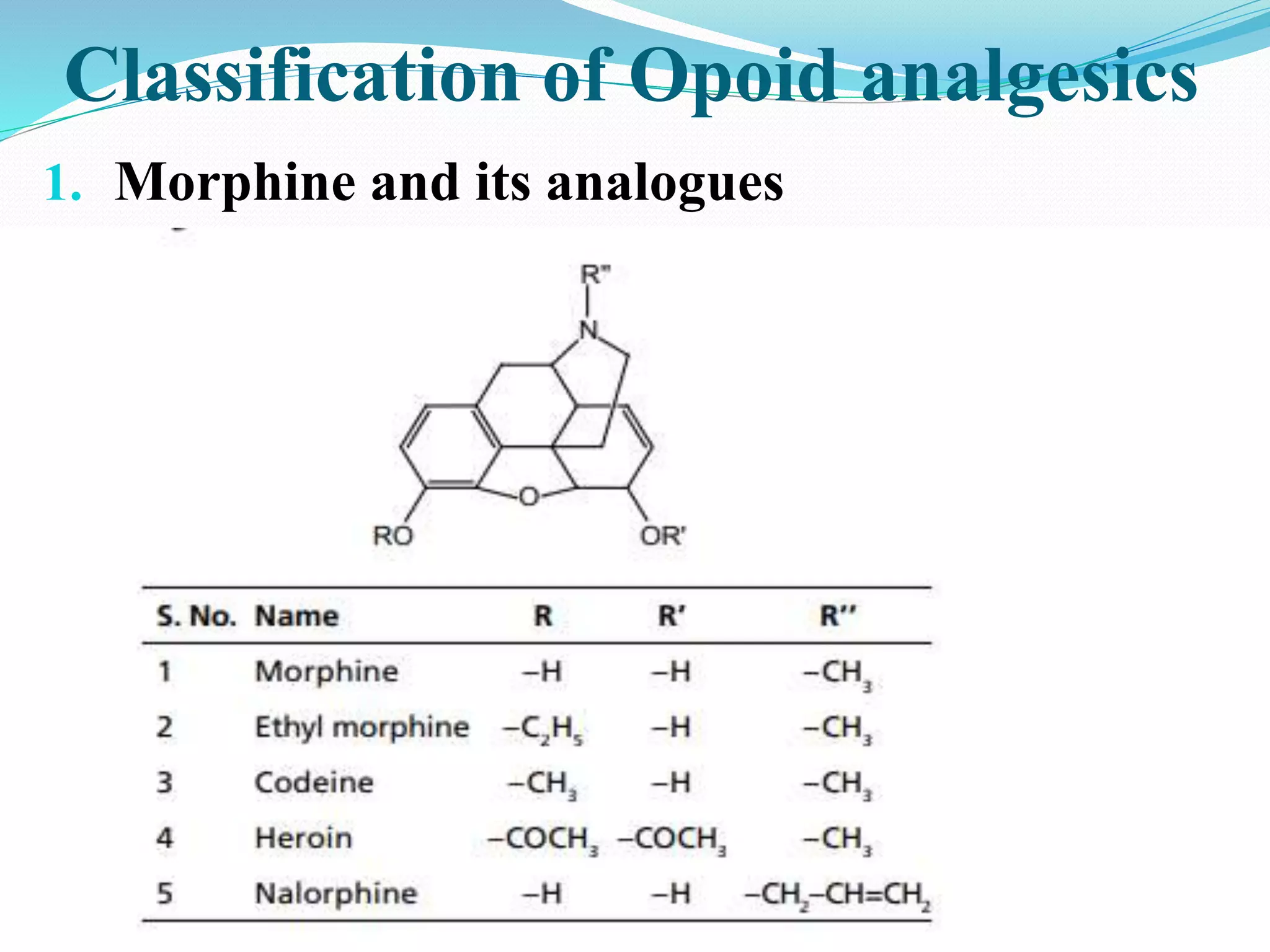
Classification of Opoid analgesics
1. Morphine and its analogues
a. Hydromorphone derivatives
 Ex:
b. Dihydromorphine derivatives
Ex:
2. Meperidine analogues
Ex:
3.Methadone analogues
Ex;
4.Morphinan analogues
Ex;
5.Benzazocin derivatives
Ex;
6.Miscellaneous
Ex;
STRUCTURE ACTIVITY RELATIONSHIP
(SAR)
 The structure–activity relationship (SAR) is
the relationship between the chemical structure
of a molecule and its biological activity.
 This idea was first presented by Crum-Brown
and Fraser in 1865
 The analysis of SAR enables the determination
of the chemical group responsible for evoking a
target biological effect in the organism.
 This allows modification of the effect or
the potency of a bioactive compound (typically
a drug) by changing its chemical structure.
 Medicinal chemists use the techniques
of chemical synthesis to insert new chemical
groups into the biomedical compound and test
the modifications for their biological effects.
SAR of Morphine
 SAR of Morphine was studied by
1. Modification of alicyclic ring
2. Modification on phenyl ring
3. Modification of 3o Nitrogen
1. Modification on alicyclic ring
 The alcoholic hydroxyl group at C-6 when methylated,
esterifi ed, oxydized, removed, or replaced by halogen
analgesic activity as well as toxicity of the compound
increased.
 The reduction of C-6 keto group to C-6 β hydroxyl in
oxymorphone gives Nalbupine, it shows antagonistic action
of μ receptors.
 The saturation of the double bond at C-7 position gives more
potent compound. Examples, Dihydro morphine and
Dihydro codeine.
 Bridging of C-6 and C-14 through ethylene linkage gives
potent derivatives.
2. Modification on phenyl ring
• An aromatic phenyl ring is essential for activity.
• Modifi cation on phenolic hydroxyl group decreases the
activity.
• Any other substitution on phenyl ring diminishes
activity.
3. Modification of 3° nitrogen
 A tertiary amine is usually necessary for good opioid
activity.
 The size of the N substitution can dictate the compounds
potency and its agonists.
 The N-methyl substitution is having good agonistic
property, when increased the size of the substitution by
3–5 carbons results in antagonistic activity.
SYNTHESIS
1) Fentanyl citrate
Synthesis
Properties and uses:
 It is a white or almost white powder soluble in water,
freely soluble in methanol, and sparingly soluble in
alcohol.
 Fentanyl is related to pethidine and also to basic
anilides with analgesic properties, and is characterized
by high potency, rapid onset, and short duration of
2) Methadone HCL
Synthesis
 Properties and uses:
 It is a white or almost white crystalline powder, freely
soluble in ethanol and soluble in water.
 Even methadone, which looks structurally different
from other opioid agonists, has steric forces that
produce a confi guration that closely resembles the
opioid agonists.
 Methadone is more active and more toxic than
morphine. It can be used for the relief of many types
of pain.
 In addition, it is used as narcotic substitute treatment
because it prevents morphine abstinence syndrome.

Opoid analgesics

  • 1.
    PREPARED BY :SUDAM G MULE
  • 2.
    ANALGESICS  Analgesia maybe defined 'as a state of relative insensitivity to pain, where the capacity to tolerate pain is increased without the loss of consciousness'. Analgesics are agents that relieve pain without disturbing consciousness or altering other sensory modalities. .
  • 3.
    Analgesics are classifiedinto two major categories: 1) Opioid analgesics or Narcotic analgesics ( centrally acting). 2) Non-opioid analgesics or Non- narcotic analgesics ( peripherally acting).
  • 4.
    Opoid Analgesics/Narcotic analgesic  Opioidanalgesics are drugs that shows the action similar to the morphine , namely relief from pain.  Opioid analgesics are drugs that denote all naturally occurring, semisynthetic and synthetic drugs, which have a morphine-like action, namely, relief from pain.
  • 5.
     Opium isa dark brown resinous material obtained from the poppy (Papaver somniferum) capsule. It has two types of alkaloids; Phenanthrene derivatives and Benzoisoquinoline derivatives  Sreturner, a pharmacist isolated the active principle of opium in 1806 and named it morphine.  Narcotic analgesic agents cause sleep in conjunction with their analgesic effect. If a narcotic is used for a long time, it may become habit-forming (causing mental or psychological dependence).
  • 6.
     Opioid drugsare not only used as analgesics, but also possess numerous other useful properties. For example, morphine is used to induce sleep in the presence of pain, diarrhoea, suppress cough, and facilitate anaesthesia.  The term opioid is used generally to designate collectively the drugs, which bind specifically to any of the subspecies of the receptors of morphine and produce morphine like actions.  Side effects of opoids include, respiratory depression, decreased gastrointestinal motility leading to constipation, increased biliary tract pressure, and pruritis(itching of skin) due to histamine release.
  • 7.
    GENERAL MODE OFACTION Three classical opoid receptors i) μ (mu), ii) κ (kappa), and iii) δ (delta)  Recently, N/OFQ (nociceptin/orphan) receptor, a fourth class has been identified.  All these opoid receptors μ, κ, and δ are G protein coupled receptors situated on prejunctional neurons.
  • 8.
     All theseopoid receptors μ, κ, and δ are G protein coupled receptors situated on prejunctional neurons.  They exert inhibitory modulations by decreasing the release of junctional transmitter (i.e. noradrenaline, dopamine, 5HT), and glutamate.  Opoid receptors activation reduce intracellular cAMP formation and open K+ channels or suppress voltage gated N type Ca2+ channels. These results in hyper-polarization in synaptic junctions and decrease the neurotransmitter release.
  • 9.
     Opioid bindingto ion channel associated μ receptors inhibit the infl ux of calcium ions into the presynaptic terminal and increase the outfl ow of K+ ions from the postsynaptic membrane. This has the effect of reducing the release of the neurotransmitter glutamate and hyperpolarizing the postsynaptic membrane. Synaptic transmissionis inhibited.
  • 10.
    Classification of Opoidanalgesics 1. Morphine and its analogues
  • 11.
  • 12.
  • 13.
  • 14.
  • 15.
  • 16.
  • 17.
  • 18.
    STRUCTURE ACTIVITY RELATIONSHIP (SAR) The structure–activity relationship (SAR) is the relationship between the chemical structure of a molecule and its biological activity.  This idea was first presented by Crum-Brown and Fraser in 1865  The analysis of SAR enables the determination of the chemical group responsible for evoking a target biological effect in the organism.
  • 19.
     This allowsmodification of the effect or the potency of a bioactive compound (typically a drug) by changing its chemical structure.  Medicinal chemists use the techniques of chemical synthesis to insert new chemical groups into the biomedical compound and test the modifications for their biological effects.
  • 20.
    SAR of Morphine SAR of Morphine was studied by 1. Modification of alicyclic ring 2. Modification on phenyl ring 3. Modification of 3o Nitrogen
  • 22.
    1. Modification onalicyclic ring  The alcoholic hydroxyl group at C-6 when methylated, esterifi ed, oxydized, removed, or replaced by halogen analgesic activity as well as toxicity of the compound increased.  The reduction of C-6 keto group to C-6 β hydroxyl in oxymorphone gives Nalbupine, it shows antagonistic action of μ receptors.  The saturation of the double bond at C-7 position gives more potent compound. Examples, Dihydro morphine and Dihydro codeine.
  • 23.
     Bridging ofC-6 and C-14 through ethylene linkage gives potent derivatives. 2. Modification on phenyl ring • An aromatic phenyl ring is essential for activity. • Modifi cation on phenolic hydroxyl group decreases the activity. • Any other substitution on phenyl ring diminishes activity.
  • 24.
    3. Modification of3° nitrogen  A tertiary amine is usually necessary for good opioid activity.  The size of the N substitution can dictate the compounds potency and its agonists.  The N-methyl substitution is having good agonistic property, when increased the size of the substitution by 3–5 carbons results in antagonistic activity.
  • 25.
  • 26.
  • 27.
    Properties and uses: It is a white or almost white powder soluble in water, freely soluble in methanol, and sparingly soluble in alcohol.  Fentanyl is related to pethidine and also to basic anilides with analgesic properties, and is characterized by high potency, rapid onset, and short duration of
  • 28.
  • 29.
  • 30.
     Properties anduses:  It is a white or almost white crystalline powder, freely soluble in ethanol and soluble in water.  Even methadone, which looks structurally different from other opioid agonists, has steric forces that produce a confi guration that closely resembles the opioid agonists.  Methadone is more active and more toxic than morphine. It can be used for the relief of many types of pain.  In addition, it is used as narcotic substitute treatment because it prevents morphine abstinence syndrome.