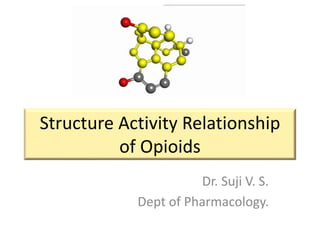
Structure Activity Relationship
of Opioids
Dr. Suji V. S.
Dept of Pharmacology.
Classification of opiods
based on structure
Eg.
Pentacyclic Morphines Codeine ,Buprenorphine,
Oxycodone, Diacetylmorphine
(Heroin)
Tetracyclic Morphinan Levorphanol, butorphanol
Tricyclic Benzazocine Pentazocine, Phenazocine
Bicyclic Phenylpiperidine Meperidine
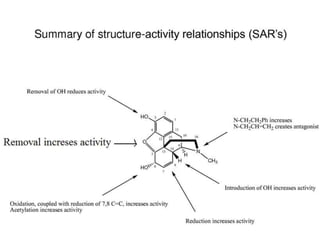
SAR
Modification to Morphine
Chiral centers
• Morphine has 5 Chiral centers.
• Only the Levo(-) rotatory isomer is active
Biological action of opiods
• depends on
1. Phenolic hydroxyl group
2. 6 hydroxyl
3. Double bond between 7 & 8 c
4. N-methyl group
5. Ether (E) bridge
6. Aromatic ring
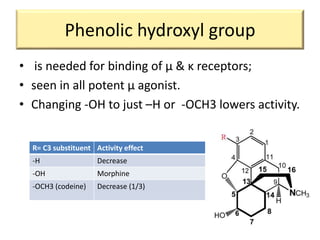
Phenolic hydroxyl group
• is needed for binding of μ & κ receptors;
• seen in all potent µ agonist.
• Changing -OH to just –H or -OCH3 lowers activity.
R= C3 substituent Activity effect
-H Decrease
-OH Morphine
-OCH3 (codeine) Decrease (1/3)
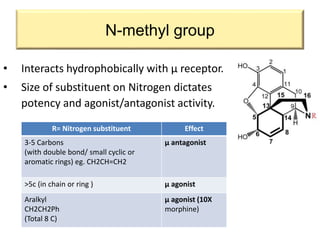
R= Nitrogen substituent Effect
3-5 Carbons
(with double bond/ small cyclic or
aromatic rings) eg. CH2CH=CH2
µ antagonist
>5c (in chain or ring ) µ agonist
Aralkyl
CH2CH2Ph
(Total 8 C)
µ agonist (10X
morphine)
N-methyl group
• Interacts hydrophobically with μ receptor.
• Size of substituent on Nitrogen dictates
potency and agonist/antagonist activity.
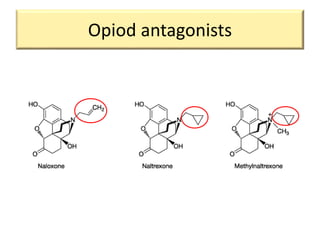
Opiod antagonists
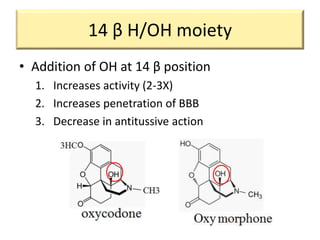
14 β H/OH moiety
• Addition of OH at 14 β position
1. Increases activity (2-3X)
2. Increases penetration of BBB
3. Decrease in antitussive action
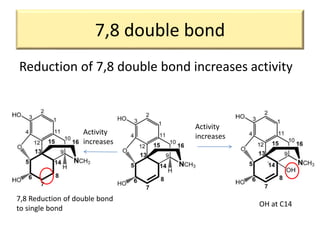
7,8 double bond
Reduction of 7,8 double bond increases activity
Activity
increases
Activity
increases
OH at C14
7,8 Reduction of double bond
to single bond
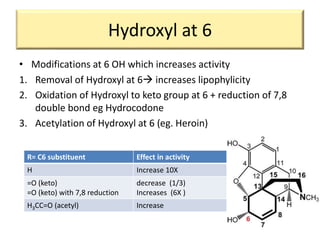
Hydroxyl at 6
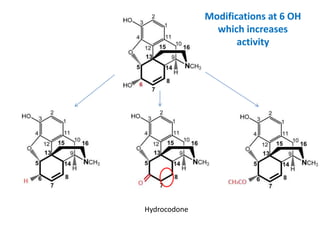
• Modifications at 6 OH which increases activity
1. Removal of Hydroxyl at 6 increases lipophylicity
2. Oxidation of Hydroxyl to keto group at 6 + reduction of 7,8
double bond eg Hydrocodone
3. Acetylation of Hydroxyl at 6 (eg. Heroin)
R= C6 substituent Effect in activity
H Increase 10X
=O (keto)
=O (keto) with 7,8 reduction
decrease (1/3)
Increases (6X )
H3CC=O (acetyl) Increase
Hydrocodone
Modifications at 6 OH
which increases
activity
Hydroxyl at 6
• Associated with mast cell degranulation 
Histamine release  allergic response
(eg . Codeine – so not given parentrally)
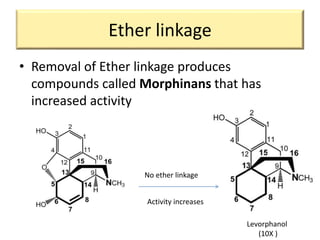
Ether linkage
• Removal of Ether linkage produces
compounds called Morphinans that has
increased activity
Activity increases
No ether linkage
Levorphanol
(10X )
Morphinans-
Levorphanol,
Potency high
Benzomorphine-
Pentazocine
Potency- low
4-Phenylpiperidines
Mepiridine
Potency low (1/10)
Loss of other rings doesn’t effect analgesic activity.
Aromatic rings
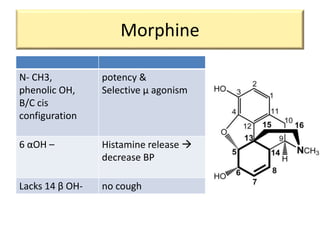
Morphine
N- CH3,
phenolic OH,
B/C cis
configuration
potency &
Selective μ agonism
6 αOH – Histamine release 
decrease BP
Lacks 14 β OH- no cough
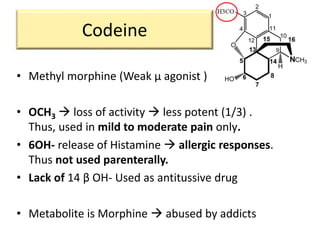
Codeine
• Methyl morphine (Weak µ agonist )
• OCH3  loss of activity  less potent (1/3) .
Thus, used in mild to moderate pain only.
• 6OH- release of Histamine  allergic responses.
Thus not used parenterally.
• Lack of 14 β OH- Used as antitussive drug
• Metabolite is Morphine  abused by addicts
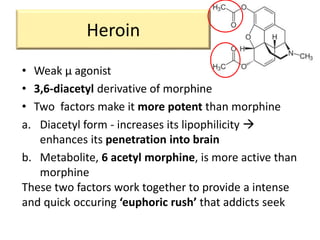
Heroin
• Weak μ agonist
• 3,6-diacetyl derivative of morphine
• Two factors make it more potent than morphine
a. Diacetyl form - increases its lipophilicity 
enhances its penetration into brain
b. Metabolite, 6 acetyl morphine, is more active than
morphine
These two factors work together to provide a intense
and quick occuring ‘euphoric rush’ that addicts seek
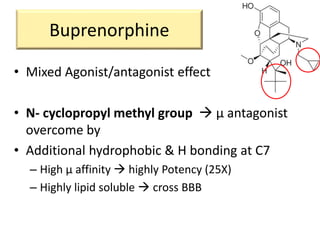
Buprenorphine
• Mixed Agonist/antagonist effect
• N- cyclopropyl methyl group  μ antagonist
overcome by
• Additional hydrophobic & H bonding at C7
– High μ affinity  highly Potency (25X)
– Highly lipid soluble  cross BBB
Pentazocine
• Benzomorphine (tricyclic)
• 1st agonist-antagonist to be used as analgesic
(κ agonist & µ antagonist)
• 5C N substitution  μ antagonist
• Missing 6 &7 carbons  compromises its
ability to interact with Receptors weak
analgesic effect (1/5X)
Tramadol
• Atypical opiod analgesic
•
• Dual action opiods
(-) isomer blocks norepinephrine reuptake
(+) isomer blocks serotonin reuptake 
analgesic activity. But effect is weak
• Metabolite is active - 1/35X
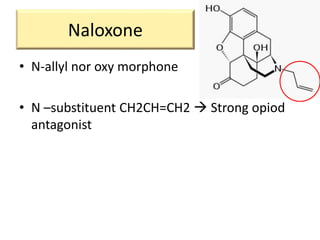
Naloxone
• N-allyl nor oxy morphone
• N –substituent CH2CH=CH2  Strong opiod
antagonist
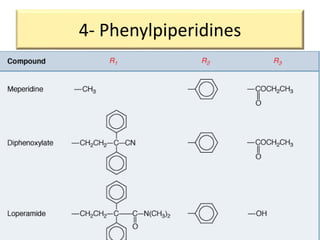
Phenylpiperidines
4- Phenylpiperidines
Phenylpiperidines
• Meperidine
• Diphenoxylate 2 important congeners
• Loperamide
• are MOR agonists
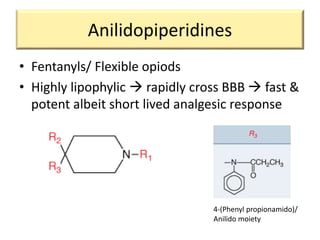
Anilidopiperidines
• Fentanyls/ Flexible opiods
• Highly lipophylic  rapidly cross BBB  fast &
potent albeit short lived analgesic response
4-(Phenyl propionamido)/
Anilido moiety
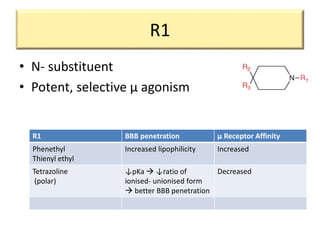
R1
• N- substituent
• Potent, selective μ agonism
R1 BBB penetration μ Receptor Affinity
Phenethyl
Thienyl ethyl
Increased lipophilicity Increased
Tetrazoline
(polar)
↓pKa  ↓ratio of
ionised- unionised form
 better BBB penetration
Decreased
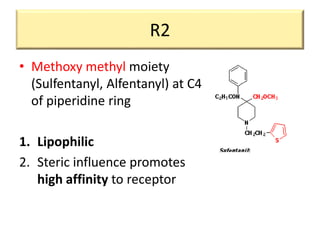
R2
• Methoxy methyl moiety
(Sulfentanyl, Alfentanyl) at C4
of piperidine ring
1. Lipophilic
2. Steric influence promotes
high affinity to receptor
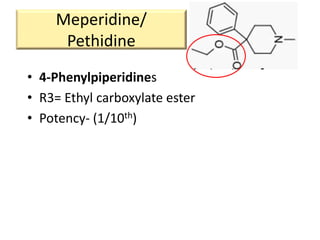
Meperidine/
Pethidine
• 4-Phenylpiperidines
• R3= Ethyl carboxylate ester
• Potency- (1/10th)
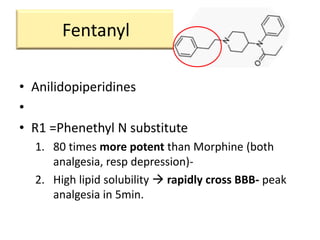
Fentanyl
• Anilidopiperidines
•
• R1 =Phenethyl N substitute
1. 80 times more potent than Morphine (both
analgesia, resp depression)-
2. High lipid solubility  rapidly cross BBB- peak
analgesia in 5min.
Thank you

Opiod Structure Activity Relationship

  • 1.
    Structure Activity Relationship ofOpioids Dr. Suji V. S. Dept of Pharmacology.
  • 2.
    Classification of opiods basedon structure Eg. Pentacyclic Morphines Codeine ,Buprenorphine, Oxycodone, Diacetylmorphine (Heroin) Tetracyclic Morphinan Levorphanol, butorphanol Tricyclic Benzazocine Pentazocine, Phenazocine Bicyclic Phenylpiperidine Meperidine
  • 3.
  • 4.
    Chiral centers • Morphinehas 5 Chiral centers. • Only the Levo(-) rotatory isomer is active
  • 5.
    Biological action ofopiods • depends on 1. Phenolic hydroxyl group 2. 6 hydroxyl 3. Double bond between 7 & 8 c 4. N-methyl group 5. Ether (E) bridge 6. Aromatic ring
  • 6.
    Phenolic hydroxyl group •is needed for binding of μ & κ receptors; • seen in all potent µ agonist. • Changing -OH to just –H or -OCH3 lowers activity. R= C3 substituent Activity effect -H Decrease -OH Morphine -OCH3 (codeine) Decrease (1/3)
  • 7.
    R= Nitrogen substituentEffect 3-5 Carbons (with double bond/ small cyclic or aromatic rings) eg. CH2CH=CH2 µ antagonist >5c (in chain or ring ) µ agonist Aralkyl CH2CH2Ph (Total 8 C) µ agonist (10X morphine) N-methyl group • Interacts hydrophobically with μ receptor. • Size of substituent on Nitrogen dictates potency and agonist/antagonist activity.
  • 8.
  • 9.
    14 β H/OHmoiety • Addition of OH at 14 β position 1. Increases activity (2-3X) 2. Increases penetration of BBB 3. Decrease in antitussive action
  • 10.
    7,8 double bond Reductionof 7,8 double bond increases activity Activity increases Activity increases OH at C14 7,8 Reduction of double bond to single bond
  • 11.
    Hydroxyl at 6 •Modifications at 6 OH which increases activity 1. Removal of Hydroxyl at 6 increases lipophylicity 2. Oxidation of Hydroxyl to keto group at 6 + reduction of 7,8 double bond eg Hydrocodone 3. Acetylation of Hydroxyl at 6 (eg. Heroin) R= C6 substituent Effect in activity H Increase 10X =O (keto) =O (keto) with 7,8 reduction decrease (1/3) Increases (6X ) H3CC=O (acetyl) Increase
  • 12.
    Hydrocodone Modifications at 6OH which increases activity
  • 13.
    Hydroxyl at 6 •Associated with mast cell degranulation  Histamine release  allergic response (eg . Codeine – so not given parentrally)
  • 14.
    Ether linkage • Removalof Ether linkage produces compounds called Morphinans that has increased activity Activity increases No ether linkage Levorphanol (10X )
  • 15.
    Morphinans- Levorphanol, Potency high Benzomorphine- Pentazocine Potency- low 4-Phenylpiperidines Mepiridine Potencylow (1/10) Loss of other rings doesn’t effect analgesic activity. Aromatic rings
  • 17.
    Morphine N- CH3, phenolic OH, B/Ccis configuration potency & Selective μ agonism 6 αOH – Histamine release  decrease BP Lacks 14 β OH- no cough
  • 18.
    Codeine • Methyl morphine(Weak µ agonist ) • OCH3  loss of activity  less potent (1/3) . Thus, used in mild to moderate pain only. • 6OH- release of Histamine  allergic responses. Thus not used parenterally. • Lack of 14 β OH- Used as antitussive drug • Metabolite is Morphine  abused by addicts
  • 19.
    Heroin • Weak μagonist • 3,6-diacetyl derivative of morphine • Two factors make it more potent than morphine a. Diacetyl form - increases its lipophilicity  enhances its penetration into brain b. Metabolite, 6 acetyl morphine, is more active than morphine These two factors work together to provide a intense and quick occuring ‘euphoric rush’ that addicts seek
  • 20.
    Buprenorphine • Mixed Agonist/antagonisteffect • N- cyclopropyl methyl group  μ antagonist overcome by • Additional hydrophobic & H bonding at C7 – High μ affinity  highly Potency (25X) – Highly lipid soluble  cross BBB
  • 21.
    Pentazocine • Benzomorphine (tricyclic) •1st agonist-antagonist to be used as analgesic (κ agonist & µ antagonist) • 5C N substitution  μ antagonist • Missing 6 &7 carbons  compromises its ability to interact with Receptors weak analgesic effect (1/5X)
  • 22.
    Tramadol • Atypical opiodanalgesic • • Dual action opiods (-) isomer blocks norepinephrine reuptake (+) isomer blocks serotonin reuptake  analgesic activity. But effect is weak • Metabolite is active - 1/35X
  • 23.
    Naloxone • N-allyl noroxy morphone • N –substituent CH2CH=CH2  Strong opiod antagonist
  • 24.
  • 25.
  • 26.
    Phenylpiperidines • Meperidine • Diphenoxylate2 important congeners • Loperamide • are MOR agonists
  • 27.
    Anilidopiperidines • Fentanyls/ Flexibleopiods • Highly lipophylic  rapidly cross BBB  fast & potent albeit short lived analgesic response 4-(Phenyl propionamido)/ Anilido moiety
  • 29.
    R1 • N- substituent •Potent, selective μ agonism R1 BBB penetration μ Receptor Affinity Phenethyl Thienyl ethyl Increased lipophilicity Increased Tetrazoline (polar) ↓pKa  ↓ratio of ionised- unionised form  better BBB penetration Decreased
  • 30.
    R2 • Methoxy methylmoiety (Sulfentanyl, Alfentanyl) at C4 of piperidine ring 1. Lipophilic 2. Steric influence promotes high affinity to receptor
  • 31.
    Meperidine/ Pethidine • 4-Phenylpiperidines • R3=Ethyl carboxylate ester • Potency- (1/10th)
  • 32.
    Fentanyl • Anilidopiperidines • • R1=Phenethyl N substitute 1. 80 times more potent than Morphine (both analgesia, resp depression)- 2. High lipid solubility  rapidly cross BBB- peak analgesia in 5min.
  • 33.

Editor's Notes

  • #30 Tetrazoline polar group ( strong electron withdrawing ring system)  ↓pKa  ↓ratio of ionised- unionised form  better BBB penetration ↓ratio of ionised- unionised form maintained at receptor surface ↓ cation available for ion- ion anchoring with recptor ↓μ Receptor affinity