Drugs Affecting
the Central Nervous System
Presented by,
ASWINI SASIDHARAN
DEPT. OF PHARMACEUTICAL CHEMISTRY
GRACE COLLEGE OF PHARMACY, PALAKKAD
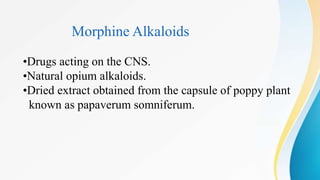
Morphine Alkaloids
•Drugs acting on the CNS.
•Natural opium alkaloids.
•Dried extract obtained from the capsule of poppy plant
known as papaverum somniferum.
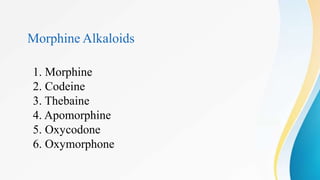
Morphine Alkaloids
1. Morphine
2. Codeine
3. Thebaine
4. Apomorphine
5. Oxycodone
6. Oxymorphone
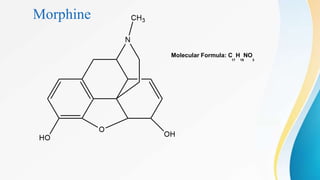
Morphine
Molecular Formula: C H NO
19
17 3
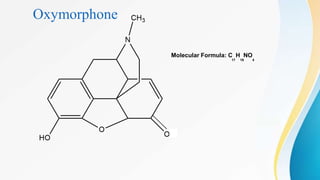
Oxymorphone
Molecular Formula: C H NO
19
17 4
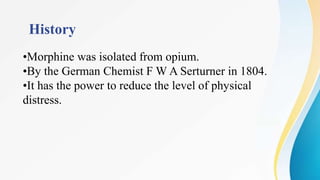
History
•Morphine was isolated from opium.
•By the German Chemist F W A Serturner in 1804.
•It has the power to reduce the level of physical
distress.
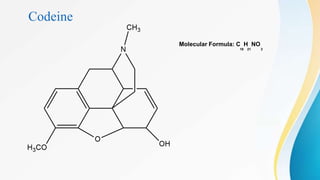
Codeine
Molecular Formula: C H NO
18 21 3
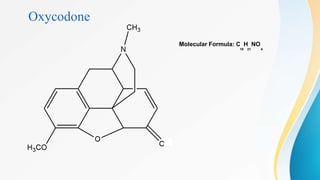
Oxycodone
Molecular Formula: C H NO
18 21 4
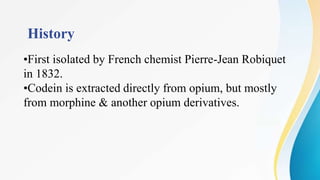
History
•First isolated by French chemist Pierre-Jean Robiquet
in 1832.
•Codein is extracted directly from opium, but mostly
from morphine & another opium derivatives.
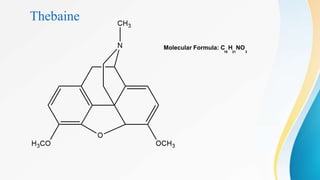
Thebaine
Molecular Formula: C H NO
19 21 3
History
•Thebaine (paramorphine), also known as Codeine
methyl enol ether.
•It is an opiate alkaloid.
•Name comes from the Greek word “Theber” an ancient
city in Upper Egypt.
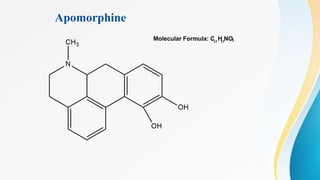
Apomorphine
Molecular Formula: C H NO
17 17 2
History
•The use of apomorphine was suggested by Weil in
France in 1884, although seemingly not pursued until
1951.
•Clinical use was reported in 1970.
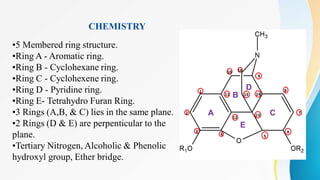
CHEMISTRY
A
B
C
D
E
•5 Membered ring structure.
•Ring A - Aromatic ring.
•Ring B - Cyclohexane ring.
•Ring C - Cyclohexene ring.
•Ring D - Pyridine ring.
•Ring E- Tetrahydro Furan Ring.
•3 Rings (A,B, & C) lies in the same plane.
•2 Rings (D & E) are perpenticular to the
plane.
•Tertiary Nitrogen, Alcoholic & Phenolic
hydroxyl group, Ether bridge.
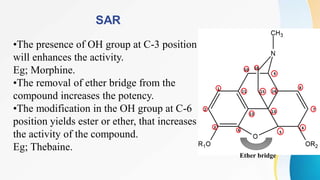
SAR
•The presence of OH group at C-3 position
will enhances the activity.
Eg; Morphine.
•The removal of ether bridge from the
compound increases the potency.
•The modification in the OH group at C-6
position yields ester or ether, that increases
the activity of the compound.
Eg; Thebaine.
Ether bridge
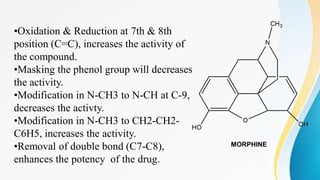
•Oxidation & Reduction at 7th & 8th
position (C=C), increases the activity of
the compound.
•Masking the phenol group will decreases
the activity.
•Modification in N-CH3 to N-CH at C-9,
decreases the activty.
•Modification in N-CH3 to CH2-CH2-
C6H5, increases the activity.
•Removal of double bond (C7-C8),
enhances the potency of the drug.
MORPHINE
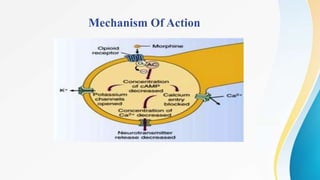
Mechanism Of Action
Uses
•Relieve moderate to severe pain (Analgesics).
•Relieve stuffy nose (Decongestants).
•Used for the pain relief in: Myocardial Infarction.
Long bone fracture.
Postoperative Patients.
Terminal stages of cancer.
Pulmonary embolism.
REFERENCES
1. Natural products chemistry- sources, separation & structure by Raymond Cooper &
George Nicola, Pageno; 91-95.
2.Textbook of medicinal chemistry, volume I by V Alagarsamy, Pageno; 247-252.
3.Wilson and Gisvolds Textbook of organic Medicinal Pharmaceutical chemistry, 12 th
Edition by John M Beale & John H Block, Pageno; 783-785.
4. Essential’s of pharmacology, 7th Edition by K D Thripathi.
THANK YOU

MORPHINE ALKALOIDS

  • 1.
    Drugs Affecting the CentralNervous System Presented by, ASWINI SASIDHARAN DEPT. OF PHARMACEUTICAL CHEMISTRY GRACE COLLEGE OF PHARMACY, PALAKKAD
  • 2.
    Morphine Alkaloids •Drugs actingon the CNS. •Natural opium alkaloids. •Dried extract obtained from the capsule of poppy plant known as papaverum somniferum.
  • 3.
    Morphine Alkaloids 1. Morphine 2.Codeine 3. Thebaine 4. Apomorphine 5. Oxycodone 6. Oxymorphone
  • 4.
  • 5.
  • 6.
    History •Morphine was isolatedfrom opium. •By the German Chemist F W A Serturner in 1804. •It has the power to reduce the level of physical distress.
  • 7.
  • 8.
  • 9.
    History •First isolated byFrench chemist Pierre-Jean Robiquet in 1832. •Codein is extracted directly from opium, but mostly from morphine & another opium derivatives.
  • 10.
  • 11.
    History •Thebaine (paramorphine), alsoknown as Codeine methyl enol ether. •It is an opiate alkaloid. •Name comes from the Greek word “Theber” an ancient city in Upper Egypt.
  • 12.
  • 13.
    History •The use ofapomorphine was suggested by Weil in France in 1884, although seemingly not pursued until 1951. •Clinical use was reported in 1970.
  • 14.
    CHEMISTRY A B C D E •5 Membered ringstructure. •Ring A - Aromatic ring. •Ring B - Cyclohexane ring. •Ring C - Cyclohexene ring. •Ring D - Pyridine ring. •Ring E- Tetrahydro Furan Ring. •3 Rings (A,B, & C) lies in the same plane. •2 Rings (D & E) are perpenticular to the plane. •Tertiary Nitrogen, Alcoholic & Phenolic hydroxyl group, Ether bridge.
  • 15.
    SAR •The presence ofOH group at C-3 position will enhances the activity. Eg; Morphine. •The removal of ether bridge from the compound increases the potency. •The modification in the OH group at C-6 position yields ester or ether, that increases the activity of the compound. Eg; Thebaine. Ether bridge
  • 16.
    •Oxidation & Reductionat 7th & 8th position (C=C), increases the activity of the compound. •Masking the phenol group will decreases the activity. •Modification in N-CH3 to N-CH at C-9, decreases the activty. •Modification in N-CH3 to CH2-CH2- C6H5, increases the activity. •Removal of double bond (C7-C8), enhances the potency of the drug. MORPHINE
  • 17.
  • 18.
    Uses •Relieve moderate tosevere pain (Analgesics). •Relieve stuffy nose (Decongestants). •Used for the pain relief in: Myocardial Infarction. Long bone fracture. Postoperative Patients. Terminal stages of cancer. Pulmonary embolism.
  • 19.
    REFERENCES 1. Natural productschemistry- sources, separation & structure by Raymond Cooper & George Nicola, Pageno; 91-95. 2.Textbook of medicinal chemistry, volume I by V Alagarsamy, Pageno; 247-252. 3.Wilson and Gisvolds Textbook of organic Medicinal Pharmaceutical chemistry, 12 th Edition by John M Beale & John H Block, Pageno; 783-785. 4. Essential’s of pharmacology, 7th Edition by K D Thripathi.
  • 20.