STRUCTURE ACTIVITY
RELATIONSHIP
Abdul Samad
Dr. Syed Badshah
1
 Structure
 Activity
 SAR (Discussion/Elaboration)
Contents
2
3
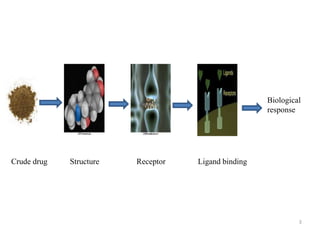
Crude drug Structure Ligand bindingReceptor
Biological
response
4
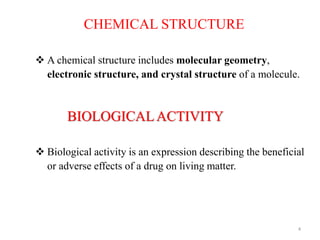
CHEMICAL STRUCTURE
 A chemical structure includes molecular geometry,
electronic structure, and crystal structure of a molecule.
BIOLOGICALACTIVITY
 Biological activity is an expression describing the beneficial
or adverse effects of a drug on living matter.
5
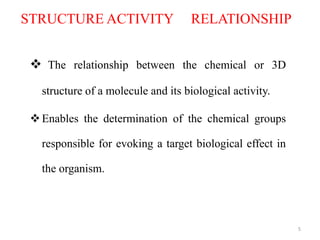
STRUCTURE ACTIVITY RELATIONSHIP
 The relationship between the chemical or 3D
structure of a molecule and its biological activity.
Enables the determination of the chemical groups
responsible for evoking a target biological effect in
the organism.
6
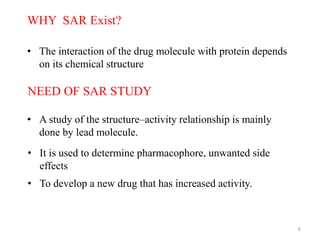
WHY SAR Exist?
• The interaction of the drug molecule with protein depends
on its chemical structure
NEED OF SAR STUDY
• A study of the structure–activity relationship is mainly
done by lead molecule.
• It is used to determine pharmacophore, unwanted side
effects
• To develop a new drug that has increased activity.
7
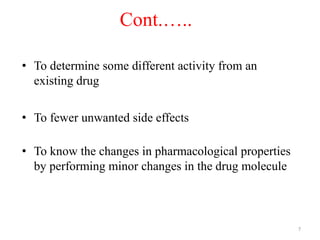
Cont.…..
• To determine some different activity from an
existing drug
• To fewer unwanted side effects
• To know the changes in pharmacological properties
by performing minor changes in the drug molecule
8
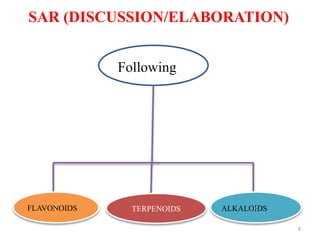
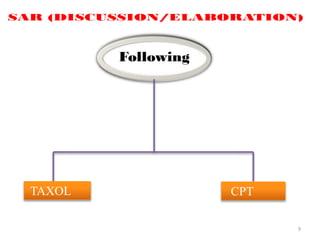
SAR (DISCUSSION/ELABORATION)
FFFFFFFFFFFFFFFFFollowing
cALKALOIDSCFLAVONOIDS TERPENOIDS
9
TAXOL CPT
10
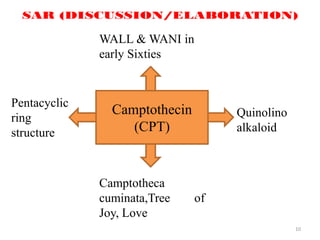
Camptothecin
(CPT)
WALL & WANI in
early Sixties
Camptotheca
cuminata,Tree of
Joy, Love
Quinolino
alkaloid
Pentacyclic
ring
structure
11
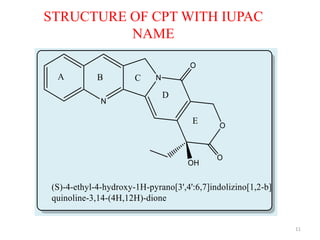
STRUCTURE OF CPT WITH IUPAC
NAME
12
A B C
D
E
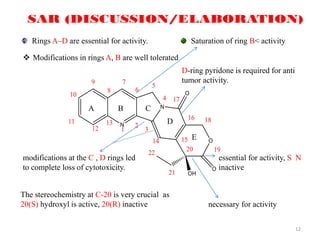
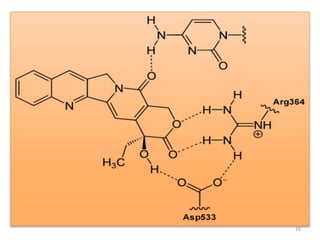
Rings A–D are essential for activity. Saturation of ring B< activity
necessary for activity
essential for activity, S N
inactive
D-ring pyridone is required for anti
tumor activity.
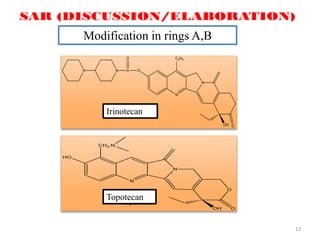
 Modifications in rings A, B are well tolerated
The stereochemistry at C-20 is very crucial as
20(S) hydroxyl is active, 20(R) inactive
modifications at the C , D rings led
to complete loss of cytotoxicity.
13
Modification in rings A,B
Topotecan
Irinotecan
14
Modification in rings C,D
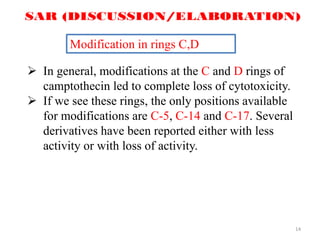
 In general, modifications at the C and D rings of
camptothecin led to complete loss of cytotoxicity.
 If we see these rings, the only positions available
for modifications are C-5, C-14 and C-17. Several
derivatives have been reported either with less
activity or with loss of activity.
15
Modification in ring E
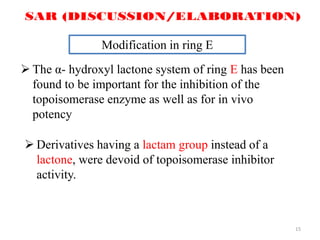
 The α- hydroxyl lactone system of ring E has been
found to be important for the inhibition of the
topoisomerase enzyme as well as for in vivo
potency
 Derivatives having a lactam group instead of a
lactone, were devoid of topoisomerase inhibitor
activity.
16
17
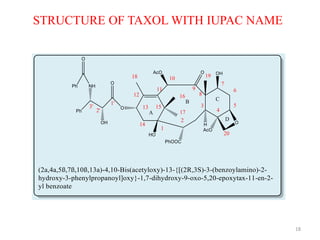
TAXOL
Taxol, paclitaxel, trade name taxol,
by Dr. WALL and Dr. WANI
Complex
polyoxygenated
diterpenoid
Pacific yew, Taxus
brevifolia
basic [9.3.1.0]
Pentadecane, tetracyclic
ring system.
N-benzoyl-b-phenyl
isoserine side chain, at
the C-13 hydroxyl as an
ester linkage.
18
STRUCTURE OF TAXOL WITH IUPAC NAME
19
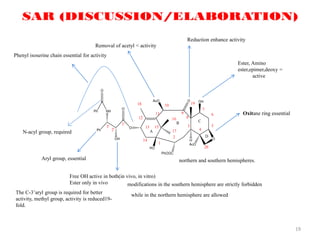
Oxitane ring essential
Ester, Amino
ester,epimer,deoxy =
active
Reduction enhance activity
Removal of acetyl < activity
Phenyl isoserine chain essential for activity
N-acyl group, required
Aryl group, essential
Free OH active in both(in vivo, in vitro)
Ester only in vivo
The C-3’aryl group is required for better
activity, methyl group, activity is reduced19-
fold.
northern and southern hemispheres.
modifications in the southern hemisphere are strictly forbidden
while in the northern hemisphere are allowed
20
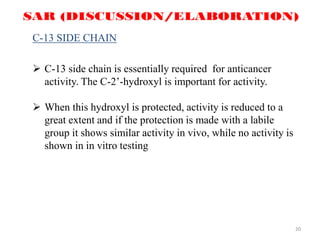
C-13 SIDE CHAIN
 C-13 side chain is essentially required for anticancer
activity. The C-2’-hydroxyl is important for activity.
 When this hydroxyl is protected, activity is reduced to a
great extent and if the protection is made with a labile
group it shows similar activity in vivo, while no activity is
shown in in vitro testing
21
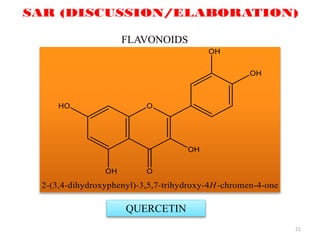
FLAVONOIDS
QUERCETIN
22
23
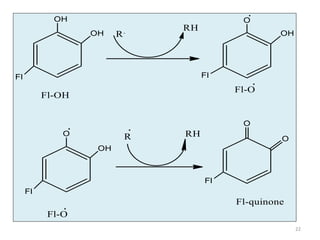
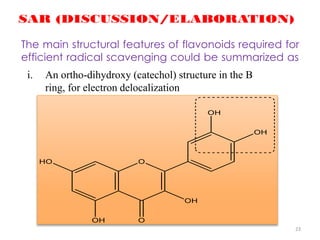
The main structural features of flavonoids required for
efficient radical scavenging could be summarized as
i. An ortho-dihydroxy (catechol) structure in the B
ring, for electron delocalization
24
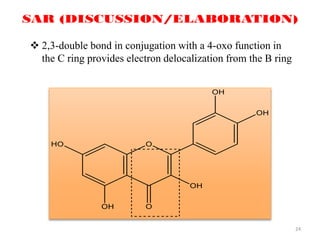
 2,3-double bond in conjugation with a 4-oxo function in
the C ring provides electron delocalization from the B ring
25
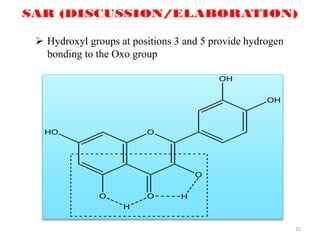
 Hydroxyl groups at positions 3 and 5 provide hydrogen
bonding to the Oxo group
26
THANK YOU

Structure activity relationship 6

  • 1.
  • 2.
     Structure  Activity SAR (Discussion/Elaboration) Contents 2
  • 3.
    3 Crude drug StructureLigand bindingReceptor Biological response
  • 4.
    4 CHEMICAL STRUCTURE  Achemical structure includes molecular geometry, electronic structure, and crystal structure of a molecule. BIOLOGICALACTIVITY  Biological activity is an expression describing the beneficial or adverse effects of a drug on living matter.
  • 5.
    5 STRUCTURE ACTIVITY RELATIONSHIP The relationship between the chemical or 3D structure of a molecule and its biological activity. Enables the determination of the chemical groups responsible for evoking a target biological effect in the organism.
  • 6.
    6 WHY SAR Exist? •The interaction of the drug molecule with protein depends on its chemical structure NEED OF SAR STUDY • A study of the structure–activity relationship is mainly done by lead molecule. • It is used to determine pharmacophore, unwanted side effects • To develop a new drug that has increased activity.
  • 7.
    7 Cont.….. • To determinesome different activity from an existing drug • To fewer unwanted side effects • To know the changes in pharmacological properties by performing minor changes in the drug molecule
  • 8.
  • 9.
  • 10.
    10 Camptothecin (CPT) WALL & WANIin early Sixties Camptotheca cuminata,Tree of Joy, Love Quinolino alkaloid Pentacyclic ring structure
  • 11.
    11 STRUCTURE OF CPTWITH IUPAC NAME
  • 12.
    12 A B C D E RingsA–D are essential for activity. Saturation of ring B< activity necessary for activity essential for activity, S N inactive D-ring pyridone is required for anti tumor activity.  Modifications in rings A, B are well tolerated The stereochemistry at C-20 is very crucial as 20(S) hydroxyl is active, 20(R) inactive modifications at the C , D rings led to complete loss of cytotoxicity.
  • 13.
    13 Modification in ringsA,B Topotecan Irinotecan
  • 14.
    14 Modification in ringsC,D  In general, modifications at the C and D rings of camptothecin led to complete loss of cytotoxicity.  If we see these rings, the only positions available for modifications are C-5, C-14 and C-17. Several derivatives have been reported either with less activity or with loss of activity.
  • 15.
    15 Modification in ringE  The α- hydroxyl lactone system of ring E has been found to be important for the inhibition of the topoisomerase enzyme as well as for in vivo potency  Derivatives having a lactam group instead of a lactone, were devoid of topoisomerase inhibitor activity.
  • 16.
  • 17.
    17 TAXOL Taxol, paclitaxel, tradename taxol, by Dr. WALL and Dr. WANI Complex polyoxygenated diterpenoid Pacific yew, Taxus brevifolia basic [9.3.1.0] Pentadecane, tetracyclic ring system. N-benzoyl-b-phenyl isoserine side chain, at the C-13 hydroxyl as an ester linkage.
  • 18.
    18 STRUCTURE OF TAXOLWITH IUPAC NAME
  • 19.
    19 Oxitane ring essential Ester,Amino ester,epimer,deoxy = active Reduction enhance activity Removal of acetyl < activity Phenyl isoserine chain essential for activity N-acyl group, required Aryl group, essential Free OH active in both(in vivo, in vitro) Ester only in vivo The C-3’aryl group is required for better activity, methyl group, activity is reduced19- fold. northern and southern hemispheres. modifications in the southern hemisphere are strictly forbidden while in the northern hemisphere are allowed
  • 20.
    20 C-13 SIDE CHAIN C-13 side chain is essentially required for anticancer activity. The C-2’-hydroxyl is important for activity.  When this hydroxyl is protected, activity is reduced to a great extent and if the protection is made with a labile group it shows similar activity in vivo, while no activity is shown in in vitro testing
  • 21.
  • 22.
  • 23.
    23 The main structuralfeatures of flavonoids required for efficient radical scavenging could be summarized as i. An ortho-dihydroxy (catechol) structure in the B ring, for electron delocalization
  • 24.
    24  2,3-double bondin conjugation with a 4-oxo function in the C ring provides electron delocalization from the B ring
  • 25.
    25  Hydroxyl groupsat positions 3 and 5 provide hydrogen bonding to the Oxo group
  • 26.