Fused Heterocyclic componds
Acridine
Lecture by
S.Mathivanan.,M.Pharm
Asst Professor
Pharmacy
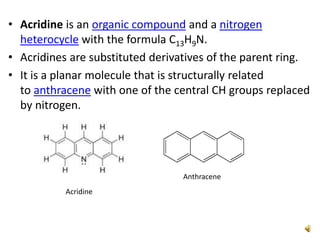
• Acridine is an organic compound and a nitrogen
heterocycle with the formula C13H9N.
• Acridines are substituted derivatives of the parent ring.
• It is a planar molecule that is structurally related
to anthracene with one of the central CH groups replaced
by nitrogen.
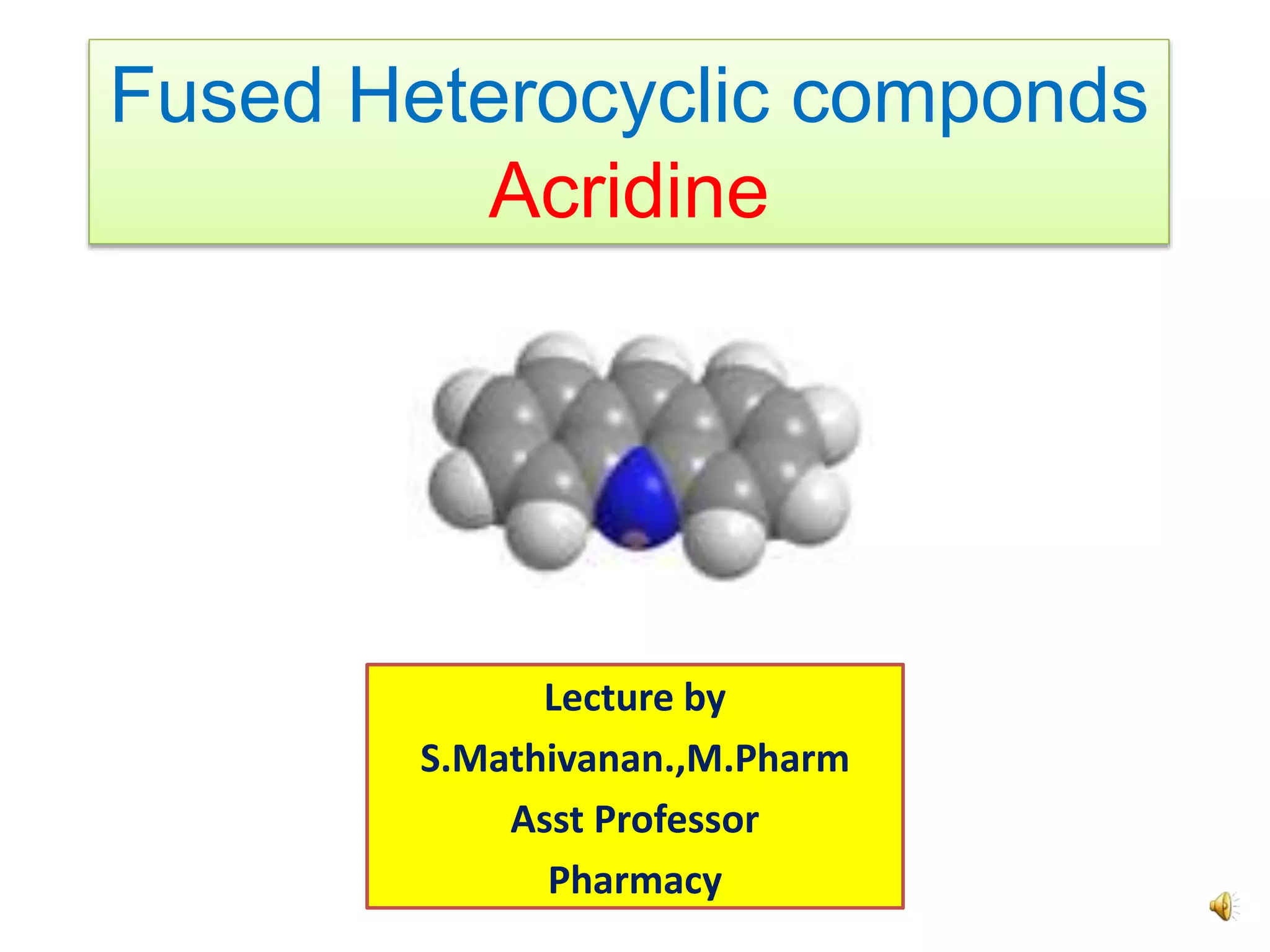
Acridine
Anthracene
• Chemically, acridine is an alkaloid from
anthracene.
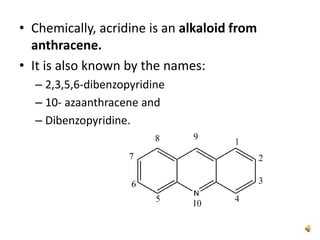
• It is also known by the names:
– 2,3,5,6-dibenzopyridine
– 10- azaanthracene and
– Dibenzopyridine.
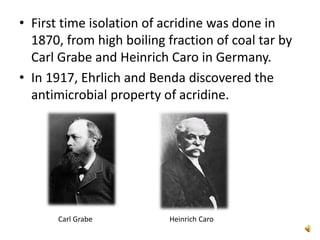
• First time isolation of acridine was done in
1870, from high boiling fraction of coal tar by
Carl Grabe and Heinrich Caro in Germany.
• In 1917, Ehrlich and Benda discovered the
antimicrobial property of acridine.
Carl Grabe Heinrich Caro
• The structure activity relationship of acridine
antibacterial was established by an Australian chemist
Adrien Albert.
• The finding of his study indicated that cationic
ionization and planar molecular surface area = 38 A is
necessary for antibacterial activity.
• During the World War II the scarcity of quinine lead to
discovery of acridine based, antimalarial drug
mepacrine.
• However, the contemporary antibacterial therapy
(sulfonamide, 1935 and penicillin, 1944) superseded
the acridine based therapy.
• But in present arena, massive increase in drug
resistance bacterial infections has attracted the
attention toward acridine once again
Physical properties
• Appearance : White powder
• Acridine has an irritating odor.
• It crystallizes in colorless to light yellow needles.
• Melting point : 110°C
• Boiling point : 346°C.
• Density : 1.005 g/cm3
• It is characterized by its irritating action on skin
and by the blue fluorescence showed by solutions
of its salts
Chemical properties:
1.Aromaticity :
• In acridine all ring atoms (13 carbons and 1 nitrogen)
are SP2 hybridized.
• Two SP2 orbitals on each atom overlap with each other
to form the C-C and C-N σ bonds.
• The third SP2 orbital on each carbon atom overlaps
with an S orbital of hydrogen and forms C-H σ bonds.
• The third SP2 orbital of nitrogen is occupied by the lone
pair of electron of nitrogen.
• Each ring atom in ring possess one un hybridized p –
orbital containing one electron and those are
perpendicular to the plane containing the σ bonds.
• Overlap of these p – orbitals produces
delocalized π – molecular orbital containing 14
electrons.
• Acridine shows aromatic properties because
the resulting molecular orbital satisfies the
Huckle’s rule (4n+2 rule).
• The nitrogen lone pair is not released into the
aromatic system.
• It is a planar molecule that is structurally
related to anthracene with one of the central
CH group is replaced by nitrogen.
2. Weakly Basic :
Acridine is separated from coal tar by shaking
out with dilute sulfuric acid, and then
precipitating from sulfuric acid solution with
potassium dichromate. The resulting acridine
dichromate is decomposed in the final step by
ammonia. Acridine and its homologues are
stable compounds of weakly basic character.
Acridine has a pKa value of 5.6, similar to that
of pyridine.
SYNTHESIS OF ACRIDINE
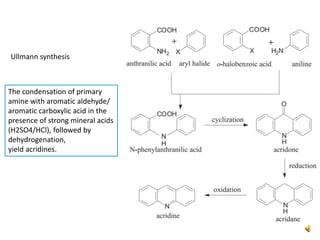
The condensation of primary
amine with aromatic aldehyde/
aromatic carboxylic acid in the
presence of strong mineral acids
(H2SO4/HCl), followed by
dehydrogenation,
yield acridines.
Ullmann synthesis
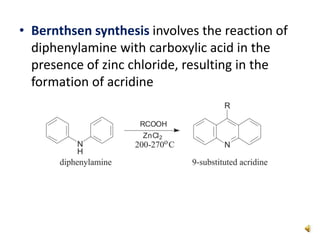
• Bernthsen synthesis involves the reaction of
diphenylamine with carboxylic acid in the
presence of zinc chloride, resulting in the
formation of acridine
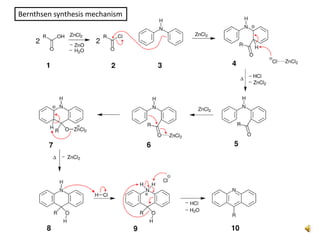
Bernthsen synthesis mechanism
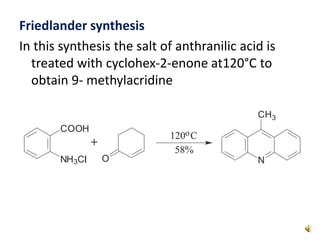
Friedlander synthesis
In this synthesis the salt of anthranilic acid is
treated with cyclohex-2-enone at120°C to
obtain 9- methylacridine
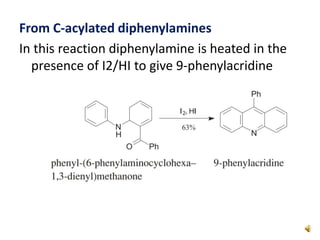
From C-acylated diphenylamines
In this reaction diphenylamine is heated in the
presence of I2/HI to give 9-phenylacridine
Reactions of Acridine
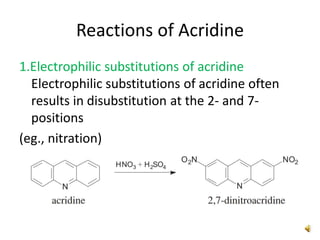
1.Electrophilic substitutions of acridine
Electrophilic substitutions of acridine often
results in disubstitution at the 2- and 7-
positions
(eg., nitration)
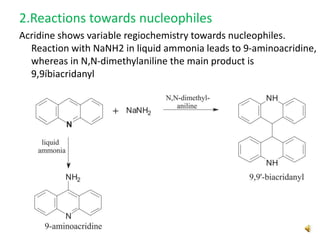
2.Reactions towards nucleophiles
Acridine shows variable regiochemistry towards nucleophiles.
Reaction with NaNH2 in liquid ammonia leads to 9-aminoacridine,
whereas in N,N-dimethylaniline the main product is
9,9íbiacridanyl
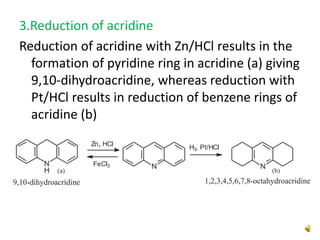
3.Reduction of acridine
Reduction of acridine with Zn/HCl results in the
formation of pyridine ring in acridine (a) giving
9,10-dihydroacridine, whereas reduction with
Pt/HCl results in reduction of benzene rings of
acridine (b)
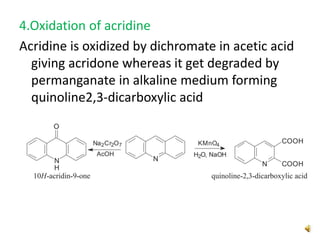
4.Oxidation of acridine
Acridine is oxidized by dichromate in acetic acid
giving acridone whereas it get degraded by
permanganate in alkaline medium forming
quinoline2,3-dicarboxylic acid
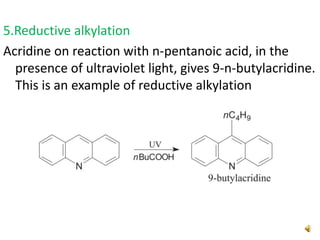
5.Reductive alkylation
Acridine on reaction with n-pentanoic acid, in the
presence of ultraviolet light, gives 9-n-butylacridine.
This is an example of reductive alkylation
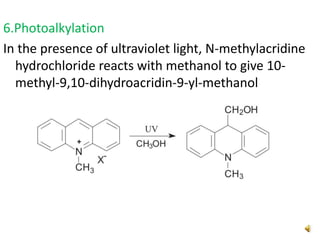
6.Photoalkylation
In the presence of ultraviolet light, N-methylacridine
hydrochloride reacts with methanol to give 10-
methyl-9,10-dihydroacridin-9-yl-methanol
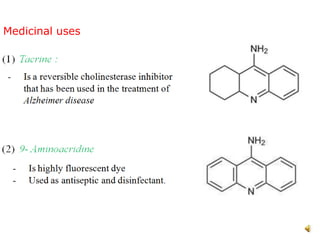
Medicinal uses
• Bucricaine [butyl-(1,2,3,4-tetrahydroacridin-9-
yl)- amine] is used topically for surface
anesthesia of eye and given by injection for
infilteration anesthesia, peripheral nerve block
and spinal anesthesia.
• Quinacrine [2-methoxy-6-chloro-9-(1-diethylamino-
3-methylpropanamine)-acridine] is also known as
mepacrine. It acts as gametocytocide. It destroy the
sexual erythrocytic forms of plasmodia and act as
antimalarial agent
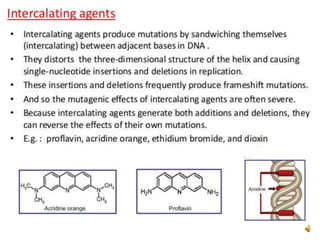
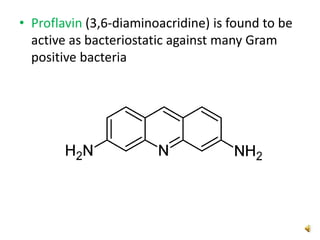
• Proflavin (3,6-diaminoacridine) is found to be
active as bacteriostatic against many Gram
positive bacteria
• Nitracrine [1-nitro-9-
(dimethylaminopropylamino)acridine] causes the
DNA damage and acts as an anticancer agent
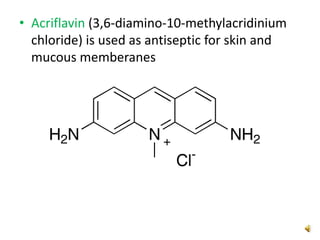
• Acriflavin (3,6-diamino-10-methylacridinium
chloride) is used as antiseptic for skin and
mucous memberanes
Stay Home...Stay safe...!!!

Fused heterocyclic componds acridine

  • 1.
    Fused Heterocyclic componds Acridine Lectureby S.Mathivanan.,M.Pharm Asst Professor Pharmacy
  • 2.
    • Acridine isan organic compound and a nitrogen heterocycle with the formula C13H9N. • Acridines are substituted derivatives of the parent ring. • It is a planar molecule that is structurally related to anthracene with one of the central CH groups replaced by nitrogen. Acridine Anthracene
  • 3.
    • Chemically, acridineis an alkaloid from anthracene. • It is also known by the names: – 2,3,5,6-dibenzopyridine – 10- azaanthracene and – Dibenzopyridine.
  • 5.
    • First timeisolation of acridine was done in 1870, from high boiling fraction of coal tar by Carl Grabe and Heinrich Caro in Germany. • In 1917, Ehrlich and Benda discovered the antimicrobial property of acridine. Carl Grabe Heinrich Caro
  • 6.
    • The structureactivity relationship of acridine antibacterial was established by an Australian chemist Adrien Albert. • The finding of his study indicated that cationic ionization and planar molecular surface area = 38 A is necessary for antibacterial activity. • During the World War II the scarcity of quinine lead to discovery of acridine based, antimalarial drug mepacrine. • However, the contemporary antibacterial therapy (sulfonamide, 1935 and penicillin, 1944) superseded the acridine based therapy. • But in present arena, massive increase in drug resistance bacterial infections has attracted the attention toward acridine once again
  • 7.
    Physical properties • Appearance: White powder • Acridine has an irritating odor. • It crystallizes in colorless to light yellow needles. • Melting point : 110°C • Boiling point : 346°C. • Density : 1.005 g/cm3 • It is characterized by its irritating action on skin and by the blue fluorescence showed by solutions of its salts
  • 8.
    Chemical properties: 1.Aromaticity : •In acridine all ring atoms (13 carbons and 1 nitrogen) are SP2 hybridized. • Two SP2 orbitals on each atom overlap with each other to form the C-C and C-N σ bonds. • The third SP2 orbital on each carbon atom overlaps with an S orbital of hydrogen and forms C-H σ bonds. • The third SP2 orbital of nitrogen is occupied by the lone pair of electron of nitrogen. • Each ring atom in ring possess one un hybridized p – orbital containing one electron and those are perpendicular to the plane containing the σ bonds.
  • 9.
    • Overlap ofthese p – orbitals produces delocalized π – molecular orbital containing 14 electrons. • Acridine shows aromatic properties because the resulting molecular orbital satisfies the Huckle’s rule (4n+2 rule). • The nitrogen lone pair is not released into the aromatic system. • It is a planar molecule that is structurally related to anthracene with one of the central CH group is replaced by nitrogen.
  • 10.
    2. Weakly Basic: Acridine is separated from coal tar by shaking out with dilute sulfuric acid, and then precipitating from sulfuric acid solution with potassium dichromate. The resulting acridine dichromate is decomposed in the final step by ammonia. Acridine and its homologues are stable compounds of weakly basic character. Acridine has a pKa value of 5.6, similar to that of pyridine.
  • 11.
  • 12.
    The condensation ofprimary amine with aromatic aldehyde/ aromatic carboxylic acid in the presence of strong mineral acids (H2SO4/HCl), followed by dehydrogenation, yield acridines. Ullmann synthesis
  • 13.
    • Bernthsen synthesisinvolves the reaction of diphenylamine with carboxylic acid in the presence of zinc chloride, resulting in the formation of acridine
  • 14.
  • 15.
    Friedlander synthesis In thissynthesis the salt of anthranilic acid is treated with cyclohex-2-enone at120°C to obtain 9- methylacridine
  • 16.
    From C-acylated diphenylamines Inthis reaction diphenylamine is heated in the presence of I2/HI to give 9-phenylacridine
  • 17.
    Reactions of Acridine 1.Electrophilicsubstitutions of acridine Electrophilic substitutions of acridine often results in disubstitution at the 2- and 7- positions (eg., nitration)
  • 18.
    2.Reactions towards nucleophiles Acridineshows variable regiochemistry towards nucleophiles. Reaction with NaNH2 in liquid ammonia leads to 9-aminoacridine, whereas in N,N-dimethylaniline the main product is 9,9íbiacridanyl
  • 19.
    3.Reduction of acridine Reductionof acridine with Zn/HCl results in the formation of pyridine ring in acridine (a) giving 9,10-dihydroacridine, whereas reduction with Pt/HCl results in reduction of benzene rings of acridine (b)
  • 20.
    4.Oxidation of acridine Acridineis oxidized by dichromate in acetic acid giving acridone whereas it get degraded by permanganate in alkaline medium forming quinoline2,3-dicarboxylic acid
  • 21.
    5.Reductive alkylation Acridine onreaction with n-pentanoic acid, in the presence of ultraviolet light, gives 9-n-butylacridine. This is an example of reductive alkylation
  • 22.
    6.Photoalkylation In the presenceof ultraviolet light, N-methylacridine hydrochloride reacts with methanol to give 10- methyl-9,10-dihydroacridin-9-yl-methanol
  • 23.
  • 24.
    • Bucricaine [butyl-(1,2,3,4-tetrahydroacridin-9- yl)-amine] is used topically for surface anesthesia of eye and given by injection for infilteration anesthesia, peripheral nerve block and spinal anesthesia.
  • 25.
    • Quinacrine [2-methoxy-6-chloro-9-(1-diethylamino- 3-methylpropanamine)-acridine]is also known as mepacrine. It acts as gametocytocide. It destroy the sexual erythrocytic forms of plasmodia and act as antimalarial agent
  • 26.
    • Proflavin (3,6-diaminoacridine)is found to be active as bacteriostatic against many Gram positive bacteria
  • 27.
    • Nitracrine [1-nitro-9- (dimethylaminopropylamino)acridine]causes the DNA damage and acts as an anticancer agent
  • 28.
    • Acriflavin (3,6-diamino-10-methylacridinium chloride)is used as antiseptic for skin and mucous memberanes
  • 29.