Presented by
Shikha D. Popali
Harshpal Singh Wahi
M. Pharmacy 1st semester
(Pharmaceutical chemistry)
Gurunanak college of pharmacy,
Nagpur
Overview
 Introduction
 What is prodrug & prodrug design?
 Objectives of prodrug design
 Basic concept of prodrugs
 Classification of prodrugs
 Prodrugs of functional group
 Why use prodrugs?
 Applications of prodrugs
 Examples
 Recent search
 Conclusion
 References
12/18/2019 2
 In 1958, Albert introduced the prodrug term for the first time in his book
„selective toxicity‟. This term includes any inert compound that undergoes
in vivo biotransformation.
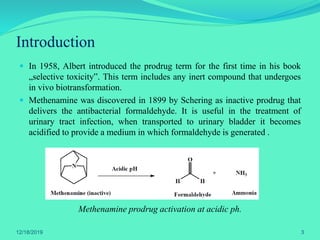
 Methenamine was discovered in 1899 by Schering as inactive prodrug that
delivers the antibacterial formaldehyde. It is useful in the treatment of
urinary tract infection, when transported to urinary bladder it becomes
acidified to provide a medium in which formaldehyde is generated .
Methenamine prodrug activation at acidic ph.
Introduction
12/18/2019 3
What is prodrug & prodrug design?
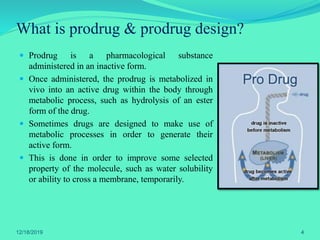
 Prodrug is a pharmacological substance
administered in an inactive form.
 Once administered, the prodrug is metabolized in
vivo into an active drug within the body through
metabolic process, such as hydrolysis of an ester
form of the drug.
 Sometimes drugs are designed to make use of
metabolic processes in order to generate their
active form.
 This is done in order to improve some selected
property of the molecule, such as water solubility
or ability to cross a membrane, temporarily.
12/18/2019 4
Objectives of prodrug design
The main objectives of a prodrug designing are
• To bring active drugs to their respective active sites.
• To provide the desired pharmacological effects while minimizing
adverse metabolic and/or toxicological events.
• To improve the clinical and therapeutic effectiveness of those drugs
which suffer from some undesirable properties that otherwise hinder
their clinical usefulness.
• To avoid the practice of clinically Coad ministering two drugs in order
to enhance pharmacological activity or prevent clinical side effects.
12/18/2019 5
Basic concept of prodrugs
• The drug – promoiety is the prodrug that is typically pharmacologically
inactive.
• Limitation of a parent drug that prevents optimal (bio)pharmaceutical or
pharmacokinetic performance.
• The drug and promoiety are covalently linked via bio-reversible groups that
are chemically or enzymatically labile.
Promoiety
A functional group used
To modify the structure
Of pharmacologically
Active agents to improve
Physicochemical,
Biopharmaceutical or
Pharmacokinetic properties.
12/18/2019 6
Classification of prodrugs
A. Carrier-linked prodrugs:
 Simple prodrug that contains an active drug linked with a carrier group
that is removed enzymatically.
 The carrier group must be non-toxic and biologically inactive when
detached from drug.
 Carrier type Prodrug: formulation and drug release
12/18/2019 7
 Carrier- linked prodrug may further be classified into:
1) Double prodrugs pro-prodrugs or cascade-latentiated prodrug
Where a prodrug is futherderivatized in a fashion such that only
enzymatic conversion to prodrug is possible before the latter can cleave to
release the active drug.
2) Macromolecular prodrugs
Where macromolecules like polysaccharides, dextrans, cyclodextrins,
proteins, peptides and polymers are used as carriers.
3) Site- specific prodrugs
where a carrier acts as a transporter of the active drug to a specific
targeted site.
4) Mutual prodrug
where the carrier used is another biologically active drug instead of
some inert molecule.
12/18/2019 8
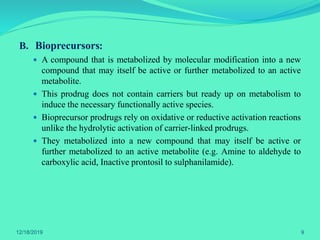
B. Bioprecursors:
 A compound that is metabolized by molecular modification into a new
compound that may itself be active or further metabolized to an active
metabolite.
 This prodrug does not contain carriers but ready up on metabolism to
induce the necessary functionally active species.
 Bioprecursor prodrugs rely on oxidative or reductive activation reactions
unlike the hydrolytic activation of carrier-linked prodrugs.
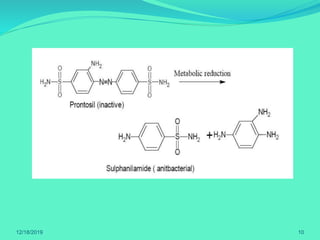
 They metabolized into a new compound that may itself be active or
further metabolized to an active metabolite (e.g. Amine to aldehyde to
carboxylic acid, Inactive prontosil to sulphanilamide).
12/18/2019 9
12/18/2019 10
Prodrugs of functional group
 Various types of functional groups are present in different therapeutic
agents. These functional groups react with other functional groups of non
toxic promoiety to form prodrugs.
 1) Ester
Groups like -COOH, -OH can easily undergo esterification reaction.
Bioavailability of drug can be improved by ester formation. Enzyme
esterase which is present widely in vivo can easily break up the linkage at
target organ so that targeted delivery is achieved e.g. Thioester of
Erythromycin, palmitate ester of Clindamycin.
Prodrug Active Form of Drug
12/18/2019 11
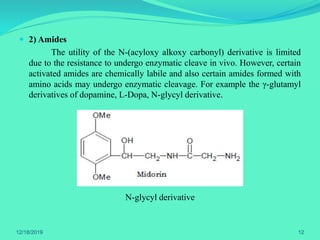
 2) Amides
The utility of the N-(acyloxy alkoxy carbonyl) derivative is limited
due to the resistance to undergo enzymatic cleave in vivo. However, certain
activated amides are chemically labile and also certain amides formed with
amino acids may undergo enzymatic cleavage. For example the γ-glutamyl
derivatives of dopamine, L-Dopa, N-glycyl derivative.
N-glycyl derivative
12/18/2019 12
 3) Prodrugs of amides, imides and urides
• e.g.N-hydroxymethylation
The N-hydroxyl methyl derivatives of amides or imide type
compounds are more water soluble than the parent compounds. By
replacing a proton bind to nitrogen atom by a hydroxyl methyl group, intra
or intermolecular hydrogen bonding in such molecules may be increased
resulting in a decrease in melting point and increase in water solubility
The mechanism for the decomposition of N-hydroxyl methyl derivatives.
12/18/2019 13
 4) Ring formation derivative
Thiamine quaternary ammonium compounds like Hydantoin, Barbituric
acid etc. can undergo ring opening and show in vivo pharmacological properties.
 5) Glycol amide esters
These are bioavailable products of carboxylic group e.g. Benzoic acid
esters.
 6) Carbamates
They exhibit restricted distribution in the body. Carbamates do not have
any specific enzyme for hydrolysis. However, enzymes such as esterase can
hydrolyze carbamates e.g. co-carboxy methyl phenyl ester of Amphetamine.
Other approaches used in the formation of prodrug are phosphamides,
glycosides, ethers, and ketals.
12/18/2019 14
Why use prodrugs?
 Improve membrane permeability
 Improve absorption and distribution
 Improve solubility
 Alter metabolism
 Alter toxicity
 Alter elimination
12/18/2019 15
Application of prodrugs
 Pharmaceutical applications
 Improvement of taste
 Improvement of odour
 Reduction of irritation
 Reduction of pain on injection
 Enhancement of drug solubility and dissolution rate
 Enhancement of chemical stability of drug
 Pharmacokinetic applications
 Enhancement of provability
 Prevention of pre-systemic metabolism
 Prolongation of duration of action
 Reduction of toxicity
 Site specific drug-delivery
12/18/2019 16
E.g.
A. Esters
 Esters are the most commonly employed prodrugs.
 Numerous catalytic esterases are present in vivo to hydrolyze simple
esters.
Prodrug Active Form of Drug
12/18/2019 17
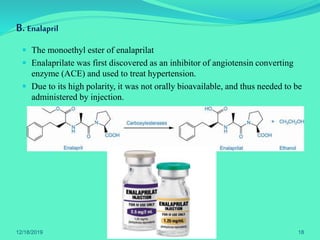
B.Enalapril
 The monoethyl ester of enalaprilat
 Enalaprilate was first discovered as an inhibitor of angiotensin converting
enzyme (ACE) and used to treat hypertension.
 Due to its high polarity, it was not orally bioavailable, and thus needed to be
administered by injection.
12/18/2019 18
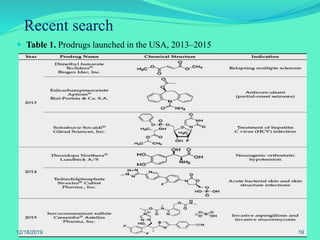
Recent search
 Table 1. Prodrugs launched in the USA, 2013–2015
12/18/2019 19
Conclusion
 Prodrugs are inactive compounds which are converted to active drugs in the
body.
 Prodrugs were design to improve pharmacokinetic and drug delivery
properties.
 Esters are commonly used as prodrugs to make a drug less polar.
 The nature of the ester can be altered to vary the rate of hydrolysis.
12/18/2019 20
References
1. Alagarsamy, V. (2010). Textbook of medicinal chemistry (vol. 1, pp. 71-79).
New Delhi: reed/elsevier.
2. Testa, b., & Mayer, J. (2003). <I>hydrolysis in drug and prodrug
metabolism: chemistry, biochemistry, and enzymology</i>. Zurich: VHCA.
3. Drug metabolism. (N.D.). Retrieved November 18, 2014, from
http://www.Merckmanuals.Com/home/drugs/administration and kinetics of
drugs/drug metabolism.html.
4. Supriya shirke*, Sheetal Shewale and Manik Satpute (2015), Department
of Pharmaceutics, SCOP Satara, Maharashtra, India. Prodrug design: an
overview international journal of pharmaceutical, chemical and biological
sciences, IJPCBS 2015, 5(1), 232-241(pp. 233-236).
5. Prodrug design available from:
file:///I:/prodrug/prodrug%20concept%20PPT.htm.
12/18/2019 21
12/18/2019 22
THANKS TO
ALL OF U
12/18/2019 23

PRODRUG DESIGN [M.PHARM]

  • 1.
    Presented by Shikha D.Popali Harshpal Singh Wahi M. Pharmacy 1st semester (Pharmaceutical chemistry) Gurunanak college of pharmacy, Nagpur
  • 2.
    Overview  Introduction  Whatis prodrug & prodrug design?  Objectives of prodrug design  Basic concept of prodrugs  Classification of prodrugs  Prodrugs of functional group  Why use prodrugs?  Applications of prodrugs  Examples  Recent search  Conclusion  References 12/18/2019 2
  • 3.
     In 1958,Albert introduced the prodrug term for the first time in his book „selective toxicity‟. This term includes any inert compound that undergoes in vivo biotransformation.  Methenamine was discovered in 1899 by Schering as inactive prodrug that delivers the antibacterial formaldehyde. It is useful in the treatment of urinary tract infection, when transported to urinary bladder it becomes acidified to provide a medium in which formaldehyde is generated . Methenamine prodrug activation at acidic ph. Introduction 12/18/2019 3
  • 4.
    What is prodrug& prodrug design?  Prodrug is a pharmacological substance administered in an inactive form.  Once administered, the prodrug is metabolized in vivo into an active drug within the body through metabolic process, such as hydrolysis of an ester form of the drug.  Sometimes drugs are designed to make use of metabolic processes in order to generate their active form.  This is done in order to improve some selected property of the molecule, such as water solubility or ability to cross a membrane, temporarily. 12/18/2019 4
  • 5.
    Objectives of prodrugdesign The main objectives of a prodrug designing are • To bring active drugs to their respective active sites. • To provide the desired pharmacological effects while minimizing adverse metabolic and/or toxicological events. • To improve the clinical and therapeutic effectiveness of those drugs which suffer from some undesirable properties that otherwise hinder their clinical usefulness. • To avoid the practice of clinically Coad ministering two drugs in order to enhance pharmacological activity or prevent clinical side effects. 12/18/2019 5
  • 6.
    Basic concept ofprodrugs • The drug – promoiety is the prodrug that is typically pharmacologically inactive. • Limitation of a parent drug that prevents optimal (bio)pharmaceutical or pharmacokinetic performance. • The drug and promoiety are covalently linked via bio-reversible groups that are chemically or enzymatically labile. Promoiety A functional group used To modify the structure Of pharmacologically Active agents to improve Physicochemical, Biopharmaceutical or Pharmacokinetic properties. 12/18/2019 6
  • 7.
    Classification of prodrugs A.Carrier-linked prodrugs:  Simple prodrug that contains an active drug linked with a carrier group that is removed enzymatically.  The carrier group must be non-toxic and biologically inactive when detached from drug.  Carrier type Prodrug: formulation and drug release 12/18/2019 7
  • 8.
     Carrier- linkedprodrug may further be classified into: 1) Double prodrugs pro-prodrugs or cascade-latentiated prodrug Where a prodrug is futherderivatized in a fashion such that only enzymatic conversion to prodrug is possible before the latter can cleave to release the active drug. 2) Macromolecular prodrugs Where macromolecules like polysaccharides, dextrans, cyclodextrins, proteins, peptides and polymers are used as carriers. 3) Site- specific prodrugs where a carrier acts as a transporter of the active drug to a specific targeted site. 4) Mutual prodrug where the carrier used is another biologically active drug instead of some inert molecule. 12/18/2019 8
  • 9.
    B. Bioprecursors:  Acompound that is metabolized by molecular modification into a new compound that may itself be active or further metabolized to an active metabolite.  This prodrug does not contain carriers but ready up on metabolism to induce the necessary functionally active species.  Bioprecursor prodrugs rely on oxidative or reductive activation reactions unlike the hydrolytic activation of carrier-linked prodrugs.  They metabolized into a new compound that may itself be active or further metabolized to an active metabolite (e.g. Amine to aldehyde to carboxylic acid, Inactive prontosil to sulphanilamide). 12/18/2019 9
  • 10.
  • 11.
    Prodrugs of functionalgroup  Various types of functional groups are present in different therapeutic agents. These functional groups react with other functional groups of non toxic promoiety to form prodrugs.  1) Ester Groups like -COOH, -OH can easily undergo esterification reaction. Bioavailability of drug can be improved by ester formation. Enzyme esterase which is present widely in vivo can easily break up the linkage at target organ so that targeted delivery is achieved e.g. Thioester of Erythromycin, palmitate ester of Clindamycin. Prodrug Active Form of Drug 12/18/2019 11
  • 12.
     2) Amides Theutility of the N-(acyloxy alkoxy carbonyl) derivative is limited due to the resistance to undergo enzymatic cleave in vivo. However, certain activated amides are chemically labile and also certain amides formed with amino acids may undergo enzymatic cleavage. For example the γ-glutamyl derivatives of dopamine, L-Dopa, N-glycyl derivative. N-glycyl derivative 12/18/2019 12
  • 13.
     3) Prodrugsof amides, imides and urides • e.g.N-hydroxymethylation The N-hydroxyl methyl derivatives of amides or imide type compounds are more water soluble than the parent compounds. By replacing a proton bind to nitrogen atom by a hydroxyl methyl group, intra or intermolecular hydrogen bonding in such molecules may be increased resulting in a decrease in melting point and increase in water solubility The mechanism for the decomposition of N-hydroxyl methyl derivatives. 12/18/2019 13
  • 14.
     4) Ringformation derivative Thiamine quaternary ammonium compounds like Hydantoin, Barbituric acid etc. can undergo ring opening and show in vivo pharmacological properties.  5) Glycol amide esters These are bioavailable products of carboxylic group e.g. Benzoic acid esters.  6) Carbamates They exhibit restricted distribution in the body. Carbamates do not have any specific enzyme for hydrolysis. However, enzymes such as esterase can hydrolyze carbamates e.g. co-carboxy methyl phenyl ester of Amphetamine. Other approaches used in the formation of prodrug are phosphamides, glycosides, ethers, and ketals. 12/18/2019 14
  • 15.
    Why use prodrugs? Improve membrane permeability  Improve absorption and distribution  Improve solubility  Alter metabolism  Alter toxicity  Alter elimination 12/18/2019 15
  • 16.
    Application of prodrugs Pharmaceutical applications  Improvement of taste  Improvement of odour  Reduction of irritation  Reduction of pain on injection  Enhancement of drug solubility and dissolution rate  Enhancement of chemical stability of drug  Pharmacokinetic applications  Enhancement of provability  Prevention of pre-systemic metabolism  Prolongation of duration of action  Reduction of toxicity  Site specific drug-delivery 12/18/2019 16
  • 17.
    E.g. A. Esters  Estersare the most commonly employed prodrugs.  Numerous catalytic esterases are present in vivo to hydrolyze simple esters. Prodrug Active Form of Drug 12/18/2019 17
  • 18.
    B.Enalapril  The monoethylester of enalaprilat  Enalaprilate was first discovered as an inhibitor of angiotensin converting enzyme (ACE) and used to treat hypertension.  Due to its high polarity, it was not orally bioavailable, and thus needed to be administered by injection. 12/18/2019 18
  • 19.
    Recent search  Table1. Prodrugs launched in the USA, 2013–2015 12/18/2019 19
  • 20.
    Conclusion  Prodrugs areinactive compounds which are converted to active drugs in the body.  Prodrugs were design to improve pharmacokinetic and drug delivery properties.  Esters are commonly used as prodrugs to make a drug less polar.  The nature of the ester can be altered to vary the rate of hydrolysis. 12/18/2019 20
  • 21.
    References 1. Alagarsamy, V.(2010). Textbook of medicinal chemistry (vol. 1, pp. 71-79). New Delhi: reed/elsevier. 2. Testa, b., & Mayer, J. (2003). <I>hydrolysis in drug and prodrug metabolism: chemistry, biochemistry, and enzymology</i>. Zurich: VHCA. 3. Drug metabolism. (N.D.). Retrieved November 18, 2014, from http://www.Merckmanuals.Com/home/drugs/administration and kinetics of drugs/drug metabolism.html. 4. Supriya shirke*, Sheetal Shewale and Manik Satpute (2015), Department of Pharmaceutics, SCOP Satara, Maharashtra, India. Prodrug design: an overview international journal of pharmaceutical, chemical and biological sciences, IJPCBS 2015, 5(1), 232-241(pp. 233-236). 5. Prodrug design available from: file:///I:/prodrug/prodrug%20concept%20PPT.htm. 12/18/2019 21
  • 22.
  • 23.
    THANKS TO ALL OFU 12/18/2019 23

Editor's Notes

  • #21 Metabolism process. Esters- to cross cell membranes more easily.