STEREOCHEMISTRY
&
DRUGACTION
PREPARED BY : AZMIN M MOGAL (M.PHARM SEM -1)
GUIDED BY : Dr. UTTAM MORE
DEPARTMENT : PHARMACEUTICAL CHEMISTRY
( ADVANCED MEDICINAL CHEMISTRY )
1
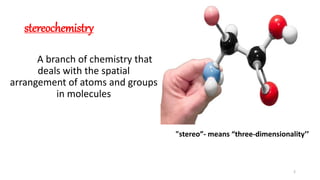
stereochemistry
AA A branch of chemistry that
deals with the spatial
arrangement of atoms and groups
in molecules
"stereo”- means “three-dimensionality’’
2
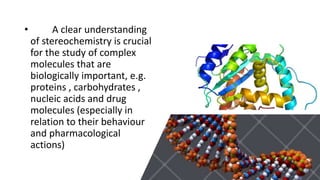
• A clear understanding
of stereochemistry is crucial
for the study of complex
molecules that are
biologically important, e.g.
proteins , carbohydrates ,
nucleic acids and drug
molecules (especially in
relation to their behaviour
and pharmacological
actions)
3
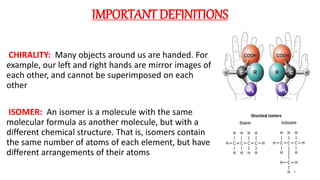
IMPORTANT DEFINITIONS
CHIRALITY: Many objects around us are handed. For
example, our left and right hands are mirror images of
each other, and cannot be superimposed on each
other
ISOMER: An isomer is a molecule with the same
molecular formula as another molecule, but with a
different chemical structure. That is, isomers contain
the same number of atoms of each element, but have
different arrangements of their atoms
4
STEREOISOMERS : Compounds with the same molecular connectivity but
differ in the spatial arrangement of their constituent atoms or groups.
ENANTIOMER : Greek word: enantio : opposite
merons : parts
Stereoisomers with non superimposable mirror images.
DIASTEREOMER : Diastereomers are stereoisomers that are not mirror
images of one another and are non-superimposable on one another.
Stereoisomers with two or more stereocenters can be diastereomers.
5
• PHARMACOKINETIC:
the study of the bodily
absorption,
distribution,
metabolism, and
excretion of drugs
(ADME) – What body
does to the drug
• PHARMACODYNAMIC:
What the drug does to
the body
6
7
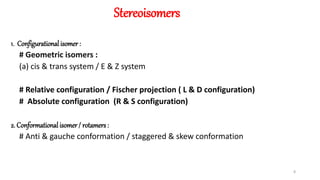
Stereoisomers
1. Configurational isomer :
# Geometric isomers :
(a) cis & trans system / E & Z system
# Relative configuration / Fischer projection ( L & D configuration)
# Absolute configuration (R & S configuration)
2. Conformational isomer / rotamers :
# Anti & gauche conformation / staggered & skew conformation
8
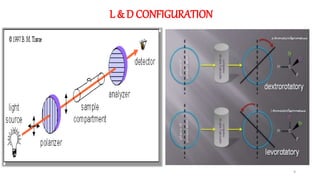
L & D CONFIGURATION
9
EXAMPLE OF
L & D
SYSTEM
10
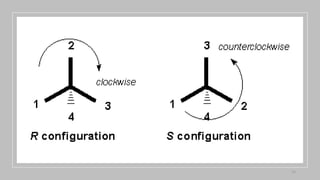
R & S CONFIGURATION
11
12
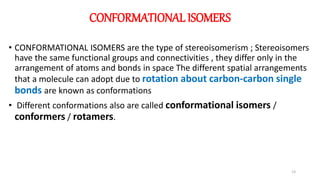
CONFORMATIONAL ISOMERS
• CONFORMATIONAL ISOMERS are the type of stereoisomerism ; Stereoisomers
have the same functional groups and connectivities , they differ only in the
arrangement of atoms and bonds in space The different spatial arrangements
that a molecule can adopt due to rotation about carbon-carbon single
bonds are known as conformations
• Different conformations also are called conformational isomers /
conformers / rotamers.
13
PHARMACOKINETIC & PHARMACODYNAMIC STEREOSELECTIVITY
Many drugs used in clinical practice contain one or more chiral
centers. These chiral drugs are often used therapeutically
either as pure stereoisomers or as a racemic mixture. The
three dimensional interaction of two enantiomers with a
macromolecule, such as an enzyme or receptor, to form
diastereomeric complexes may result in chiral recognition and
significant differences in pharmacokinetic processes as well as
the pharmacodynamics.
14
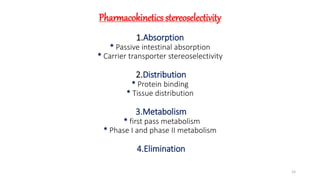
Pharmacokinetics stereoselectivity
1.Absorption
* Passive intestinal absorption
* Carrier transporter stereoselectivity
2.Distribution
* Protein binding
* Tissue distribution
3.Metabolism
* first pass metabolism
* Phase I and phase II metabolism
4.Elimination
15
Absorption and stereoselectivity
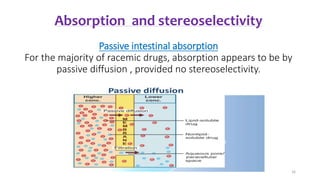
Passive intestinal absorption
For the majority of racemic drugs, absorption appears to be by
passive diffusion , provided no stereoselectivity.
16
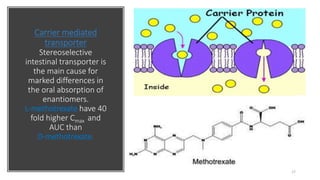
Carrier mediated
transporter
Stereoselective
intestinal transporter is
the main cause for
marked differences in
the oral absorption of
enantiomers.
L-methotrexate have 40
fold higher Cmax and
AUC than
D-methotrexate.
17
Distribution
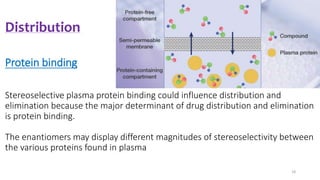
Protein binding
Stereoselective plasma protein binding could influence distribution and
elimination because the major determinant of drug distribution and elimination
is protein binding.
The enantiomers may display different magnitudes of stereoselectivity between
the various proteins found in plasma
18
Ex// the R-propranolol binding to albumin is greater than S-propranolol and the opposite is
observed for 1 -acid glycoprotein.
* Highly albumin bound
* Less potent
* Highly metabolized
* Low plasma concentration
*highly bound to AAG
available as unbound
* 40-100 time more potent
*Less metabolized
*High plasma concentration 19
Metabolism
Stereoselective drug
metabolism is commonly
observed in vitro for
racemic drugs and can
results in substantial
differences in the vivo
plasma concentration –time
profiles between
enantiomers due to
stereoselective
bioavailability or drug
disposition.
20
Phase I and phase II metabolism
The magnitude of stereoselectivity depends on the metabolic
pathways involved drug metabolism.
6
21
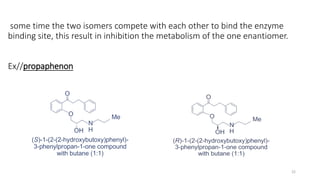
some time the two isomers compete with each other to bind the enzyme
binding site, this result in inhibition the metabolism of the one enantiomer.
Ex//propaphenon
22
EFFECT ON PHARMACOKINETIC OF SOME STEREOACTIVE DRUGS
PK
parameter
Examples
Absorption 1. L-Methotrexate is better absorbed than D-
Methotrexate
2. Esomeprazole is more bioavailable than
racemic omeprazole
Vol. of
distribution
1. S-Warfarin has lower Vd than R-Warfarin.
2. Levoceterizine has smaller Vd than its
dextroisomer.
Metabolism S-warfarin is more potent and metabolized by
ring oxidation while R- Warfarin is less potent
and metabolized by side chain reduction
Half-life S-warfarin= 32 hours; R-warfarin= 54 hours 23
PHARMACODYNAMICS
• Easson – Stedman hypothesis
In 1886, Piutti ; reported different physiologic actions for the enantiomers of
asparagine, (+) asparagine having sweet taste and (-) asparagine a bland one.
This was one of the earliest observation that enantiomers can exhibit differences
in biological action.
In 1933, Easson-Stedman reported that differences in biological activity
between enantiomers resulted from selective reactivity of one enantiomer with
its receptor. They postulated that such interactions require minimum
three- point fit to receptor. If the molecule is unable to properly fit into the
receptor and , therefore , cannot ‘trigger’ the action.
24
PHARMACODYNAMIC
25
Easson-Stedman Hypothesis
•The Easson-Stedman Hypothesis states that
the more potent enantiomer must be
involved in a minimum of three
intermolecular interactions with the
receptor surface .
26
EXAMPLE ; Drug receptor interaction of (R) – (-)-epinephrine ,
(S)-(+)- epinephrine , and N- methyl dopamine.
27
REFERENCES
• Thomas L. LEMKE , David A. WILLIAMS , “FOYE’S PRINCIPLES OF MEDICINAL
CHEMISTY ’’ , (south Asian edition) sixth edition, stereochemistry, stereochemistry
and Biological Activity , Lippincott Williams & wilkins ,Wolters Kluwer Indian
publication , 2011, 30-45, 51.
• YOUTUBE :
cis & trans configuration; link ; https://www.youtube.com/watch?v=-38re1DSIv4
R & S system ;link;
https://www.youtube.com/watch?v=KoAnGRlCG_M&list=PLaySzQJTCO1nsM3ItT8irQ
650tYgjHk6i&index=3
Anti & gauche conformation ; link;
https://www.youtube.com/watch?v=BpIww4loV9M
• Jerry March , “ ADVANCED ORGANIC CHEMISTRY ” , FOURTH EDITION , published
by John Wiley & sons( Asia) , 2005 , 94 & 127.
• Wikipedia & other internet sources.
28
29

Stereochemistry

  • 1.
    STEREOCHEMISTRY & DRUGACTION PREPARED BY :AZMIN M MOGAL (M.PHARM SEM -1) GUIDED BY : Dr. UTTAM MORE DEPARTMENT : PHARMACEUTICAL CHEMISTRY ( ADVANCED MEDICINAL CHEMISTRY ) 1
  • 2.
    stereochemistry AA A branchof chemistry that deals with the spatial arrangement of atoms and groups in molecules "stereo”- means “three-dimensionality’’ 2
  • 3.
    • A clearunderstanding of stereochemistry is crucial for the study of complex molecules that are biologically important, e.g. proteins , carbohydrates , nucleic acids and drug molecules (especially in relation to their behaviour and pharmacological actions) 3
  • 4.
    IMPORTANT DEFINITIONS CHIRALITY: Manyobjects around us are handed. For example, our left and right hands are mirror images of each other, and cannot be superimposed on each other ISOMER: An isomer is a molecule with the same molecular formula as another molecule, but with a different chemical structure. That is, isomers contain the same number of atoms of each element, but have different arrangements of their atoms 4
  • 5.
    STEREOISOMERS : Compoundswith the same molecular connectivity but differ in the spatial arrangement of their constituent atoms or groups. ENANTIOMER : Greek word: enantio : opposite merons : parts Stereoisomers with non superimposable mirror images. DIASTEREOMER : Diastereomers are stereoisomers that are not mirror images of one another and are non-superimposable on one another. Stereoisomers with two or more stereocenters can be diastereomers. 5
  • 6.
    • PHARMACOKINETIC: the studyof the bodily absorption, distribution, metabolism, and excretion of drugs (ADME) – What body does to the drug • PHARMACODYNAMIC: What the drug does to the body 6
  • 7.
  • 8.
    Stereoisomers 1. Configurational isomer: # Geometric isomers : (a) cis & trans system / E & Z system # Relative configuration / Fischer projection ( L & D configuration) # Absolute configuration (R & S configuration) 2. Conformational isomer / rotamers : # Anti & gauche conformation / staggered & skew conformation 8
  • 9.
    L & DCONFIGURATION 9
  • 10.
    EXAMPLE OF L &D SYSTEM 10
  • 11.
    R & SCONFIGURATION 11
  • 12.
  • 13.
    CONFORMATIONAL ISOMERS • CONFORMATIONALISOMERS are the type of stereoisomerism ; Stereoisomers have the same functional groups and connectivities , they differ only in the arrangement of atoms and bonds in space The different spatial arrangements that a molecule can adopt due to rotation about carbon-carbon single bonds are known as conformations • Different conformations also are called conformational isomers / conformers / rotamers. 13
  • 14.
    PHARMACOKINETIC & PHARMACODYNAMICSTEREOSELECTIVITY Many drugs used in clinical practice contain one or more chiral centers. These chiral drugs are often used therapeutically either as pure stereoisomers or as a racemic mixture. The three dimensional interaction of two enantiomers with a macromolecule, such as an enzyme or receptor, to form diastereomeric complexes may result in chiral recognition and significant differences in pharmacokinetic processes as well as the pharmacodynamics. 14
  • 15.
    Pharmacokinetics stereoselectivity 1.Absorption * Passiveintestinal absorption * Carrier transporter stereoselectivity 2.Distribution * Protein binding * Tissue distribution 3.Metabolism * first pass metabolism * Phase I and phase II metabolism 4.Elimination 15
  • 16.
    Absorption and stereoselectivity Passiveintestinal absorption For the majority of racemic drugs, absorption appears to be by passive diffusion , provided no stereoselectivity. 16
  • 17.
    Carrier mediated transporter Stereoselective intestinal transporteris the main cause for marked differences in the oral absorption of enantiomers. L-methotrexate have 40 fold higher Cmax and AUC than D-methotrexate. 17
  • 18.
    Distribution Protein binding Stereoselective plasmaprotein binding could influence distribution and elimination because the major determinant of drug distribution and elimination is protein binding. The enantiomers may display different magnitudes of stereoselectivity between the various proteins found in plasma 18
  • 19.
    Ex// the R-propranololbinding to albumin is greater than S-propranolol and the opposite is observed for 1 -acid glycoprotein. * Highly albumin bound * Less potent * Highly metabolized * Low plasma concentration *highly bound to AAG available as unbound * 40-100 time more potent *Less metabolized *High plasma concentration 19
  • 20.
    Metabolism Stereoselective drug metabolism iscommonly observed in vitro for racemic drugs and can results in substantial differences in the vivo plasma concentration –time profiles between enantiomers due to stereoselective bioavailability or drug disposition. 20
  • 21.
    Phase I andphase II metabolism The magnitude of stereoselectivity depends on the metabolic pathways involved drug metabolism. 6 21
  • 22.
    some time thetwo isomers compete with each other to bind the enzyme binding site, this result in inhibition the metabolism of the one enantiomer. Ex//propaphenon 22
  • 23.
    EFFECT ON PHARMACOKINETICOF SOME STEREOACTIVE DRUGS PK parameter Examples Absorption 1. L-Methotrexate is better absorbed than D- Methotrexate 2. Esomeprazole is more bioavailable than racemic omeprazole Vol. of distribution 1. S-Warfarin has lower Vd than R-Warfarin. 2. Levoceterizine has smaller Vd than its dextroisomer. Metabolism S-warfarin is more potent and metabolized by ring oxidation while R- Warfarin is less potent and metabolized by side chain reduction Half-life S-warfarin= 32 hours; R-warfarin= 54 hours 23
  • 24.
    PHARMACODYNAMICS • Easson –Stedman hypothesis In 1886, Piutti ; reported different physiologic actions for the enantiomers of asparagine, (+) asparagine having sweet taste and (-) asparagine a bland one. This was one of the earliest observation that enantiomers can exhibit differences in biological action. In 1933, Easson-Stedman reported that differences in biological activity between enantiomers resulted from selective reactivity of one enantiomer with its receptor. They postulated that such interactions require minimum three- point fit to receptor. If the molecule is unable to properly fit into the receptor and , therefore , cannot ‘trigger’ the action. 24
  • 25.
  • 26.
    Easson-Stedman Hypothesis •The Easson-StedmanHypothesis states that the more potent enantiomer must be involved in a minimum of three intermolecular interactions with the receptor surface . 26
  • 27.
    EXAMPLE ; Drugreceptor interaction of (R) – (-)-epinephrine , (S)-(+)- epinephrine , and N- methyl dopamine. 27
  • 28.
    REFERENCES • Thomas L.LEMKE , David A. WILLIAMS , “FOYE’S PRINCIPLES OF MEDICINAL CHEMISTY ’’ , (south Asian edition) sixth edition, stereochemistry, stereochemistry and Biological Activity , Lippincott Williams & wilkins ,Wolters Kluwer Indian publication , 2011, 30-45, 51. • YOUTUBE : cis & trans configuration; link ; https://www.youtube.com/watch?v=-38re1DSIv4 R & S system ;link; https://www.youtube.com/watch?v=KoAnGRlCG_M&list=PLaySzQJTCO1nsM3ItT8irQ 650tYgjHk6i&index=3 Anti & gauche conformation ; link; https://www.youtube.com/watch?v=BpIww4loV9M • Jerry March , “ ADVANCED ORGANIC CHEMISTRY ” , FOURTH EDITION , published by John Wiley & sons( Asia) , 2005 , 94 & 127. • Wikipedia & other internet sources. 28
  • 29.