STORES CONTROL
DR. MOHAMED KUTTY KAKKAKUNNAN
Associate Professor
P.G. Dept of Commerce
NAM COLLEGE KALLIKKANDY
Kannur –Kerala – India
STORES CONTROL
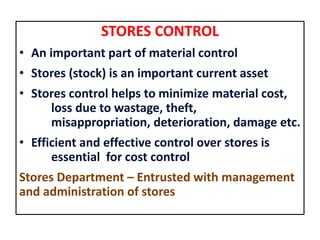
• An important part of material control
• Stores (stock) is an important current asset
• Stores control helps to minimize material cost,
loss due to wastage, theft,
misappropriation, deterioration, damage etc.
• Efficient and effective control over stores is
essential for cost control
Stores Department – Entrusted with management
and administration of stores
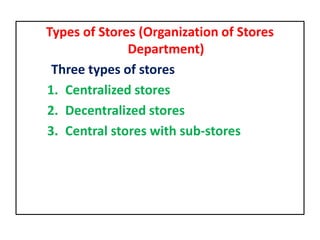
Types of Stores (Organization of Stores
Department)
Three types of stores
1. Centralized stores
2. Decentralized stores
3. Central stores with sub-stores
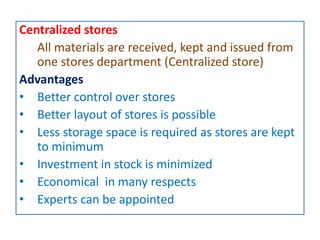
Centralized stores
All materials are received, kept and issued from
one stores department (Centralized store)
Advantages
• Better control over stores
• Better layout of stores is possible
• Less storage space is required as stores are kept
to minimum
• Investment in stock is minimized
• Economical in many respects
• Experts can be appointed
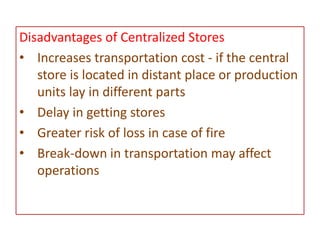
Disadvantages of Centralized Stores
• Increases transportation cost - if the central
store is located in distant place or production
units lay in different parts
• Delay in getting stores
• Greater risk of loss in case of fire
• Break-down in transportation may affect
operations
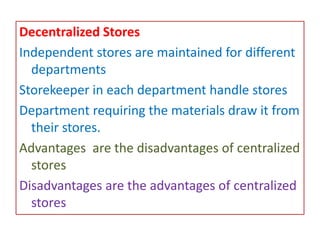
Decentralized Stores
Independent stores are maintained for different
departments
Storekeeper in each department handle stores
Department requiring the materials draw it from
their stores.
Advantages are the disadvantages of centralized
stores
Disadvantages are the advantages of centralized
stores
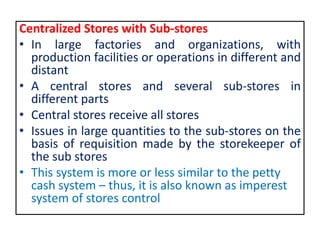
Centralized Stores with Sub-stores
• In large factories and organizations, with
production facilities or operations in different and
distant
• A central stores and several sub-stores in
different parts
• Central stores receive all stores
• Issues in large quantities to the sub-stores on the
basis of requisition made by the storekeeper of
the sub stores
• This system is more or less similar to the petty
cash system – thus, it is also known as imperest
system of stores control
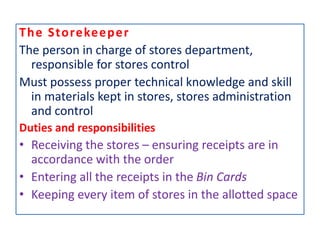
The Storekeeper
The person in charge of stores department,
responsible for stores control
Must possess proper technical knowledge and skill
in materials kept in stores, stores administration
and control
Duties and responsibilities
• Receiving the stores – ensuring receipts are in
accordance with the order
• Entering all the receipts in the Bin Cards
• Keeping every item of stores in the allotted space
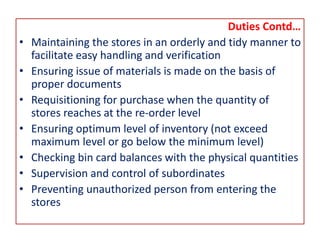
Duties Contd…
• Maintaining the stores in an orderly and tidy manner to
facilitate easy handling and verification
• Ensuring issue of materials is made on the basis of
proper documents
• Requisitioning for purchase when the quantity of
stores reaches at the re-order level
• Ensuring optimum level of inventory (not exceed
maximum level or go below the minimum level)
• Checking bin card balances with the physical quantities
• Supervision and control of subordinates
• Preventing unauthorized person from entering the
stores
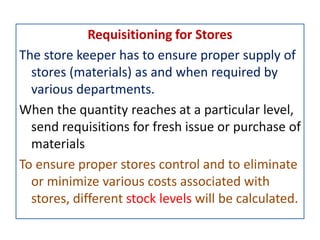
Requisitioning for Stores
The store keeper has to ensure proper supply of
stores (materials) as and when required by
various departments.
When the quantity reaches at a particular level,
send requisitions for fresh issue or purchase of
materials
To ensure proper stores control and to eliminate
or minimize various costs associated with
stores, different stock levels will be calculated.
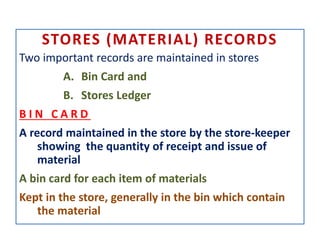
STORES (MATERIAL) RECORDS
Two important records are maintained in stores
A. Bin Card and
B. Stores Ledger
B I N C A R D
A record maintained in the store by the store-keeper
showing the quantity of receipt and issue of
material
A bin card for each item of materials
Kept in the store, generally in the bin which contain
the material
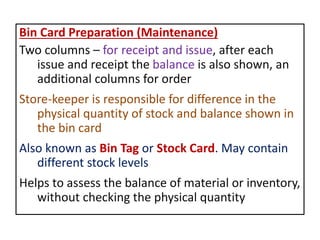
Bin Card Preparation (Maintenance)
Two columns – for receipt and issue, after each
issue and receipt the balance is also shown, an
additional columns for order
Store-keeper is responsible for difference in the
physical quantity of stock and balance shown in
the bin card
Also known as Bin Tag or Stock Card. May contain
different stock levels
Helps to assess the balance of material or inventory,
without checking the physical quantity
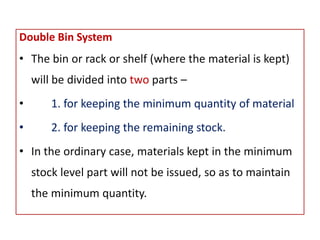
Double Bin System
• The bin or rack or shelf (where the material is kept)
will be divided into two parts –
• 1. for keeping the minimum quantity of material
• 2. for keeping the remaining stock.
• In the ordinary case, materials kept in the minimum
stock level part will not be issued, so as to maintain
the minimum quantity.
STORES LEDGER
• A record maintained by the Costing
Department, which shows the receipt, issue
and balance of material in the store in terms
of both quantity and values.
• Like bin card, there will be a stores ledger for
each material
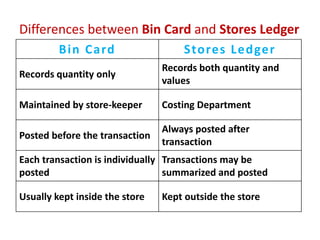
Differences between Bin Card and Stores Ledger
Bin Card Stores Ledger
Records quantity only
Records both quantity and
values
Maintained by store-keeper Costing Department
Posted before the transaction
Always posted after
transaction
Each transaction is individually
posted
Transactions may be
summarized and posted
Usually kept inside the store Kept outside the store
Need for Bin Cards (are bin cards necessary?)
Two records – (bin card and stores ledger) serve the same
purpose, duplication of work – no need for bin cards
Necessary due to the following reasons
• Storekeeper is responsible for maintenance of stores,
thus, he should have a record of movement of stores
• Responsible for difference in physical quantities, helps
to frequent check
• Entries are made before or immediately after the
transaction, provides up-to-date information on
balance
• Bin cards and stores ledger facilitate cross check of
issues, receipts and balance of materials
ISSUE CONTROL
Materials are -
• kept in the store for issuing to different jobs,
process, etc as and when required
• issued by the storekeeper on the basis of proper
requisition made by the responsible person
Material Requisition: A requisition made by the
responsible person (foreman, Production
manager etc) for issue of materials required with
quantities.
• Kept as a document by the store keeper
• Material are issued only on the basis of material
requisition. Authorization for issue
Bill of Materials
• Is a complete list of all materials required with
quantities for a particular job, process or
order
• A single document and serves the same
purpose of different material requisitions to
be made for different materials to be used for
a job, process, or order
Surplus or Excess Materials
May be returned or transferred to another job, process or
order
Material Returned Note ( Stores Debit Note / Shop Credit
Note) is prepared by the department when the surplus
material is returned to the store.
Triplicate – on receipt of the returned material, store
keeper signs the note and one is kept with him, one copy
is send to the returned department and another is send
to the costing department
Discourage transfer - chances for misappropriation, fraud,
wastage etc.
Allow on the basis of proper Material Transfer Note.
Prepared by the department with excess material
Material Abstract
An analytical statement prepared periodically on
the basis of the various material requisition
notes, returned notes and transfer notes.
• Shows the value of materials consumed in
each job at a glance.
• Shows the total amount of material to be
debited to each job and overheads.
Spoilage
-refers to the production that does not meet the
dimensional or quality standards in such a way
that it cannot be rectified economically and is
junked (debris) and sold for a disposal value
Treatment of spoilage
Cost of normal spoilage is bone by good units of
output
Cost of abnormal spoilage is transferred to
costing profit and loss account

Stores control

  • 1.
    STORES CONTROL DR. MOHAMEDKUTTY KAKKAKUNNAN Associate Professor P.G. Dept of Commerce NAM COLLEGE KALLIKKANDY Kannur –Kerala – India
  • 2.
    STORES CONTROL • Animportant part of material control • Stores (stock) is an important current asset • Stores control helps to minimize material cost, loss due to wastage, theft, misappropriation, deterioration, damage etc. • Efficient and effective control over stores is essential for cost control Stores Department – Entrusted with management and administration of stores
  • 3.
    Types of Stores(Organization of Stores Department) Three types of stores 1. Centralized stores 2. Decentralized stores 3. Central stores with sub-stores
  • 4.
    Centralized stores All materialsare received, kept and issued from one stores department (Centralized store) Advantages • Better control over stores • Better layout of stores is possible • Less storage space is required as stores are kept to minimum • Investment in stock is minimized • Economical in many respects • Experts can be appointed
  • 5.
    Disadvantages of CentralizedStores • Increases transportation cost - if the central store is located in distant place or production units lay in different parts • Delay in getting stores • Greater risk of loss in case of fire • Break-down in transportation may affect operations
  • 6.
    Decentralized Stores Independent storesare maintained for different departments Storekeeper in each department handle stores Department requiring the materials draw it from their stores. Advantages are the disadvantages of centralized stores Disadvantages are the advantages of centralized stores
  • 7.
    Centralized Stores withSub-stores • In large factories and organizations, with production facilities or operations in different and distant • A central stores and several sub-stores in different parts • Central stores receive all stores • Issues in large quantities to the sub-stores on the basis of requisition made by the storekeeper of the sub stores • This system is more or less similar to the petty cash system – thus, it is also known as imperest system of stores control
  • 8.
    The Storekeeper The personin charge of stores department, responsible for stores control Must possess proper technical knowledge and skill in materials kept in stores, stores administration and control Duties and responsibilities • Receiving the stores – ensuring receipts are in accordance with the order • Entering all the receipts in the Bin Cards • Keeping every item of stores in the allotted space
  • 9.
    Duties Contd… • Maintainingthe stores in an orderly and tidy manner to facilitate easy handling and verification • Ensuring issue of materials is made on the basis of proper documents • Requisitioning for purchase when the quantity of stores reaches at the re-order level • Ensuring optimum level of inventory (not exceed maximum level or go below the minimum level) • Checking bin card balances with the physical quantities • Supervision and control of subordinates • Preventing unauthorized person from entering the stores
  • 10.
    Requisitioning for Stores Thestore keeper has to ensure proper supply of stores (materials) as and when required by various departments. When the quantity reaches at a particular level, send requisitions for fresh issue or purchase of materials To ensure proper stores control and to eliminate or minimize various costs associated with stores, different stock levels will be calculated.
  • 11.
    STORES (MATERIAL) RECORDS Twoimportant records are maintained in stores A. Bin Card and B. Stores Ledger B I N C A R D A record maintained in the store by the store-keeper showing the quantity of receipt and issue of material A bin card for each item of materials Kept in the store, generally in the bin which contain the material
  • 12.
    Bin Card Preparation(Maintenance) Two columns – for receipt and issue, after each issue and receipt the balance is also shown, an additional columns for order Store-keeper is responsible for difference in the physical quantity of stock and balance shown in the bin card Also known as Bin Tag or Stock Card. May contain different stock levels Helps to assess the balance of material or inventory, without checking the physical quantity
  • 13.
    Double Bin System •The bin or rack or shelf (where the material is kept) will be divided into two parts – • 1. for keeping the minimum quantity of material • 2. for keeping the remaining stock. • In the ordinary case, materials kept in the minimum stock level part will not be issued, so as to maintain the minimum quantity.
  • 14.
    STORES LEDGER • Arecord maintained by the Costing Department, which shows the receipt, issue and balance of material in the store in terms of both quantity and values. • Like bin card, there will be a stores ledger for each material
  • 15.
    Differences between BinCard and Stores Ledger Bin Card Stores Ledger Records quantity only Records both quantity and values Maintained by store-keeper Costing Department Posted before the transaction Always posted after transaction Each transaction is individually posted Transactions may be summarized and posted Usually kept inside the store Kept outside the store
  • 16.
    Need for BinCards (are bin cards necessary?) Two records – (bin card and stores ledger) serve the same purpose, duplication of work – no need for bin cards Necessary due to the following reasons • Storekeeper is responsible for maintenance of stores, thus, he should have a record of movement of stores • Responsible for difference in physical quantities, helps to frequent check • Entries are made before or immediately after the transaction, provides up-to-date information on balance • Bin cards and stores ledger facilitate cross check of issues, receipts and balance of materials
  • 17.
    ISSUE CONTROL Materials are- • kept in the store for issuing to different jobs, process, etc as and when required • issued by the storekeeper on the basis of proper requisition made by the responsible person Material Requisition: A requisition made by the responsible person (foreman, Production manager etc) for issue of materials required with quantities. • Kept as a document by the store keeper • Material are issued only on the basis of material requisition. Authorization for issue
  • 18.
    Bill of Materials •Is a complete list of all materials required with quantities for a particular job, process or order • A single document and serves the same purpose of different material requisitions to be made for different materials to be used for a job, process, or order
  • 19.
    Surplus or ExcessMaterials May be returned or transferred to another job, process or order Material Returned Note ( Stores Debit Note / Shop Credit Note) is prepared by the department when the surplus material is returned to the store. Triplicate – on receipt of the returned material, store keeper signs the note and one is kept with him, one copy is send to the returned department and another is send to the costing department Discourage transfer - chances for misappropriation, fraud, wastage etc. Allow on the basis of proper Material Transfer Note. Prepared by the department with excess material
  • 20.
    Material Abstract An analyticalstatement prepared periodically on the basis of the various material requisition notes, returned notes and transfer notes. • Shows the value of materials consumed in each job at a glance. • Shows the total amount of material to be debited to each job and overheads.
  • 21.
    Spoilage -refers to theproduction that does not meet the dimensional or quality standards in such a way that it cannot be rectified economically and is junked (debris) and sold for a disposal value Treatment of spoilage Cost of normal spoilage is bone by good units of output Cost of abnormal spoilage is transferred to costing profit and loss account