Introduction
 The aim of every business activity is to increase the
  value of the original resources which are risked by the
  owners in the venture. Receiving and storing are the
  key considerations in the material management
  because
(I) The quality of the end product largely depends on
      the quality of material received
(II) It is responsible for smooth flow of material
(III) Stores organisation acts as custodian of stock items
(IV) Affects the production cost
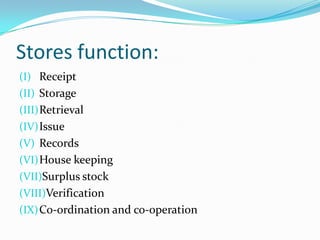
Stores function:
(I) Receipt
(II) Storage
(III) Retrieval
(IV) Issue
(V) Records
(VI) House keeping
(VII)Surplus stock
(VIII)Verification
(IX) Co-ordination and co-operation
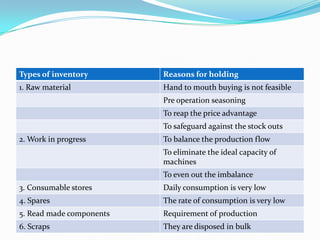
Types of inventory        Reasons for holding
1. Raw material           Hand to mouth buying is not feasible
                          Pre operation seasoning
                          To reap the price advantage
                          To safeguard against the stock outs
2. Work in progress       To balance the production flow
                          To eliminate the ideal capacity of
                          machines
                          To even out the imbalance
3. Consumable stores      Daily consumption is very low
4. Spares                 The rate of consumption is very low
5. Read made components   Requirement of production
6. Scraps                 They are disposed in bulk
Comparison of high and low level
of inventories
High level                                 Low level
Locking up of working capital              Production stoppages
High insurance charges                     Idle production capacity
More storage space                         Idle labor time
Deterioration in the quality of material   Liability of fixed overhead
Chances of theft and pilferage             Failure to meet delivery order
Evaporation of alcoholic material          No bulk discount
Approaches to stores location
(I) Fixed location
(II) Random location
(III) Zoned location
Recording of material
 Bin card
 The stores ledger
Issue of material
(I) FIFO
(II) LIFO
(III) HIFO
(IV) Average cost method
(V) Replacement price method
(VI) Standard price method
(VII)Actual price method
(VIII)Inflated price method
Centralised and decentralised
storing
 Advantages
 Disadvantages

8. stores management

  • 2.
    Introduction  The aimof every business activity is to increase the value of the original resources which are risked by the owners in the venture. Receiving and storing are the key considerations in the material management because (I) The quality of the end product largely depends on the quality of material received (II) It is responsible for smooth flow of material (III) Stores organisation acts as custodian of stock items (IV) Affects the production cost
  • 3.
    Stores function: (I) Receipt (II)Storage (III) Retrieval (IV) Issue (V) Records (VI) House keeping (VII)Surplus stock (VIII)Verification (IX) Co-ordination and co-operation
  • 4.
    Types of inventory Reasons for holding 1. Raw material Hand to mouth buying is not feasible Pre operation seasoning To reap the price advantage To safeguard against the stock outs 2. Work in progress To balance the production flow To eliminate the ideal capacity of machines To even out the imbalance 3. Consumable stores Daily consumption is very low 4. Spares The rate of consumption is very low 5. Read made components Requirement of production 6. Scraps They are disposed in bulk
  • 5.
    Comparison of highand low level of inventories High level Low level Locking up of working capital Production stoppages High insurance charges Idle production capacity More storage space Idle labor time Deterioration in the quality of material Liability of fixed overhead Chances of theft and pilferage Failure to meet delivery order Evaporation of alcoholic material No bulk discount
  • 6.
    Approaches to storeslocation (I) Fixed location (II) Random location (III) Zoned location
  • 7.
    Recording of material Bin card  The stores ledger
  • 8.
    Issue of material (I)FIFO (II) LIFO (III) HIFO (IV) Average cost method (V) Replacement price method (VI) Standard price method (VII)Actual price method (VIII)Inflated price method
  • 9.
    Centralised and decentralised storing Advantages  Disadvantages