G R O U P M E M B E R S :
WAREHOUSING IN SUPPLY CHAIN
MANAGEMENT
Lecturer: Mg. Max Galarza
Members:
• Cristhian Sánchez
• Jacinto Mieles
• Mario Pachecho
• Nathaly Moncayo
• Judith Zambrano
• Kevin Soto
February 15
Logistics II
GRADE: 10
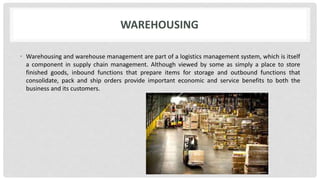
WAREHOUSING
• Warehousing and warehouse management are part of a logistics management system, which is itself
a component in supply chain management. Although viewed by some as simply a place to store
finished goods, inbound functions that prepare items for storage and outbound functions that
consolidate, pack and ship orders provide important economic and service benefits to both the
business and its customers.
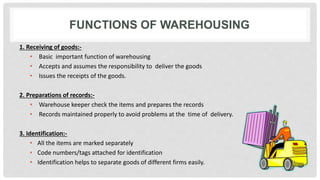
FUNCTIONS OF WAREHOUSING
1. Receiving of goods:-
• Basic important function of warehousing
• Accepts and assumes the responsibility to deliver the goods
• Issues the receipts of the goods.
2. Preparations of records:-
• Warehouse keeper check the items and prepares the records
• Records maintained properly to avoid problems at the time of delivery.
3. Identification:-
• All the items are marked separately
• Code numbers/tags attached for identification
• Identification helps to separate goods of different firms easily.
4. Storing:-
• Major function of warehousing
• Goods are kept safely in warehouse
• Helps in proper protections of goods e.g. food crops , fruits, vegetable etc.
5. Packing:-
• Provided by the warehouse keeper if owner requires such facilities
• Packaging is done in a reasonable way according to size and quantity of goods.
6. Information about receipts:-
• Warehouse keeper checks and informs about the goods to the concerned department
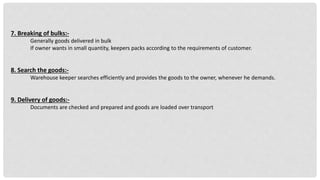
7. Breaking of bulks:-
Generally goods delivered in bulk
If owner wants in small quantity, keepers packs according to the requirements of customer.
8. Search the goods:-
Warehouse keeper searches efficiently and provides the goods to the owner, whenever he demands.
9. Delivery of goods:-
Documents are checked and prepared and goods are loaded over transport
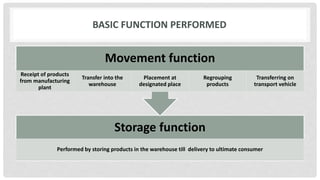
BASIC FUNCTION PERFORMED
Storage function
Performed by storing products in the warehouse till delivery to ultimate consumer
Movement function
Receipt of products
from manufacturing
plant
Transfer into the
warehouse
Placement at
designated place
Regrouping
products
Transferring on
transport vehicle
Consolidation
warehouse
Plant B
[Product B for
Customer X]
Plant C
[Product C for
Customer X]
Customer X
[Product A+
Product B+
Product C]
Plant A
[Product A for
Customer X]
CONSOLIDATION
ECONOMIC AND SERVICE BENEFIT OF WAREHOUSING
Plant A
[Product A
for
Customers
X+Y+Z]
Break bulk
warehouse
Customer
X
Customer
Y
Customer
Z
BREAK BULK WAREHOUSE
CROSS DOCK WAREHOUSE
Plant A
[Product A]
For
W, X, Z
Plant B
[Product B]
For
W,X,Y,Z
Cross Dock
warehouse
Customer W
[A+B+C]
Customer X
[A+B]
Customer Y
[B+C]
Customer Z
A+ C
Plant C
[Product C]
For
W, Y, Z
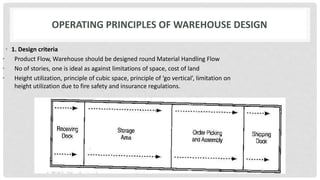
OPERATING PRINCIPLES OF WAREHOUSE DESIGN
• 1. Design criteria
• Product Flow, Warehouse should be designed round Material Handling Flow
• No of stories, one is ideal as against limitations of space, cost of land
• Height utilization, principle of cubic space, principle of ‘go vertical’, limitation on
height utilization due to fire safety and insurance regulations.
2. Handling Technology
• Movement continuity
• Reducing runs
• Reducing short runs with intermediate stops
• Ensuring longer runs
• Movement scale economies
3. Storage Plan
• Characteristics of product
• Open air storage for bulky products
• Heavy items closer to floor
• Light items on higher rungs
• Fast moving items in large bulk closer to aisles
• Hazardous items
REASONS FOR WAREHOUSING
• To support the company’s customer policy.
• To maintain a source of supply without interruptions.
• To achieve transportation economies.
• To support changing market conditions and sudden changes in demand.
• To support any JIT programs.
• To provide customers with the right mix of products at all times and all locations.
• To ensure least logistics cost for a desired level of customer service.
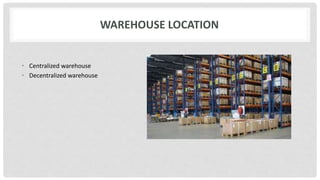
WAREHOUSE LOCATION
• Centralized warehouse
• Decentralized warehouse
CENTRALISED WAREHOUSING
Benefits:
1. It improves operating efficiency and inventory control is felt easier and effective.
2. There is no need to carry large stock and there are no dangers of stock outs resulting in
low level inventories.
3. Transport facilities are optimally used as routing and scheduling becomes handy.
4. The firm is better placed to meet the demand fluctuations from different market
segments at relatively short notice.
Drawbacks:
1. It results in loss of customer service due to spatial considerations and delays are caused.
2. The firm is deprived of its potential market share.
3. It results in heavy transport costs unless each delivery is sizeable as the carrier has to cover long
distance.
DECENTREALISE WAREHOUSE
Benefits:
1. The firm serves the customers better positioning the inventory in their proximity. This is the result
of maximum time utility created by it.
2. The firm is likely to effect savings in freight charges because of bulk handling
3. It facilitates product movement by block rates
Bibliography
http://smallbusiness.chron.com/importance-warehousing-logistics-system-74825.html
http://www.motorsense.co.uk/warehousing.php
http://blog.kencogroup.com/benefits-of-choosing-the-correct-warehouse-management-system-
software-wms-for-you

Warehousing

  • 1.
    G R OU P M E M B E R S : WAREHOUSING IN SUPPLY CHAIN MANAGEMENT Lecturer: Mg. Max Galarza Members: • Cristhian Sánchez • Jacinto Mieles • Mario Pachecho • Nathaly Moncayo • Judith Zambrano • Kevin Soto February 15 Logistics II GRADE: 10
  • 2.
    WAREHOUSING • Warehousing andwarehouse management are part of a logistics management system, which is itself a component in supply chain management. Although viewed by some as simply a place to store finished goods, inbound functions that prepare items for storage and outbound functions that consolidate, pack and ship orders provide important economic and service benefits to both the business and its customers.
  • 3.
    FUNCTIONS OF WAREHOUSING 1.Receiving of goods:- • Basic important function of warehousing • Accepts and assumes the responsibility to deliver the goods • Issues the receipts of the goods. 2. Preparations of records:- • Warehouse keeper check the items and prepares the records • Records maintained properly to avoid problems at the time of delivery. 3. Identification:- • All the items are marked separately • Code numbers/tags attached for identification • Identification helps to separate goods of different firms easily.
  • 4.
    4. Storing:- • Majorfunction of warehousing • Goods are kept safely in warehouse • Helps in proper protections of goods e.g. food crops , fruits, vegetable etc. 5. Packing:- • Provided by the warehouse keeper if owner requires such facilities • Packaging is done in a reasonable way according to size and quantity of goods. 6. Information about receipts:- • Warehouse keeper checks and informs about the goods to the concerned department
  • 5.
    7. Breaking ofbulks:- Generally goods delivered in bulk If owner wants in small quantity, keepers packs according to the requirements of customer. 8. Search the goods:- Warehouse keeper searches efficiently and provides the goods to the owner, whenever he demands. 9. Delivery of goods:- Documents are checked and prepared and goods are loaded over transport
  • 6.
    BASIC FUNCTION PERFORMED Storagefunction Performed by storing products in the warehouse till delivery to ultimate consumer Movement function Receipt of products from manufacturing plant Transfer into the warehouse Placement at designated place Regrouping products Transferring on transport vehicle
  • 7.
    Consolidation warehouse Plant B [Product Bfor Customer X] Plant C [Product C for Customer X] Customer X [Product A+ Product B+ Product C] Plant A [Product A for Customer X] CONSOLIDATION ECONOMIC AND SERVICE BENEFIT OF WAREHOUSING
  • 8.
    Plant A [Product A for Customers X+Y+Z] Breakbulk warehouse Customer X Customer Y Customer Z BREAK BULK WAREHOUSE
  • 9.
    CROSS DOCK WAREHOUSE PlantA [Product A] For W, X, Z Plant B [Product B] For W,X,Y,Z Cross Dock warehouse Customer W [A+B+C] Customer X [A+B] Customer Y [B+C] Customer Z A+ C Plant C [Product C] For W, Y, Z
  • 10.
    OPERATING PRINCIPLES OFWAREHOUSE DESIGN • 1. Design criteria • Product Flow, Warehouse should be designed round Material Handling Flow • No of stories, one is ideal as against limitations of space, cost of land • Height utilization, principle of cubic space, principle of ‘go vertical’, limitation on height utilization due to fire safety and insurance regulations.
  • 11.
    2. Handling Technology •Movement continuity • Reducing runs • Reducing short runs with intermediate stops • Ensuring longer runs • Movement scale economies 3. Storage Plan • Characteristics of product • Open air storage for bulky products • Heavy items closer to floor • Light items on higher rungs • Fast moving items in large bulk closer to aisles • Hazardous items
  • 12.
    REASONS FOR WAREHOUSING •To support the company’s customer policy. • To maintain a source of supply without interruptions. • To achieve transportation economies. • To support changing market conditions and sudden changes in demand. • To support any JIT programs. • To provide customers with the right mix of products at all times and all locations. • To ensure least logistics cost for a desired level of customer service.
  • 13.
    WAREHOUSE LOCATION • Centralizedwarehouse • Decentralized warehouse
  • 14.
    CENTRALISED WAREHOUSING Benefits: 1. Itimproves operating efficiency and inventory control is felt easier and effective. 2. There is no need to carry large stock and there are no dangers of stock outs resulting in low level inventories. 3. Transport facilities are optimally used as routing and scheduling becomes handy. 4. The firm is better placed to meet the demand fluctuations from different market segments at relatively short notice.
  • 15.
    Drawbacks: 1. It resultsin loss of customer service due to spatial considerations and delays are caused. 2. The firm is deprived of its potential market share. 3. It results in heavy transport costs unless each delivery is sizeable as the carrier has to cover long distance.
  • 16.
    DECENTREALISE WAREHOUSE Benefits: 1. Thefirm serves the customers better positioning the inventory in their proximity. This is the result of maximum time utility created by it. 2. The firm is likely to effect savings in freight charges because of bulk handling 3. It facilitates product movement by block rates
  • 17.